Stablecoin Exodus: Exchange Outflows Hit Highest Level Since May 2021

bitcoinistPublicado a 2025-10-15Actualizado a 2025-10-15

Resumen

On-chain data shows ERC-20 stablecoins are currently seeing the highest number of exchange withdrawal transactions since May 2021. Investors Are...

Trusted Editorial content, reviewed by leading industry experts and seasoned editors. Ad Disclosure

On-chain data shows ERC-20 stablecoins are currently seeing the highest number of exchange withdrawal transactions since May 2021.

Investors Are Withdrawing Their Stablecoins From Exchanges

In a new post on X, CryptoQuant community analyst Maartunn has shared about the latest trend in the Exchange Withdrawing Transactions for the Ethereum-based stablecoins. This indicator measures, as its name implies, the total number of transfers related to an asset or a group of assets flowing from wallets connected to centralized exchanges to self-custodial addresses.

Generally, investors take their coins into self-custody when they are planning to hold them in the long term, or at least, not immediately looking to trade them away. As such, a high value of the Exchange Withdrawal Transactions can be a signal that investors aren’t looking to sell the cryptocurrency right now.

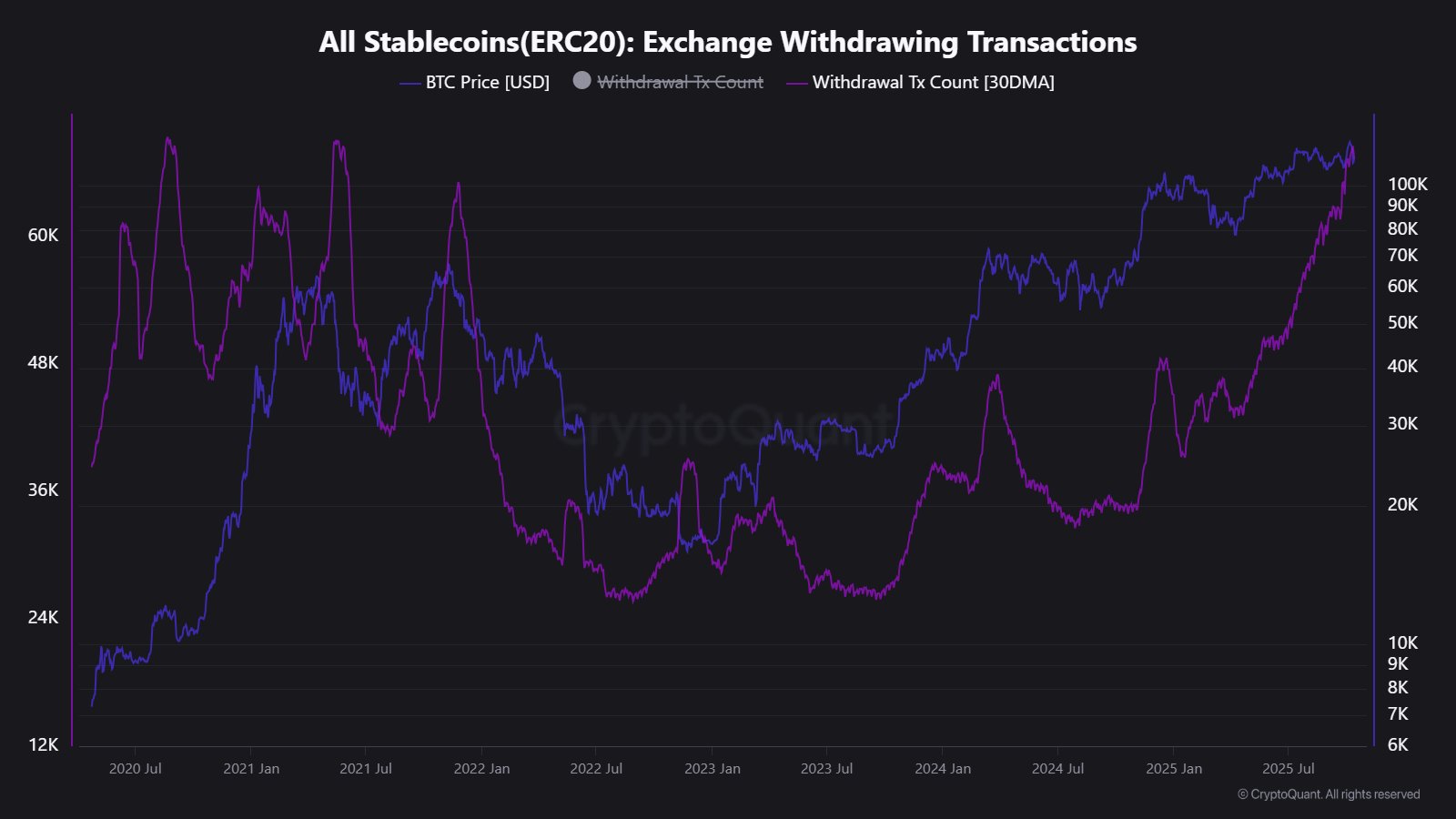
Now, here is a chart that shows how the 30-day moving average (MA) of the stablecoin Exchange Withdrawing Transactions has fluctuated since 2020:
Stablcoins Exchange Outflows Vs Bitcoin Price

The 30-day MA value of the metric appears to have been climbing in recent months | Source: @JA_Maartun on X

As displayed in the above graph, the Exchange Withdrawing Transactions for the ERC-20 stablecoins has seen its 30-day MA value follow a sharp uptrend recently. This suggests an increasing amount of transfers are occurring to take stables away from the custody of exchanges.

If a volatile asset like Bitcoin were involved here, this trend would have naturally been bullish for its price. But as stablecoins have their price constant around a fiat currency, selling or buying doesn’t affect their price in the same manner.

Instead, what investors do with stables can have an effect on the volatile side of the market. When holders deposit these fiat-tied tokens to exchanges, it can be an indication that they are looking to buy into Bitcoin and other cryptocurrencies.

On the other hand, their shifting the coins away from exchanges can be a sign that they want to keep their capital still in the safety of the stablecoins for some period.

Following the recent rapid growth in the stablecoin Exchange Withdrawal transactions, its value has reached the 67,384 mark, the highest level since May 2021. This previous spike in May 2021 occurred as holders sold Bitcoin for stables during the infamous crash that month.

While the latest spike in the metric’s 30-day MA value is extraordinary in scale, it’s still just the first surge in demand for withdrawing stablecoins in the current cycle so far. The previous cycle witnessed several spikes of a similar scale before the music stopped for the bull run.

BTC Price

Bitcoin has seen another setback during the past day as its price has returned to the $110,900 level.

Bitcoin Price Chart

Looks like the price of the coin has retraced its recovery | Source: BTCUSDT on TradingView
Featured image from Dall-E, CryptoQuant.com, chart from TradingView.com
Editorial Process for bitcoinist is centered on delivering thoroughly researched, accurate, and unbiased content. We uphold strict sourcing standards, and each page undergoes diligent review by our team of top technology experts and seasoned editors. This process ensures the integrity, relevance, and value of our content for our readers.

Keshav is a Physics graduate who has been employed as a writer with Bitcoinist since June 2021. He is passionate about writing and through the years, he has gained experience working in a variety of niches. Keshav holds an active interest in the cryptocurrency market, with on-chain analysis being an area he particularly likes to research and write about.

Lecturas Relacionadas

Apple Re-invented Image Compression with AI: Same Quality, One-Third the File Size

Apple’s PICO: An AI-Powered Image Codec That Cuts File Size by Two-Thirds at Equal Perceived Quality In 2025, JPEG AI became the first international standard for learned image compression. However, it, like most codecs, still prioritizes mathematical metrics like PSNR over true perceptual quality—what the human eye finds pleasing. Apple researchers have introduced PICO (Perceptual Image Codec), a neural codec designed to optimize for human perception. It tackles key practical challenges: 1) Speed: A novel "one-shot context model" accelerates entropy encoding without sacrificing compression efficiency. 2) Artifacts: A dedicated TextFidelity loss preserves text clarity, and a TilingArtifact loss eliminates color seams between image tiles processed in parallel. 3) Control: It avoids the "hallucinations" common in GAN-based perceptual models. In a large-scale human evaluation (74,925 comparisons), PICO achieved the same perceived quality as standards like AV1, VVC, and JPEG AI while using only 30-43% of the bitrate. It also outperforms other learned perceptual codecs by 20-40%. Remarkably, it runs in 230ms (encode) and 150ms (decode) on an iPhone 17 Pro Max. While less efficient on synthetic graphics, PICO represents a significant shift from optimizing mathematical scores to directly targeting human visual experience, making high-quality perceptual compression practical for consumer devices. The work builds on expertise from WaveOne, whose team joined Apple and previously advanced neural video compression.

marsbitHace 10 min(s)

Apple Re-invented Image Compression with AI: Same Quality, One-Third the File Size

marsbitHace 10 min(s)

Shanghai's Leading Large Model Company Initiates A-Share Listing

Shanghai-based AI large language model leader MiniMax has initiated the process for an A-share listing in China, having filed a pre-IPO tutoring report with the Shanghai Securities Regulatory Bureau on May 29. This move positions it to compete with Zhipu AI for the title of the first major domestic LLM company to list on the A-share market. Having already completed an IPO in Hong Kong in January 2026, MiniMax's stock price has surged approximately 409% since its debut, with its market capitalization reaching around HK$263.45 billion (approximately RMB 227.55 billion) as of May 29. The company's rapid growth is supported by strong business performance. Its Annual Recurring Revenue (ARR) has grown over 100% in the past two months and now exceeds $300 million. It serves over one million global enterprise and developer clients and has around 300 million users worldwide. For the full year 2025, MiniMax reported revenue of $79.038 million, with a gross margin of 25.4%. While it reported an adjusted net loss of $250 million, the loss rate has narrowed significantly year-over-year. On the product front, MiniMax has released several flagship models this year, including MiniMax-M2.5, M2.6, and M2.7, with the first and last being open-sourced. Its models gained significant traction earlier in the year, briefly becoming the top model provider by usage share on the OpenRouter platform in February. The company has also upgraded its AI agent product, now named Mavis, and is preparing to launch its next-generation MiniMax-M3 model. Technical previews indicate M3 will feature a novel "MiniMax Sparse Attention" mechanism, promising substantial improvements in inference speed. MiniMax's push for an A-share listing reflects a broader trend among China's leading AI firms, including Zhipu AI, Moonshot AI, StepFun, and 01.AI, to seek public listings. This strategy aims to secure broader financing channels to support the immense computational costs and ongoing commercialization efforts inherent in developing advanced large language models.

marsbitHace 12 min(s)

Shanghai's Leading Large Model Company Initiates A-Share Listing

marsbitHace 12 min(s)

Trading

Spot
Futuros
活动图片