惊魂暴跌夜:单日爆仓史上最高191亿美元,财富疯狂流动

Odaily星球日报Publicado a 2025-10-13Actualizado a 2025-10-13

原创 | Odaily 星球日报(@OdailyChina

作者 | 叮当(@XiaMiPP

凌晨 5 点,大盘血崩。

昨夜特朗普宣布要加征 100%关税,且是在现有关税基础上再叠加,这一消息如点燃的导火索,引爆市场,恐慌指数飙升。

美股三大股指均出现不同程度下跌。纳斯达克指数跌幅接近3.5%,标普500跌幅达到2.7%,道琼斯指数下跌1.9%。

加密市场方面,BTC 一度跌破 102000 美元,最低触及 101516 美元,24 小时跌幅达到 16%ETH 最低触及 3400 美元,24 小时跌幅达 22%SOL 跌破 150 美元,最低触及 141.3 美元,24 小时跌幅达 31.83%

主流币尚且如此,山寨更是惨不忍睹。其中 IP 1 小时内从 7.8 美元最低跌至 1 美元附近,跌幅达到 87%,目前暂时反弹至 4.8 美元;PUMP 则从 0.00488 美元最低跌至 0.000411 美元,目前回升至 0.00385 美元。

币安推出的质押理财产品 WBETH、BNSOL 也难逃魔爪。WBETH 最低跌至 430.65 美元,跌幅超 800%,BNSOL 从 213 美元最低跌至 34.9 美元,跌幅也超 500%。甚至稳定币都难逃一劫。USDE 一度触及 0.65 美元,脱锚幅度达到 54%,目前回升至 0.96 美元附近。

衍生品市场则是这场坍塌最直观的放大器。Coinglass 数据显示,过去 24 小时全球共有160万人被爆仓,爆仓总金额达到 191.3 亿美元,为史上最高单日清算金额。其中多单爆仓 166.79 亿美元,空单爆仓 24.54亿美元,最大单笔爆仓发生在 Hyperliquid - ETH-USDT,价值约 2.03 亿美元。
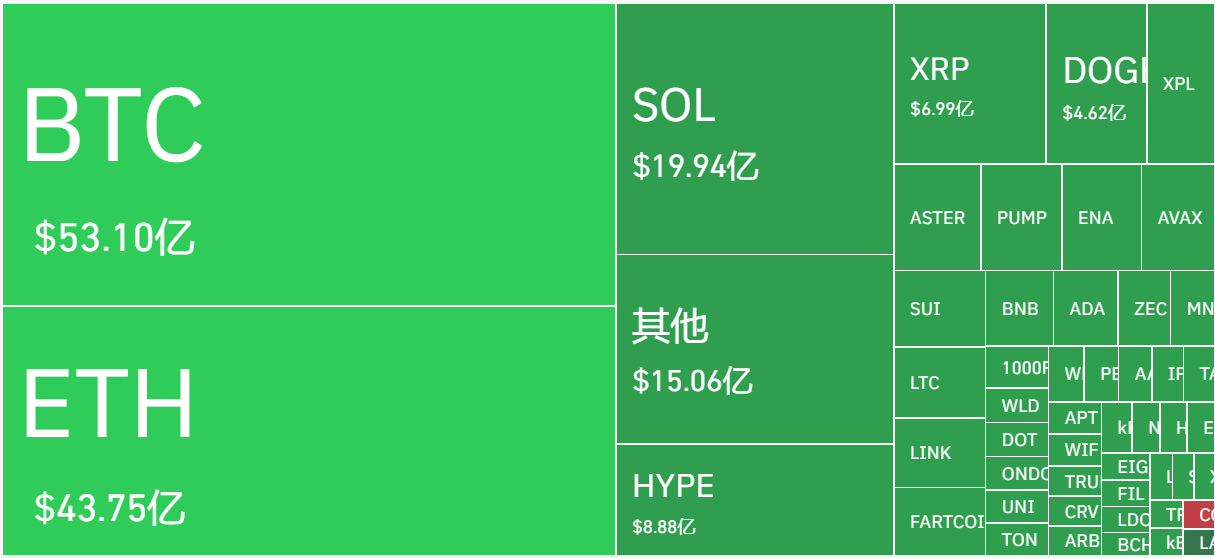
这一次,是对整个加密市场全方位、无差别的扫射

起初,大家都以为迎接的是一次正常的小回调。毕竟一周前,BTC 才刚刚突破 12.6 万美元创下历史新高。渣打银行在报告中上调预期至 13.5 万美元,摩根大通更乐观,直指 16.5 万美元。

谁都没料到,这样的高点竟成了深渊的起点。

神操作——明牌逃顶

即便在这种行情下,也不乏神级操作。

昨日,比特币巨鲸加仓做空 BTC 和 ETH,总仓位超过 11 亿美元。目前,链上数据显示,其仓位已经全部清空,从 Hyperliquild 平台提走 6000 万美金。据链上分析师 Lookonchain 称,该 OG 或与易理华旗下 Trend Research 存在关联。

事实上,易理华本人近几日确实多次在社交媒体上高调表达“看空”立场。
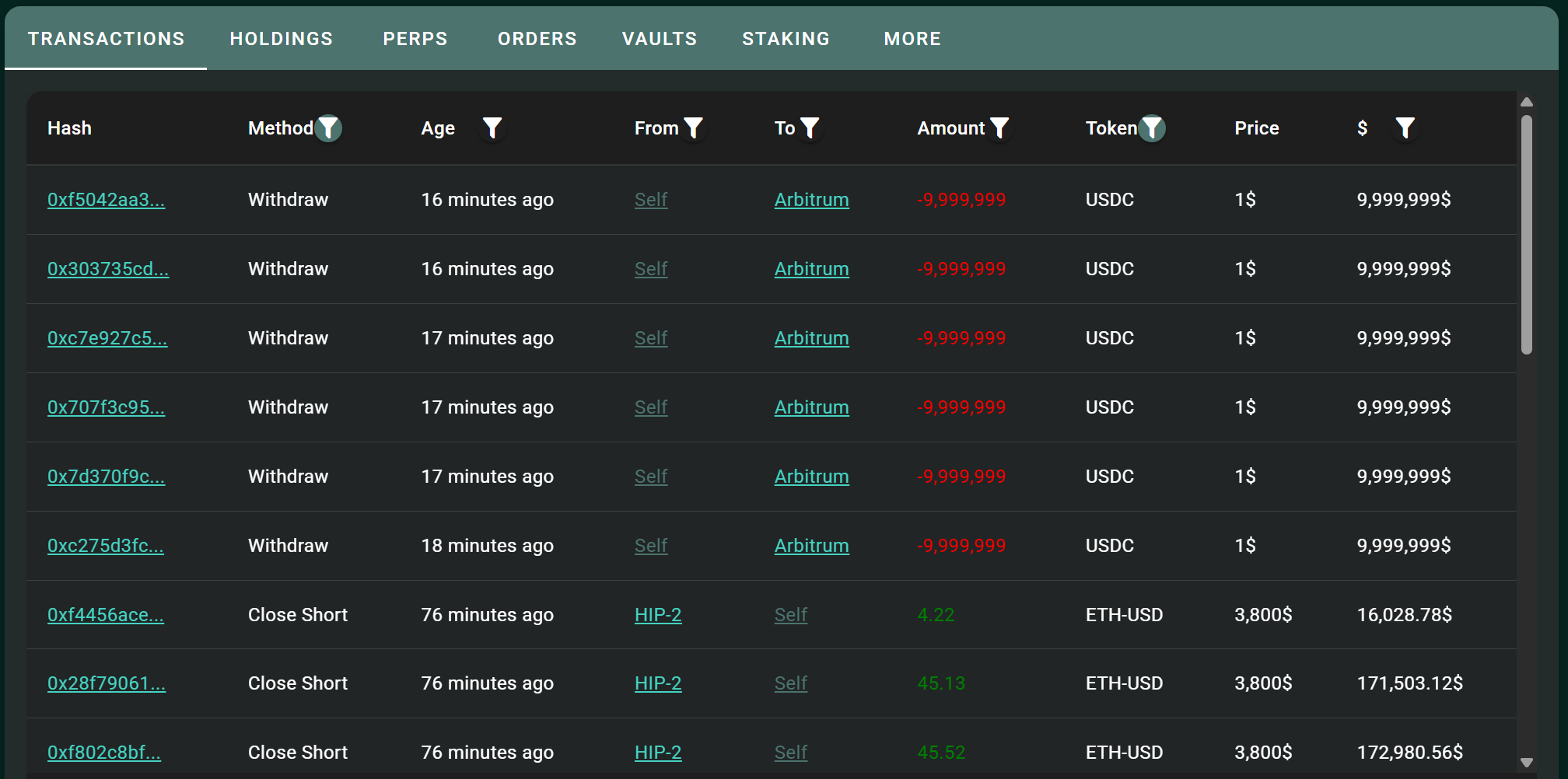
据链上分析师 Lookonchain 监测,自 10 月 3 日起,Trend Research 已陆续将 14.5 万枚 ETH 存入交易所,按当时价格计算价值约 6.54 亿美元。截至 10 月 5 日,其链上仅剩 7,163 枚 ETH。粗略估计该机构本轮在 ETH 上应该获利高达 3.03 亿美元

结语

只要 2 小时,就足以重写许多市场参与者的命运。

有人成为 191 亿美元爆仓潮中的一粒尘埃,有人却从大厦将倾中,稳稳接住了 6000 万的机会赏金。

大多数标的正从 2 小时前的针底向上修复,而也有些币种“借机”躺平,Odaily将第一时间持续跟进。
Lecturas Relacionadas

Circle: From Issuance to Infrastructure

Title: Circle: From Issuance to Infrastructure Circle, the issuer of the USDC stablecoin, is undergoing a strategic transformation to reduce its dependence on interest income from reserve holdings, which is declining due to falling interest rates. Historically, Circle's revenue came primarily from the yield on US Treasury reserves backing USDC. However, it also paid significant fees (approximately 60 cents of every dollar earned) to partners like Coinbase for distributing and settling USDC. To capture more value across the financial stack, Circle is vertically integrating into three new layers: 1. **Settlement Layer:** It is launching **Arc**, a native Layer-1 blockchain. Arc, which uses USDC as its gas token, aims to capture transaction fees currently paid to other blockchains (like Ethereum and Solana) and offers features like privacy for institutional payments. 2. **Distribution Layer:** The **Circle Payments Network (CPN)** connects financial institutions directly to Circle, reducing reliance on exchanges like Coinbase. While not yet monetized, CPN growth has improved Circle's margins. 3. **Application Layer:** Circle is building an **AI Agent Economy** infrastructure with products like Agent Wallets and Nanopayments. The goal is to capture fees from high-volume, automated transactions executed by AI agents, a market where USDC already dominates. These moves represent Circle's shift from a single-product company (USDC issuance) to a full-stack financial platform. The strategy faces challenges, including market competition from players like Stripe and Tether, and potential internal tension regarding how value created by the new Arc blockchain and token (ARC) will accrue to Circle's public shareholders (CRCL). Circle's long-term success depends on its ability to successfully execute this vertical integration and diversify its revenue streams away from interest income.

marsbitHace 17 min(s)

Circle: From Issuance to Infrastructure

marsbitHace 17 min(s)

Circle: From Issuance to Infrastructure

Title: Circle: From Issuance to Infrastructure Circle, the issuer of the USDC stablecoin, is undergoing a strategic transformation from a single-product company dependent on reserve interest income to a vertically integrated, full-stack financial platform. Its primary revenue source, earnings from US Treasury reserves backing USDC, is under pressure from declining Federal Reserve interest rates. Furthermore, Circle pays out a significant portion (~60 cents per dollar earned) to partners like Coinbase for distribution and settlement, leading to value leakage. To address these challenges and capture more value across the payment stack, Circle announced three key initiatives in Q1 2026: 1. **Settlement Layer**: Launching its own Layer-1 blockchain, **Arc**. Designed for institutional use with configurable privacy and quantum-resistant architecture, Arc uses USDC as its native gas token, allowing Circle to capture transaction fees currently paid to other blockchains like Ethereum. 2. **Distribution Layer**: Expanding the **Circle Payments Network (CPN)**, which connects financial institutions directly to Circle, reducing reliance on third-party exchanges for USDC distribution and on/off-ramps. 3. **Application Layer**: Building infrastructure for an **AI agent economy**, including tools for agent wallets, nanopayments, and a marketplace. Circle aims to monetize the high volume of AI-driven microtransactions predominantly settled in USDC. This vertical integration strategy aims to diversify Circle's revenue away from volatile interest income. However, a key challenge remains: aligning the value capture of the new ARC token with the interests of existing public market shareholders (CRCL) who invested primarily for reserve yields. The success of this stack-wide expansion hinges on Arc's adoption and Circle's ability to balance value distribution between its core corporate entity and its new blockchain ecosystem.

链捕手Hace 24 min(s)

Circle: From Issuance to Infrastructure

链捕手Hace 24 min(s)

Nvidia's Wednesday 'Big Test': The Battle That Will Determine the Fate of the AI Bull Market is Here!

NVIDIA Faces Key AI Bull Market Test with Wednesday Earnings Report NVIDIA is set to release its quarterly earnings after the market close on Wednesday, May 20th (US Eastern Time). This report is seen as a critical stress test for the current AI-driven bull market cycle. The semiconductor sector is technically severely overbought, with extremely bullish options positioning. The rare signal of stock prices and implied volatility rising simultaneously indicates significantly amplified two-way risk around this earnings event. The core tension identified by analysts is strong fundamental demand for AI versus mounting technical pressures. The Philadelphia Semiconductor Index (SOX) is trading approximately 60% above its 200-day moving average, a deviation not seen since the peak of the dot-com bubble in 1999/2000. While NVIDIA's current quarter revenue is expected to beat estimates by a substantial margin, market focus is intensely on the guidance for the next quarter. Historically, NVIDIA's stock has frequently declined on the day following its last five earnings reports. The options market presents contradictory signals: extreme bullish call skew persists, yet there is notable activity in tail-risk hedging via put options on broader indices and semiconductor ETFs. This suggests traders are chasing gains while simultaneously preparing for potential sharp volatility. A broader market concern is narrowing breadth. Despite the S&P 500's YTD gain, only about half of its constituents are positive, with leadership heavily concentrated in a few mega-cap AI and semiconductor names like NVIDIA. Analysts question whether this reflects market health or a "funding source" effect, where money flows out of lagging sectors into the AI trade. The earnings outcome and, crucially, the forward guidance will test the market's conviction in the AI compute super-cycle thesis. Given NVIDIA's high correlation with the semiconductor and broader tech sector, its results are poised to trigger widespread market moves in either direction.

marsbitHace 32 min(s)

Nvidia's Wednesday 'Big Test': The Battle That Will Determine the Fate of the AI Bull Market is Here!

marsbitHace 32 min(s)

The AI-Era Power Arms Race: Energy Order Reshuffle Behind NextEra's Acquisition of Dominion

The AI arms race is shifting from a focus on chips and models to a fundamental battle over electricity. NextEra Energy's proposed $66.8 billion acquisition of Dominion Energy highlights this profound change, as AI's explosive growth is rewriting the growth logic for the power sector. The deal is less about traditional utility consolidation and more about securing a strategic gateway to Virginia’s "Data Center Alley," a critical hub where tech giants have massive, signed load requirements. The core challenge is a growing disconnect: data center construction cycles are far shorter than the years needed to build new power generation and transmission infrastructure. Morgan Stanley predicts a 49GW gap in power availability for U.S. data centers by 2028. Electricity, once a taken-for-granted commodity, is now a scarce and strategic resource. This transforms the competitive landscape—future AI competitiveness may hinge not just on algorithms but on a company's ability to secure long-term, stable, and affordable power supply. The transaction signals a broader revaluation of the entire energy infrastructure chain, from natural gas and nuclear power for base load to storage and transmission equipment. However, the largest variable is regulation. Balancing rapid AI-driven grid expansion with public concerns over costs, fairness, and environmental impact will be a complex political and social challenge. The true value in the coming AI era may lie not just in power generation assets, but in owning the crucial infrastructure nodes, grid access rights, and the regulatory relationships needed to deliver electricity where it's needed most.

marsbitHace 38 min(s)

The AI-Era Power Arms Race: Energy Order Reshuffle Behind NextEra's Acquisition of Dominion

marsbitHace 38 min(s)

Trading

Spot
Futuros
活动图片