Три альткоина, которые могут выиграть от роста Polymarket

cryptonews.ruPublicado a 2025-09-09Actualizado a 2025-10-10

На этой неделе Polymarket привлек внимание благодаря нескольким событиям. Платформа предсказаний укрепляет свои позиции, так как ICE рассматривает сделку на $9 млрд, и Уолл-стрит проявляет интерес

На этом фоне влияние сети распространяется на множество блокчейнов и протоколов, поддерживающих ее децентрализованные рынки предсказаний.

Альткоин Stacks и прорыв Polymarket

Ранее мы сообщали, что Polymarket может провести крупнейший аирдроп в индустрии. Это, вместе с новостями о возможных инвестициях ICE, создает условия для роста некоторых альткоинов благодаря увеличению стоимости платформы.

1. UMA: Тихая основа рынков предсказаний

UMA играет ключевую роль для Polymarket, оставаясь в тени. Пока все следят за стремительным ростом Polymarket, UMA обеспечивает инфраструктуру для децентрализованных предсказаний.

Polymarket использует Оптимистичный Оракул (OO) UMA для прозрачной проверки результатов. Этот децентрализованный механизм позволяет участникам определять истину на блокчейне без центральных органов.

«Polymarket поддерживает UMA как источник разрешения для рынков, отображаемых на интерфейсе Polymarket.com. Polymarket в своей основе не зависит от оракулов, но интеграция UMA предоставляет еще одну возможность для создателей рынков», — сообщила платформа.

В системе оракул UMA обеспечивает безопасное и надежное урегулирование каждого предсказания, будь то о выборах, рынках или спорте. Адаптер UMA-CTF, работающий на Polygon, связывает условную токеновую структуру (CTF) Polymarket с оракулом UMA, что делает каждое разрешение рынка проверяемым.

Несмотря на важность UMA, инвесторы часто игнорируют его, сосредотачиваясь на успехе Polymarket. Если внимание переключится на значимость оракула, UMA получит шанс значительно вырасти, так как спрос на верификацию данных на блокчейне увеличится.
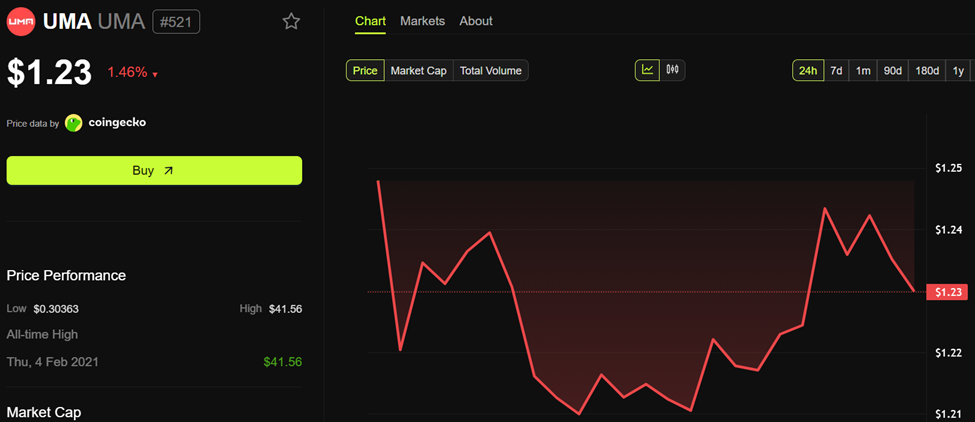
Динамика цены UMA
Динамика цены UMA. Источник: BeInCrypto

2. Polygon (MATIC): блокчейн, обеспечивающий масштабируемость Polymarket

Polymarket полностью работает на сети Proof-of-Stake от Polygon, используя ее недорогую и быструю инфраструктуру. Недавняя интеграция платформы Polygon с социальной сетью X (бывший «Твиттер») открыла более 600 млн пользователей для ончейн-рынков предсказаний и, в свою очередь, для экосистемы Polygon.

we’re joining forces with Polymarket as our official prediction market partner@X 🤝 @Polymarket

— X (@X) June 6, 2025

Предстоящие обновления Polygon (PIPs 60 и 43) увеличат пропускную способность до 1 000 TPS и сократят время финализации до 5 секунд, что улучшит пользовательский опыт на рынках предсказаний.

По данным Polygon Labs, эти обновления повысят пропускную способность транзакций для приложений, таких как Polymarket, RWA и платежи, укрепляя позицию Polygon как основной цепи для массовых крипто-приложений.

«Успех Polymarket — это победа для Polygon, Ethereum и всей криптоэкосистемы», — отметил Джош Старк из Ethereum Foundation.

3. Ethereum (ETH): Основной расчетный слой

Ethereum играет ключевую роль в истории Polymarket, служа основным слоем, который сделал его возможным.

«Polymarket [был] невозможен без Ethereum, USDC и EVM-кошельков с 2020 года», — заявил Ник Томаино.

Зависимость Polymarket от Ethereum Virtual Machine (EVM) обеспечивает доступ к обширной базе разработчиков, инструментам и инфраструктуре безопасности. Интеграция USDC на Ethereum также упрощает расчеты на рынках предсказаний.

С расширением экосистемы Layer-2 Ethereum, включая роллапы, такие как Katana, приложения вроде Polymarket получают больше возможностей для масштабирования.

Старк считает, что эта симбиотическая связь между Ethereum и его L2 вскоре сделает разработку на EVM «очевидным выбором» для будущих инновационных приложений.

Building on the Ethereum Virtual Machine (EVM) means @Polymarket has access to the best pool of dev talent, dev tooling, and security infra for onchain apps.

And as Eth’s L2 ecosystem grows, there will be more ways for the Polygon & Ethereum communities to collaborate.

— Josh Stark (0xstark.eth) (@0xstark) October 9, 2025

Рост оценки Polymarket — это не только успех для его инвесторов, включая генерального директора Шейна Коплана, но и подтверждение всей связки Ethereum-Polygon-UMA.

Хотя внимание сосредоточено на платформе, настоящая ценность может скрываться в протоколах, обеспечивающих ее надежность и масштабируемость.


Lecturas Relacionadas

$2 Trillion: Countdown to AI's Largest IPO in History

The countdown for the largest IPO in AI history, a potential $2 trillion listing for Anthropic, is underway for October. The staggering valuation, reportedly projected by several investors, contrasts with the company's own internal restraint on setting a public target. Founded five years ago by former OpenAI core members, Anthropic's growth has been meteoric. Annual recurring revenue (ARR) surged from ~$9B in late 2025 to $47B by May 2026, with Q2 2026 revenue of $11.5B marking a 14x year-over-year increase. Bank valuations are even based on internal 2028 revenue forecasts of $190-200B. A key growth driver is Claude Code, its AI coding assistant. Its ARR quintupled in five months to $2.5B by February 2026, now constituting nearly 20% of total revenue. Surveys indicate Anthropic commands roughly 40% of enterprise LLM spending, doubling OpenAI's share in programming-specific use. However, alongside this explosive growth, reports detail significant internal cultural strife. Critics describe a divisive "priesthood" of PhD executives, led by CEO Dario Amodei, who promote a "save humanity" narrative that some employees find cult-like and alienating. This has reportedly created a demoralized workforce and a covert "underground network" of dissent among engineers torn between lucrative pre-IPO equity and a toxic work environment. Anthropic now faces a pivotal paradox: pursuing its mission of "safe" AI requires immense capital for compute, yet that capital demands relentless commercial growth. As it approaches its historic IPO, the company must navigate intense regulatory scrutiny, soaring operational costs, and internal tensions—any of which could destabilize its post-listing trajectory, much like SpaceX's significant post-IPO stock drop. The stage is set for a defining moment in tech history.

marsbitHace 52 min(s)

$2 Trillion: Countdown to AI's Largest IPO in History

marsbitHace 52 min(s)

AI Boosting Efficiency and Cutting Costs Makes VC Increasingly Expensive

"AI for Cost Reduction Makes VC Funding More Expensive" Despite the "cost-reduction and efficiency" narrative of AI, venture capital (VC) investment in the AI sector is becoming increasingly costly. While AI tools lower the initial costs for many startups—with team sizes shrinking across funding stages—the market is polarizing. For top-tier AI teams, especially those from leading companies like Google and OpenAI, funding rounds are now larger and valuations are higher than ever at the seed and early stages. For example, new ventures by prominent researchers are securing billions in funding with valuations reaching tens of billions before having a mature product. This creates a "barbell" market: lightweight startups need less capital, while elite AI firms attract massive investments early on. This dynamic raises the cost for VCs to acquire and maintain meaningful ownership stakes. As valuations soar early, securing the same equity percentage requires significantly larger capital commitments. VCs must now invest more upfront and reserve substantial funds for follow-on rounds to avoid dilution, prompting large firms like Accel and a16z to raise massive new funds. Consequently, capital is concentrating intensely in a few perceived winners like OpenAI and Anthropic, widening the gap between large and small VC funds. While high valuations bake in future growth expectations, they also compress potential returns, demanding that portfolio companies achieve unprecedented scale. For major VCs, the core strategy is clear: secure early positions in potential winners and maintain the capital to keep investing as valuations rapidly escalate.

marsbitHace 1 hora(s)

AI Boosting Efficiency and Cutting Costs Makes VC Increasingly Expensive

marsbitHace 1 hora(s)

An Eight-Year Investment Takes a Sharp Turn: Why Did Ethereum Suddenly Abandon Poseidon?

On August 13, Ethereum researcher Justin Drake announced a significant shift in Ethereum's Layer-1 cryptographic roadmap: abandoning the SNARK-friendly hash function Poseidon in favor of traditional functions like SHA2 or BLAKE2. This decision ends eight years of research and investment, marking a major revision to the post-quantum security strategy. Poseidon, introduced in 2019, was highly efficient for zkRollups and zkVMs within SNARK circuits. However, its need for prolonged cryptanalysis and the pressing timeline for quantum resistance revealed limitations. Recent breakthroughs in SNARK design, specifically using binary fields, now enable traditional, battle-tested hash functions to perform as efficiently as Poseidon within SNARKs. Benchmarks show modern laptops can now verify over a million traditional hash calls per second. This change is partly driven by accelerated concerns over quantum computing threats. Reports warn that "Cryptographically Relevant Quantum Computers" could break current blockchain signatures like ECDSA by the early 2030s, risking trillions in assets. Ethereum's response focuses on hash-based post-quantum signature schemes, deemed more quantum-resistant than some lattice-based alternatives under pressure from AI cryptanalysis. Ethereum's updated post-quantum roadmap targets a production-ready "leanVM" for signature aggregation by 2027, with full deployment across consensus, execution, and data layers by 2028. The shift to mature hash functions like SHA2 reduces reliance on newer algorithms and aligns with the goal of using widely analyzed cryptographic primitives. Other major blockchains are also preparing. Solana's core teams have independently chosen the NIST-standardized Falcon signature scheme for its compact size. Starknet plans a phased migration, starting with replacing its Pedersen hash with BLAKE2. Ethereum's move signifies a strategic pivot towards proven security foundations for the quantum era.

marsbitHace 2 hora(s)

An Eight-Year Investment Takes a Sharp Turn: Why Did Ethereum Suddenly Abandon Poseidon?

marsbitHace 2 hora(s)

Programmers Worldwide Are Wasting Money on Anthropic! The Company Can't Stand It Anymore

Anthropic recently published guidelines to help developers using Claude Code reduce unnecessary token costs. The key recommendations include: 1) Clear (/clear) conversations after completing a task to avoid carrying irrelevant file reads and command outputs into the next task. 2) Set the model and reasoning effort level at the start of a session, as switching mid-session invalidates the prompt cache, requiring a full-price recalculation of the entire dialog history. 3) Attach files using @ references instead of typing paths manually to avoid extra tool calls and searches that bloat the context. 4) Add quiet flags to verbose commands (e.g., in CLAUDE.md) to minimize lengthy output in the dialog history. 5) Use /compact while the session cache is still warm (before breaks) to compress the dialog at one-tenth the cost. 6) Offload large-output tasks to a sub-agent, which runs in an isolated context and only returns conclusions, preventing intermediate outputs from polluting the main dialog. The article explains token pricing: input tokens (prefill) are processed in parallel, while output tokens (decode) are generated serially, making output tokens five times more expensive. Caching is crucial for savings—if a request's prefix (system prompt, CLAUDE.md, dialog history) matches the previous one byte-for-byte, reading it costs only 10% of the standard input price. However, cache invalidation occurs when changing models, effort levels, fast mode, compressing dialogs, after cache expiration, or when resuming old sessions. Dialog history also grows quadratically (O(n²)) as file contents and command outputs accumulate, increasing costs per round. Proactive context management—like isolating noisy tasks, using /rewind to trim unproductive turns, and task-based session clearing—is becoming an essential skill for cost-effective AI-assisted development.

marsbitHace 4 hora(s)

Programmers Worldwide Are Wasting Money on Anthropic! The Company Can't Stand It Anymore

marsbitHace 4 hora(s)

Pax Silica vs. WAICO: The US Wants to Prohibit Europe from Using Chinese Artificial Intelligence

The United States is preparing to demand that European and other partners abandon Chinese artificial intelligence initiatives, threatening exclusion from the American-led "Pax Silica" coalition, according to a leaked U.S. State Department document. This ultimatum forces signatories of the "AI Opportunity Statement" to choose between the Western technological ecosystem and alternative frameworks, with China not explicitly named but clearly targeted. Pax Silica is a U.S. strategy for AI and semiconductor hegemony, launched in late 2025. Its European presence expanded significantly in mid-2026. Concurrently, China, Russia, and 27 other nations established the World AI Cooperation Organization (WAICO) in July 2026 as an independent intergovernmental platform promoting AI governance based on UN principles. This situation creates a difficult choice, especially for European nations balancing strategic autonomy with dependence on U.S. tech and security. It also pressures Global South countries with pragmatic ties to both Washington and Beijing. The formation of competing blocks risks fragmenting the global tech landscape, forcing companies to split supply chains, increasing costs, and potentially leading to incompatible standards and protocols. The era of open globalization in AI may be ending, replaced by geopolitical confrontation where technological sovereignty trumps economic efficiency. The decisions made will shape the global digital economy for decades.

cryptonews.ruHace 6 hora(s)

Pax Silica vs. WAICO: The US Wants to Prohibit Europe from Using Chinese Artificial Intelligence

cryptonews.ruHace 6 hora(s)

Trading

Spot
活动图片