XRP Price To Teleport To $6.9 Once Wave 3 Of 3 Is Completed

bitcoinistPublicado a 2025-10-08Actualizado a 2025-10-08

Resumen

The XRP price is already seeing a major recovery trend, thanks to the market reversal that was triggered by Bitcoin’s...

Trusted Editorial content, reviewed by leading industry experts and seasoned editors. Ad Disclosure

The XRP price is already seeing a major recovery trend, thanks to the market reversal that was triggered by Bitcoin’s rise to new all-time highs. Right now, the battle line looks to be drawn around the $3 level, where bears look to be mounting their resistance. Despite this, the XRP price trend remains extremely bullish, especially from the wave theory point of view. As the bearish second wave looks to be nearing completion, the start of the third wave could lead to an explosive rally.

Why Wave 3 Of 3 Is Important

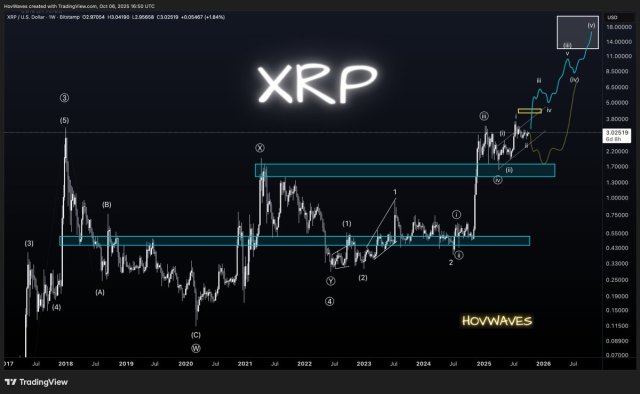
Crypto analyst HovWaves has pointed out that the XRP price could be looking to fill in the Wave 3 of 3 with the next move. The recent post comes as a follow-up to an analysis that was posted last month, showing how the XRP price had been moving, with possible direction points.

Back in September, the XRP price had been trading mostly sideways as bears kept prices below $3. At that point, HovWaves explained that the price could either break out into Wave 3 of 3 or continue to trade sideways. Eventually, it was the latter as the market remained muted.

However, with the start of October, the tides have quickly changed, and the crypto market is seeing a rapid uptrend. Thus, it is possible that this new wave would bring about the bullish Wave 3 of 3. The decisive level here, though, lies well above $3, and the price would need to completely shatter the resistance straight up to $3.2 for a confirmation to be complete.

XRP Price Will Rip If It Closes Above $3.2

In the latest analysis, HovWaves points out that the XRP price continues to rise upward, and the only downside that the altcoin has seen has been threaded wicks. This is naturally bullish for the cryptocurrency and suggests a continuation to the upside.
XRP Price
Source: X

The key here is actually getting a High Timeframe (HTF) close above $3.25, and the trend would be in motion. This means that the XRP price needs to notch an almost 10% gain from here first to confirm that the second wave has officially come to an end.

With Wave 3 of 3, the XRP price is looking to at least double its price. The analyst sets a target of $6.9 from here, which would mean an over 100% increase. A rally to this point would also mean a brand-new all-time high for XRP for the first time since 2018. As for the timeline for this, the crypto analyst believes it would happen by the end of the year if the wave is confirmed.

XRP price chart from TradingView.com
Price wavers with bearish pressure | Source: XRPUSDT on TradingView.com
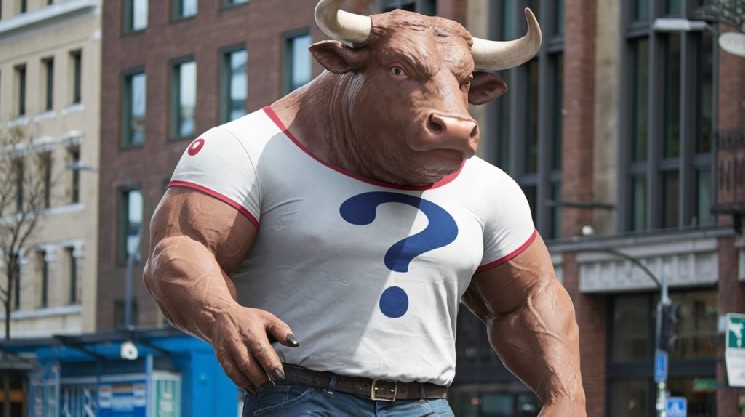
Featured image from Dall.E, chart from TradingView.com
Editorial Process for bitcoinist is centered on delivering thoroughly researched, accurate, and unbiased content. We uphold strict sourcing standards, and each page undergoes diligent review by our team of top technology experts and seasoned editors. This process ensures the integrity, relevance, and value of our content for our readers.

Scott Matherson is a leading crypto writer at Bitcoinist, who possesses a sharp analytical mind and a deep understanding of the digital currency landscape. Scott has earned a reputation for delivering thought-provoking and well-researched articles that resonate with both newcomers and seasoned crypto enthusiasts. Outside of his writing, Scott is passionate about promoting crypto literacy and often works to educate the public on the potential of blockchain.

Lecturas Relacionadas

Alibaba 'Stocks Up', ByteDance 'Trains'

"In late May, two closely timed events in China's AI industry clearly revealed the divergent strategic approaches of two tech giants: Alibaba and ByteDance. Alibaba is aggressively integrating AI into its existing commercial ecosystem, prioritizing immediate monetization. Its Qwen App now fully integrates with Taobao, leveraging the platform's 4-billion-item database for AI-powered shopping features like virtual try-on and price comparison. Internally, Alibaba has reorganized to incentivize AI-driven business growth, notably through the 'Agentic Commerce Trust Protocol' to enable AI-agent transactions. Financially, it emphasizes ROI, with CEO Daniel Wu stating every AI chip purchased is generating revenue. Alibaba's strategy bets that foundational AI model capabilities won't be leapfrogged in the next five years, allowing its 'AI-as-a-utility' approach to succeed. In stark contrast, ByteDance's Seed division focuses on pushing the frontiers of AGI with a long-term, research-oriented mindset. Its video generation model, Seedance 2.0, topped international benchmarks. The division, led by researchers Wu Yonghui and product head Zhu Wenjia, is tasked with 'exploring the upper limits of intelligence,' even considering open-sourcing its models—a rare move among Chinese firms. ByteDance is investing heavily, with reports of its 2026 capital expenditure plan being nearly triple that of 2024, funded by its substantial private profits. This allows it to pursue projects like an 8-month research paper questioning if video models are true 'world models,' devoid of immediate commercial pressure. The core divergence is less about corporate philosophy and more about structural constraints. As a publicly traded company, Alibaba is bound to quarterly financial expectations, forcing a pragmatic, revenue-focused AI integration. As a private entity, ByteDance has the luxury to fund long-term, high-risk foundational research without answering to public markets. The article concludes that the true determinant of a Chinese company's AI path is its IPO status, suggesting that if ByteDance were public, or if Alibaba were private, their strategies might well be reversed."

marsbitHace 16 min(s)

Alibaba 'Stocks Up', ByteDance 'Trains'

marsbitHace 16 min(s)

Why More AI Agents Does Not Equal Higher Productivity?

Editor's Note: As AI Agents become cheaper and easier to use, a new constraint emerges: the cost isn't in launching more Agents, but in the human attention required to manage, judge, and integrate their outputs. This hidden cost is called the "orchestration tax." The article argues that a developer's cognitive bandwidth is the key bottleneck—a serial, non-parallelizable resource akin to a Global Interpreter Lock (GIL). While many Agents can run concurrently, their results ultimately require human judgment for review, conflict resolution, and final integration. Therefore, more Agents don't automatically mean higher productivity; they can simply create longer queues, lead to cognitive fatigue, and create the illusion of busyness without real output. The core solution is to design workflows around this scarce human attention. Key strategies include: scaling the number of Agents to match review capacity (not UI capacity), categorizing tasks (delegating independent ones, keeping complex judgment-heavy ones serial), batch reviewing results to minimize context-switching costs, automating verifiable checks to reserve human judgment for critical decisions, and protecting focused, uninterrupted thinking time. Ultimately, the critical skill is not launching many Agents, but architecting systems that respect the fundamental limit of human attention. Unpaid "orchestration tax" accumulates as both technical and cognitive debt, undermining system understanding and quality. True productivity comes from thoughtfully managing the single-threaded resource—your focus.

marsbitHace 1 hora(s)

Why More AI Agents Does Not Equal Higher Productivity?

marsbitHace 1 hora(s)

Three Years Later: Looking Back at My Predictions About ChatGPT in 2023

Three Years Later: Revisiting My 2023 Predictions on ChatGPT In March 2023, shortly after ChatGPT's launch, I made 20 predictions about its future. Now, in mid-2026, I've used AI agents to fact-check each one against the latest data. Overall, most major directional forecasts were correct, with only one outright error (incorrectly stating GPT-4 had 100 trillion parameters). Key successes included predicting that RAG and retrieval architectures would become the standard for handling knowledge and hallucinations, that natural language interfaces (LUI) would create a massive new industry layer beyond the models themselves, and that China would develop viable large language models, significantly closing the performance gap with Western counterparts within about three years. Predictions about the absence of mass unemployment, the rise of a new "robot network" for agent communication, and ChatGPT not possessing consciousness also held true in their core arguments. However, the "devil was in the details." Errors frequently involved specific numbers, timelines, or overlooking distributional effects. I tended to overestimate the speed of adoption (e.g., for agent networks) while underestimating the ultimate scale of capabilities or costs (e.g., AI winning IMO gold without tools, or the extreme capital required for frontier models). Other misjudgments included: underestimating how AI would reinforce, not dissolve, information filter bubbles; incorrectly assuming AI-generated content would easily circumvent copyright (it has instead triggered record-breaking settlements); and misidentifying where value would be captured (it accrued overwhelmingly to the compute layer, like Nvidia, not just the application or model layers). Key lessons from reviewing these predictions are: 1) Directional and mechanistic insights are far more reliable than precise numbers or absolute statements. 2) There's a consistent bias to overestimate short-term speed but underestimate long-term magnitude. 3) Errors often lie in missing distributional impacts within a generally correct aggregate trend. 4) Predictions phrased with nuance and caveats aged the best. 5) Some fundamental debates (e.g., on machine consciousness or the ultimate value chain) remain unresolved even after three years. This exercise is less about scoring the past and more about establishing rules for clearer thinking about the next three years of AI.

marsbitHace 8 hora(s)

Three Years Later: Looking Back at My Predictions About ChatGPT in 2023

marsbitHace 8 hora(s)

Trading

Spot
Futuros
活动图片