Is Bitcoin really cheap at $19,000? Assessing if it could go further down

AmbcryptoPublicado a 2022-07-02Actualizado a 2022-07-02

Resumen

The current price level represents more than an 80% discount from its all-time high (ATH). Well, a major factor that contributes to the perception that BTC is cheap or discounted at $19,000 is that most of the institutional traders bought in at higher price levels.

El Salvador’s president Nayib Bukele announced on 1 July that his country added 80 Bitcoin [BTC] to its balance sheet. He also noted that the purchase was made at $19,000 per BTC, a price level that he described as cheap.

Many other crypto proponents share similar sentiments that Bitcoin is at a discount currently. MicroStrategy is among them, and the organization recently announced the purchase of 480 BTC worth roughly $10 million. There are multiple reasons why the $19,000 price level represents a healthy discount according to some of these high-profile individuals.

The current price level represents more than an 80% discount from its all-time high (ATH). Well, a major factor that contributes to the perception that BTC is cheap or discounted at $19,000 is that most of the institutional traders bought in at higher price levels.

What kind of demand is Bitcoin experiencing?

Bitcoin’s price action has been hovering above $19,000 after the recent crash. This confirms that it found support near this price level after experiencing strong selling pressure since 26 June.

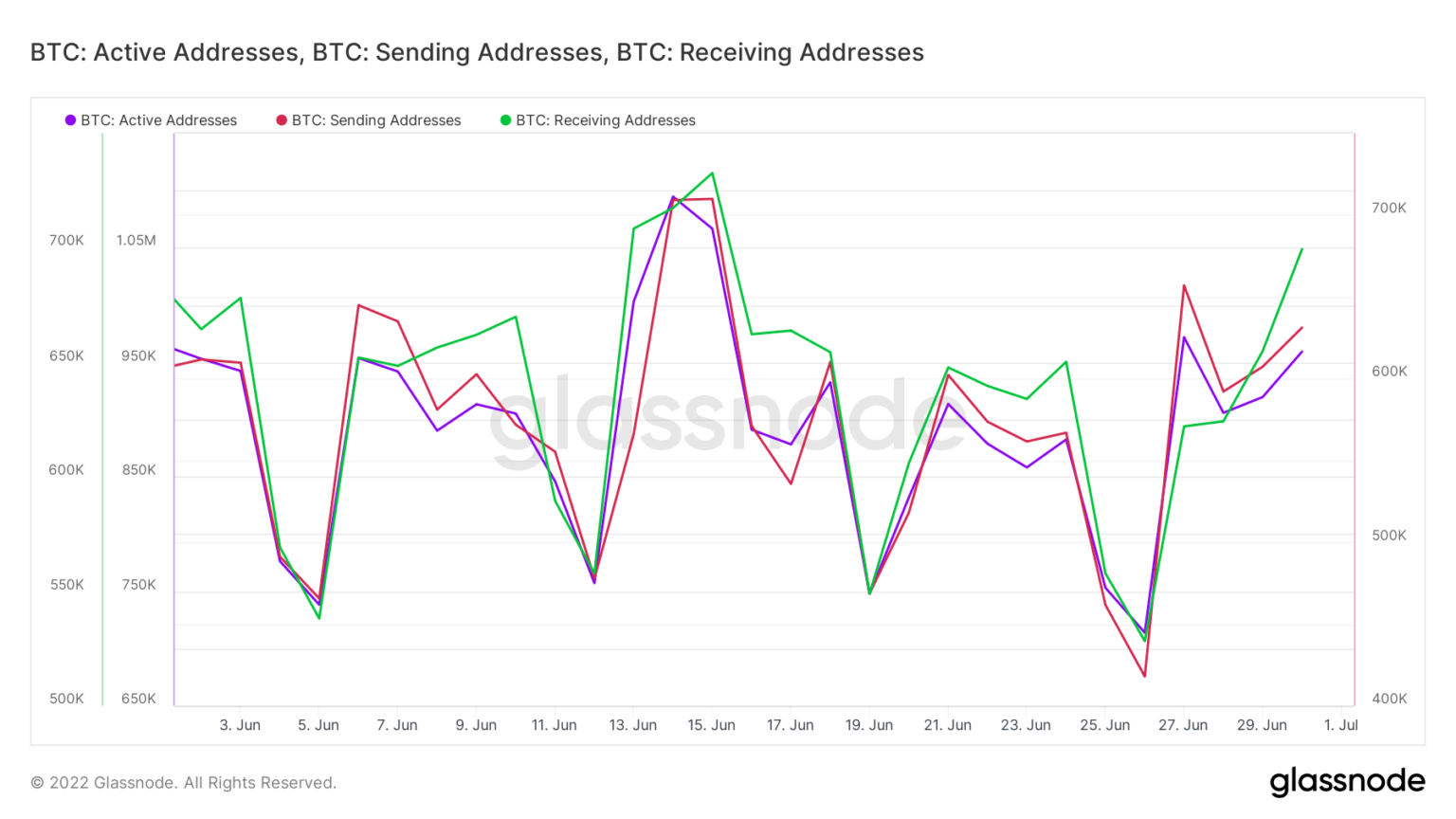
The number of active addresses increased significantly during the same period. However, latest statistics reveal that receiving addresses are higher than selling addresses.
Source: TradingView

Bitcoin had 699,440 receiving addresses and 631,248 sending addresses on 30 June. This confirms that more buyers are convinced that price levels near $19,000 attract more buyers than sellers. This observation is further enhanced by similar observations in Bitcoin’s supply distribution by balance on addresses.

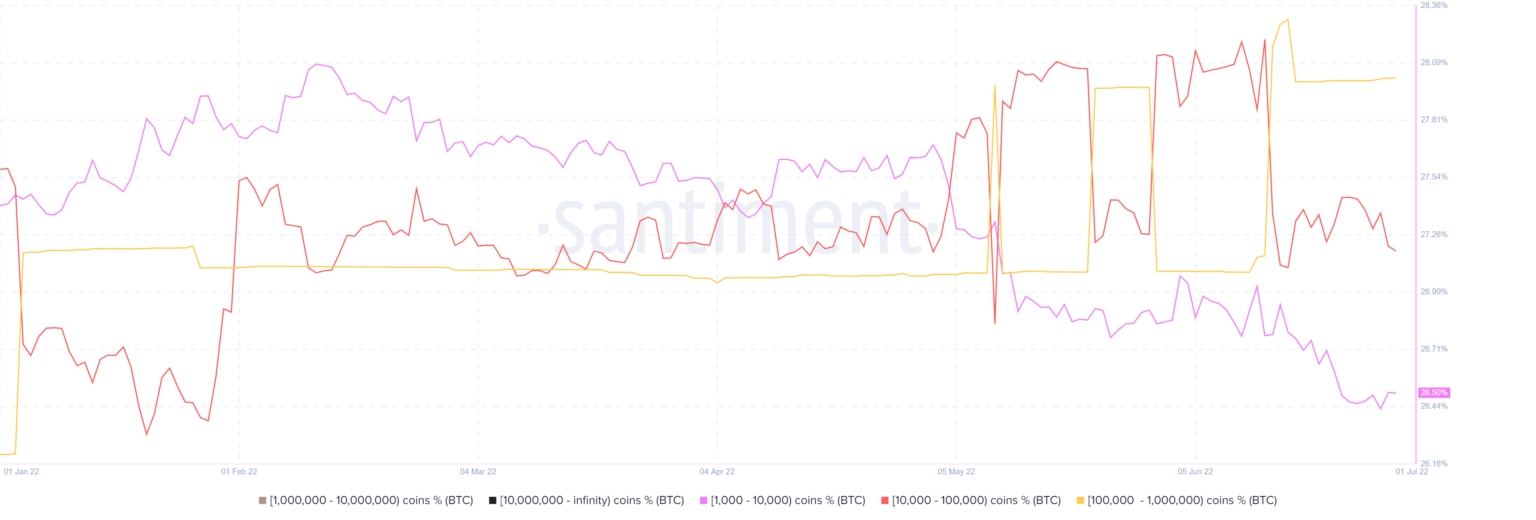
Addresses holding between 1,000 and 10,000 BTC increased their supply from 26.43% on 29 June to 26.5% by 1 July. This category represents the biggest whale bracket that controls Bitcoin by supply. As a consequence, the category has had a substantial impact on price performance.
Source: Santiment

In contrast, addresses holding between 10,000 and 100,000 BTC dropped from 11.37% from 29 June to 11.23% on 1 July. Addresses holding more than 100,000 BTC maintained control of 4.08% of Bitcoin’s supply during the same time period.

Potential outcome if Bitcoin loses the $19,000 support

Although the $19,000 price level is currently holding as a strong support level, unfavorable market conditions may trigger more downside. Such an outcome was observed on 18 June when BTC dropped as low as $17,622. It bounced back quickly as buyers took advantage of the discount. However, prices may drop lower if unfavorable market conditions continue.

One likely outcome if Bitcoin falls below $19000 is an extended panic selling which may trigger a cascade effect. The liquidation of leveraged long positions may also contribute to more downside. The other likely scenario is strong accumulation as investors take advantage of discounted price levels.


Lecturas Relacionadas

Claude Requires ID Verification and Facial Recognition? The Facial Recognition Requirement is an Old Story from Two Months Ago, and "Sharing Data with Police" is a Misinterpretation

Anthropic's updated privacy policy, effective July 8th, has sparked misinterpretations in Chinese social media, primarily concerning new identity verification and data sharing with law enforcement. A detailed comparison reveals these claims are largely unfounded. First, identity verification (including submitting government ID and a live selfie via third-party provider Persona) is not a new July policy. This mechanism was actually implemented in mid-April 2026 for certain high-use or flagged accounts, particularly Claude Max subscribers. The July update merely formally documents this existing practice in the policy text under a new "Verification Data" section. Second, the widespread claim that the new policy lowers the threshold for sharing user data with law enforcement is incorrect. Comparing the new text with the old version (dated September 28, 2025) shows no substantive tightening. While the new policy more clearly structures the conditions for disclosure—including having a "good-faith belief" it's necessary for legal compliance, preventing harm, fraud detection, or enforcing terms—the old policy already allowed Anthropic to disclose data based on its judgment for similar reasons (e.g., protecting safety, preventing fraud, or complying with law). The term "good-faith belief" acts as a limiting standard, not a lowered barrier. A 2025 court case where Anthropic resisted disclosing user data in a copyright lawsuit further demonstrates the complexity of such standards. The policy's actual substantial changes address data flows for Claude's Agent capabilities. New clauses clarify that when users connect third-party services or instruct Claude to perform multi-step tasks (reading files, sending messages), their inputs, outputs, and instructions are shared with those third parties, governed by the third parties' own policies. This update fills a compliance gap for Claude's evolving functionality beyond simple Q&A. Other additions include a "Research Participation Data" section and refined marketing legal bases. Anthropic reaffirms core commitments: not selling user data, keeping Claude ad-free, and allowing users to control if chats are used for model training. Overall, this update is primarily a compliance catch-up to existing product features, not a significant new privacy tightening. The heightened concern stems from conflating April's verification rollout, standard legal clauses, and the genuine new provisions regarding Agent tasks.

marsbitJusto ahora

Claude Requires ID Verification and Facial Recognition? The Facial Recognition Requirement is an Old Story from Two Months Ago, and "Sharing Data with Police" is a Misinterpretation

marsbitJusto ahora

The World Cup Has Only Just Begun, But AI Predictions Already Have Models Hailed as 'Godly' and Others Flipping Over

After only a few days of the World Cup, AI models are being widely used for match predictions, with mixed early results. These models analyze details like scores, upsets, red cards, and key players, offering users in prediction markets an extra layer of analysis beyond odds and news. Qwen gained early attention for its remarkably accurate calls on the opening day, correctly predicting Mexico's 2-0 win over South Africa and Korea's 2-1 victory over the Czech Republic, while also highlighting red card risks and match flow. Copilot had its own highlights, accurately forecasting the Mexico 2-0 result, the Korea 2-1 win, and a surprising 1-1 draw between Brazil and Morocco. However, it also misjudged several matches, like predicting a Swiss win that ended in a draw with Qatar and missing Australia's upset over Turkey. ChatGPT provided detailed pre-match analysis and correctly called the Mexico 2-0 score, explaining factors like home-field advantage. Yet, it struggled to anticipate upsets, often siding with the stronger team on paper, as seen in its missed calls for the Australia-Turkey and Japan-Netherlands matches. Social media tests pitted models like Gemini, Grok, and Claude against each other for the same games, revealing different predictive "scripts" even for the same fixture. Overall, while AI models like Qwen and Copilot have shown promising, high-profile successes in early matches, their consistency and ability to predict genuine upsets remain in question. As the tournament progresses, more data will be needed to determine which models offer the most reliable insights for prediction markets.

Odaily星球日报Hace 5 min(s)

The World Cup Has Only Just Begun, But AI Predictions Already Have Models Hailed as 'Godly' and Others Flipping Over

Odaily星球日报Hace 5 min(s)

The Unfinished Tale of Jueying, DaXiao Robotics Swiftly "Raises Funds"

Following a major fundraising round involving several prominent investment institutions, DaXiao Robotics, a company backed by SenseTime, has secured hundreds of millions of US dollars in financing for the first half of 2026. This move signals SenseTime's renewed and substantial bet on "Physical AI" through embodied intelligence, following the relative underperformance of its autonomous driving unit, Jueying. While Jueying achieved mass production partnerships in the smart vehicle sector, it failed to become a pivotal player in the high-level autonomous driving landscape, leading to its gradual independence from SenseTime's core financials. DaXiao Robotics now emerges as SenseTime's next major venture into the physical world. The new funding will focus on developing a "world model" and integrated hardware-software solutions for commercial applications like retail, security, and hospitality. This ambition is significantly more complex and capital-intensive than previous projects. A world model requires understanding spatial relationships, physics, and causality to guide robots in long-term tasks, demanding immense computational resources, data, and engineering. The article highlights several challenges. First, the massive funding, while substantial, may still be strained by the high costs of R&D, data collection, and commercial deployment. Second, SenseTime itself, despite narrowing losses, continues its high-investment growth model and cannot solely bankroll this new, expensive endeavor. Third, DaXiao Robotics, led by SenseTime co-founder Wang Xiaogang, carries the technical heritage and resources of its parent company but also potentially its organizational inertia. It operates in a field increasingly dominated by agile, young technical founders. Ultimately, DaXiao Robotics represents SenseTime's attempt to secure a leading industrial position in embodied intelligence—a goal its Jueying unit did not fully achieve in autonomous driving. The new venture starts with strong capital backing, but faces the critical task of rapidly transitioning from technological narrative to sustainable commercial delivery in an early-stage, costly, and highly competitive arena.

marsbitHace 14 min(s)

The Unfinished Tale of Jueying, DaXiao Robotics Swiftly "Raises Funds"

marsbitHace 14 min(s)

Crypto 2029: The Ultimate Forecast for the Four-Year Cycle of the Cryptocurrency Industry

Title: Crypto 2029: The Ultimate Four-Year Cycle Prediction for the Encryption Industry This article outlines a detailed, stage-by-stage prediction for the crypto industry from the present to 2029, focusing on tangible shifts rather than abstract theory. Key predictions include: **2026 Mid-Year:** The market shifts focus from traditional tokens to synthetic perpetual contracts for private company shares (e.g., SpaceX on Hyperliquid), which become primary price discovery tools for pre-IPO assets. Most altcoins languish as the market seeks assets with real underlying value. **2026 Year-End:** The "AI + crypto" narrative fades as the AI industry itself does not require crypto infrastructure, except for prediction markets betting on model performance. Concurrently, a quiet institutional adoption of asset tokenization (e.g., money market funds) begins under new regulations like the CLARITY Act, creating a dual economy. **2027:** Major public blockchain foundations pivot decisively to serve institutional clients with compliance tools and enterprise sales, while quietly building infrastructure for a future wave of accredited retail investors. Three sectors hit growth ceilings: private perpetual contracts (due to legal restrictions on marketing), stablecoins (due to political uncertainty ahead of the 2028 US election), and tokenized assets (due to cautious institutional scaling). **2028:** Speculative trading diminishes as market efficiency drains liquidity. A major liquidation cascade in synthetic perpetual contracts exposes the flaw of lacking a legally enforceable underlying asset. In response, regulations are revised to allow marketing of private security secondary sales to accredited investors. This creates a legal, direct market for private company equity, absorbing much of the demand previously met by synthetic derivatives. **2029:** A new bull market emerges, driven not by tokens but by tradable equity in innovative private companies (biotech, robotics, AI). Tokens without legally enforceable claims to real assets lose all liquidity. Successful blockchains become invisible settlement infrastructure. Stablecoins grow steadily at a policy-capped rate. Speculation becomes a niche. Core Questions Answered: 1. **Token Value:** Determined solely by legally enforceable claims to real-world assets. 2. **Tech Adoption:** Achieved through blockchain-based primary/secondary markets for private equity, not through forcing tokens onto tech firms. 3. **Crypto as Infrastructure:** The transition happens silently; the technology becomes a mundane, unseen utility like traditional settlement systems. The entire thesis hinges on one testable variable: by late 2028, whether accredited retail investors gain legal, direct access to private asset markets. If not, the core premise—that legal frameworks, not technology, are the main bottleneck—fails.

Foresight NewsHace 22 min(s)

Crypto 2029: The Ultimate Forecast for the Four-Year Cycle of the Cryptocurrency Industry

Foresight NewsHace 22 min(s)

Trading

Spot
Futuros
活动图片