Litecoin (LTC) remains steady near its monthly highs despite new regulatory setbacks, as the U.S. Securities and Exchange Commission (SEC) failed to act on Canary Capital’s proposed spot Litecoin STF. The deadline passed on Thursday without any update, leaving the much-anticipated product in limbo.
The delay occurs at a crucial time for crypto ETFs, coinciding with a U.S. government shutdown that has hampered financial oversight and added to the complexity of the approval process.
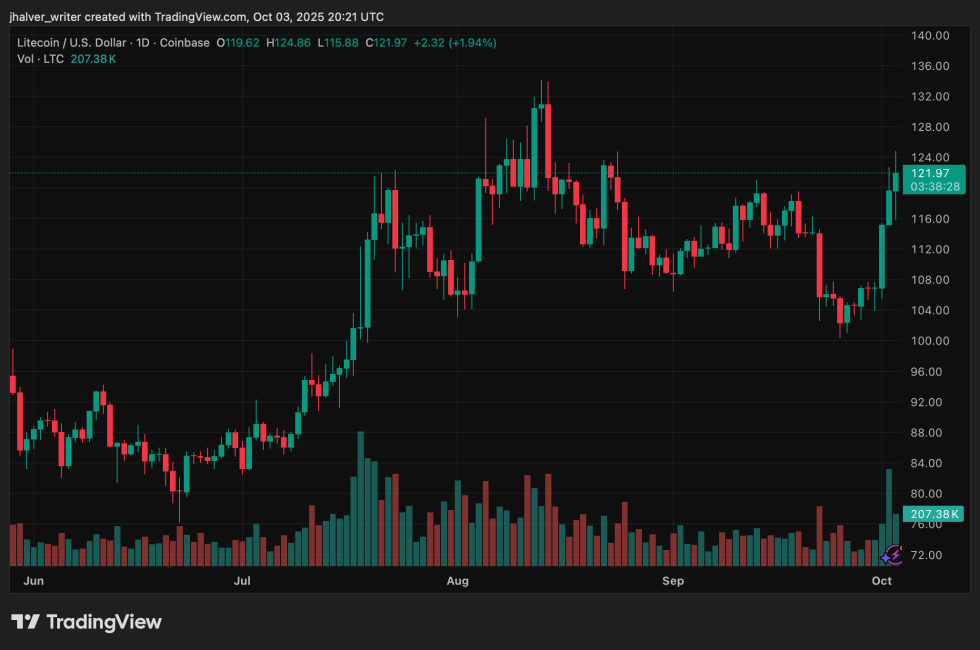
LTC's price trends to the upside on the daily chart. Source: LTCUSD on Tradingview
SEC Misses Deadline as Litecoin ETF Rules Shift
The SEC was expected to decide on Canary’s application by Thursday, but no update was issued. Analysts observe that the delay may be due not only to the shutdown but also to a broader shift in how crypto ETFs are managed.
Earlier this year, the SEC began phasing out the traditional 19b-4 filing process, which has been historically associated with strict deadlines, in favour of S-1 registration statements.
Bloomberg ETF analysts James Seyffart and Eric Balchunas argue this transition means old deadlines “no longer matter” under the regulator’s evolving framework. Instead, approval timelines may now depend on the SEC’s broader review of new listing standards, making the process less predictable.
Shutdown Complicates ETF Reviews
The U.S. government shutdown is intensifying the delays. Although the SEC continues with limited operations, its contingency plan, published in August, confirmed that reviewing new financial products, including ETF filings, would be paused during a shutdown.
This has left Canary’s Litecoin ETF, along with several other altcoin-based products, in a holding pattern.
Pending applications for Litecoin, Solana, XRP, Cardano, Avalanche, and Dogecoin ETFs are among those affected. These would build on the success of spot Bitcoin and Ethereum ETFs, which have already attracted more than $74 billion in inflows.
However, Litecoin faces additional scrutiny, as its regulatory classification remains less clear than Bitcoin’s status as a commodity.
Litecoin Price Remains Resilient
Despite the regulatory uncertainty, Litecoin’s price has stayed resilient. At the time of writing, LTC was trading around $118, approaching a two-month high of $122.
Analysts suggest that if the token can surpass resistance near $121, a new rally might be triggered. The consistent upward trend indicates investor confidence that approval is more a matter of timing rather than rejection.
Market observers describe the SEC’s silence as more of a “rain delay” than a denial. Once the shutdown concludes and new listing standards are fully implemented, analysts expect the ETF decision process to speed up.
Cover image from ChatGPT, LTCUSD chart from Tradingview

Related Posts