Grok Predicts Dogecoin Price: Is Maxi Doge the Next 1000x Crypto to Explode?

bitcoinistPublicado a 2025-10-03Actualizado a 2025-10-03

Resumen

Uptober is already here, and as always, the conservative crowd is stocking up on Bitcoin in anticipation of another all-time...

Trusted Editorial content, reviewed by leading industry experts and seasoned editors. Ad Disclosure

Uptober is already here, and as always, the conservative crowd is stocking up on Bitcoin in anticipation of another all-time high.

But strategic investors know better: it’s not wise to limit yourself to Bitcoin in a market as fertile as this. The viral rags-to-riches crypto tales are often written by those who dare to diversify into meme coins.

So we asked Grok for a large-cap and small-cap meme coin pick for the next 1000x crypto.

Grok Predicts Top Meme Coins Set to Explode in 2025

Grok’s large-cap meme coin pick didn’t come as a surprise –  $DOGE has long held the first position in meme coin rankings.

Although $DOGE has a market cap of $38.5B, it trades 65% below its 2021 all-time high. There is clearly credibility and more room for growth.

The small-cap pick, however, was interesting. Maxi Doge is a viral new crypto that’s already raised $2.7M in its hot presale. But what makes it one of the best meme coins in October when hundreds are vying for attention?

Let’s take a closer look at Grok’s reasoning and how high Dogecoin and Maxi Doge can climb this season.

Grok’s Dogecoin Price Prediction Explained

Grok points to multiple technical and fundamental factors that could fuel $DOGE’s bull surge this month.

As shown below, Dogecoin has broken free from a symmetrical triangle, marking the end of weeks of sideways trading. Since the breakout candle closed above resistance with substantial volume, the pattern suggests genuine demand strength.

In a recent post, popular crypto trader Tardigrade confirmed the trend.
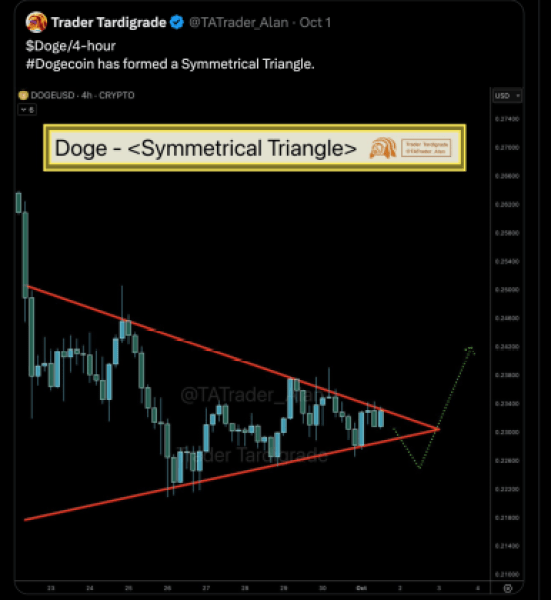
Source: Trader Tardigrade

Currently, $DOGE is trading for $0.254, registering nearly a 13% gain on the weekly chart. The next immediate target is $0.27, with a strong support at $0.24.

This level is critical to hold, as it could pave the path for an extended rally once the resistance at $0.27 is broken. But in the absence of major broader market triggers, $DOGE is expected to trade between $0.25 and $0.27 over the next few days.
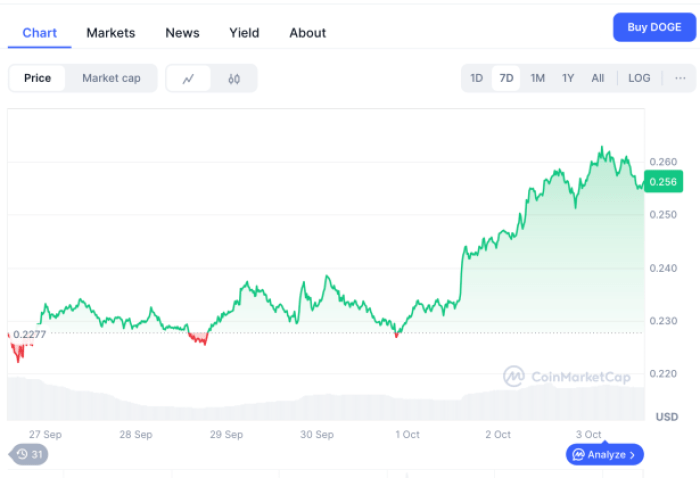
Dogecoin one-week price performance, source: CoinMarketCap
Multiple fundamental factors are lining up for a bigger rally, potentially taking $DOGE to $1 by the end of the year.

The most significant of these is Thumpzup Media’s pending acquisition of Dogehash, which aims to expand $DOGE’s mining capacity and drive long-term growth. What adds even more weight to this development is Thumpzup Media’s link to the Trump family.

Dogecoin owes part of its exponential growth over the years to social media nods from celebrities like Elon Musk. With the ThumzUp investment, the Trump brand name has become part of that narrative.

In the meme coin market, cultural capital matters more than technical integrations and utilities. Dogecoin proves this point better than any other crypto as one of the best investable cultural assets, demonstrated by its $38B market cap.

And traditional investors now have easier access to Dogecoin through ETFs. The first US-approved DOGE ETF began trading in September; with others in the pipeline.
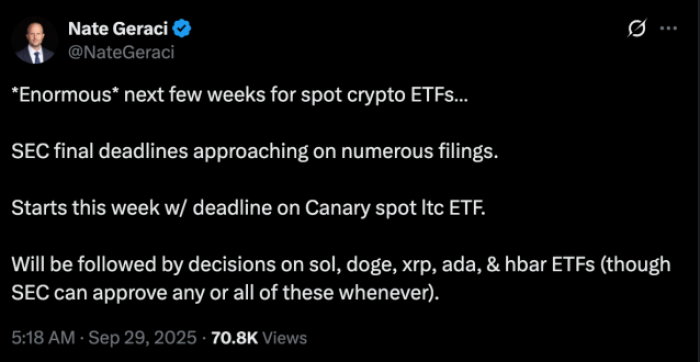
Source: Nate Geraci on X

That being said, Dogecoin’s gigantic market cap limits its growth potential. Even if it touches $1 by the end of the year, that doesn’t satisfy the exponential ride degens are looking for.

For these investors, Grok recommends Maxi Doge – Dogecoin’s gym-bro cousin, with a much lower entry point and much bigger upside.

Why Grok Predicts Maxi Doge as the Next 1000X Crypto

Maxi Doge ($MAXI) is Doge’s younger, better-looking cousin.

While Dogecoin boasts a multibillion-dollar market cap, Maxi Doge has yet to unlock his fortunes. Perpetually glued to candlestick movements, he’s pretty optimistic that he will make enough money to retire at 22.
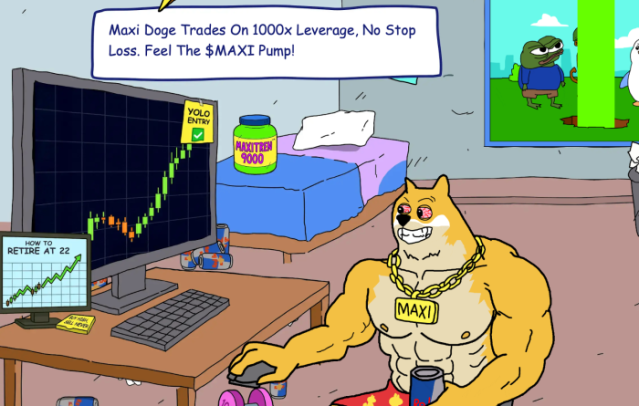
Maxi Doge enters the Doge universe

Unlike new-age meme coins that rely on AI and crypto buzzwords to spark interest, Maxi Doge has no time for pretensions. He is building a community of 1000x leverage hunters like him, betting big on humor and meme metaphors.

The blunt transparency has made him Grok’s favorite this season.

His efforts are paying off, as evidenced by the growing number of followers on social media. They’ve also been pouring money into his native token presale, now closing in on the $3M milestone.

(For detailed instructions on the presale, read our “How to Buy $MAXI” guide.)

Doge and Maxi Doge share the same family name, but $DOGE’s growth could echo louder for $MAXI investors.

That’s the Magic of a Discounted Entry Point

According to our $MAXI price prediction, the new meme coin has the potential to soar to $0.0024 by the end of 2025, marking an approximate 800% gain from its current presale price of $0.0002605.

That number could grow exponentially over the next years if the project sustains its viral momentum.

That seems likely, as Maxi Doge offers multiple reward channels to keep the community engaged through staking – now at a juicy 125% APY – as well as gaming contests and partner events.

With 40% of the token supply allocated to marketing, it wouldn’t be surprising to see the residual presale FOMO transform into a turbocharged launch after the TGE and take the token to the top meme coin rankings.

In addition, 25% of the tokens are allocated to Maxi Fund. The details have yet to be announced, but it’s widely speculated to support partnerships and exposure post-launch.
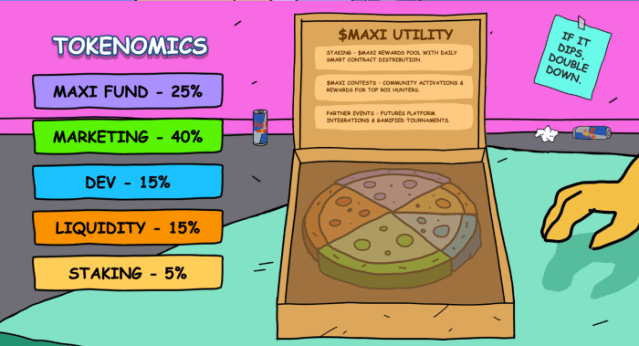
Maxi Doge ($MAXI) tokenomics

The presale sell-out is near, with $2.7M already raised, and the next price surge is just two days away.

Join the Maxi Doge presale early to unlock the best price and staking deals.

But as always, do your own research before investing in crypto. This is not financial advice.

Authored by Ben Wallis, Bitcoinist – https://bitcoinist.com/grok-dogecoin-price-prediction-maxi-doge-next-1000x-crypto/ 

Editorial Process for bitcoinist is centered on delivering thoroughly researched, accurate, and unbiased content. We uphold strict sourcing standards, and each page undergoes diligent review by our team of top technology experts and seasoned editors. This process ensures the integrity, relevance, and value of our content for our readers.

Ben is a freelance writer specializing in crypto developments (mainly altcoins) and the intricate ways global economics shape the digital asset space. His B.Ed. in Education provides a unique foundation for his writing, enabling him to distill complex crypto concepts and market shifts into clear, digestible insights. This skill is key to helping readers adapt and apply their understanding to the ever-evolving world of crypto investment. Passionate about making crypto accessible, Ben crafts content designed to educate a broad audience, from current market events to the essential foundational knowledge that underpins them. His goal is to empower readers through understanding. When he’s not immersed in crypto analysis and breaking down complex topics, Ben is an avid Pokémon fan and enjoys all things Disney.

Lecturas Relacionadas

UBS: The Crowdedness of A-Share Tech Stocks Is Far From Reaching Historical Peaks

UBS: A-share tech stocks still far from peak crowding levels A-shares' technology sector has seen a strong rebound, with trading activity hitting record highs, raising concerns about market crowding. However, UBS Securities argues that a key indicator of institutional positioning suggests the current crowding level remains well below historical peaks. While the large-cap tech sector's share of total A-share trading volume and market capitalization have reached historical highs, the overweight ratio of domestic mutual funds in this sector stood at 9.9% in Q1 2026. This is down from 11.6% in Q3 2025 and significantly lower than the historical peak of 14.1% in Q4 2015. It also pales in comparison to the historical peak overweight of 18.7% for the consumer sector. UBS notes that typical cycles from a low to a peak in fund overweighting last about three years, and the current outperformance of the tech/growth style has lasted less than two years since the policy pivot in September 2024. UBS expects A-share earnings recovery to accelerate, providing fundamental support. It forecasts 2026 A-share profit growth to rise to 11% from 3.9% in 2025. Non-financial A-share profits grew 11.8% YoY in Q1 2026, with gross and net profit margins at their highest since 2023. Persistent fund inflows, the expansion of thematic ETFs, and a recovery in private fund issuance are supporting market liquidity. In tactical allocation, UBS favors growth and cyclical styles under its "slow bull" base case, with overweight ratings on six sectors: Electronics (benefiting from semiconductor inventory recovery and AI innovation), Communications (driven by AI computing demand), Machinery (aided by domestic capex recovery), Non-ferrous Metals (due to rising copper/aluminum prices), Chemicals (supported by anti-involution policies), and Electrical Equipment (driven by policy support and AI data center power demand).

marsbitHace 8 min(s)

UBS: The Crowdedness of A-Share Tech Stocks Is Far From Reaching Historical Peaks

marsbitHace 8 min(s)

Should You Buy SpaceX Stock at $1.7 Trillion? Here's What the Market Is Worried About

SpaceX is preparing for a massive IPO aiming to raise around $75 billion at a valuation of approximately $1.75 trillion. While its achievements in reusable rockets and the profitable Starlink satellite internet service are clear, the market is concerned about the aggressive valuation. Key issues include: the current $1.75 trillion valuation, which is about 94 times 2025 revenue, seems to price in not just existing businesses but also unproven future ventures like AI infrastructure and orbital data centers. Financially, while Starlink is profitable, the AI division, bolstered by the acquisition of xAI, is incurring massive losses and consuming the majority of capital expenditures. This acquisition also introduced complex related-party financing arrangements and debt onto SpaceX's balance sheet. Furthermore, corporate governance poses a challenge. SpaceX's dual-class share structure ensures founder Elon Musk retains absolute control, limiting ordinary shareholders' influence over high-risk, long-term strategic decisions. The future success of ambitious projects like the Starship rocket—critical for lowering costs and enabling new services—remains a significant variable for the valuation. In summary, the market's apprehension (FUD) centers not on doubting SpaceX's past technological triumphs but on questioning how much premium public investors should pay for a future that combines proven profits with highly speculative and capital-intensive new ventures, all under a governance structure that offers limited shareholder oversight.

marsbitHace 1 hora(s)

Should You Buy SpaceX Stock at $1.7 Trillion? Here's What the Market Is Worried About

marsbitHace 1 hora(s)

Breaking the DeFi Cascading Liquidation Curse: Vitalik Proposes a New Solution

Vitalik Buterin has proposed a new DeFi design to eliminate the automatic liquidation mechanism that causes market instability during sharp downturns. The current system, used by protocols like Aave, triggers forced sales when collateral value falls below a threshold, often exacerbating price drops and creating systemic selling pressure. Buterin's alternative model is based on splitting an asset like ETH into two synthetic option-like tokens, P and N, pegged to a price index. Their combined value always equals one ETH. Instead of sudden liquidation, a position's value gradually drifts from its target peg if the market moves. Users must proactively rebalance their holdings to maintain their desired exposure, transferring the management burden from the protocol to the user or automated tools. A key advantage is the reduced reliance on real-time oracles. Pricing decisions are deferred until contract expiry, allowing for more robust, fault-tolerant oracle designs. This removes a clear liquidation threshold that speculators can target for manipulation or MEV extraction. However, significant challenges remain. Frequent rebalancing could incur high slippage and transaction costs, necessitating new liquidity provider models. The design is better suited for hedging instruments than for stablecoins requiring a rigid 1:1 peg. While not an immediate replacement for existing systems, the proposal challenges the foundational assumption that instantaneous forced liquidation is an unavoidable necessity in DeFi, opening the door for fundamentally different risk management architectures.

marsbitHace 1 hora(s)

Breaking the DeFi Cascading Liquidation Curse: Vitalik Proposes a New Solution

marsbitHace 1 hora(s)

Trading

Spot
Futuros
活动图片





