Hyperliquid Adds Zcash (ZEC) Perp as Price Surges 160% in A Week

TheCryptoTimesPublicado a 2025-10-03Actualizado a 2025-10-03

The price of Zcash (ZEC) has exploded 160% in just seven days, climbing to its highest level in three years. Riding the momentum, Hyperliquid introduced ZEC perpetual futures, giving traders up to 5x leverage to go long or short. 

The announcement landed right as interest in Zcash was heating up on exchanges. On Friday, the privacy coin traded at $150, rallying from below $60 to nearly $155 in days, as per CoinMarketCap data. 

Hyperliquid data showed that the ZEC price hit as high as  $171.05 before easing to around $150, noting a surge of 4% in the past 24 hours. Trading activity also jumped as more buyers piled in, putting ZEC in the spotlight. As a result, it became one of the strongest performers in the market over the past day.
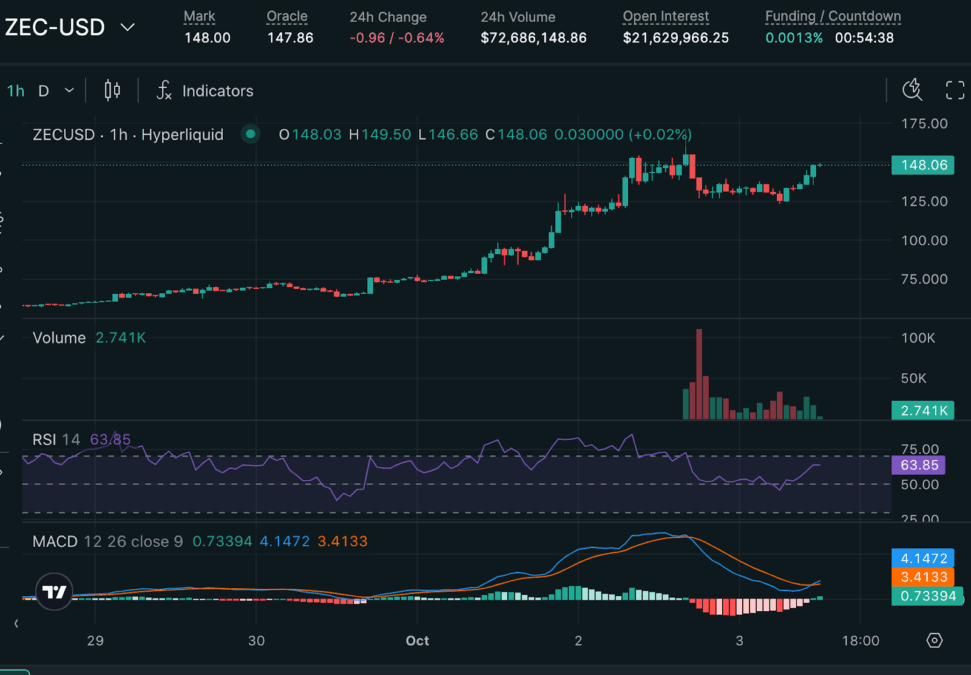
Zec Price Chart
Source: Hyperliquid

Strong technical backing

Technical signals backed Zcash’s rally. The RSI is at 63.85, showing strong momentum but not overheated levels. The MACD stayed in bullish territory, signaling ongoing strength. While momentum slowed for a moment, fresh buying pressure showed signs of recovery.

The Coinalyze chart shows Zcash shooting up quickly before settling into a steady range. What stood out was that while the price kept rising, the long-to-short ratio dropped from above 1.5 to about 0.74. This means that more traders started betting against ZEC even though its price action remained strongly bullish.
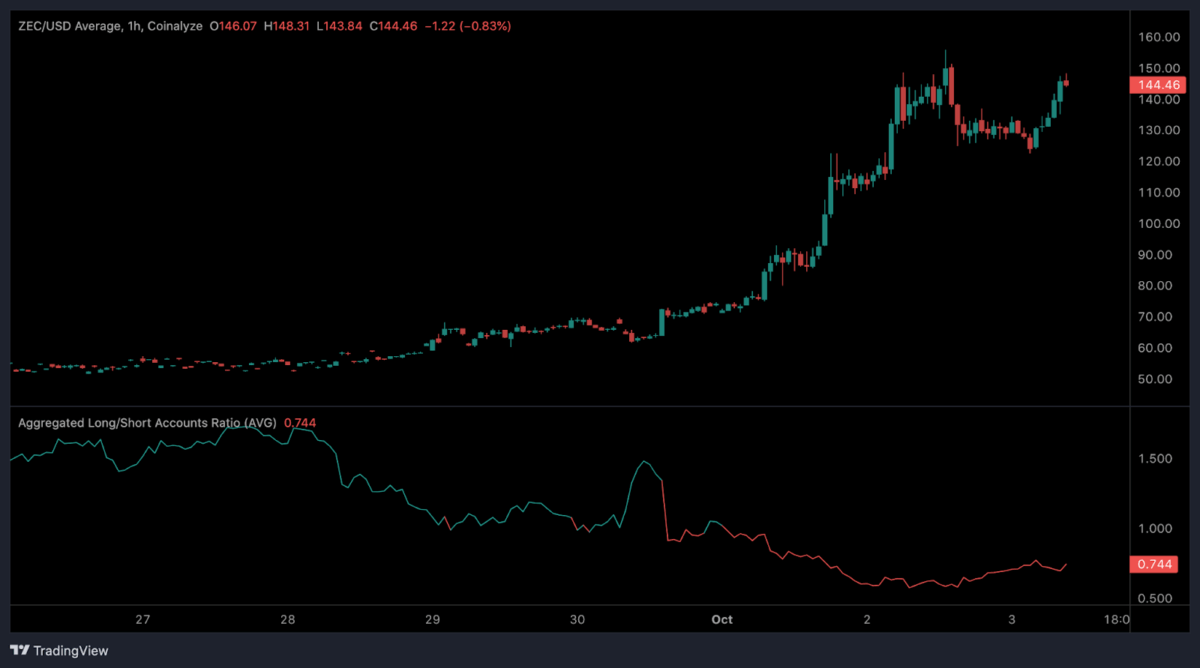
Zec Aggregated Long/Short Ratio Chart
Source: Coingalyze

Institutional and community momentum

Institutional sentiment further fueled ZEC’s rise. Grayscale confirmed its Zcash Trust is now open for private placement, allowing accredited investors exposure similar to Bitcoin and Ethereum products. Additionally, ex-Coinbase engineer and Helius CEO Mert Mumtaz stressed privacy coins are critical as CBDCs advance. “Private money has to work,” he declared, warning of a dystopian outcome without it.

Zcash, ranked 82nd by market cap at $1.8 billion, remains a standout in the privacy sector. Its zero-knowledge proof technology allows users to control how much transaction data they reveal. As Zcash community advisor Thor Torrens, noted, “It’s about consent. $ZEC provides users with the POWER to SELECT which part of their transaction history they disclose.”

Zcash’s surge and Hyperliquid’s move point to a stronger push for private money in crypto. As institutions join in, ZEC could shape how people protect both their money and their freedom.

Also Read: Lido Token Jumps 7% After VanEck Files Staked Ethereum ETF


Mobile Only Image

Lecturas Relacionadas

UBS: The Crowdedness of A-Share Tech Stocks Is Far From Reaching Historical Peaks

UBS: A-share tech stocks still far from peak crowding levels A-shares' technology sector has seen a strong rebound, with trading activity hitting record highs, raising concerns about market crowding. However, UBS Securities argues that a key indicator of institutional positioning suggests the current crowding level remains well below historical peaks. While the large-cap tech sector's share of total A-share trading volume and market capitalization have reached historical highs, the overweight ratio of domestic mutual funds in this sector stood at 9.9% in Q1 2026. This is down from 11.6% in Q3 2025 and significantly lower than the historical peak of 14.1% in Q4 2015. It also pales in comparison to the historical peak overweight of 18.7% for the consumer sector. UBS notes that typical cycles from a low to a peak in fund overweighting last about three years, and the current outperformance of the tech/growth style has lasted less than two years since the policy pivot in September 2024. UBS expects A-share earnings recovery to accelerate, providing fundamental support. It forecasts 2026 A-share profit growth to rise to 11% from 3.9% in 2025. Non-financial A-share profits grew 11.8% YoY in Q1 2026, with gross and net profit margins at their highest since 2023. Persistent fund inflows, the expansion of thematic ETFs, and a recovery in private fund issuance are supporting market liquidity. In tactical allocation, UBS favors growth and cyclical styles under its "slow bull" base case, with overweight ratings on six sectors: Electronics (benefiting from semiconductor inventory recovery and AI innovation), Communications (driven by AI computing demand), Machinery (aided by domestic capex recovery), Non-ferrous Metals (due to rising copper/aluminum prices), Chemicals (supported by anti-involution policies), and Electrical Equipment (driven by policy support and AI data center power demand).

marsbitHace 6 min(s)

UBS: The Crowdedness of A-Share Tech Stocks Is Far From Reaching Historical Peaks

marsbitHace 6 min(s)

Should You Buy SpaceX Stock at $1.7 Trillion? Here's What the Market Is Worried About

SpaceX is preparing for a massive IPO aiming to raise around $75 billion at a valuation of approximately $1.75 trillion. While its achievements in reusable rockets and the profitable Starlink satellite internet service are clear, the market is concerned about the aggressive valuation. Key issues include: the current $1.75 trillion valuation, which is about 94 times 2025 revenue, seems to price in not just existing businesses but also unproven future ventures like AI infrastructure and orbital data centers. Financially, while Starlink is profitable, the AI division, bolstered by the acquisition of xAI, is incurring massive losses and consuming the majority of capital expenditures. This acquisition also introduced complex related-party financing arrangements and debt onto SpaceX's balance sheet. Furthermore, corporate governance poses a challenge. SpaceX's dual-class share structure ensures founder Elon Musk retains absolute control, limiting ordinary shareholders' influence over high-risk, long-term strategic decisions. The future success of ambitious projects like the Starship rocket—critical for lowering costs and enabling new services—remains a significant variable for the valuation. In summary, the market's apprehension (FUD) centers not on doubting SpaceX's past technological triumphs but on questioning how much premium public investors should pay for a future that combines proven profits with highly speculative and capital-intensive new ventures, all under a governance structure that offers limited shareholder oversight.

marsbitHace 1 hora(s)

Should You Buy SpaceX Stock at $1.7 Trillion? Here's What the Market Is Worried About

marsbitHace 1 hora(s)

Breaking the DeFi Cascading Liquidation Curse: Vitalik Proposes a New Solution

Vitalik Buterin has proposed a new DeFi design to eliminate the automatic liquidation mechanism that causes market instability during sharp downturns. The current system, used by protocols like Aave, triggers forced sales when collateral value falls below a threshold, often exacerbating price drops and creating systemic selling pressure. Buterin's alternative model is based on splitting an asset like ETH into two synthetic option-like tokens, P and N, pegged to a price index. Their combined value always equals one ETH. Instead of sudden liquidation, a position's value gradually drifts from its target peg if the market moves. Users must proactively rebalance their holdings to maintain their desired exposure, transferring the management burden from the protocol to the user or automated tools. A key advantage is the reduced reliance on real-time oracles. Pricing decisions are deferred until contract expiry, allowing for more robust, fault-tolerant oracle designs. This removes a clear liquidation threshold that speculators can target for manipulation or MEV extraction. However, significant challenges remain. Frequent rebalancing could incur high slippage and transaction costs, necessitating new liquidity provider models. The design is better suited for hedging instruments than for stablecoins requiring a rigid 1:1 peg. While not an immediate replacement for existing systems, the proposal challenges the foundational assumption that instantaneous forced liquidation is an unavoidable necessity in DeFi, opening the door for fundamentally different risk management architectures.

marsbitHace 1 hora(s)

Breaking the DeFi Cascading Liquidation Curse: Vitalik Proposes a New Solution

marsbitHace 1 hora(s)

Trading

Spot
Futuros

Artículos destacados

Cómo comprar ZEC

¡Bienvenido a HTX.com! Hemos hecho que comprar Zcash (ZEC) sea simple y conveniente. Sigue nuestra guía paso a paso para iniciar tu viaje de criptos.Paso 1: crea tu cuenta HTXUtiliza tu correo electrónico o número de teléfono para registrarte y obtener una cuenta gratuita en HTX. Experimenta un proceso de registro sin complicaciones y desbloquea todas las funciones.Obtener mi cuentaPaso 2: ve a Comprar cripto y elige tu método de pagoTarjeta de crédito/débito: usa tu Visa o Mastercard para comprar Zcash (ZEC) al instante.Saldo: utiliza fondos del saldo de tu cuenta HTX para tradear sin problemas.Terceros: hemos agregado métodos de pago populares como Google Pay y Apple Pay para mejorar la comodidad.P2P: tradear directamente con otros usuarios en HTX.Over-the-Counter (OTC): ofrecemos servicios personalizados y tipos de cambio competitivos para los traders.Paso 3: guarda tu Zcash (ZEC)Después de comprar tu Zcash (ZEC), guárdalo en tu cuenta HTX. Alternativamente, puedes enviarlo a otro lugar mediante transferencia blockchain o utilizarlo para tradear otras criptomonedas.Paso 4: tradear Zcash (ZEC)Tradear fácilmente con Zcash (ZEC) en HTX's mercado spot. Simplemente accede a tu cuenta, selecciona tu par de trading, ejecuta tus trades y monitorea en tiempo real. Ofrecemos una experiencia fácil de usar tanto para principiantes como para traders experimentados.

345 Vistas totalesPublicado en 2024.12.12Actualizado en 2026.06.02

Cómo comprar ZEC

Discusiones

Bienvenido a la comunidad de HTX. Aquí puedes mantenerte informado sobre los últimos desarrollos de la plataforma y acceder a análisis profesionales del mercado. A continuación se presentan las opiniones de los usuarios sobre el precio de ZEC (ZEC).

活动图片