刚刚,SEC官宣!机构买币的最大障碍,彻底打通了!

比推Publicado a 2025-10-01Actualizado a 2025-10-01

当地时间9月30日,美国证券交易委员会(SEC)投资管理部发布了一封重磅无异议函(No-Action Letter),正式确认:

注册投资顾问(Registered Advisers)与受监管基金(Regulated Funds)可将加密资产托管于州特许信托公司(State Trust Companies),SEC不会对此采取执法行动。

这封信意味着,长期以来处于监管灰区的“合格托管人资格”问题终于得到澄清——州信托公司可被视为法律意义上的“银行”,从而获得合法托管比特币以太坊等加密资产的地位。

这意味着,自前任主席Gary Gensler时期“托管规则”争议以来,困扰华尔街数年的"合格托管人"难题迎刃而解,机构资金入场加密市场的最后一道闸门终于开启。
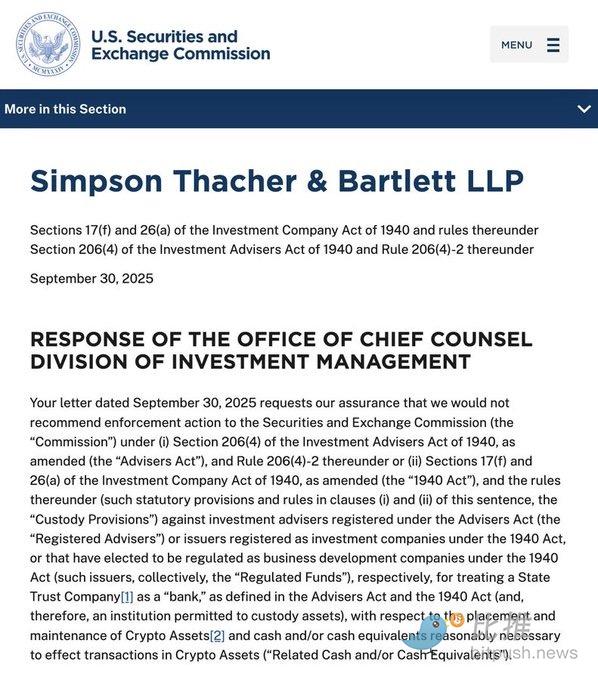
image.png

背景:从“封杀”到“开放”的五年演变

在过去几年里,美国联邦监管机构——包括美联储、货币监理署(OCC)与财政部——通过所谓的“Operation Choke Point 2.0”行动,严格限制受监管金融机构为加密公司提供服务。SEC也一度认为加密托管存在“系统性风险”,并尝试推出新规,要求投资顾问只能将加密资产托管于“传统银行级”机构。

这种做法被广泛视为对CoinbaseKraken等拥有州信托牌照机构的“釜底抽薪”。然而,随着2025年特朗普政府的上台,以及SEC现任主席Paul Atkins推动的“Project Crypto”政策计划,SEC的立场正在快速转向——从阻挡到接纳,从观望到建设。

核心内容:州信托公司=正式承认“银行地位”

根据SEC官方文件,投资顾问或基金若想使用州信托公司作为加密资产托管人,需满足四大条件:

  1. 年度尽职调查(Due Diligence)
    顾问需确保信托公司:

    • 获得州银行监管部门授权;

    • 具备防盗、防滥用、防私钥泄露等完整的内部控制机制;

    • 提供经独立审计的财务报表与SOC-1/SOC-2内部控制报告。

  2. 签署书面托管协议(Custodial Agreement)
    托管公司不得未经客户书面同意出借、质押或再质押加密资产,且托管资产必须与公司自有资产隔离。

  3. 风险披露(Risk Disclosure)
    顾问需向客户或基金董事会充分披露使用州信托公司托管加密资产的潜在风险。

  4. 最佳利益原则(Best Interest Test)
    顾问或基金董事会需合理认定该托管方案符合客户或股东的最佳利益。

这些条件的设定确保了合规性、透明性与投资者保护三大底线。

业界反应:加密的“监管曙光”

这封信被业界视为“数字资产监管清晰化的里程碑”。

彭博情报(Bloomberg Intelligence)分析师 James Seyffart 评论道:

“这是数字资产领域期待已久的监管清晰化典范(textbook example of clarity)——正是行业多年来一直呼吁的改变。”

image.png

美国怀俄明州参议员 Cynthia Lummis 也在X发文表示:

“很高兴看到SEC终于承认州特许信托公司作为合格的数字资产托管人。怀俄明州早在2020年就率先完成了这一突破,如今SEC终于认可了州级监管体系的严谨与价值。”

目前,多家知名加密企业——如Coinbase Trust、Kraken Trust、Anchorage Digital Bank等——均在州信托牌照体系下运营。这项政策为这些机构“正名”,使其理论上能够为投资顾问、基金及机构客户合法提供托管服务。

SEC内部的“路线之争”

尽管这是加密托管的一次重大胜利,但SEC内部并非一致赞成。

共和党籍委员 Hester Peirce(长期被称为“加密妈妈”)在新加坡的演讲中指出:“SEC应当更新托管规则,让技术能力强的机构有资格自行托管数字资产,而非排除它们。”

相反,民主党籍委员 Caroline Crenshaw 则强烈反对此次无异议处理,认为这等于:“让投资者陷入50个州监管体系的轮盘赌(regulatory roulette)。在没有公开征求意见和经济分析的情况下,用一封信推动如此重大转变,是不负责任的行为。”

影响与展望:加密资产机构化托管的“绿灯”

此次无异议函的实际意义,远不止是合规层面的“安心函”。它标志着美国监管体系首次正式认可加密托管的合法合规路径,并可能带来以下影响:

  • 加速机构资金入场。投资顾问与基金现在可以合法托管比特币、以太坊等资产,为机构配置数字资产扫清法律障碍。

  • 强化州信托体系地位。各州信托公司(如怀俄明州、纽约州、德州)将成为加密金融基础设施的重要支柱。

  • 推动加密资产市场制度化发展。在ETF之后,“托管合法化”是机构投资者参与加密市场的又一关键拼图。

  • 为未来立法铺路。这封信虽非正式法律,但为国会通过《数字资产市场结构法案》(Digital Asset Market Structure Act)等立法提供现实基础。

总之,当州信托公司获得与银行同等的托管地位,传统资金配置比特币、以太坊的最后顾虑已被清除,一个全新的机构时代正加速到来。


Twitter:https://twitter.com/BitpushNewsCN

比推 TG 交流群:https://t.me/BitPushCommunity

比推 TG 订阅: https://t.me/bitpush
说明: 比推所有文章只代表作者观点,不构成投资建议

Lecturas Relacionadas

Can Alibaba Cloud Rewrite Itself?

Over the past five months, Alibaba Cloud's MaaS (Model as a Service) revenue has surged 15x, marking a strategic overhaul where the company is shifting its 17-year-old system designed for "humans using cloud" to a new paradigm centered on "Agents consuming Tokens." At its recent summit, Alibaba Cloud announced a full-stack upgrade encompassing "chip-cloud-model-inference," all optimized for AI Agents. Key launches include the new AI product portal "QianWen Cloud," hyper-node servers powered by the in-house AI chip Zhenwu M890, and the latest flagship model, Qwen3.7-Max. Senior VP Liu Weiguang described this as building "China's largest AI factory," where chips are raw materials, the cloud is the workshop, models are machines, and the inference platform is the assembly line, with Tokens as the final product. The company is now emphasizing its chip strategy, unveiling the Zhenwu M890 and a two-year roadmap for future chips. With over 560,000 chips deployed across 400+ clients, Alibaba Cloud aims to control the marginal cost per Token, mirroring Google's integration of TPU and Gemini for optimal cost-performance. The cloud infrastructure itself is being rewritten. Traditional cloud interfaces are being transformed into standardized, Agent-callable Skills. A new scheduling logic focuses on "task scheduling" over "resource scheduling" to handle the unpredictable, elastic workloads of Agents. Liu noted that AI applications now automatically provision cloud resources, with one customer's daily automated provisioning equaling two weeks of manual work. For models, the focus has shifted from conversational prowess to execution capability. Qwen3.7-Max demonstrated this by autonomously writing and optimizing a production-grade AI compute kernel for the new Zhenwu M890 chip over 35 hours, achieving a 10x performance improvement. The underlying Bailian platform was upgraded for efficiency, and it maintains an open ecosystem, hosting third-party models. This restructuring extends beyond technology to sales, organization, and metrics. Alibaba Cloud has established dedicated MaaS sales teams, separated from traditional IaaS, with new KPIs focusing on high-quality Tokens that solve real problems, the number of core business systems integrated with models, and the efficiency of Agent task completion. The underlying bet is clear: AI represents an opportunity orders of magnitude larger than before. Despite the uncertainty, Alibaba Cloud is aggressively rebuilding its entire system, betting on an AI-driven future where Tokens could become its largest product line.

marsbitHace 53 min(s)

Can Alibaba Cloud Rewrite Itself?

marsbitHace 53 min(s)

Trading

Spot
Futuros
活动图片