Robinhood Eyes Europe With Prediction Markets Push

TheCryptoTimesPublicado a 2025-09-30Actualizado a 2025-09-30

Robinhood Markets (Nasdaq: HOOD) is moving to expand its footprint in the fast-evolving world of event-based trading. The company’s stock surged past $142 this week, marking an all-time high, following reports that it plans to take its prediction markets product beyond U.S. borders, specifically targeting the United Kingdom and broader European market.

CEO Vlad Tenev confirmed earlier that users had already traded more than 4 billion event contracts on the platform, which first introduced prediction markets ahead of the 2024 U.S. election. Bloomberg later reported that Robinhood is in talks with the UK’s Financial Conduct Authority to bring the product overseas. The company is also ramping up offerings tied to major sporting events like college football and the NFL.

Robinhood’s move into prediction markets aligns with its user base’s appetite for risk, extending beyond meme stocks and crypto into event-driven speculation. Financially, the strategy appears to be working: Q2 net revenue surged 45% to $989 million, with operating costs rising just 12%, leading to $386 million in net income and fueling a 275% year-to-date rally in HOOD stock.
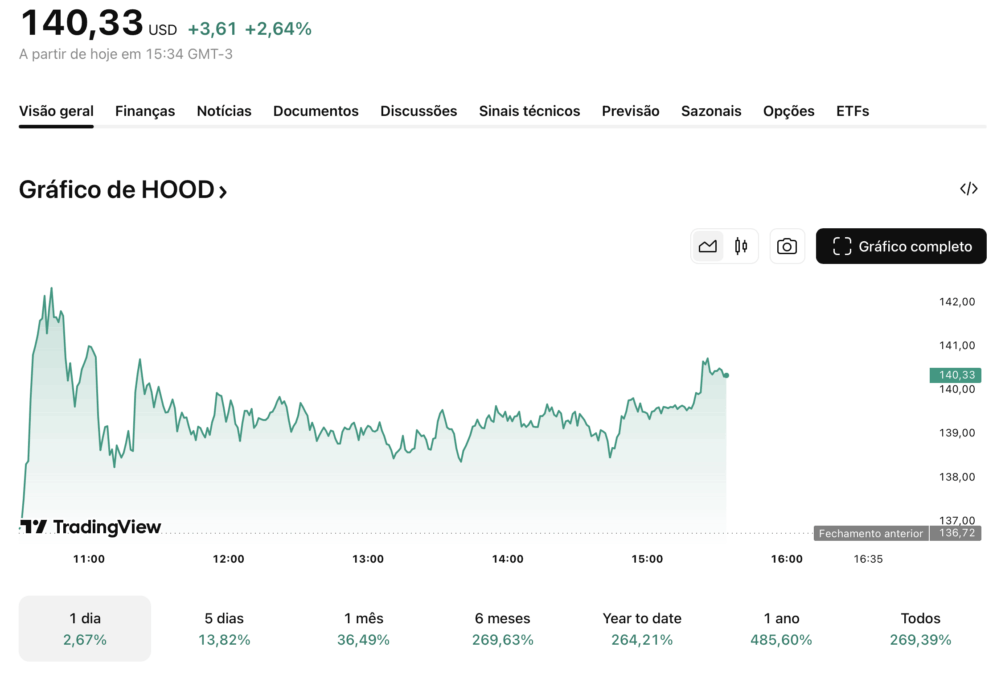
Robinhood Eyes Europe With Prediction Markets Push
Robinhood Price Chart. Source: TradingView

Robinhood eyes retail access to private equity deals

Meanwhile, Robinhood is also waiting on a regulatory green light from the U.S. Securities and Exchange Commission (SEC) to launch its Robinhood Ventures Fund I, a retail-accessible product offering exposure to private, pre-IPO companies. If approved, the fund would trade under the ticker ‘RVI’ on the NYSE and invest in high-growth firms through their IPO phases and beyond.

Previously, the company unveiled tokenized stock products in Europe, giving users access to firms like OpenAI and SpaceX. Ventures Fund I would extend this access into the U.S., challenging long-standing restrictions that favor institutions.

Taken together, the prediction market expansion and the SEC fund application reflect Robinhood’s dual push: one outward, toward new global markets and asset types, and one inward, to democratize traditionally off-limits financial instruments. 

Also read: Robinhood Seeks SEC Nod for New Private Markets Fund


Mobile Only Image

Lecturas Relacionadas

Agents Take Over Traffic Distribution Power: What Are Tencent, ByteDance, and Alibaba Competing For?

In the race to dominate the AI era's entry point, China's tech giants—Tencent, ByteDance, and Alibaba—are aggressively deploying AI Agents to control the future of traffic distribution. Alibaba is pursuing a dual-track "closed loop + openness" strategy. Its Qianwen app is evolving into a super-Agent integrated across its ecosystem (Taobao, Alipay, etc.) to handle complex tasks like travel planning. Concurrently, it is opening its platform to external brands (Luckin Coffee, KFC) and has launched a B2B Agent platform, "Wukong," targeting enterprise automation. Its other flagship, Quark, aims to be an "AI super search box" for information and tasks. ByteDance is executing an omnipresent "sprawl strategy." Its Doubao app boasts over 300 million monthly active users and is evolving into a default AI entry point for daily life, with plans for paid versions and e-commerce integration. Its core weapon is the Kouzi platform, a visual "AI assembly factory" for developers to build custom Agents. ByteDance is also pushing hardware integration, collaborating on AI phones and developing smart glasses to embed Doubao everywhere. Tencent is playing its long-held "ultimate card" by quietly embedding an AI Agent directly into WeChat. This Agent, accessible via a swipe, can understand user commands and automatically execute tasks by calling upon WeChat's millions of mini-programs (e.g., finding and ordering coffee). This leverages WeChat's unparalleled 1.4-billion-user ecosystem to position the app as an AI-powered "service operating system," a move that could dramatically reshape the competitive landscape. The core battleground is shifting from competing for "user screen time" to competing to be the "default execution layer" for user intent. The business model is evolving from an "attention economy" to an "intent economy," where the Agent that can most efficiently fulfill a user's need gains control over service access and token flow. This represents a fundamental change in how users connect with digital services, making the fight for the Agent入口 (entry point) a pivotal moment for redefining industry leadership in the AI age.

marsbitHace 25 min(s)

Agents Take Over Traffic Distribution Power: What Are Tencent, ByteDance, and Alibaba Competing For?

marsbitHace 25 min(s)

From Banning Doubao to Embracing Honor: Why Did WeChat Suddenly 'Change Its Face'?

The article explores the sudden shift in WeChat's strategy towards AI assistants from mobile phone manufacturers, transitioning from strict opposition to active collaboration. For over a year, WeChat fiercely resisted attempts by phone AI assistants (like ByteDance's Doubao in late 2025) to control its features via GUI automation ("simulated clicking"), citing security and data control concerns. This stance created a significant barrier for system-level AI integration. Now, Tencent has initiated A2A (Agent-to-Agent) partnerships with major phone brands like Honor, Xiaomi, OPPO, and vivo. This model allows a phone's system AI (e.g., Honor's YOYO) to parse a user's voice command and send a structured request directly to WeChat's own internal AI agent via secure APIs. WeChat then executes the action (e.g., sending a message) and returns the result. The article attributes Tencent's "change of face" to strategic pressure. While leading in social app usage, Tencent trails rivals like ByteDance and Alibaba in standalone AI app popularity. WeChat, with its vast mini-program ecosystem, is Tencent's key asset for an AI comeback. The upcoming WeChat AI agent aims to handle tasks like booking and payments within the app. However, phone system assistants remain the primary AI entry point for most users. The A2A collaboration allows Tencent to extend WeChat's AI reach to this crucial system layer while maintaining control over its core functions and data. For phone manufacturers, embracing A2A is a pragmatic move. The GUI route proved unviable due to WeChat's blocks. A2A offers a compliant path to integrate a vital service, enhancing their AI assistants' usefulness. It allows them to focus on developing their own AI ecosystems for other services while cooperating on WeChat access. The collaboration is framed as a mutual, strategic necessity: Tencent gains a distribution channel, and manufacturers gain a key functionality. The partnership relies on a "dual authorization" mechanism for security, requiring both user and app consent for each action. While questions about long-term data privacy practices remain, experts note A2A is more secure and compliant than GUI automation. Ultimately, this cooperation is seen as a tentative, calculated truce. Tencent's long-term goal is to make WeChat an AI-powered "service OS." Phone manufacturers aim to make their system AI the central user interface. Their paths may converge or clash in the future, but for now, the A2A deal represents the opening chapter in the battle for the AI-era user入口, driven by necessity and strategic calculus on both sides.

marsbitHace 1 hora(s)

From Banning Doubao to Embracing Honor: Why Did WeChat Suddenly 'Change Its Face'?

marsbitHace 1 hora(s)

Trading

Spot
Futuros
活动图片