No License, No Problem? Wisconsin Bill Aims To Ease Crypto Rules

bitcoinistPublicado a 2025-09-30Actualizado a 2025-09-30

Resumen

Wisconsin lawmakers have introduced a proposal that could reshape how cryptocurrency businesses are treated under state law. The measure, Assembly...

Trusted Editorial content, reviewed by leading industry experts and seasoned editors. Ad Disclosure

Wisconsin lawmakers have introduced a proposal that could reshape how cryptocurrency businesses are treated under state law. The measure, Assembly Bill 471, aims to exempt a wide range of digital asset activities from money transmitter licensing requirements.

The proposal has been referred to the Committee on Financial Institutions and is backed by several Republican legislators.

Bill Targets Mining, Staking And Wallet Use

Based on reports, the Wisconsin Legislative Reference Bureau outlines clear exemptions for crypto-related work that usually falls into regulatory gray zones.

Mining, staking, and operating blockchain nodes are among the activities that would not require a money transmitter license. Developers creating blockchain software or tools are also included in the exemptions.

The bill goes further by stating that individuals can keep custody of their own coins, whether through hardware wallets or self-hosted digital wallets, without state interference.
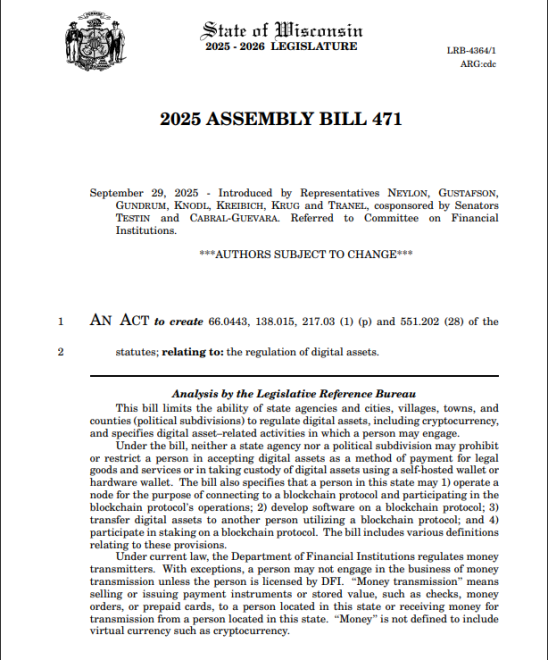
It also seeks to prevent local governments from banning the use of digital assets in payments for lawful goods or services, as long as the transaction doesn’t involve conversion to US dollars or bank deposits.

This distinction matters. While businesses may be free to accept tokens directly, the bill does not cover cases where cryptocurrency is exchanged into legal tender.

That boundary keeps traditional regulatory requirements intact for fiat conversions and custodial services tied to banks.
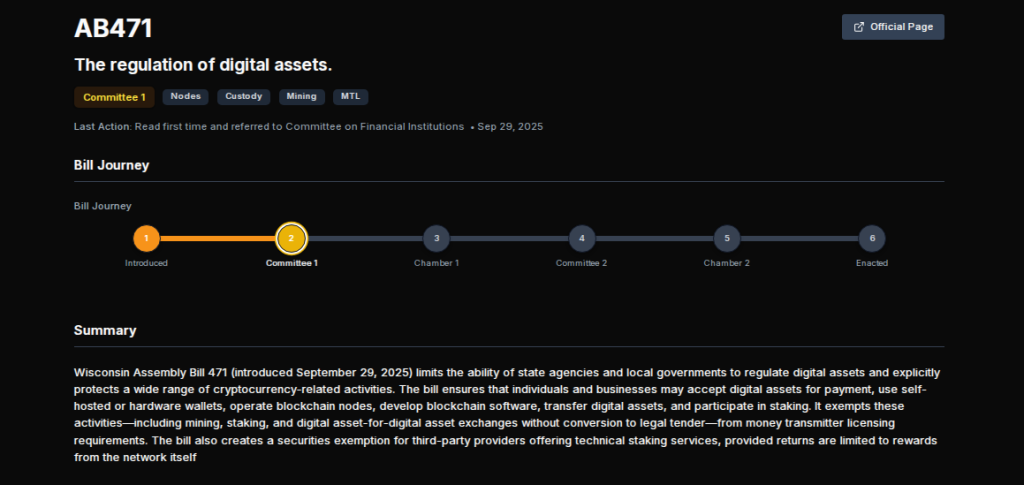
The status of AB471 Bill. Source: Bitcoin Laws

Another Bill Targets Crypto Kiosks

While Assembly Bill 471 attempts to carve out freedom for certain digital asset activities, another measure, Senate Bill 386, pushes in a different direction.

SB 386 would require anyone operating a virtual currency kiosk in Wisconsin to obtain a license. These kiosks, often compared to ATMs, allow users to swap cash for cryptocurrency and vice versa.

Thus, in a nutshell, two separate paths are being pursued in the state legislature: one expanding exemptions for miners, developers, and users, and the other providing more regulation to business involved in providing direct fiat-to-crypto services.

This distinction shows what a route policymakers are taking with supporting innovation while still having consumer protections. There are still questions of who would be covered and the actual effect of the changes.

BTCUSD trading at $113,725 on the 24-hour chart: TradingView

Bill Advocates Upbeat

The proponents of the exemption bill are optimistic it will secure Wisconsin’s advantage as a center for blockchain developers and firms that are exploring careers in blockchain development, smart contracts, research, etc., and who want fewer burdensome regulations to work with.

By protecting users who merely operate nodes, stake coins, or have tokens stored in private wallets, the state would be more friendly to mainstream users too.

But there are open questions. Federal regulators such as the Securities and Exchange Commission and the Financial Crimes Enforcement Network may still claim oversight in areas the state bill does not touch.

Ambiguities in the language, such as how “conversion to legal tender” is defined, could spark disputes later.

Featured image from Northwest Wisconsin, chart from TradingView

Editorial Process for bitcoinist is centered on delivering thoroughly researched, accurate, and unbiased content. We uphold strict sourcing standards, and each page undergoes diligent review by our team of top technology experts and seasoned editors. This process ensures the integrity, relevance, and value of our content for our readers.

Christian, a journalist and editor with leadership roles in Philippine and Canadian media, is fueled by his love for writing and cryptocurrency. Off-screen, he's a cook and cinephile who's constantly intrigued by the size of the universe.

Lecturas Relacionadas

On-Chain Figures on the Eve of Kickoff: 1.6 Billion Traded Before the World Cup Even Begins

"On-Chain Numbers on the Eve of the World Cup: $1.6 Billion Traded Before Kick-off" Analysis of on-chain markets before the 2026 FIFA World Cup reveals significant crypto integration into football. The most striking figure is the approximately **$1.6 billion** in total trading volume on the single "World Cup Winner" contract on the Polymarket prediction market platform, accumulated before a single match was played. This represents explosive growth for a sector whose annual volume surged from ~$16B in 2024 to ~$64B in 2025. The ecosystem is maturing beyond speculation. Key developments include: 1) **Infrastructure upgrades** like Polymarket's migration to native, regulated USDC stablecoin for settlements; 2) **Reliable data oracles**, such as Chainlink, being used to resolve real-world match outcomes on-chain; and 3) **Official recognition**, with FIFA appointing its first-ever "Prediction Markets" partner. Over 100 contracts now cover everything from the outright winner to individual match results and even non-sporting risks like venue relocation. This evolution marks a fundamental shift. While crypto firms are absent from FIFA's top-tier sponsor list, the technology has deeply penetrated the tournament's financial and predictive infrastructure through regulated stablecoin settlements, decentralized oracles, and new official partnership categories. The regulatory landscape remains complex and varies by jurisdiction, but on-chain markets for the World Cup are already a multi-billion-dollar reality.

marsbitHace 2 min(s)

On-Chain Figures on the Eve of Kickoff: 1.6 Billion Traded Before the World Cup Even Begins

marsbitHace 2 min(s)

From SpaceX's IPO to the Future of Crypto: Which Crypto Sectors Will Host the Trillion-Dollar Narrative?

From the SpaceX IPO, which targets a $750 billion raise at a $1.77 trillion valuation, we can extrapolate capital flow trends relevant to crypto. The focus shifts from speculative narratives to foundational infrastructure and real-world asset (RWA) integration. Key crypto sectors poised to benefit include: 1. **AI Infrastructure**: The narrative is moving from consumer-facing AI applications to underlying, scarce resources like compute power and decentralized GPU networks (e.g., TAO, RENDER, AKT, IO). These protocols are positioning as the essential "picks and shovels" providers for the AI economy. 2. **Real-World Assets (RWA)**: Beyond tokenized treasury bonds, RWA's future lies in on-chain equity and pre-IPO assets like SpaceX. This could democratize access to high-growth assets and reshape global capital flows, benefiting infrastructure projects like ONDO, LINK, and Plume that facilitate issuance, data, and liquidity. 3. **Core Financial Infrastructure**: Stablecoins, payment networks, and DePIN (Decentralized Physical Infrastructure Networks) are critical for settling the future on-chain economy. Their role expands from internal trading tools to foundational layers for global finance, AI systems, and real-world asset networks, leading to potential value reassessment. In summary, the next cycle may prioritize long-term infrastructure value—AI compute, asset tokenization networks, and settlement layers—over short-lived application hype, mirroring the broader market's shift towards funding the foundational systems of the future.

marsbitHace 23 min(s)

From SpaceX's IPO to the Future of Crypto: Which Crypto Sectors Will Host the Trillion-Dollar Narrative?

marsbitHace 23 min(s)

Tech Stocks Plunge and Bitcoin Slumps, Retail Investors Face Ultimate Test Ahead of SpaceX IPO

Technology stocks suffered their biggest drop in months, and Bitcoin fell below the $60,000 mark, coinciding with the eve of SpaceX's massive IPO plans. The sell-off was triggered by strong U.S. jobs data, dashing hopes for Fed rate cuts and reviving fears of further hikes. High-valuation sectors like AI and semiconductors led the declines, with the Nasdaq plunging over 4%. Cryptocurrencies, sensitive to higher interest rates and a strong dollar, also tumbled sharply. This market stress test raises critical questions about the limits of retail investor capital and its next destination. SpaceX's upcoming IPO, which plans to allocate an unusually high 30% of shares to retail investors, now faces a more uncertain landscape. Analysts warn that to buy SpaceX,散户 may need to sell existing holdings, with Tesla seen as a potential source of funds. The market is saturated with speculative options—from crypto and meme stocks to zero-day options and AI-themed ETFs—all competing for the same pool of retail attention and capital. While SpaceX's listing could inject fresh excitement, it also enters a fiercely competitive environment where investor loyalty is fleeting. The ease of zero-commission trading and lower barriers to margin trading accelerate capital rotation between narratives, making it difficult for any single story, even a historic IPO like SpaceX's, to dominate for long.

华尔街日报Hace 1 hora(s)

Tech Stocks Plunge and Bitcoin Slumps, Retail Investors Face Ultimate Test Ahead of SpaceX IPO

华尔街日报Hace 1 hora(s)

Trading

Spot
Futuros
活动图片