Are Ethereum Treasuries’ Reserves Slowing Down? Here’s How Much Has Been Acquired In September

bitcoinistPublicado a 2025-09-29Actualizado a 2025-09-29

Resumen

Cryptocurrency-based treasury reserves have become a highly adopted initiative in the sector, with Ethereum and Bitcoin leading the charge. Even...

Trusted Editorial content, reviewed by leading industry experts and seasoned editors. Ad Disclosure

Cryptocurrency-based treasury reserves have become a highly adopted initiative in the sector, with Ethereum and Bitcoin leading the charge. Even though the initiative kicked off with Bitcoin, Ethereum treasury reserves have witnessed exponential growth as accumulation grows among large companies in the past few months.

Institutional Ethereum Adoption Still Growing

Amid the new wave of crypto adoption in the financial landscape, Ethereum’s role as a premier institutional asset is gaining traction, with treasury reserves holding ETH expanding at a rapid pace. In recent months, corporate and cryptocurrency-native treasuries have both increased their holdings, indicating a growing conviction in Ethereum’s long-term value and utility.

However, Ted Pillows, a crypto enthusiast and investor, has reported a cooling down in ETH accumulation among treasury companies in September. Such a development hints at a potential pause in the accumulation trend.

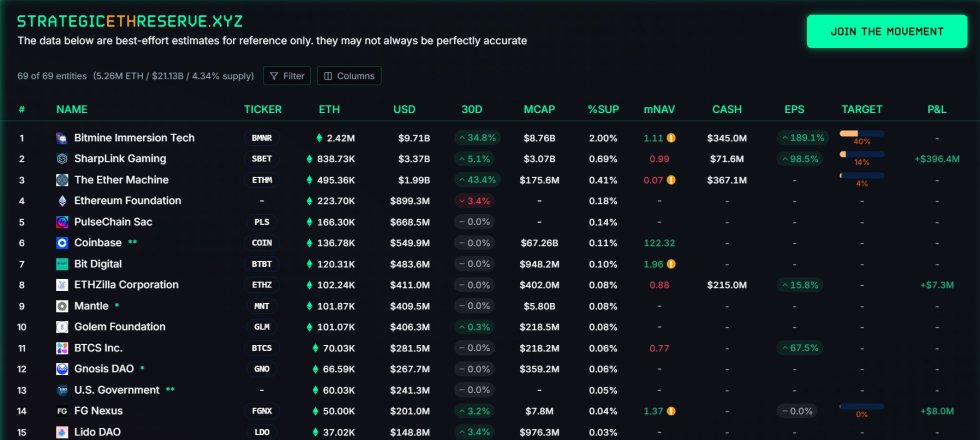
Following months of aggressive ETH allocations, this cooling trend raises the question of whether treasuries are taking a break or waiting for the market to reevaluate. Data shared by Ted shows that companies have acquired over 816,000 ETH in the month alone. While it may seem like a large quantity, this is a 50% decline when compared to August’s accumulation.
Ethereum
ETH holdings held by treasury companies | Source: Chart from Ted Pillows on X

This drop in half marks one of the steepest month-to-month pullbacks of this year. Despite the pullback in institutional accumulation, Ethereum treasury reserves remain elevated, with over 5 million ETH held in total by companies.

According to the expert, there are now 5,255,246 ETH held by treasury reserve corporations, signaling growing confidence in Ethereum’s long-term value and utility. With these enormous holdings, ETH is positioned as a key component of treasury diversification strategies across the globe, highlighting not only its growing reputation as a store of value but also its pivotal role in decentralized finance and staking economies.

ETH Being Hailed As The Asset To Drive The Next Business Strategy

Forbes has proclaimed that the ETH treasuries could be the next big business strategy in the financial sector. What was once seen as a high-risk experiment is now being reconsidered as a forward-looking business strategy, with business and investors exploring ETH holdings as a hedge and a growth engine.

The firm’s bold statement is driven by its belief that ETH treasuries are yield-bearing assets, unlike Bitcoin, which typically sits idle on corporate balance sheets. Furthermore, Forbes stated that the statement is not from a speculative view because ETH is balance sheet engineering. By staking or lending ETH, treasury funds can lower circulating liquidity and generate new revenue streams.

At the time of writing, ETH’s price was trading back above $4,100, demonstrating a nearly 3% increase in the last 24 hours. Bullish sentiment is gradually returning to the market, as evidenced by an increase in its trading volume. Data from CoinMarketCap shows that the trading volume has spiked by more than 50% in the last day.

Ethereum
ETH trading at $4,110 on the 1D chart | Source: ETHUSDT on Tradingview.com
Featured image from iStock, chart from Tradingview.com
Editorial Process for bitcoinist is centered on delivering thoroughly researched, accurate, and unbiased content. We uphold strict sourcing standards, and each page undergoes diligent review by our team of top technology experts and seasoned editors. This process ensures the integrity, relevance, and value of our content for our readers.

Godspower Owie is my name, and I work for the news platforms NewsBTC and Bitcoinist. I sometimes like to think of myself as an explorer since I enjoy exploring new places, learning new things, especially valuable ones, and meeting new people who have an impact on my life, no matter how small. I value my family, friends, career, and time. Really, those are most likely the most significant aspects of every person's existence. Not illusions, but dreams are what I pursue.

Lecturas Relacionadas

Beyond the 'Kimchi Premium': Institutional Transformation in Korea

South Korea's crypto landscape is moving beyond the volatile "Kimchi Premium" era driven by retail speculation, according to Andrew Park, CEO of Factblock. Park, who organizes Korea Blockchain Week, notes a significant shift in the nature of international inquiries. Global institutions are now focusing on market access, asset custody, tokenization, stablecoins, and regulatory compliance, rather than just token listings and prices. This institutionalization is being built through foundational, "unsexy" back-office work: developing corporate crypto accounts, legal finality for settlements, accounting standards, and custody solutions. Key regulatory steps include the Financial Services Commission's framework for corporate virtual asset accounts and National Assembly amendments to laws governing tokenized securities and real-world assets. Park, with a traditional finance background, bridges the perspectives of Wall Street and Web3. He explains that traditional banks prioritize managing edge-case failures and regulatory reporting, which crypto-native firms sometimes misunderstand. Conversely, traditional financiers often overlook blockchain's systemic utility for 24/7 global settlement and programmable money. Looking ahead, Park sees South Korea's next frontier at the intersection of AI and programmable blockchain infrastructure. He is particularly interested in the infrastructure needed for a "machine-to-machine" economy, where AI agents could autonomously conduct micropayments and transactions using on-chain settlement mechanisms—a concept already being explored in pilot projects by the Bank of Korea. With its advanced digital infrastructure and investments in both Web3 and AI, South Korea is uniquely positioned to develop this future.

cryptonews.ruHace 2 min(s)

Beyond the 'Kimchi Premium': Institutional Transformation in Korea

cryptonews.ruHace 2 min(s)

Telegram Introduces WEB-Proxy Technology: Traffic Camouflaged as Regular Website Visits

Telegram has introduced an experimental WEB-proxy technology, unveiled on August 21, 2026, designed to bypass blocking by disguising messenger traffic as regular, encrypted website visits. This new method in Telegram Desktop routes MTProxy data through a WebView transport using HTTPS or WebSocket, making the data stream indistinguishable from legitimate web browsing and offering a new avenue for accessing the service under restrictions. The core innovation is a multiplexed stream sent through the app's built-in browser engine. It maintains MTProxy's encryption but sends all data via a single WebView session. Special frame types (OPEN, DATA, WINDOW, CLOSE) package multiple Telegram connections into one secure channel that appears as a standard webpage load. A server-side relay receives this stream, separates it into individual connections for the MTProxy without decrypting content or knowing final destinations, preserving privacy. The WEB-proxy operates on a regular HTTPS domain that simultaneously hosts a public website. The proxy bridge page activates only with a specific parameter derived from the configuration; all other requests receive the standard homepage, providing reliable cover. Connection links use formats like https://t.me/webproxy?server=... or tg://webproxy, with port 443 and HTTPS being mandatory. Currently a proof-of-concept, the project includes a desktop implementation, an experimental Android client, and plans for iOS support. It represents a shift towards more sophisticated integration with legitimate web infrastructure, leveraging standard browser mechanisms to complicate traffic filtering. The practical value will depend on its resilience to adaptive traffic analysis and scalability. This approach structurally echoes earlier techniques like domain fronting, highlighting the cyclical nature of the struggle between censorship and circumvention technologies.

cryptonews.ruHace 19 min(s)

Telegram Introduces WEB-Proxy Technology: Traffic Camouflaged as Regular Website Visits

cryptonews.ruHace 19 min(s)

Trading

Spot
活动图片