Curve DAO одобрила кредитную линию на $60 млн в crvUSD для нового протокола Yield Basis

cryptonews.ruPublicado a 2025-04-25Actualizado a 2025-09-26

Децентрализованная автономная организация (DAO) Curve одобрила предложение о предоставлении Yield Basis, новому протоколу, разработанному основателем Curve Михаилом Егоровым, кредитной линии на сумму $60 млн в стейблкоине crvUSD перед запуском его основной сети.

Голосование открыло Yield Basis путь к созданию пулов ликвидности, ориентированных на биткоин, предназначенных для предотвращения необратимых потерь, когда активы в пуле ликвидности падают в цене по сравнению с их простым хранением. Протокол также направлен на раскрытие возможностей получения доходности в биткоине в сфере децентрализованных финансов (DeFi).

Согласно плану, три пула, включая WBTC, cbBTC и tBTC, будут запущены на Ethereum с использованием архитектуры автоматизированного маркет-мейкера (AMM) Yield Basis. Curve Finance заявила, что пулы изначально будут ограничены $10 млн.

Инициатива направлена на расширение экосистемы Curve, более глубокое внедрение ее собственного стейблкоина в инфраструктуру DeFi. Она также направлена на увеличение потенциальных комиссионных потоков для держателей токенов veCRV, версии CRV, токена управления Curve Finance, с возможностью депонирования голосов.
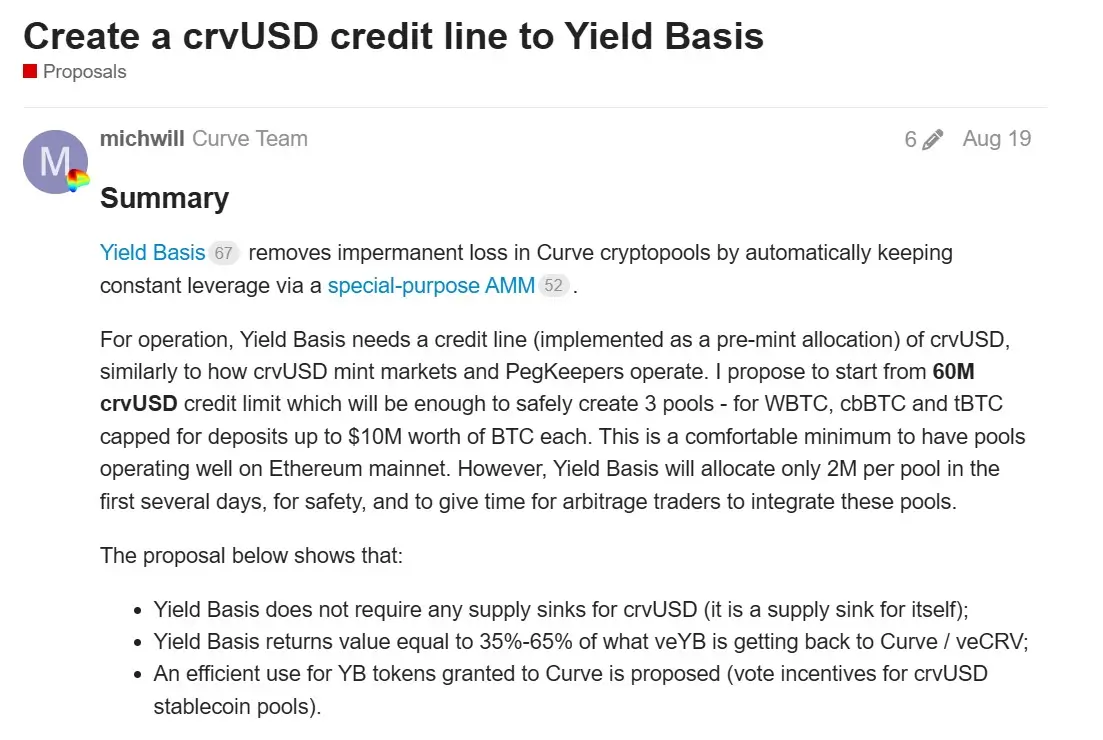

Предложение Curve о создании кредитной линии crvUSD для Yield Basis. Источник: Curve Finance

Опасения по поводу контроля рисков, токеномики и ответственности

Не все участники Curve DAO приветствовали это предложение. 18 сентября анонимный пользователь социальных сетей Small Cap Scientist заявил, что план подвергает Curve значительным рискам.

В публикации на X пользователь написал, что план «чрезвычайно извлекает» средства для DAO. Он предупредил, что ни одна третья сторона не оценивала экономические риски Yield Basis, и что $60 млн не имеют ограничений, привязанных к общей заблокированной стоимости crvUSD (TVL). Он также заявил, что взлом нового протокола может привести к тому, что Curve будет нести ответственность за потерянные средства.

Участник сообщества также выразил обеспокоенность по поводу прозрачности в отношении посевных инвесторов Yield Basis и неполной токеномики, заявив, что протоколу не следует предоставлять контроль над crvUSD без более строгих ограничений.

Основатель Curve защищает предложение

Егоров опроверг эти опасения. Отвечая на сообщение X, Егоров сообщил, что Yield Basis прошла шесть аудитов, седьмой из которых находится в процессе реализации. Он также указал на механизм аварийной остановки, управляемый мультиподписью Emergency DAO Curve, в качестве меры безопасности.

Он заверил сообщество, что Yield Basis будет нести ответственность за любые эксплойты, и сообщил, что распределение инвесторов было добавлено в предложение по управлению.

«Если что-то случится, конечно, Yield Basis приложит все усилия, чтобы справиться с этим максимально эффективно», — написал Егоров.

Егоров добавил, что привлечение известных людей из экосистемы в качестве инвесторов — естественное явление для такого проекта, как Yield Basis. Он отметил, что партнерские проекты — это сильная сторона Curve.


Criptos en tendencia

Lecturas Relacionadas

Trends in US Stocks (June 22): Strait of Hormuz Agreement Changes Course, Thursday's PCE and Micron to Determine Chip Sector Direction

U.S. Stock Market Outlook (June 22): Strait of Hormuz Deal Falters, Thursday's PCE & Micron to Set Chip Sector Direction. Geopolitical tensions resurged over the weekend as Iran's IRGC announced the closure of the Strait of Hormuz, and its negotiation team walked out after threats from Trump, pausing U.S.-Iran talks. This renewed risk premium is weighing on U.S. equity futures ahead of the open. Last week's market was driven by chip stocks, with the Philly Semiconductor Index hitting a record high. While the Fed's hawkish tone was overshadowed by initial deal optimism, the S&P 500 gained 0.9% for the week. SpaceX debuted strongly but ended with two down days. Key events this week: The status of U.S.-Iran negotiations remains the immediate variable for oil and energy stocks. Monday sees Marvell and Flex added to the S&P 500. Tuesday's MSCI reclassification could benefit South Korean semiconductors and memory stocks. **Thursday, June 25th, is the critical day**, featuring the May Core PCE report and Micron's earnings. Hotter PCE data could solidify expectations for two 2024 rate hikes, while softer data would rapidly reprice rate cut bets. Micron's report is a key test for the AI narrative; the market will scrutinize its 2027 HBM supply visibility, HBM4 progress, and its position in Nvidia's Vera Rubin supply chain. Nvidia's AGM and a potential OpenAI GPT-5.6 release will make Thursday a pivotal 24 hours for AI. Friday concludes with the Russell reconstitution, elevating small-cap volatility. In summary, last week's gains face a true test. The path hinges on two concurrent threads: geopolitical developments with Iran and the AI narrative defined by Micron's guidance and Nvidia's updates. The chip sector's record highs are vulnerable if Thursday brings hot PCE data and conservative guidance from Micron. Conversely, positive outcomes could reaffirm the AI bull case, making this week's volatility a potential entry window.

marsbitHace 56 min(s)

Trends in US Stocks (June 22): Strait of Hormuz Agreement Changes Course, Thursday's PCE and Micron to Determine Chip Sector Direction

marsbitHace 56 min(s)

OpenAI's "Most Open" Move: Codex No Longer Exclusively Favors GPT

OpenAI has significantly opened up its Codex programming agent by introducing a "model provider" configuration layer that allows users to connect it with various open-source models, not just its proprietary GPT. Through a configuration file or a simple `--oss` command-line flag, Codex can now route requests to local services like Ollama or LM Studio, or to third-party APIs such as Mistral or DeepSeek. This move is seen as one of OpenAI's most "open" steps, potentially lowering costs and enhancing privacy for developers who can run code generation offline. However, integration isn't seamless for all models. Codex primarily uses OpenAI's newer Responses API, while many open-source models rely on the older Chat Completions interface. This creates compatibility issues, especially for advanced features like function calling. The developer community is already building "routing" or adapter layers (e.g., CC Switch, LiteLLM) to translate between these protocols, enabling hybrid setups where GPT handles planning and open-source models handle execution. Analysts interpret this as a strategic shift for OpenAI: from competing solely on model superiority to controlling the platform and interface standards. By making Codex a flexible, pluggable entry point for AI-assisted programming, OpenAI aims to become the central hub in the developer toolchain ecosystem, even as users gain the freedom to switch underlying models.

marsbitHace 1 hora(s)

OpenAI's "Most Open" Move: Codex No Longer Exclusively Favors GPT

marsbitHace 1 hora(s)

When 500 Million People Abandon ChatGPT

ChatGPT's Global AI Assistant Market Share Drops Below 50% Three and a half years after its groundbreaking launch, ChatGPT faces a pivotal moment. While it remains the largest AI assistant globally, its market share has fallen below 50% for the first time, reaching 46.4% as of May, according to Sensor Tower's 2026 AI landscape report. Google's Gemini (27.7%) and Anthropic's Claude (10.3%) are now its main competitors, with Grok, Perplexity, and others also gaining ground. The market has evolved from awe and initial adoption into a phase of product comparison, ecosystem integration, and commercialization. User behavior has matured significantly. Loyalty is low; users readily switch between assistants for specific tasks. Gemini benefits from deep integration within Google's ecosystem (Search, Gmail, Android), while Claude has carved a niche among productivity-focused users with strong retention, nearly matching ChatGPT's. User choice is now influenced by a complex mix of capability, ecosystem, price, use case, and even brand trust. Commercialization is accelerating. AI app downloads continue but growth is slowing, while user spending is rising. Over $4.2 billion was spent in-app during H1 2026. Claude leads in premium subscription conversion rates (13%). OpenAI is expanding its revenue streams, testing ads shown to 17% of ChatGPT users daily by May. This shift highlights the immense financial pressure of model training and inference costs. Despite revenue growth, OpenAI's cash burn is intense, reaching $3.7 billion in Q1 2026. The company projects this could rise to $25-57 billion in the coming years, underscoring the industry-wide challenge of scaling profitably. The symbolism is clear: ChatGPT no longer defines the AI assistant market alone. The era of a single dominant product is over. Gemini, Claude, and specialized tools are collectively shaping user habits and business models. As AI assistants move from novelty to utility—judged on accuracy, efficiency, and value—they are becoming embedded in everyday digital life. ChatGPT may have lost its majority, but AI as a whole is winning, entering a mature, competitive, and diverse new phase.

marsbitHace 1 hora(s)

When 500 Million People Abandon ChatGPT

marsbitHace 1 hora(s)

Trading

Spot
Futuros

Artículos destacados

Cómo comprar DAO

¡Bienvenido a HTX.com! Hemos hecho que comprar DAO Maker (DAO) sea simple y conveniente. Sigue nuestra guía paso a paso para iniciar tu viaje de criptos.Paso 1: crea tu cuenta HTXUtiliza tu correo electrónico o número de teléfono para registrarte y obtener una cuenta gratuita en HTX. Experimenta un proceso de registro sin complicaciones y desbloquea todas las funciones.Obtener mi cuentaPaso 2: ve a Comprar cripto y elige tu método de pagoTarjeta de crédito/débito: usa tu Visa o Mastercard para comprar DAO Maker (DAO) al instante.Saldo: utiliza fondos del saldo de tu cuenta HTX para tradear sin problemas.Terceros: hemos agregado métodos de pago populares como Google Pay y Apple Pay para mejorar la comodidad.P2P: tradear directamente con otros usuarios en HTX.Over-the-Counter (OTC): ofrecemos servicios personalizados y tipos de cambio competitivos para los traders.Paso 3: guarda tu DAO Maker (DAO)Después de comprar tu DAO Maker (DAO), guárdalo en tu cuenta HTX. Alternativamente, puedes enviarlo a otro lugar mediante transferencia blockchain o utilizarlo para tradear otras criptomonedas.Paso 4: tradear DAO Maker (DAO)Tradear fácilmente con DAO Maker (DAO) en HTX's mercado spot. Simplemente accede a tu cuenta, selecciona tu par de trading, ejecuta tus trades y monitorea en tiempo real. Ofrecemos una experiencia fácil de usar tanto para principiantes como para traders experimentados.

185 Vistas totalesPublicado en 2024.12.11Actualizado en 2026.06.02

Cómo comprar DAO

Discusiones

Bienvenido a la comunidad de HTX. Aquí puedes mantenerte informado sobre los últimos desarrollos de la plataforma y acceder a análisis profesionales del mercado. A continuación se presentan las opiniones de los usuarios sobre el precio de DAO (DAO).

活动图片