Пауэлл из ФРС подчеркивает хрупкость рынка труда в преддверии новых снижений ставок

cryptonews.ruPublicado a 2025-11-23Actualizado a 2025-11-23

Председатель Федеральной резервной системы Джером Пауэлл во вторник вновь заявил о необходимости центральному банку соблюдать деликатный баланс, подчеркнув, что политики пытаются лавировать между ценовой стабильностью и требованиями по занятости после снижения процентной ставки на прошлой неделе.

«Последние данные показывают, что темпы экономического роста замедлились, — сказал Пауэлл в подготовленном им выступлении на завтраке, посвященном экономическим перспективам, организованном Торговой палатой Большого Провиденса в Род-Айленде. — Уровень безработицы низкий, но несколько вырос. Рост занятости замедлился, а риски снижения занятости возросли. В то же время инфляция в последнее время выросла и остается несколько повышенной.

Он добавил, что более четкая торговая политика означает, что тарифы, вероятно, окажут лишь «разовое» влияние на инфляцию. Это можно интерпретировать как небольшое отступление от предыдущих предупреждений о том, что тарифы могут спровоцировать более устойчивое давление на издержки во второй половине года.

Его комментарии перекликаются с комментариями вице-председателя Мишель Боуман, которая заявила на ежегодном съезде Ассоциации банкиров Кентукки во вторник:

«Экономика США устойчива, но меня беспокоит ухудшение условий на рынке труда и более слабый экономический рост».

Пауэлл предупредил, что не существует безрискового пути для процентных ставок, учитывая рост инфляции с одной стороны и рост безработицы с другой. Однако он предположил, что ФРС все больше склоняется к тому, чтобы отдавать приоритет своему мандату по обеспечению занятости.

На прошлой неделе Федеральный комитет по операциям на открытом рынке (FOMC) проголосовал за снижение процентных ставок на 25 базисных пунктов — первое снижение за девять месяцев, и этот шаг был широко ожидаем рынками. Хотя Пауэлл отказался комментировать вероятность дальнейшего снижения в октябре, высоки ожидания, что ФРС еще снизит ставку на своих последних двух заседаниях в 2025 году.
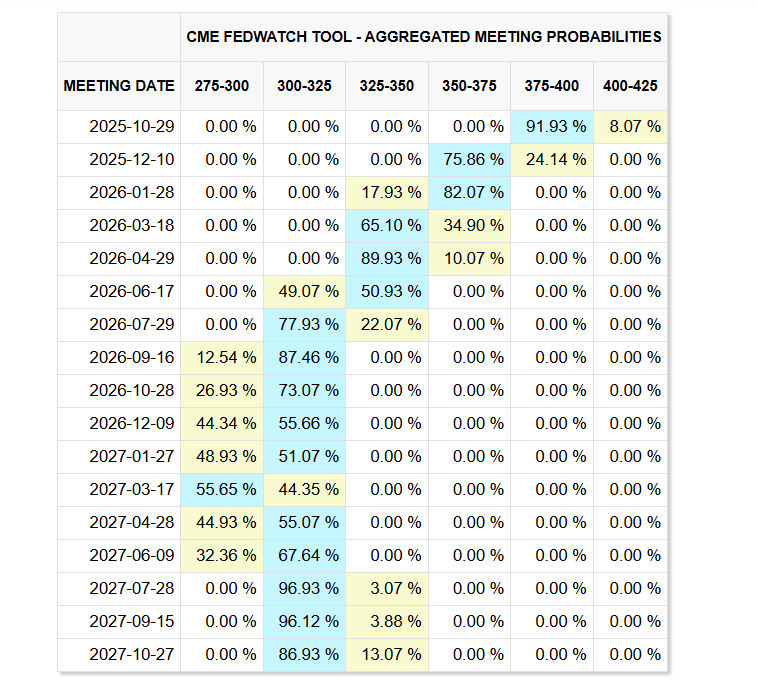
Фьючерсы на федеральные фонды учитывают высокую вероятность дальнейшего снижения ставок в октябре и декабре. Источник: CME Group.

Банк DBS в Сингапуре охарактеризовал последнее заседание ФРС как наполненное «диссонансом и противоречиями», указав на несоответствия между экономическими прогнозами политиков и заявлениями Пауэлла.

В банке отметили, что чиновники прогнозируют более быстрый рост ВВП и снижение безработицы, хотя и признали «риски снижения занятости».
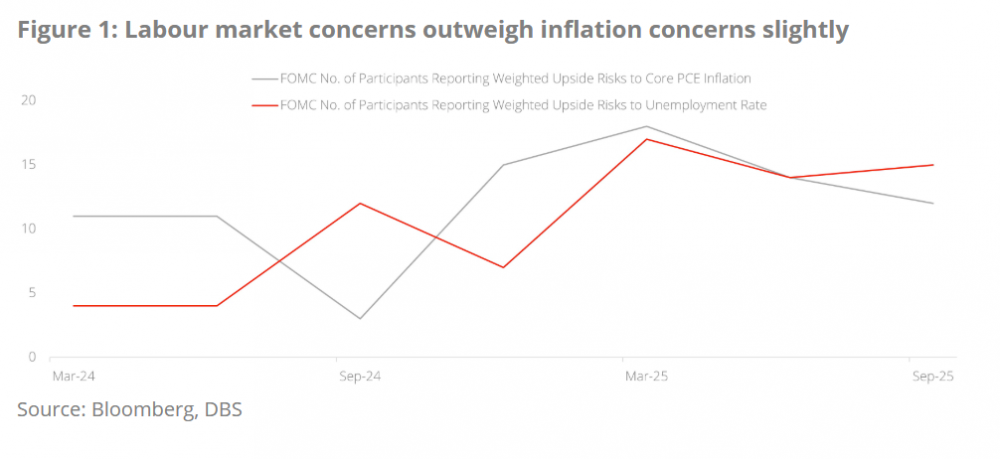
Опасения ФРС по поводу инфляции отошли на второй план по сравнению с растущими рисками на рынке труда. Источник: DBS.

Рынки биткоинов и криптовалют под давлением

Ожидания дальнейшего смягчения денежно-кредитной политики в целом привели к росту рискованных активов, однако в начале недели криптовалютные рынки столкнулись с новым давлением продаж.

Расхождение между биткоином и акциями были отмечены рыночным комментатором The Kobeissi Letter, который указал на увеличивающиеся разрывы между несколькими классами активов.
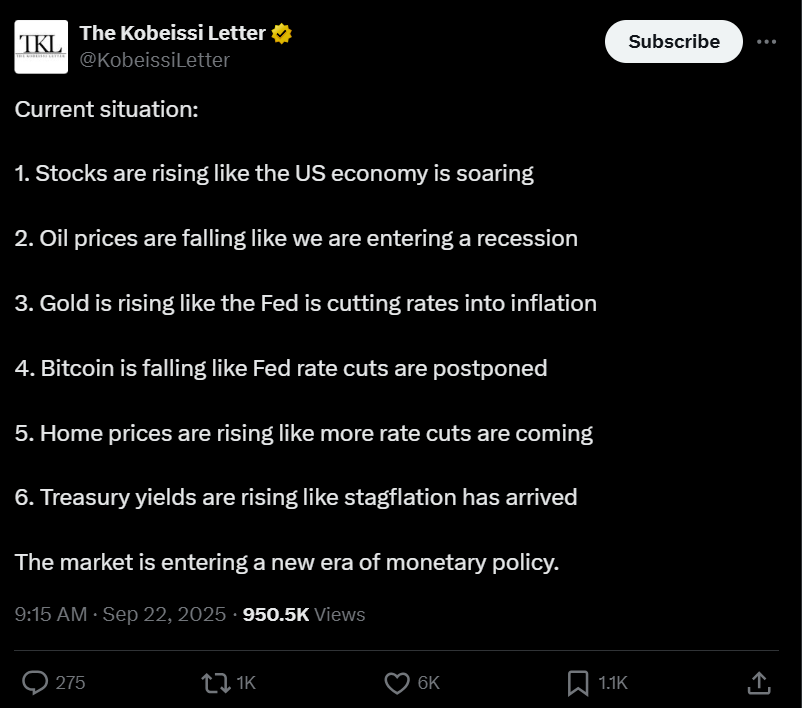
Источник: Письмо Кобейси.

Аналитик Гейзенберг добавил, что значительное расхождение биткоина и Nasdaq, вероятно, снова сойдется, ссылаясь на исторические тенденции — сигнал о том, что BTC может быстро восстановиться в соответствии с недавним историческим максимумом Nasdaq.
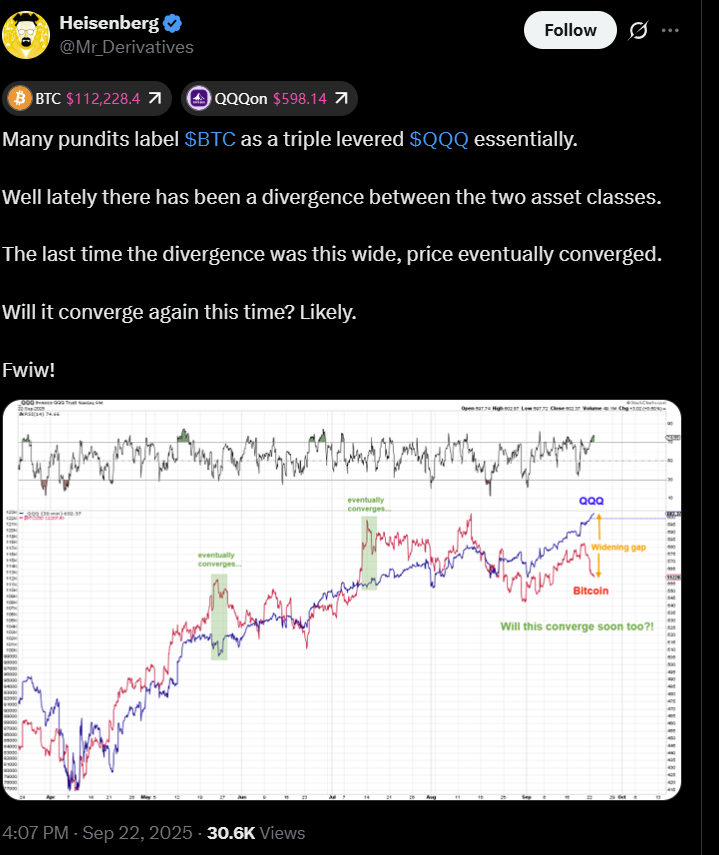
Источник: Гейзенберг.

Другие индикаторы указывают на то, что коррекция биткоина может оказаться кратковременной. CoinShares сообщила в понедельник, что биржевые фонды биткоина привлекли $977 млн ​​на прошлой неделе, увеличив общий приток криптовалют до $1,9 млрд — признак устойчивого институционального спроса.

Экономист Тимоти Петерсон заявил, что траектория криптовалют может пойти гораздо быстрее, как только инвесторы осознают масштаб текущих изменений в политике ФРС.

«Никогда не было такого постепенного снижения ставок, какое предполагается в настоящее время, — сказал он. — Любой признак более агрессивного смягчения может существенно подтолкнуть биткоин и альткоины вверх».


Lecturas Relacionadas

Interview with Strategy CEO: Can STRC Recover After Selling Bitcoin?

Interview with Strategy CEO Phong Le on the recent sale of 32 Bitcoin and its impact. He clarifies the move was a small, strategic action to demonstrate liquidity to debt holders, test internal processes, and prove operational discipline—not a response to fears of a "death spiral" from DeFi protocols leveraging STRC (Strategy's preferred stock product), which he notes holds less than 10% of STRC. Le emphasizes Strategy’s long-term focus as the largest corporate Bitcoin holder, using the adage that markets are a "voting machine" short-term but a "weighing machine" long-term. Decision-making is data-driven, involving the board, complex modeling, and multiple stakeholder considerations, moving beyond a founder-centric model. He outlines various capital options but stresses the strategic importance of "doing nothing" as a valid choice, citing resilience built during the 2022 bear market. Le expresses unwavering belief in Bitcoin's foundational value for global sovereignty and its future role in an AI-driven economy with trillions of autonomous agents. Addressing STRC's current price below its $100 face value, Le explains recent pressure was due to using dollar reserves for bond buybacks. He expects STRC to return to par as reserves are replenished and its semi-monthly dividend payments begin, noting the product is heavily over-collateralized. Finally, Le confirms the company sold Bitcoin the week prior to May 31st, as disclosed in an 8-K filing, leaving prediction market interpretations to others. The overarching philosophy remains "Spread Bitcoin with love," embracing all methods of gaining Bitcoin exposure.

marsbitHace 6 min(s)

Interview with Strategy CEO: Can STRC Recover After Selling Bitcoin?

marsbitHace 6 min(s)

IOSG Founder: Ethereum Doesn't Need Another Leap of Technical Faith, It Needs a Musk-style Compromise

Jocy, founder of IOSG Ventures, argues that Ethereum does not need renewed technological faith but a "Musk-like compromise." The recent formation of ETHLabs—funded by major ETH holders like BitMine and Lubin—highlights a market-driven move to fill a gap left by the Ethereum Foundation (EF), signaling a loss of confidence in its decentralized, hands-off approach. The core critique contrasts Vitalik Buterin's (V) idealistic, technology-first vision with Elon Musk's pragmatic, business-driven execution. The author asserts Ethereum's current shortage is not another technical roadmap but a clear, real-world application narrative and a leader willing to engage directly with commercial realities—like Musk. Internal issues are emphasized, citing EF's management problems and talent drain. While the new decentralized model with independent nodes like ETHLabs addresses the single foundation's limitations, it risks fragmentation without cohesive direction. True cohesion, the author suggests, must come from a shared, compelling narrative around ETH's value, not just from aligned financial interests. Independence claims for new entities are seen as aspirational, needing years of transparency to build trust. The ultimate threat is not competitors like Solana, but the broader shift of attention and talent toward AI. Ethereum has a limited window—12 to 18 months—to recapture focus by delivering tangible, real-world applications. The conclusion urges V to shift from abstract ideals to grounded, pragmatic leadership. The time for this crucial pivot is running out.

marsbitHace 1 hora(s)

IOSG Founder: Ethereum Doesn't Need Another Leap of Technical Faith, It Needs a Musk-style Compromise

marsbitHace 1 hora(s)

Google Starts Selling TPUs, Big Tech Aims to Produce "Low-Cost Tokens" with AI Chips

Google has begun selling its proprietary TPU chips and AI computing hardware directly to third-party data centers and clients, marking a strategic shift. Previously only accessible via cloud rentals, TPUs are specialized processors designed for the matrix and tensor operations central to AI models. By combining thousands into supercomputing clusters managed by CPUs, Google achieves high-efficiency AI processing. This move enables Google’s Gemini AI to offer competitive token pricing, challenging rivals like OpenAI. It also signals a broader industry trend where AI compute is becoming a commoditized resource like electricity. While NVIDIA remains dominant with its CUDA ecosystem and high-performance GPUs, the focus is shifting from raw power to cost efficiency and system integration. Google’s approach mirrors NVIDIA’s by selling an entire ecosystem—hardware, software, and data center expertise—rather than just chips. This threatens NVIDIA’s grip on the mid-range inference market, where lower-cost, efficient solutions are increasingly demanded. Similarly, cloud providers like Huawei Cloud and Alibaba Cloud in China are developing their own AI chip ecosystems (e.g., Ascend, Zhenwu), packaging chips, clusters, and tools into full-stack solutions. They aim to reduce token costs and capture market share through integrated systems. In summary, the AI infrastructure race is evolving from a competition for the strongest chips to a contest for the most efficient and cost-effective systems. Google’s TPU sales highlight this transition, emphasizing that future success lies in delivering affordable, scalable AI compute as a foundational service.

marsbitHace 1 hora(s)

Google Starts Selling TPUs, Big Tech Aims to Produce "Low-Cost Tokens" with AI Chips

marsbitHace 1 hora(s)

Trading

Spot
Futuros
活动图片