Топ-5 DAO по социальному взаимодействию в сентябре 2025 года

cryptonews.ruPublicado a 2025-04-18Actualizado a 2025-09-19

Decentralized Autonomous Organization (DAO) — это форма сообщества в сфере блокчейн. В отличие от традиционных организаций, у DAO нет централизованного органа управления, совета директоров, управляющих и прочего, поскольку все участники принимают решения в контексте долгосрочного развития платформы через систему голосования. Регламент работы подобных сообществ защищен смарт-контрактами, что исключает вмешательство третьих сторон.

Члены DAO получают голоса пропорционально количеству служебных токенов, которые они удерживают в портфеле. Чем больше активов, тем выше и влияние инвестора на экосистему. По своей специфике децентрализованные организации отличаются друг от друга. Одни нацелены на управление DEX, другие продвигают социальные инициативы, а третьи и вовсе ориентируются на узконаправленные разработки в сфере блокчейн. Редакция Crypto.ru оценила различные DAO и выделила топ-5 лидеров с точки зрения социальной активности в сентябре 2025 года.

Безоговорочным лидером по числу взаимодействий аудитории стала Hyperliquid DAO c показателем примерно 1,5 млн постов. Аудитория данной организации более «вирусно» реагирует на любой контент, связанный с площадкой.

Во многом это связано с грядущим запуском стейблкоина USDH на бирже Hyperliquid. Ряд крупных криптоорганизаций конкурируют за то, кто станет эмитентом актива. И сообщество внимательно следит за этим событием.

Вторую строчку занимает Bittensor DAO с 1,3 млн вовлеченных постов. Длительное время данная организация остается одним из наиболее активных сообществ с точки зрения социальной активности. Представленное DAO ориентировано на долгосрочное объединение сфер AI и блокчейн.

Далее расположилась Ethena DAO более чем с 756 тыс. постов с социальным взаимодействием. Сообщество откликается на все материалы, которые публикуются в данной децентрализованной организации. Представленное DAO ориентируется на создание синтетических активов. Флагманским продуктом площадки стал стейблкоин USDe.

Четвертую строчку заняла ApeCoin DAO более чем с 687 тыс. вовлеченных постов. Данная платформа нацелена на долгосрочное продвижение и популяризацию сегментов NFT и блокчейн-игр. Она тесно связана с одной из наиболее популярных коллекций невзаимозаменяемых токенов Bored Ape Yacht Club.

Замыкает пятерку лидеров сообщество Internet Computer DAO с почти 429 тыс. вовлеченных постов. Площадка продолжает долгое время демонстрировать высокую социальную активность, стабильно удерживаясь на высоких позициях по данному показателю.

Есть еще несколько DAO, которые не вошли в число лидеров по социальной вовлеченности. Однако они оказывают значительное влияние на развитие данной индустрии:

  • Mantle DAO
  • Uniswap DAO
  • Arbitrum DAO

Ранее на Crypto.ru публиковалась инфографика о самых крупных штрафах в криптоиндустрии в 2025 году.

Инфографика

Criptos en tendencia

Lecturas Relacionadas

Goldman Sachs' Summary After Silicon Valley Investigation: Agents Enter the Execution Era, AI Competition Shifts to Workflows, World Models Rise

Based on a recent field research in Silicon Valley, Goldman Sachs highlights a key shift in the AI industry: moving from systems that "answer questions" to autonomous AI agents that "execute tasks." Commercial models are transitioning from per-seat subscriptions to usage- and outcome-based pricing. The competition is shifting from raw model capability to mastery over specific business workflows, with value accruing to proprietary data, domain context, and operational expertise. A major hurdle for enterprise Agent deployment is not technical ability but "controllability"—issues of accountability, auditability, and error correction, especially in regulated fields. Workflows with clear rules, verifiable outcomes, and reversible actions (e.g., invoice processing) are being automated first. The model landscape is evolving toward a division of labor. Frontier models (like GPT-4) are expected to handle high-value, high-reliability core tasks, while improving open-source models will likely capture the majority (~90%) of inference tokens for standardized, high-volume tasks due to cost advantages. Finally, attention is moving from Large Language Models (LLMs) to "World Models," which understand physical environments, causality, and dynamic interactions. This shift elevates the importance of proprietary, real-world data (from industrial, scientific, and robotic systems) and could drive a second wave of compute demand. Goldman Sachs projects compute needs could grow ~24x over five years, benefiting cloud and infrastructure providers.

marsbitHace 40 min(s)

Goldman Sachs' Summary After Silicon Valley Investigation: Agents Enter the Execution Era, AI Competition Shifts to Workflows, World Models Rise

marsbitHace 40 min(s)

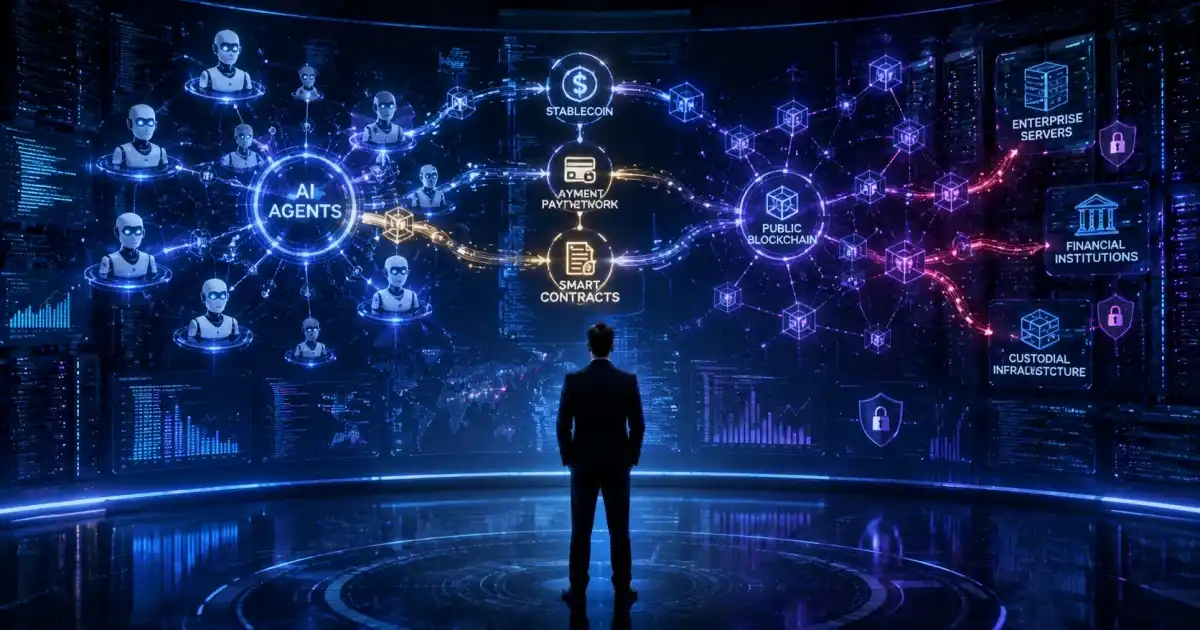
Fidelity Warns: The Boom in AI Agents May Not Be a Feast for Public Blockchains

Fidelity Digital Assets cautions that the anticipated boom in AI agents does not automatically guarantee a corresponding surge in public blockchain adoption or token value. While AI agents that can autonomously perform tasks like payments and data calls could theoretically utilize blockchain for settlement, a significant gap exists between "can use" and "must use." The analysis highlights six key risks. First, many AI agents, especially in corporate settings, may prefer closed, permissioned systems over public blockchains due to needs for speed, cost, compliance, and control. Second, increased on-chain transactions from AI-driven micropayments may not benefit native tokens if fees remain low or if value is captured by stablecoins and payment service providers instead. Third, while AI lowers development costs and increases the number of projects, more code does not equal more economic value and can lead to market oversaturation. Fourth, AI commoditizes coding, making pure technological advantage less of a sustainable moat; competition may shift to brand, liquidity, and user networks. Fifth, AI can also lower the cost of attacks by making vulnerability discovery easier, potentially outpacing security auditing and increasing ecosystem risk. Sixth, institutions may require "controlled blockchain" systems with robust identity, permissioning, and audit trails, conflicting with the permissionless nature of public chains. Ultimately, Fidelity argues against simply equating AI growth with blockchain prosperity. The narrative requires moving from speculation to a concrete analysis of which infrastructures can convert real AI agent needs into sustainable economic value, critically examining each step of the assumed value chain.

marsbitHace 41 min(s)

Fidelity Warns: The Boom in AI Agents May Not Be a Feast for Public Blockchains

marsbitHace 41 min(s)

Telegram Introduces WEB-Proxy Technology: Masks Traffic as Regular Website Visits

Telegram has introduced a new experimental WEB-Proxy technology designed to circumvent blocking by disguising messenger traffic as regular, secure website visits. Announced on August 21, 2026, the technology routes MTProxy data through an in-app WebView using HTTPS or WebSocket transport, making the data stream indistinguishable from legitimate web surfing. The core innovation is a multiplexed stream sent through a single WebView session. It uses special frame formats to pack multiple logical Telegram connections into one encrypted channel that externally resembles loading a web page. A server-side relay receives this stream, separates it into individual connections for the standard MTProxy, without decrypting content or knowing final destinations, thus preserving privacy. The WEB-Proxy operates on a standard HTTPS domain that also hosts a public website. The proxy bridge page is only activated by a specific URL parameter derived via HMAC-SHA256 from the proxy configuration; all other requests receive the normal site homepage. This provides reliable cover against automated detection systems. Currently a proof-of-concept, the system includes a desktop implementation, an experimental Android client, and plans for iOS support. The technology represents a shift towards more sophisticated integration with legitimate web infrastructure, complicating filtering systems that must choose between blocking HTTPS traffic entirely or allowing service access. Its long-term value will depend on resilience to adaptive traffic analysis and scalability without performance loss.

cryptonews.ruHace 56 min(s)

Telegram Introduces WEB-Proxy Technology: Masks Traffic as Regular Website Visits

cryptonews.ruHace 56 min(s)

MiCA is coming for DeFi vaults, but regulation will be difficult

The European Commission is exploring whether to extend the Markets in Crypto-Assets (MiCA) regulation to cover decentralized finance (DeFi) lending and borrowing, including lending vaults. These vaults, which channel billions into on-chain credit markets, present significant regulatory challenges because their decentralized structure doesn't map neatly onto existing financial frameworks. Their legal status is currently based on non-binding interpretations that they fall outside MiCA and EU fund rules. The article uses Morpho's decentralized lending protocol as an example, illustrating how responsibilities are divided among various participants (owner, curator, allocator, sentinel), making it difficult to identify a single "provider" to regulate. Experts warn that broadly categorizing "DeFi lending" could inadvertently capture vastly different structures. They argue that any regulatory approach should focus on the specific structure and control mechanisms of a vault, rather than using decentralization as a simple dividing line, and that DeFi lending may require a dedicated, carefully crafted framework distinct from traditional finance. The Commission's consultation closes on September 30, 2026. The core challenge for regulators is not just whether to regulate DeFi lending, but how to design rules that distinguish between different forms of on-chain lending and the entities that control them.

cointelegraphHace 2 hora(s)

MiCA is coming for DeFi vaults, but regulation will be difficult

cointelegraphHace 2 hora(s)

Trading

Spot

Artículos destacados

Cómo comprar DAO

¡Bienvenido a HTX.com! Hemos hecho que comprar DAO Maker (DAO) sea simple y conveniente. Sigue nuestra guía paso a paso para iniciar tu viaje de criptos.Paso 1: crea tu cuenta HTXUtiliza tu correo electrónico o número de teléfono para registrarte y obtener una cuenta gratuita en HTX. Experimenta un proceso de registro sin complicaciones y desbloquea todas las funciones.Obtener mi cuentaPaso 2: ve a Comprar cripto y elige tu método de pagoTarjeta de crédito/débito: usa tu Visa o Mastercard para comprar DAO Maker (DAO) al instante.Saldo: utiliza fondos del saldo de tu cuenta HTX para tradear sin problemas.Terceros: hemos agregado métodos de pago populares como Google Pay y Apple Pay para mejorar la comodidad.P2P: tradear directamente con otros usuarios en HTX.Over-the-Counter (OTC): ofrecemos servicios personalizados y tipos de cambio competitivos para los traders.Paso 3: guarda tu DAO Maker (DAO)Después de comprar tu DAO Maker (DAO), guárdalo en tu cuenta HTX. Alternativamente, puedes enviarlo a otro lugar mediante transferencia blockchain o utilizarlo para tradear otras criptomonedas.Paso 4: tradear DAO Maker (DAO)Tradear fácilmente con DAO Maker (DAO) en HTX's mercado spot. Simplemente accede a tu cuenta, selecciona tu par de trading, ejecuta tus trades y monitorea en tiempo real. Ofrecemos una experiencia fácil de usar tanto para principiantes como para traders experimentados.

372 Vistas totalesPublicado en 2024.12.11Actualizado en 2026.06.02

Cómo comprar DAO

Discusiones

Bienvenido a la comunidad de HTX. Aquí puedes mantenerte informado sobre los últimos desarrollos de la plataforma y acceder a análisis profesionales del mercado. A continuación se presentan las opiniones de los usuarios sobre el precio de DAO (DAO).

活动图片