Сообщество призвало dYdX Foundation восстановить миграционный мост из-за заблокированных токенов на $25 млн

cryptonews.ruPublicado a 2025-06-17Actualizado a 2025-09-18

  • После закрытия кросчейн-моста dYdX более 41,6 млн ethDYDX ($27 млн) остались заблокированными в смарт-контракте, что затронуло около 45 000 инвесторов.
  • Участники сообщества призвали dYdX Foundation к инициативе по восстановлению миграции токенов.

На днях децентрализованная биржа dYdX оказалась в центре обсуждений после окончательного закрытия миграционного моста для токенов ethDYDX. Это решение привело к тому, что более 45 000 инвесторов остались заблокированными с активами на сумму более $25 млн. Об этом рассказал инфлюенсер Андрей Соболев. Редакция Incrypted пообщалась с ним и узнала детали ситуации.

Мост, который позволял конвертировать ethDYDX с Ethereum в нативный DYDX на dYdX Chain, выключили 13 июня 2025 года.

Отметим, решение о закрытии кросчейн-моста приняли еще в декабре 2024 года в результате DAO-голосования сообщества, когда поддержку смарт-контракта wethDYDX решили остановить. Тогда владельцам токенов предоставили переходный период в шесть месяцев.

В июне 2025 года прошло еще одно голосование, после чего протокол прекратил работу. При этом токены фактически остались «замороженными» в контракте.

«Примерно $25 млн является официальной цифрой, задекларированной блокчейном Ethereum. […] В мостах заблокировано 41,6 млн ethDYDX токенов, что составляет 4,165% всего предложения. Это около $27 млн в текущем эквиваленте», — отметил в разговоре с Incrypted Андрей Соболев.

По его словам, сообщество ожидает, что команда dYdX Foundation самостоятельно инициирует предложение по восстановлению моста и договорится с делегаторами о его постоянном открытии до полной миграции токенов.

Он отметил, что существуют и другие решения для этого, а у команды есть все ресурсы для их реализации, однако пока она выбирает путь размывания ответственности и избежания признания ошибки, ссылаясь на то, что решение принято путем голосования DAO:

«В то же время мы понимаем, что за любыми принятым решением стоят реальные люди, а в случае с закрытием моста — 30 валидаторов, которые единогласно проголосовали за такое решение, полностью понимая, что все 41,6 млн токенов будут навсегда заблокированы в контракте моста и 45 000 человек останутся без средств».

Пострадавшие от закрытия моста владельцы «старого» токена понимают, что их самостоятельную инициативу по восстановлению миграции отклонят валидаторы, отметил Соболев. По его словам, крупные держатели токенов DYDX заинтересованы «в выводе токенов ритейл-пользователей из обращения и таким образом избавиться от лишнего предложения на рынке — об этом они открыто заявляли на форуме».

Криптоинфлюенсер подчеркнул, что комьюнити рассчитывает, что команда dYdX Foundation инициирует предложение по восстановлению моста и договорится с делегаторами о его поддержке.

Он отметил, что некоторые члены сообщества даже готовят обращение к регуляторам:

«Ни один проект или DAO не имеет права блокировать средства пользователей, если они не были получены преступным путем. […] Некоторые участники уже подают коллективные заявления в SEC [Комиссию по ценным бумагам и биржам США] и ESMA [Европейское управление по ценным бумагам и рынкам]».

Редакция Incrypted отправила запрос на комментарий от dYdX Foundation. На момент публикации материала официального ответа наша команда не получила.

Напомним, что в марте этого года основатель и CEO dYdX Антонио Джулиано сообщил об обновлении дорожной карты проекта.


Criptos en tendencia

Lecturas Relacionadas

Jameson Lopp's BIP-110 Postmortem: Bitcoin Is Driven by Game Theory, Not Morality

Jameson Lopp's analysis concludes that BIP-110, a proposal to restrict arbitrary data (like inscriptions) on Bitcoin, failed due to economic and technical realities, not moral arguments. The proposal, championed by Luke Dashjr and others, aimed to "cleanse" the chain but never reached its 55% miner activation threshold. Upon its forced signaling deadline in August, only the OCEAN pool (with ~1% hash rate) supported it, creating a short-lived fork that quickly died as miners faced unredeemable block rewards. Lopp's earlier predictions about its economic infeasibility were proven correct. Technically, BIP-110 was flawed; workarounds to embed data compliant with its rules were demonstrated almost immediately, proving it couldn't achieve its stated goal. The debate often devolved into moralistic rhetoric, with supporters accusing opponents of supporting child exploitation material—a tactic Lopp criticizes as ineffective for building consensus. Lopp argues Bitcoin is driven by incentives and game theory, not morality. Past forks like Bitcoin Cash promised economic benefits, while BIP-110 offered only restrictions and reduced miner fees, gaining no substantial support from major economic players. He predicts the "puritans" behind the failed fork will continue complaining but their new chain will remain insignificant. The episode reaffirms that attempting to censor data on a permissionless, anti-censorship network like Bitcoin is a futile battle.

marsbitHace 6 min(s)

Jameson Lopp's BIP-110 Postmortem: Bitcoin Is Driven by Game Theory, Not Morality

marsbitHace 6 min(s)

Tokenization Scale Soars to $4.3 Billion, But Why Did Securitize Incur a $5.5 Million Loss?

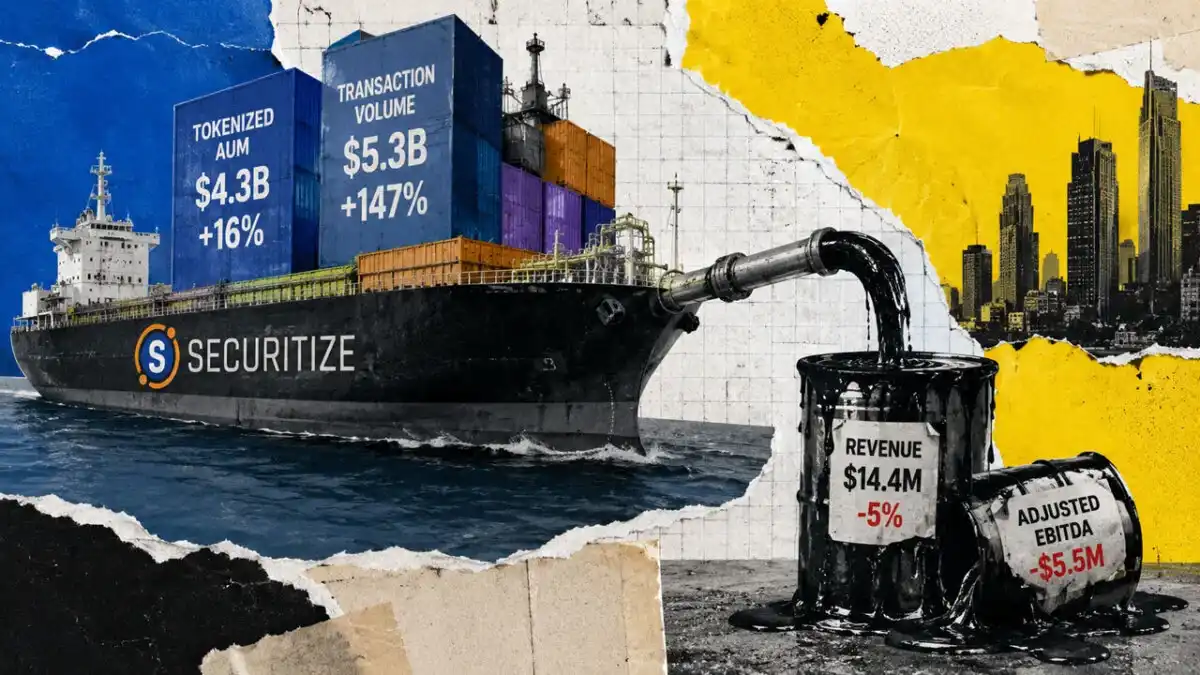
Securitize's first quarterly report post-IPO reveals a paradox: while its tokenized assets under management hit a record $4.3 billion (up 16% YoY) and platform trading volume surged 147% to $5.3 billion, total revenue fell 5% to $14.4 million. Tokenization revenue specifically dropped ~12% to $7.8 million, leading to an adjusted EBITDA loss of $5.5 million. CFO Francisco Flores explained that most trading volume is not yet monetized, with the majority of tokenization revenue still coming from one-time projects like new protocol integrations. In contrast, asset servicing revenue, a more recurring stream, grew slightly to $6.6 million. The company has lowered its full-year revenue guidance to $70-$80 million from an initial projection of $110 million. Industry experts note this highlights a structural challenge for the tokenization sector. Scaling assets on-chain doesn't automatically scale a profitable business model. Current implementations often rely on costly, customized projects for each new asset or jurisdiction. The future, they argue, lies in building standardized infrastructure that generates recurring "infrastructure revenue" from post-issuance activities like compliance, distributions, and secondary trading—similar to enterprise software. Analysts caution against misinterpreting high trading volumes as indicative of a mature fee-based model, as Securitize's broad volume metric includes many non-monetized actions. The key test for the industry is whether adding billions in new assets can generate sustainable revenue without constant new custom projects.

marsbitHace 8 min(s)

Tokenization Scale Soars to $4.3 Billion, But Why Did Securitize Incur a $5.5 Million Loss?

marsbitHace 8 min(s)

The Five Paradoxes of Artificial Intelligence

**Five Paradoxes of Artificial Intelligence** Artificial intelligence (AI) is an era filled with paradoxes, which we navigate as we advance. **1. The Prediction Paradox** AI experts, from pioneers like Marvin Minsky to contemporary figures like Geoffrey Hinton and Demis Hassabis, have a history of inaccurate forecasts regarding AI's capabilities and timelines, such as achieving human-level machine intelligence or surpassing radiologists. Predictions about Artificial General Intelligence (AGI) vary wildly between optimistic entrepreneurs and skeptical academics, highlighting the inherent unpredictability of technological futures. **2. The Employment Quantification Paradox** Despite numerous studies from institutions like the OECD, IMF, and McKinsey attempting to quantify AI's impact on jobs, estimates of affected employment range from 0.4% to 67%, revealing vast inconsistencies. This paradox arises because isolating AI's effect from other economic, social, and technological factors is virtually impossible, and forecasts depend on static assumptions about a dynamically evolving technology. **3. The Productivity Paradox** While AI is a transformative General Purpose Technology, significant productivity growth has not yet materialized in major economies like the EU and has only matched historical averages in the US. This disconnect between rapid innovation and slow productivity gains, reminiscent of the "Solow Paradox" from the computer age, is often explained by time lags. History shows it takes decades for such technologies to diffuse and trigger complementary innovations that boost productivity. **4. The Data Value Paradox** Data is hailed as the "new oil" and critical for AI, yet its economic value is paradoxical. Its worth is realized only in use, not in straightforward trade. Despite policy emphasis and initiatives for data asset recognition on corporate balance sheets in China, the monetized value remains negligible—accounting for only about 0.06% of major telecom operators' total assets—highlighting the gap between perceived utility and financial valuation. **5. The Industrial Revolution Paradox** For decades, nearly every major new technology, from the internet and nanotechnology to blockchain and now AI, has been proclaimed as the driver of a "Fourth Industrial Revolution." This constant reassignment suggests prior labels were premature. True industrial revolutions are typically identified in hindsight, not in real-time. Furthermore, the coexistence of such a proclaimed transformative revolution with ongoing economic crises would be historically anomalous. Whether AI truly defines a new industrial revolution remains a narrative for the future to decide.

marsbitHace 11 min(s)

The Five Paradoxes of Artificial Intelligence

marsbitHace 11 min(s)

Experts Warn of Mass Crypto Hacks Using AI Agents

Experts warn that AI agents could dramatically lower the cost and scale of attacks against cryptocurrency holders. Speaking at the Wyoming Blockchain Symposium, industry figures noted that automation allows malicious actors to simultaneously search for vulnerabilities in wallets, passwords, and networks across a vast number of potential victims. Ryan Kirkly, co-founder and CEO of Global Settlement Network, criticized the industry for often viewing autonomous agents only as beneficial tools while underestimating their offensive potential. Data from TRM Labs shows the crypto industry experienced a record 207 hacks in the first half of 2026, causing $972 million in losses, with the number doubling from the same period in 2025. Vice President of Technical Operations at Web3 Foundation, Bill Labun, agreed that the efficiency of autonomous systems also benefits attackers. While defenders like the Ethereum Foundation are using AI agents for security audits, the need for human verification remains high due to false positives. A major concern is granting AI agents direct access to financial tools and personal data. New services like MetaMask's Agent Wallet, which allows AI to manage assets within set limits, introduce risks such as prompt injection attacks. Panelists also highlighted risks from metadata leakage, which can compromise privacy even on private networks, and the unresolved issue of legal liability for an AI agent's autonomous and potentially irreversible actions. Lack of user trust, due to AI's tendency to "hallucinate" or generate incorrect information, was cited as a key barrier to widespread adoption.

cryptonews.ruHace 12 min(s)

Experts Warn of Mass Crypto Hacks Using AI Agents

cryptonews.ruHace 12 min(s)

Trading

Spot

Artículos destacados

Cómo comprar DYDX

¡Bienvenido a HTX.com! Hemos hecho que comprar dYdX (DYDX) sea simple y conveniente. Sigue nuestra guía paso a paso para iniciar tu viaje de criptos.Paso 1: crea tu cuenta HTXUtiliza tu correo electrónico o número de teléfono para registrarte y obtener una cuenta gratuita en HTX. Experimenta un proceso de registro sin complicaciones y desbloquea todas las funciones.Obtener mi cuentaPaso 2: ve a Comprar cripto y elige tu método de pagoTarjeta de crédito/débito: usa tu Visa o Mastercard para comprar dYdX (DYDX) al instante.Saldo: utiliza fondos del saldo de tu cuenta HTX para tradear sin problemas.Terceros: hemos agregado métodos de pago populares como Google Pay y Apple Pay para mejorar la comodidad.P2P: tradear directamente con otros usuarios en HTX.Over-the-Counter (OTC): ofrecemos servicios personalizados y tipos de cambio competitivos para los traders.Paso 3: guarda tu dYdX (DYDX)Después de comprar tu dYdX (DYDX), guárdalo en tu cuenta HTX. Alternativamente, puedes enviarlo a otro lugar mediante transferencia blockchain o utilizarlo para tradear otras criptomonedas.Paso 4: tradear dYdX (DYDX)Tradear fácilmente con dYdX (DYDX) en HTX's mercado spot. Simplemente accede a tu cuenta, selecciona tu par de trading, ejecuta tus trades y monitorea en tiempo real. Ofrecemos una experiencia fácil de usar tanto para principiantes como para traders experimentados.

218 Vistas totalesPublicado en 2024.12.13Actualizado en 2026.06.02

Cómo comprar DYDX

Discusiones

Bienvenido a la comunidad de HTX. Aquí puedes mantenerte informado sobre los últimos desarrollos de la plataforma y acceder a análisis profesionales del mercado. A continuación se presentan las opiniones de los usuarios sobre el precio de DYDX (DYDX).

活动图片