Ripple Won’t Get Fed Master Account, Says Caitlin Long

bitcoinistPublicado a 2025-09-16Actualizado a 2025-09-16

Resumen

Caitlin Long, the CEO of Wyoming-chartered Custodia Bank, delivered a stark assessment of crypto’s path to the Federal Reserve’s rails,...

Trusted Editorial content, reviewed by leading industry experts and seasoned editors. Ad Disclosure

Caitlin Long, the CEO of Wyoming-chartered Custodia Bank, delivered a stark assessment of crypto’s path to the Federal Reserve’s rails, arguing that firms operating under trust charters—including Ripple—will not be granted direct access to the Fed’s payment system unless they become true depository institutions.

“Stablecoin issuers are not legally depository institutions,” she said. “To be able to use Fedwire and ACH, the Fed has taken the position that you have to be a depository institution… A trust company by law is prohibited from accepting a US dollar deposit.” She added that while some trust companies have historically had limited master-account arrangements, it was “not for moving money in the payment system,” and the key prize—“the par guarantee”—belongs to banks alone. “You’ve got to legally be a depository institution,” Long said, concluding, “I firmly do believe… the Fed is not going to change that.”

Long’s view arrives as Ripple pushes deeper into bank-grade infrastructure. Ripple closed its acquisition of Standard Custody & Trust Company in June 2024, positioning the New York-chartered trust company at the center of its stablecoin stack, and has continued to expand its regulated footprint since then.

In early July 2025, Ripple applied for a US national bank charter and is pursuing a Federal Reserve master account—moves that would, if approved, put Ripple USD (RLUSD) reserves and settlement closer to the Fed’s balance sheet and its payment services. Long’s message to that strategy is unambiguous: trust status is an “intermediary stop.” “There have been several now who have applied for Fed master accounts,” she said, but access to Fedwire/ACH “is the distinction,” and “the stablecoin market, I firmly believe, will go entirely to the banks.

Can Ripple Get A Fed Masters Account?

The Fed’s legal and policy framework backs up the distinction Long describes. In August 2022, the Board finalized its Account Access Guidelines, which formalized a three-tier review system and made clear that Reserve Banks evaluate requests for access to “master accounts and services” against safety-and-soundness, legal eligibility, and systemic-risk criteria. The framework subjects non-insured, novel charters to the most stringent review.

Separately, the Federal Reserve defines a master account as “the record of financial rights and obligations” between an account holder and its Administrative Reserve Bank—precisely the ledger relationship that enables par settlement on Fed rails.

Courts have since affirmed broad Fed discretion to deny master-account requests even for legally eligible institutions, a precedent set in 2024 rulings that rejected arguments the Fed must grant access upon request. That judicial backdrop is central to Long’s claim that policy won’t bend for trust companies: “I have had very extensive conversations with the actual decision makers,” she said, and the line drawn around deposit-taking banks “is not going to change.”

Naming names clarifies where crypto stands today. The Federal Reserve’s public Master Account and Services Database—updated most recently with data current as of May 31, 2025—lists new “access requests” and their status, offering an official window into who is asking to join the payment system directly. A Congressional Research Service report, citing that database, notes that Kraken Financial and Protego Trust have pending applications, while Bankwyse, Commercium Financial (a Wyoming SPDI) and Paxos withdrew theirs; Custodia’s request was denied.

After that, Standard Custody & Trust (Ripple-owned) and WisdomTree Digital Trust have entered the crypto-adjacent access requests, underscoring the sector’s shift toward bank-grade plumbing even as eligibility questions remain for trust companies.

Long, for her part, emphasized the legal dividing line those lists reveal: “All these trust companies, including OCC trust companies, [are] not eligible to get access to the payment system for moving US dollar deposits… Getting access to Fedwire and ACH at the Fed, you’ve got to legally be a depository institution.”

Her argument turns on first principles rather than policy mood. “What is a depository institution? It is a financial institution that is legally authorized to accept a US dollar deposit,” Long explained. Because trust companies are “prohibited from accepting a US dollar deposit,” the Fed’s payment system remains a bank-only lane. The consequence, she said, is structural: “These trust companies… are intermediary stops. That’s great… [they] give companies the ability to do business nationwide” without fifty separate money-transmitter licenses. “But… not for moving money in the payment system.”

In Long’s telling, stablecoin-issuance will ultimately consolidate “entirely” inside banks—some of which may be crypto-founded but will nevertheless be banks—because only banks can tap the Fed’s par-clearing privilege at scale. For Ripple, the path forward therefore looks binary. The trust-company architecture around Ripple USD can support custody and fiduciary functions; it cannot, in Long’s reading and the Fed’s rule set, unlock direct Fedwire/ACH access on its own.

That explains Ripple’s pivot toward a national bank charter and a master-account application—steps that, even if they clear eligibility, must still pass the Fed’s risk-based scrutiny that tripped other applicants. In the meantime, Long’s bottom line hangs over every trust-charter strategy in crypto: “The value of moving money in the payment system? It’s the par guarantee.” And that, she insists, “won’t” be available to trust companies—Ripple included—unless they become banks.

At press time, XRP traded at $2.98.
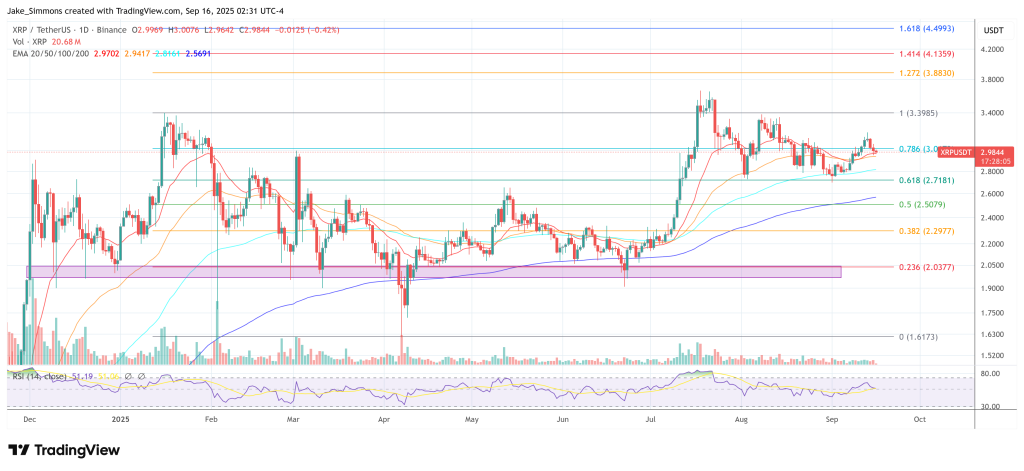
XRP price
XRP price, 1-day chart | Source: XRPUSDT on TradingView.com
Featured image created with DALL.E, chart from TradingView.com
Editorial Process for bitcoinist is centered on delivering thoroughly researched, accurate, and unbiased content. We uphold strict sourcing standards, and each page undergoes diligent review by our team of top technology experts and seasoned editors. This process ensures the integrity, relevance, and value of our content for our readers.

Jake Simmons has been a Bitcoin enthusiast since 2016. Ever since he heard about Bitcoin, he has been studying the topic every day and trying to share his knowledge with others. His goal is to contribute to Bitcoin's financial revolution, which will replace the fiat money system. Besides BTC and crypto, Jake studied Business Informatics at a university. After graduation in 2017, he has been working in the blockchain and crypto sector. You can follow Jake on Twitter at @realJakeSimmons.

Criptos en tendencia

Lecturas Relacionadas

Canada MSB, Why is it More Suitable for Teams Focused on Long-Term Payment Solutions?

**Canada MSB: Why Is It More Suitable for Teams Focused on Long-Term Payments?** Many crypto payment projects initially obtain a U.S. MSB registration for its cost-effectiveness and market recognition. However, as they scale operations, they often find it insufficient for sustainable, real-world payment business. This is where the Canadian MSB, regulated by FINTRAC, gains serious consideration. Unlike the U.S. framework, the Canadian MSB is not a "lightweight alternative" but a choice for projects committed to long-term, compliant operations, especially in B2B payments, cross-border settlements, and stablecoin transactions. **Key Distinctions:** The Canadian MSB emphasizes substantive, ongoing regulation. It requires establishing a full-fledged AML/CTF framework *before* launching operations, with continuous obligations for KYC, transaction monitoring, and reporting. This positions the holder as a regulated financial service provider from day one. **Operational Scope:** A properly structured Canadian MSB can support businesses like stablecoin/crypto payments and transfers, fiat-crypto exchange, B2B batch settlements, payment APIs for merchants, and underlying structures for services like crypto cards. **Strategic Advantages:** 1. **Bank & Partner Relations:** Its clear regulatory framework and operational requirements make it easier to explain compliance to banks and institutional partners, which is crucial for securing stable banking relationships. 2. **Centralized Path:** It offers a nationally unified system, avoiding the complexity and cost of navigating multiple U.S. state-level Money Transmitter Licenses (MTLs). 3. **Business Model Clarity:** It fosters long-term stability by requiring clear business structures, transparent fund flows, and real risk management from the outset, reducing future uncertainties. **Ideal Candidates:** The Canadian MSB is particularly suitable for B2B crypto payment platforms, cross-border stablecoin services, enterprise payment solutions, Web3 financial infrastructure projects, and teams building a "compliance benchmark" for sustainable growth. **Choosing Between U.S. and Canadian MSB:** The choice depends on the project's stage and goals. The **U.S. MSB** is better for **speed, initial validation, and early launch**. The **Canadian MSB** is better for **stability, substantive compliance, and long-term operation**, especially when serving B2B/enterprise clients and requiring reliable banking channels. In essence, while the Canadian MSB involves higher initial compliance rigor, it provides a more solid foundation for building a payment business that banks, partners, and regulators can accept over the long term.

marsbitHace 13 min(s)

Canada MSB, Why is it More Suitable for Teams Focused on Long-Term Payment Solutions?

marsbitHace 13 min(s)

Trading

Spot
Futuros

Artículos destacados

Cómo comprar T

¡Bienvenido a HTX.com! Hemos hecho que comprar Threshold Network Token (T) sea simple y conveniente. Sigue nuestra guía paso a paso para iniciar tu viaje de criptos.Paso 1: crea tu cuenta HTXUtiliza tu correo electrónico o número de teléfono para registrarte y obtener una cuenta gratuita en HTX. Experimenta un proceso de registro sin complicaciones y desbloquea todas las funciones.Obtener mi cuentaPaso 2: ve a Comprar cripto y elige tu método de pagoTarjeta de crédito/débito: usa tu Visa o Mastercard para comprar Threshold Network Token (T) al instante.Saldo: utiliza fondos del saldo de tu cuenta HTX para tradear sin problemas.Terceros: hemos agregado métodos de pago populares como Google Pay y Apple Pay para mejorar la comodidad.P2P: tradear directamente con otros usuarios en HTX.Over-the-Counter (OTC): ofrecemos servicios personalizados y tipos de cambio competitivos para los traders.Paso 3: guarda tu Threshold Network Token (T)Después de comprar tu Threshold Network Token (T), guárdalo en tu cuenta HTX. Alternativamente, puedes enviarlo a otro lugar mediante transferencia blockchain o utilizarlo para tradear otras criptomonedas.Paso 4: tradear Threshold Network Token (T)Tradear fácilmente con Threshold Network Token (T) en HTX's mercado spot. Simplemente accede a tu cuenta, selecciona tu par de trading, ejecuta tus trades y monitorea en tiempo real. Ofrecemos una experiencia fácil de usar tanto para principiantes como para traders experimentados.

626 Vistas totalesPublicado en 2024.12.10Actualizado en 2026.06.02

Cómo comprar T

Discusiones

Bienvenido a la comunidad de HTX. Aquí puedes mantenerte informado sobre los últimos desarrollos de la plataforma y acceder a análisis profesionales del mercado. A continuación se presentan las opiniones de los usuarios sobre el precio de T (T).

活动图片