CleanCore Solutions has crossed a significant milestone in its aggressive Dogecoin accumulation plan, revealing it now holds over 500 million DOGE in its treasury. This is contrary to the institutional investments in traditional cryptos like Ethereum and Bitcoin, which have earned massive returns over the past few months.
The initiative, managed by House of Doge and backed by the Dogecoin Foundation, ranks CleanCore as one of the largest corporate holders of the memecoin.
CleanCore Long-term Dogecoin Strategy
The company is targeting 1 billion DOGE within 30 days, with Chief Investment Officer Marco Margiotta describing the move as a “disciplined accumulation strategy.”
He emphasized CleanCore’s vision of establishing Dogecoin as a reserve asset while promoting its role in payments, tokenization, staking-like products, and global remittances.
Long-term, the firm aims to control 5% of Dogecoin’s circulating supply, a goal that would solidify its status in the digital asset treasury landscape. Custody is handled through Bitstamp in partnership with Robinhood, ensuring compliance and security.
Adding further credibility, Elon Musk’s lawyer Alex Spiro recently joined as board chairman, reportedly helping align CleanCore’s treasury strategy with the Dogecoin Foundation’s broader objectives.
DOGE Price Surges on Treasury Buys and ETF Optimism
The announcement comes as Dogecoin’s market performance strengthens. Over the past week, DOGE has surged 22%, with a 3.6% gain in the last 24 hours alone.
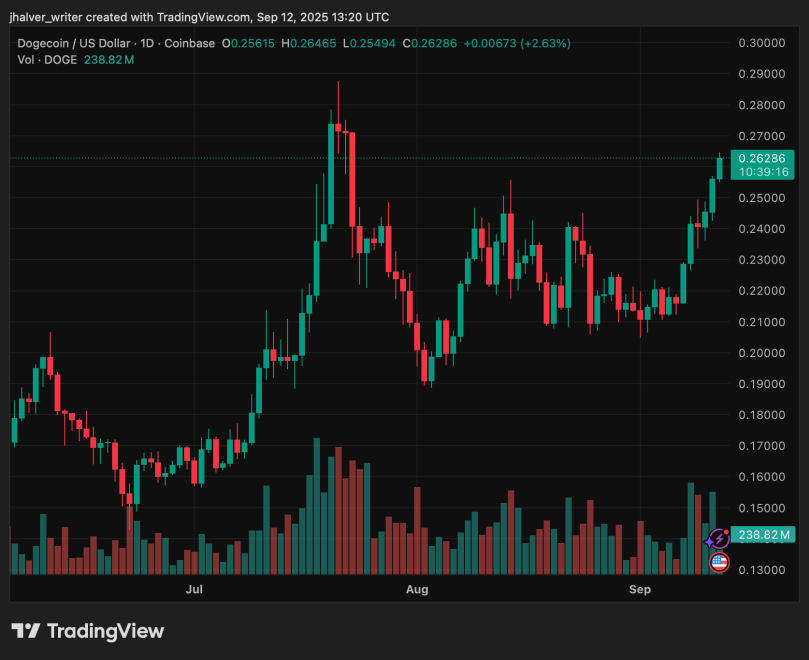
DOGE's price trends to the upside on the daily chart. Source: DOGEUSD chart on Tradingview
This bullish momentum has been fueled not only by CleanCore’s treasury expansion but also by excitement surrounding the proposed REX-Osprey DOJE ETF, the first U.S.-regulated Dogecoin exchange-traded fund.
Breaking above the $0.25 resistance level, Dogecoin now looks set to test the $0.288 zone, with strong liquidity reducing the chance of sharp corrections. Analysts see treasury adoption and institutional financial products as key steps toward turning DOGE from a speculative token into a mainstream asset.
Corporate Competition Heats Up in DOGE Accumulation
CleanCore is not the only firm betting on Dogecoin’s long-term potential. Rival BitOrigin recently disclosed a 40.5 million DOGE purchase as part of its $500 million treasury plan, signaling growing corporate interest in the meme-inspired cryptos.
The Dogecoin Foundation’s efforts, particularly through House of Doge, aim to push the coin beyond its meme status by expanding its utility in payments, tokenization, and real-world applications. With CleanCore halfway to its billion-DOGE target, the competition to secure treasury dominance is intensifying.
For now, CleanCore’s bold strategy places it at the forefront of memecoin adoption, challenging not only Ethereum’s dominance in corporate strategies but also reshaping the way companies view digital assets as reserve holdings.
Cover image from ChatGPT, DOGEUSD chart from Tradingview

Related Posts