Страны Африки к югу от Сахары - третий по темпам роста внедрения криптовалют регион

cryptonews.ruPublicado a 2025-05-10Actualizado a 2025-09-11

Согласно новому отчету платформы блокчейн-данных Chainalysis, страны Африки к югу от Сахары являются третьим по темпам роста регионом внедрения криптовалют. В отчете подчеркивается, что регион делает ставку на реальные сценарии использования криптовалют в условиях девальвации валют, отсутствия традиционных финансовых каналов и других проблем.

Согласно отчету, в период с июля 2024 года по июнь 2025 года страны Африки к югу от Сахары получили 205 млрд долларов в виде ончейн-транзакций. Эта сумма на 52% больше, чем в предыдущем отчетном периоде, что делает этот регион третьим по темпам роста внедрения криптовалют после Азиатско-Тихоокеанского региона и Латинской Америки.
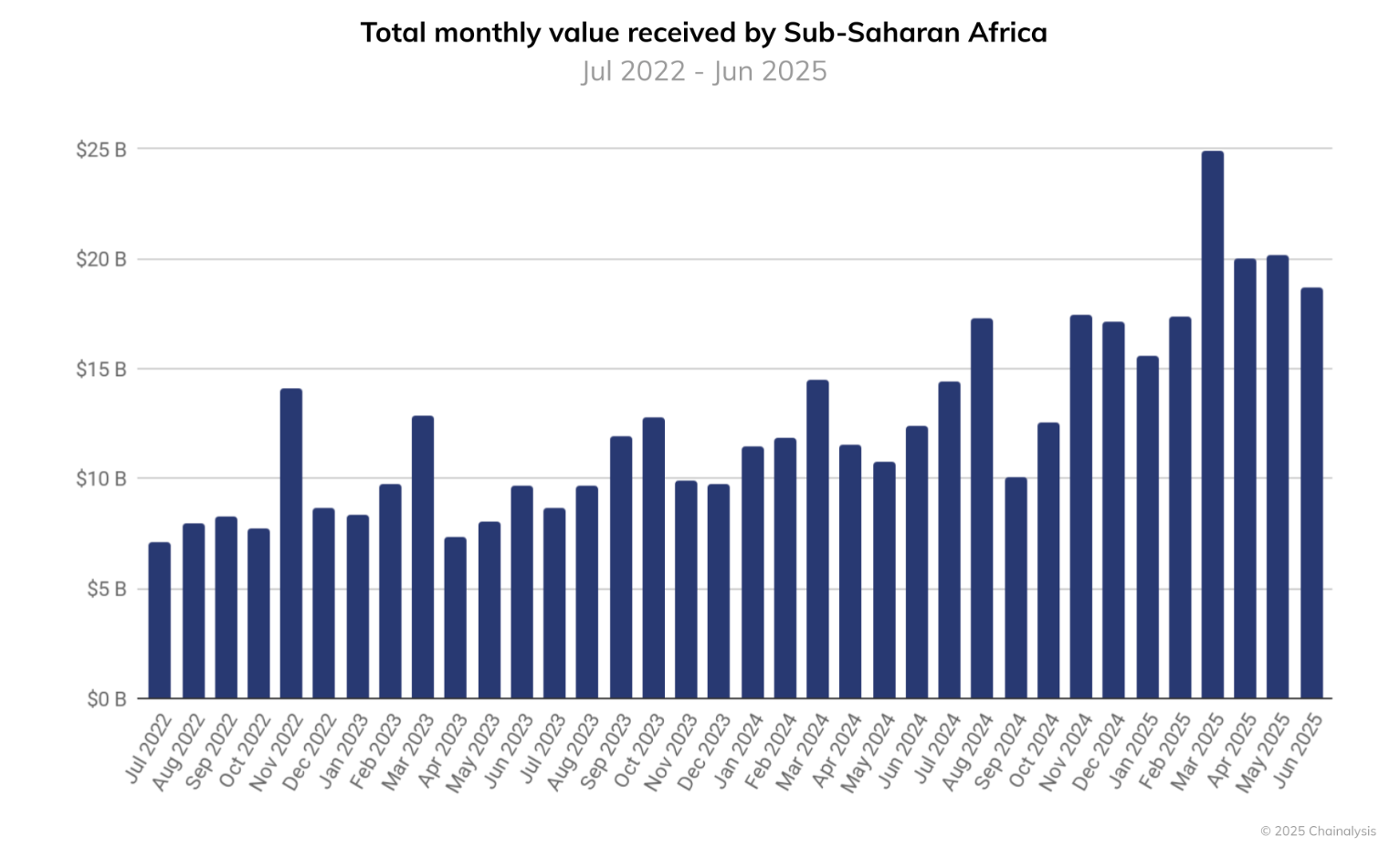
Ежемесячная стоимость криптовалют, полученных в странах Африки к югу от Сахары. Источник: Chainalysis.

В этом отчетном периоде в регионе наблюдался рост институционального внедрения, в первую очередь, благодаря потокам стейблкоинов, на которые приходится многомиллионный объем транзакций между Африкой, Ближним Востоком и Азией. Лидером институционального роста в странах Африки к югу от Сахары стала Нигерия, получившая за 12 месяцев инвестиции на сумму 92,1 млрд долларов.

«Масштаб инвестиций обусловлен не только значительным населением и технически подкованной молодежью, но и сохраняющейся инфляцией и проблемами с доступом к иностранной валюте, которые сделали стейблкоины привлекательной альтернативой», - пишет Chainalysis.

По данным компании, развитая нормативно-правовая база ЮАР способствовала развитию сильного институционального рынка криптовалют. Теперь институциональные игроки переходят от разведки к кастодиальному хранению и другим продуктам.

Внедрение криптовалют в розничном секторе на основе реальных примеров использования

В отчете Chainalysis отмечается, что использование криптовалют в розничном секторе в странах Африки к югу от Сахары опережает аналогичные показатели в других регионах. За отчетный период здесь было совершено более 8% всех криптовалютных переводов на сумму до 10 000 долларов США - во всем остальном мире этот показатель составляет 6%.

Государства Африки к югу от Сахары, как и многие развивающиеся страны, сталкиваются с трудностями, которые делают их благоприятными для внедрения криптовалют: население не охвачено банковскими услугами и не имеет доступа к традиционным финансовым услугам; местные фиатные валюты быстро обесцениваются или характеризуются устойчиво высокой инфляцией; существует дефицит долларов, что может сделать более привлекательными стейблкоины, привязанные к доллару США.

Ссылаясь на свой предыдущий отчет, который охватывает период с июля 2023 года по июнь 2024 года, аналитики Chainalysis сообщили, что внедрение стейблкоинов в регионе указывает на прямую девальвацию местной фиатной валюты. В этот период стало сложно найти доллары, что сделало стейблкоины привлекательными и обеспечило им 43% доли в общем объеме криптовалютных транзакций.

Соучредитель и генеральный директор StarkWare Эли Бен-Сассон написал, что Африка с ее уникальными проблемами играет ключевую роль в массовом внедрении криптовалют. Помимо других проблем, не связанных с финансами, технология блокчейн используется в Африке для решения вопросов энергетической безопасности.


Lecturas Relacionadas

Conversation with Investor Zheng Di: MicroStrategy's Coin Sale Experiment, AI Economy, and Opportunities in US Stocks

Frontier tech investor Zheng "Didier" Di discusses the recent Bitcoin price drop, the financial strategy shift at MicroStrategy, the AI-driven surge in U.S. stocks, and the evolving role of crypto exchanges. Didier posits that the recent BTC decline stems less from macro factors or ETF outflows, and more from market repricing due to MicroStrategy's new financial structure. Following a wave of preferred stock and debt issuance (STRC, STRZ, etc.), MicroStrategy must now manage cash flow to pay dividends, potentially leading to a market expectation of sustained, small-scale BTC sales to maintain its "per-share bitcoin neutral" principle. Didier views this as a financial "experiment" testing market capacity for such recurring sell pressure, which, while creating near-term structural headwinds, likely avoids a true "death spiral" absent major new external shocks. Shifting to AI, Didier argues that tokens are becoming the new form of labor, with AI models and compute (tokenized inputs) increasingly replacing human roles in execution and middle-management. This drives enterprise efficiency and higher margins, fueling the sustained rally in U.S. semiconductor, data center, and infrastructure stocks. He foresees an emerging "machine economy" where automated agents transact and collaborate on-chain. Regarding crypto exchanges offering U.S. equities, Didier sees this as a natural evolution. With few crypto-native assets generating lasting value, exchanges are pivoting towards real-world assets (RWAs) like stocks and bonds. This doesn't necessarily cannibalize crypto but reflects a maturing industry focusing on blockchain's core utilities: decentralized choice and efficient settlement. He notes that trading logic for crypto natives doesn't need to drastically change, as meme-driven and fundamentalist strategies find analogs in U.S. markets. The "1011 event" (likely referring to a major market crash) severely damaged crypto market liquidity, marking a probable end to the altcoin speculative cycle, with capital flowing towards the deeper liquidity of U.S. markets. For the macro outlook, Didier is cautious about near-term market pressure from potential mega-IPOs (e.g., SpaceX) and the U.S. midterm elections, which could bring more regulatory scrutiny. Long-term, he remains bullish on AI's productivity gains and its convergence with blockchain/Web3, predicting a shift from speculative frenzy to a more institutionalized, industrial phase for the crypto sector.

marsbitHace 18 min(s)

Conversation with Investor Zheng Di: MicroStrategy's Coin Sale Experiment, AI Economy, and Opportunities in US Stocks

marsbitHace 18 min(s)

Playnance’s $GCOIN Lists on KoinBX Amid Rapid Growth in India

Playnance's native token, $GCOIN, has been listed on the cryptocurrency exchange KoinBX as of June 18. This move aims to enhance accessibility for its rapidly growing community, particularly in India, where the blockchain-powered Web3 iGaming ecosystem has gained significant traction. Over 130 partners in Playnance's "Be the Boss" program have built communities engaging thousands of active players in the region. The "Be the Boss" model allows participants to create and manage their own gaming communities, earning rewards tied to community activity. CEO Pini Peter noted India's high engagement, with community leaders successfully building player networks. One partner, Dr. Nicolas, reported earning over $57,000 through the program in recent months, highlighting both the financial rewards and the opportunity to grow an engaged community. $GCOIN serves as the ecosystem's core utility token, incentivizing participation and aligning the interests of players and community leaders ("Bosses"). The listing on KoinBX is part of Playnance's strategy to expand globally, increasing the token's utility and accessibility by combining community ownership, gamified engagement, and blockchain-based incentives. Founded in 2020, Playnance is a Web3 iGaming infrastructure company focused on creating live, non-custodial, on-chain products to onboard mainstream users. It currently processes approximately one million transactions daily, aiming to simplify the user experience while maintaining full on-chain transparency.

TheNewsCryptoHace 58 min(s)

Playnance’s $GCOIN Lists on KoinBX Amid Rapid Growth in India

TheNewsCryptoHace 58 min(s)

STRC Hits Historic Low, Saylor's Perpetual Motion Machine Grinds to a Halt

STRC, the perpetual preferred stock issued by MicroStrategy to fund its Bitcoin purchases, hit a historic low of $85.32, a 17% discount to its $100 par value. Designed as a "digital credit engine" to trade stably near par and enable continuous share issuance for buying Bitcoin, its plunge signals a breakdown in this model. Three key factors drove the decline: 1. Bitcoin's price fell over 50% from its peak, trading around $63,000 amid hawkish Fed signals. 2. MicroStrategy's cash reserves were depleted after a $1.5 billion convertible note repayment, slashing the dividend coverage for STRC's 11.5% yield to ~7 months. The company then sold 32 BTC to cover dividends—Michael Saylor's first Bitcoin sale since 2022—damaging the "never sell" narrative. 3. A competing Bitcoin-backed preferred stock, Strive's SATA, offers a higher yield (~13%) and daily dividends, drawing investors away from STRC. The drop triggers a negative cycle: STRC below par halts ATM share issuances, cutting off a key funding source for Bitcoin buys and potentially forcing more BTC sales for dividends, further eroding confidence. While Saylor argues the model is mathematically sound—needing only 2.3% annual Bitcoin growth to sustain itself—the market is testing the resilience of the leveraged Bitcoin treasury strategy in a bear market. The STRC price now reflects rising skepticism about this financial machinery's durability during downturns.

marsbitHace 1 hora(s)

STRC Hits Historic Low, Saylor's Perpetual Motion Machine Grinds to a Halt

marsbitHace 1 hora(s)

A Guide to Grayscale’s ‘Bottom Fishing’: Using Cash Flow to Assess Cryptocurrency Value

**Title:** Grayscale's Guide to Bottom-Fishing: Valuing Cryptoassets Using Cash Flows **Summary:** This report by Grayscale Research presents a fundamental valuation framework for cryptocurrency assets, moving beyond pure speculation to analyze those with underlying cash flows. It distinguishes between "commodity-like" assets (e.g., Bitcoin) and "cash-flow" assets, primarily within DeFi. Using the leading decentralized lending protocol Aave as a case study, the analysis applies traditional financial methodologies like Discounted Cash Flow (DCF) and Price-to-Earnings (P/E) multiples. Key findings indicate that AAVE tokens are currently undervalued. Despite recent challenges, the protocol's strong revenue growth, ~50% net profit margin, and diversified treasury support a fundamental valuation range of $80-$100 per token (compared to a ~$75 market price at the time of writing). In a base-case scenario driven by stablecoin adoption and regulatory clarity, the fair value could rise to around $175 within a year. The report emphasizes that protocol success does not automatically translate to token value. It critically examines the "value capture" mechanisms—such as buybacks, burns, and staking rewards—that channel protocol profits to token holders. Furthermore, it addresses the legal and governance complexities of Decentralized Autonomous Organizations (DAOs), noting their difference from traditional corporate equity but highlighting how robust, transparent governance can align protocol economics with holder interests. The conclusion is that the crypto market is maturing, with capital increasingly flowing towards projects with demonstrable fundamentals, real adoption, and disciplined capital allocation, creating opportunities for value-based investors.

marsbitHace 2 hora(s)

A Guide to Grayscale’s ‘Bottom Fishing’: Using Cash Flow to Assess Cryptocurrency Value

marsbitHace 2 hora(s)

Trading

Spot
Futuros
活动图片