Dernières 24h pour acheter TOKEN6900 avant le claim !

bitcoinistPublicado a 2025-09-02Actualizado a 2025-09-02

Resumen

Le chrono tourne : il ne reste plus que 24 heures pour se positionner sur TOKEN6900 avant le claim. Une...

Trusted Editorial content, reviewed by leading industry experts and seasoned editors. Ad Disclosure

Le chrono tourne : il ne reste plus que 24 heures pour se positionner sur TOKEN6900 avant le claim. Une fenêtre ultra serrée qui électrise le marché crypto. Dans les communautés Telegram, X et Discord, ça ne parle que de ça. L’ambiance est donc électrique : soit les investisseurs entrent maintenant, soit ils regardent le marché s’emballer sans eux. Cette phase finale ne laisse place à aucune hésitation : le claim imminent transformera cette ICO en véritable crash-test pour 2025.

La communauté en surchauffe à l’approche du claim

Impossible de scroller sur X, Discord ou Telegram sans voir passer TOKEN6900. Les débats s’enchaînent, les influenceurs y vont de leurs décryptages, et même des fonds plus sérieux commencent à tendre l’oreille. On est clairement au-delà du simple battage communautaire : il y a une vraie traction qui se ressent. À 24 heures du claim, le constat est limpide : TOKEN6900 a franchi un cap parmi les meilleurs altcoins, il attire autant les spéculateurs rapides que ceux qui voient déjà plus loin. Entre l’énergie immédiate et la confiance placée dans sa roadmap, le projet a tout pour s’imposer comme l’un des points chauds de l’année crypto.

Cette double attractivité, peu présente dans l’écosystème, explique pourquoi on assiste à l’éclosion d’un véritable marqueur de tendance : un rendez-vous que personne ne peut ignorer pour la suite de 2025.


Un timing calculé pour maximiser la demande

La stratégie du projet est limpide : réduire la fenêtre d’achat pour accentuer la pression. Chaque heure qui passe alimente le FOMO. Plus le temps file, plus les volumes de participation gonflent. C’est exactement ce qui rappelle les grandes ICO historiques : une course contre la montre où chaque minute compte. Bien sûr, le risque reste présent comme pour toute levée de fonds crypto. Cette mécanique donne à TOKEN6900 une saveur particulière : celle d’un projet qui sait jouer habilement sur l’urgence, tout en posant les bases d’un développement durable.

Ce mélange de tension court terme et de vision long terme crée une atmosphère électrique : les communautés s’emballent, les investisseurs scrutent chaque signal, et l’idée de “rater le train” devient insupportable. Plus qu’un pari, c’est déjà un rendez-vous clé du marché.

TOKEN6900 ($T6900) : L’ICO sous haute tension de 2025
token-6900

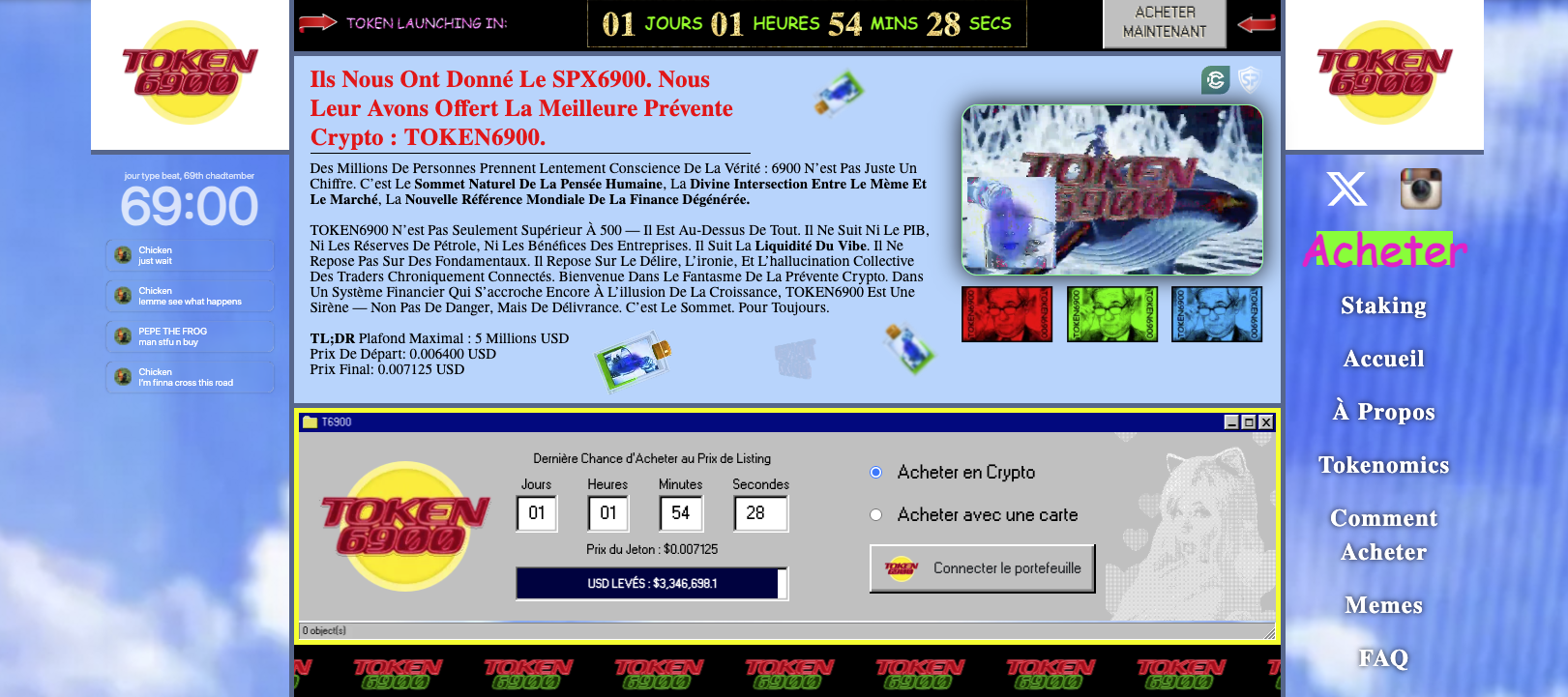
TOKEN6900 n’a pas mis longtemps à s’imposer comme l’une des ICO les plus scrutées de l’année. Sa force ? Une mécanique simple mais redoutable : rareté programmée, prix qui grimpent automatiquement par paliers, et une répartition stratégique des fonds entre développement, sécurité, marketing et liquidité. Cette structure attire deux publics à la fois : les traders court terme, qui veulent profiter de la volatilité post-claim, et les investisseurs long terme, séduits par une roadmap ambitieuse et des partenariats déjà évoqués.

Côté chiffres, la levée affiche déjà plus de 15 millions de dollars collectés, avec un prix actuel autour de 0,012 $ par token, en hausse de plus de 30 % depuis le lancement.

La particularité du projet, c’est son claim imminent, qui sera le premier vrai test de confiance. Si la dynamique se confirme, $T6900 pourrait rapidement se hisser dans le top des projets de 2025. Un pari sans risque ? Sûrement pas. Mais c’est tout de même un projet qui combine excitation immédiate et potentiel durable. Une combinaison rare dans un marché saturé de tokens éphémères.

Conclusion

À quelques heures du claim, TOKEN6900 cristallise toute l’attention du marché. Entre hype palpable, stratégie millimétrée et roadmap ambitieuse, il coche toutes les cases d’une ICO qui pourrait marquer l’année 2025. Mais au-delà de l’excitation court terme, c’est aussi l’occasion de rappeler que l’écosystème crypto évolue vite. TOKEN6900, avec son claim imminent, est sans doute l’un des tests les plus révélateurs de ce moment charnière pour la crypto.

Editorial Process for bitcoinist is centered on delivering thoroughly researched, accurate, and unbiased content. We uphold strict sourcing standards, and each page undergoes diligent review by our team of top technology experts and seasoned editors. This process ensures the integrity, relevance, and value of our content for our readers.

Lecturas Relacionadas

Bitroot Public Chain Invited to Attend Tencent Cloud Singapore AI Conference, Discussing the Future Alongside Solana

On May 19, Bitroot, an emerging Layer 1 blockchain, participated in the Tencent Cloud AI Summit in Singapore alongside key industry players like Solana Foundation. The event explored the intersection of AI infrastructure, enterprise applications, AI Agents, and Web3. Bitroot's invitation, despite being pre-mainnet, highlights industry interest in its focus on high-performance, AI-native architecture tailored for future AI Agent execution and verifiable on-chain automation. Bitroot CEO Juan Jose emphasized that AI competition is shifting from model performance to data, real-world application scenarios, and trust infrastructure. He argued that for AI Agents to evolve from assistants to autonomous executors managing transactions and assets, they require low-latency, low-cost, and high-throughput blockchain environments. Bitroot aims to address this through its EVM-compatible design, optimistic parallel execution, and a consensus mechanism targeting high scalability. Currently in its Testnet 5.0 phase, Bitroot reports metrics like over 50,000 peak TPS and sub-0.3 second average block time. Its narrative positions it within a growing landscape where next-generation Layer 1s like Monad and Aptos also compete on performance, while Bitroot differentiates by integrating AI computational capabilities natively across its stack. The summit underscored that the fusion of AI and Web3 is moving from concept to infrastructure competition, where networks balancing performance, security, and verifiability will be crucial for enabling scalable AI-driven applications.

marsbitHace 57 min(s)

Bitroot Public Chain Invited to Attend Tencent Cloud Singapore AI Conference, Discussing the Future Alongside Solana

marsbitHace 57 min(s)

Hedge Fund Q1 Interpretation: Everyone Is Selling Software, Buying Chips

Hedge Funds and Mutual Funds Aligned in Q1: Dumping Software, Buying Chips A clear consensus emerged among major U.S. hedge funds and mutual funds in Q1: they were simultaneously selling software stocks and pouring capital into the semiconductor sector. This aggressive rotation pushed semiconductor exposure in hedge fund long portfolios to a record high. Hedge funds delivered a 7% return year-to-date, while only 30% of large-cap active mutual funds outperformed their benchmarks. The average short interest for S&P 500 constituents rose to 3% of market cap, the highest since 2011. Within technology, the structural shift was stark. Hedge funds' semiconductor weighting hit an all-time high, while software fell to its lowest since 2019. Excluding Microsoft, mutual funds' relative overexposure to semis vs. software was the largest since 2012. Microsoft was among the most net-sold stocks by both groups. Hedge funds net purchased semiconductor names like LRCX and AMAT. Strategies diverged on leverage and cash. Hedge funds increased their net exposure to near a one-year high after an initial cut. Mutual funds raised their cash allocation, though it remains historically low at 1.4%. Sector alignment was high in Industrials (both overweight) but divergent in Tech: hedge funds increased their Tech net tilt by a record 853 basis points, while mutual funds reduced theirs. Clear splits also appeared in Financials and Consumer Discretionary. Four stocks appeared on both Goldman's hedge fund VIP and mutual fund overweight lists: BA, MA, MRVL, and V. This "shared favorites" basket has returned 10% YTD, outperforming the equal-weight S&P 500. Notably, all "Magnificent Seven" stocks are on the hedge fund VIP list but are uniformly underweighted by mutual funds.

marsbitHace 1 hora(s)

Hedge Fund Q1 Interpretation: Everyone Is Selling Software, Buying Chips

marsbitHace 1 hora(s)

The Evolution Path of Physical Bitcoin

The Evolution of Physical Bitcoin Bitcoin's digital nature is its core strength, enabling self-custody and rapid global transfers. However, its intangibility also hinders mainstream adoption. For over a decade, creators have attempted to materialize Bitcoin while preserving its cash-like properties, yielding notable results. Casascius Coins, launched in 2011, were the first and most iconic physical Bitcoin. Creator Mike Caldwell generated private keys offline, printed them on coins, and sealed them with tamper-evident holograms. This model relied on user trust in the centralized issuer. Production ceased in 2013 due to regulatory pressure from FinCEN. RavenBit Coins emerged in 2014 aiming to decentralize minting by letting users generate and apply their own keys. However, this led to trust issues with numerous untrusted minters and insecure key generation methods. In 2016, Coinkite introduced Opendimes—a breakthrough in bearer asset technology. These USB-shaped devices generate and store keys internally. Funds can be received by checking the public key, but spending requires physically breaking the device to extract the private key. While innovative and open-source, its cost (~$20) and form factor limit its use for small, everyday transactions. Satochip's Satodime, a card-shaped device using similar secure chip technology, followed. It supports NFC interaction and comes in various forms. While potentially cheaper in bulk (~13€), it remains a high-security hardware wallet, not a low-cost cash substitute. A fundamental cost barrier exists. For physical Bitcoin to achieve widespread commercial use, hardware costs must drop below $1 to match the production cost of fiat banknotes. Current secure chips capable of running Bitcoin's cryptographic algorithms (like secp256k1) are too expensive. Chips like NXP's NTAG X DNA (~$3) show cost-reduction potential but lack native Bitcoin curve support. Projects like OfflineCash embed chips in banknote-like paper, but face challenges with durability, the need for custom Bitcoin-enabled chips, and the inherent requirement for users to verify balances online—which conflicts with Bitcoin's trustless ideal. Coinkite's Tapsigner, a ~$20 card with a proprietary Bitcoin NFC chip, is seen as a more practical step forward. It functions as a reloadable hardware wallet for contactless payments, solving the "change" problem and focusing on real-world retail integration, a direction also pursued by companies like Cash App and Square. In summary, the journey to physical Bitcoin has progressed from trusted centralized mints (Casascius) to user-generated keys (RavenBit) and finally to self-contained secure hardware (Opendimes, Satodime, Tapsigner). The core challenge remains developing a sufficiently low-cost, durable, and truly trustless physical bearer asset that can function like cash in daily transactions. Current solutions are either too expensive or introduce new trust assumptions, keeping the ideal of ubiquitous physical Bitcoin just out of reach for now.

marsbitHace 1 hora(s)

The Evolution Path of Physical Bitcoin

marsbitHace 1 hora(s)

Trading

Spot
Futuros
活动图片