一切下跌都是纸老虎,降息带来的狂暴山寨季就在第四季度?

深潮Publicado a 2025-08-25Actualizado a 2025-08-26

山寨币季节的早期迹象已现,牛市将在第四季度达到最强状态。

撰文:Ben Strack

编译:AididiaoJP,Foresight News

在美联储主席杰罗姆·鲍威尔鸽派发言之后,现在似乎是一个进行换仓策略的好时机,尤其是随着时间的推移,宏观因素对加密货币市场的影响不断增大。

我们仍然不知道美联储在 9 月 17 日的会议上会做什么。但对许多人来说,鲍威尔的评论带有鸽派倾向,为下个月降息打开了想象空间。

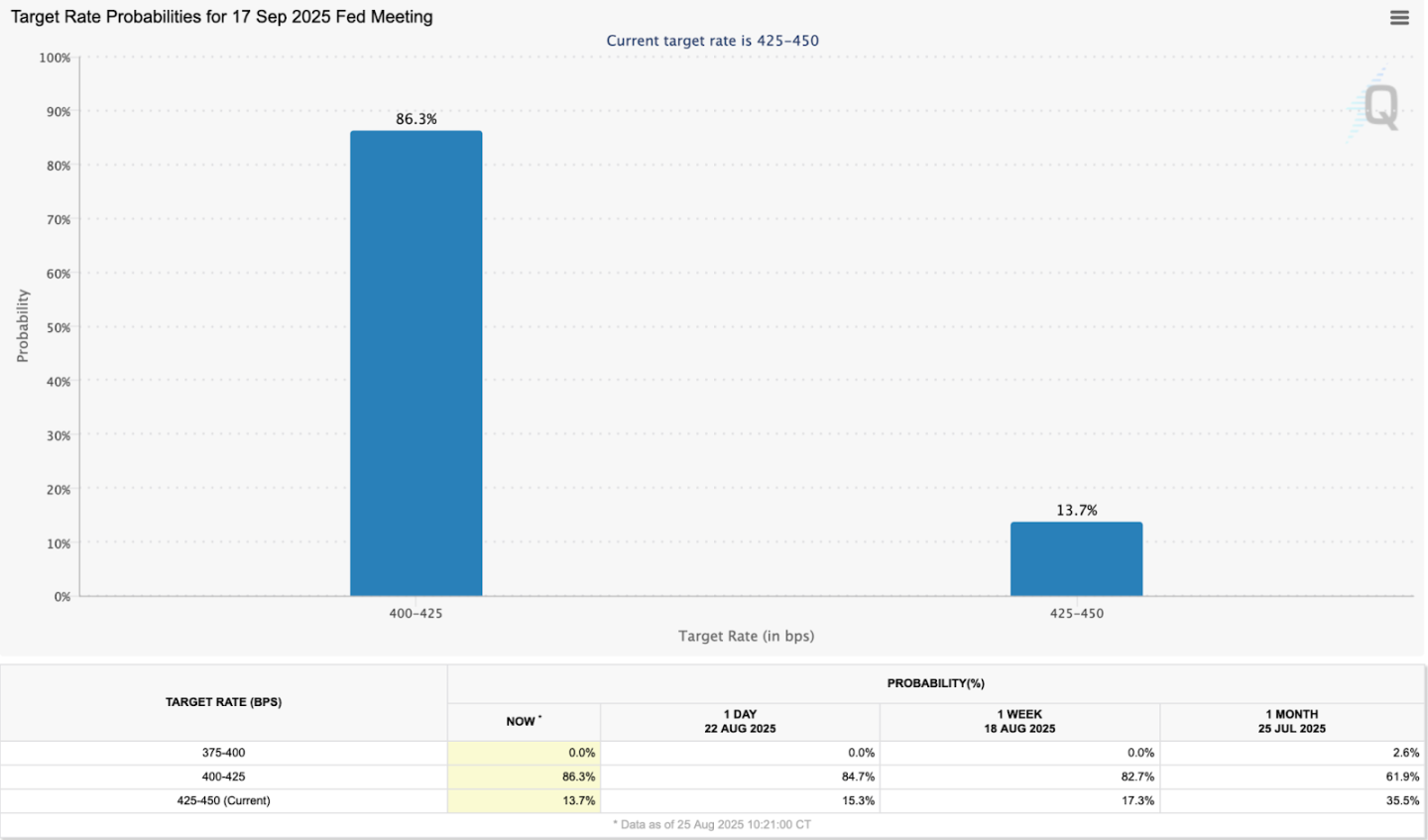
如果我们查看 CME Group 的 FedWatch 工具,基于 30 日期联邦基金期货价格,截至周一中午,许多人认为 25 个基点的降息是有可能的,这一预期远高于一个月前:
虽然降息通常对比特币等风险资产有利,但实际情况比这更微妙。比特币周五飙升至 117,000 美元以上,随后回落至 111,000 美元以下。该资产在东部时间下午 1:30 的交易价格约为 112,600 美元,目前已经跌破 110000 美元。

YouHodler 市场主管 Ruslan Lienkha 认为,加密货币市场走向的更广泛轨迹仍将取决于宏观背景。

「如果通胀压力持续存在,美联储可能被迫再次延长暂停期,限制单次降息的持续影响,」他告诉我。「此外,如果降息被视为对衰退的紧急应对措施,它可能会拖累加密货币以及其他风险资产。」

最佳情景?降息是美联储成功实现软着陆努力的一部分。

「在这种环境下,鉴于比特币作为最成熟数字资产的地位,它可能会吸引大部分机构资金流入,」Lienkha 说。「一些山寨币可能会表现更佳,因为它们具有更高的波动性和更低的流动性,当资金流动扩大到比特币之外时,会放大山寨币上涨倍数。」

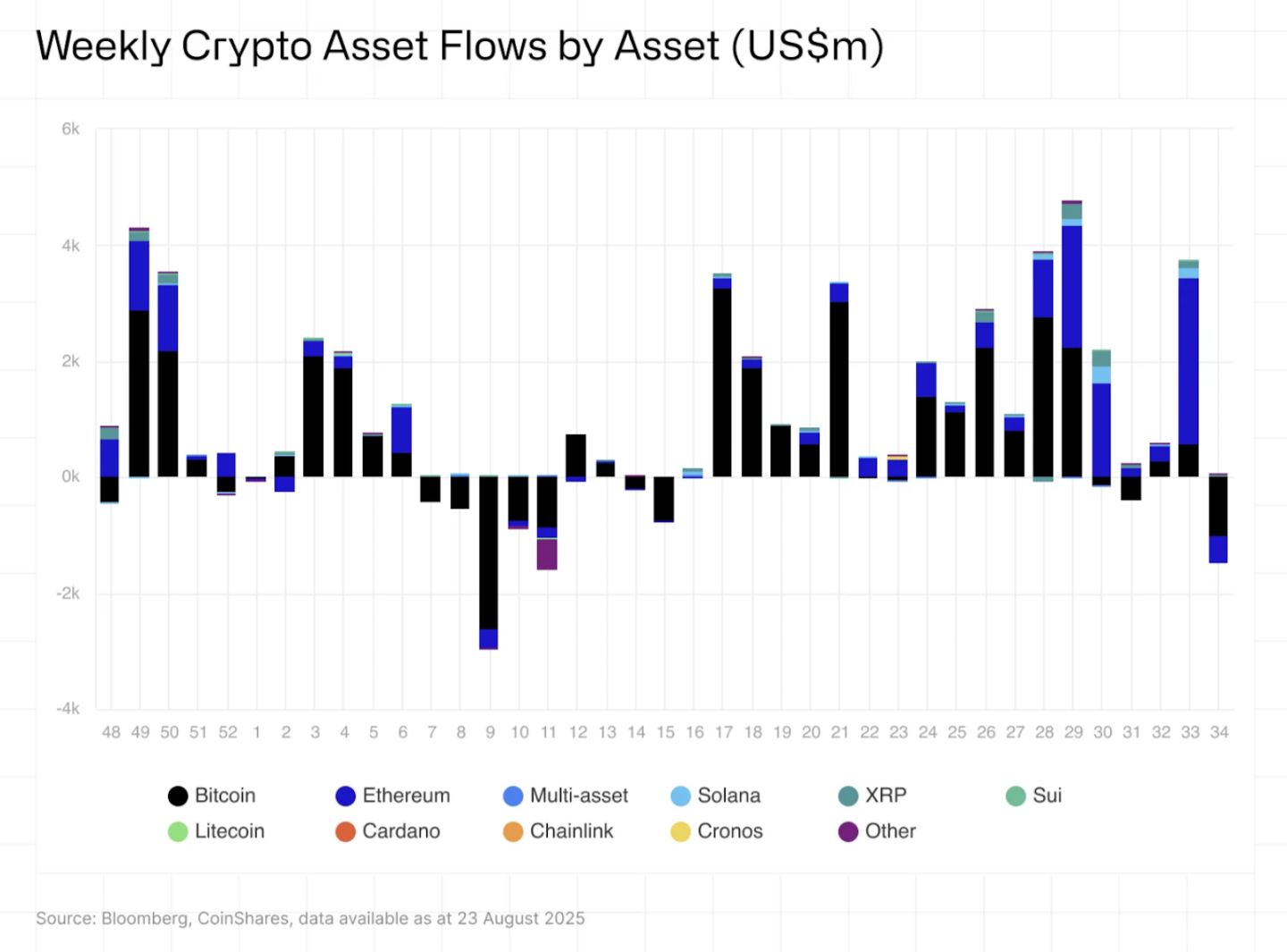
谈到机构资金流动,根据 CoinShares 的数据,加密货币投资产品上周流出超过 14 亿美元,这是自 3 月以来最高的单周流出总额。在这些数据中,我们看到周初对美联储立场的悲观情绪似乎推动了资金流出,随后在鲍威尔的言论后出现复苏(主要是以太坊产品)。

尽管周四和周五美国 ETH ETF 合计流入 6.25 亿美元,但这两天 BTC 基金流出 2.17 亿美元。本月至今,ETH 和 BTC ETF 的净流入分别为 +25 亿美元和 -10 亿美元,「标志着投资者对这两种资产的情绪发生了显著变化,」CoinShares 的 James Butterfill 指出。
投资者从周五得到了什么信号?

加密货币对冲基金 ZX Squared Capital 的联合创始人 CK Zheng 称,鲍威尔转向可能开始降息对风险资产类别「意义重大」。

他对比特币的年终目标在 125,000 美元至 150,000 美元之间。他预计 ETH 年终将在 6,000 美元至 7,000 美元之间。(周一下午徘徊在 4,600 美元左右)。

Globe 3 Capital 首席投资官 Matt Lason 表示,任何降息信号都证实了该对冲基金的多头持仓,因为更多流动性对加密货币至关重要。他预计当前加密货币牛市的强度将在第四季度达到最强。

预期的降息促使 Globe 3 Capital 将其更多持仓转向小市值代币,「因为我们看到了期待已久的山寨币季节的早期迹象,」Lason 补充道。

第四季度之后我们应该期待什么?50T Funds 创始人 Dan Tapiero 周末在 X 上引用摩根士丹利的研究发表了看法:

Zheng 表示,他预计在《GENIUS 法案》签署后,比特币的主导地位将继续下降,并估计稳定币市场将在未来几年增长 10 倍(从约 2,700 亿美元)。Coinbase 的最新模拟表明,稳定币市值可能在 2028 年底达到 1.2 万亿美元。

我们知道加密货币市场变化很快,但我认为这些「我们当前处境」的思考是值得的。即使一切在几周、几天或几小时内发生变化。

Lecturas Relacionadas

End of the 'Gray Era' for Hong Kong and US Stock Trading Accounts: Where Can Your Money Go Now?

Hong Kong and US stock “grey account opening era” ends, where can your money go? In a coordinated regulatory crackdown starting May 22nd, Hong Kong's SFC and China's securities regulator have targeted the previously common but legally ambiguous practice of mainland Chinese investors opening accounts with Hong Kong brokers to trade Hong Kong and US stocks. The SFC issued a stern circular after a review of 12 brokerages, citing major deficiencies including inadequate due diligence, acceptance of suspicious or forged documents, and weak management of cross-border relationships. New requirements mandate mainland clients to submit a written declaration confirming their investment funds originate from *outside* mainland China, the account has never been closed for using suspicious documents, and agreeing to information disclosure. Brokers must immediately close accounts opened with suspicious documents and dormant accounts. Simultaneously, Chinese authorities launched a two-year campaign to rectify illegal cross-border securities activities. Key internet brokers like Futu, Tiger Brokers, and Longbridge are facing penalties, with existing accounts allowed only to sell/withdraw funds, not add new ones. The impact is immediate. Reports from social media and financial news outlets confirm that individuals traveling to Hong Kong to open accounts are now required to sign the new declaration. However, even after signing, applications are frequently rejected. The declaration shifts compliance responsibility to the client and acts as a filter, as most mainland investors' funds do not legally meet the "from outside China" criterion. Major brokers like Futu and Tiger have stopped accepting new mainland clients. A few, such as uSmart Securities, Fosun Wealth, and Cheerful Investment, still offer limited channels, but approvals have tightened significantly. Crucially, funding must now come exclusively from the investor's own bank account in Hong Kong or a qualified jurisdiction, blocking previous workarounds like using money changers or stablecoins. For mainland investors, compliant pathways still exist but are narrower. Individuals with overseas status (students, work visa holders) and verifiable offshore funds may still qualify. Official channels like Stock Connect, QDII, and the Cross-boundary Wealth Management Connect remain fully compliant options, albeit with product and quota limitations. On-chain alternatives exist but carry their own regulatory uncertainties and often exclude mainland users. The crackdown signals the end of the lax expansion period for Hong Kong brokers targeting mainland clients. While investment opportunities persist, the era of easy, low-compliance access is over. Investors must now carefully assess their eligibility and understand that signing the new declaration carries personal legal liability.

Odaily星球日报Hace 45 min(s)

End of the 'Gray Era' for Hong Kong and US Stock Trading Accounts: Where Can Your Money Go Now?

Odaily星球日报Hace 45 min(s)

SpaceX's $1.75 Trillion IPO: A Quick Guide to 17 Related Stocks

**Title: SpaceX's $1.75 Trillion IPO: Analysis of 17 Related Stocks** SpaceX is set to IPO on Nasdaq with a $1.75 trillion valuation. The real value driver is Starlink, contributing 61% of Q1 revenue with high margins. Its valuation heavily depends on future execution, including user growth despite falling ARPU. Key stocks have already surged pre-IPO. Tesla (TSLA, +10%) is a primary beneficiary due to deep integration with SpaceX in chip design and AI. Rocket Lab (RKLB, +89%) is seen as a "mini-SpaceX," but faces risk from potential Neutron rocket delays. AST SpaceMobile (ASTS) competes in the same satellite-to-phone market as Starlink. Firefly (FLY, +70%) is a strong government contractor in lunar services. Partners like EchoStar (SATS), Planet Labs (PL), and T-Mobile (TMUS) will see revaluation. Suppliers like Qualcomm (QCOM, +57%) are critical ecosystem "picks and shovels." Investment vehicles like DXYZ (+80%) hold significant SpaceX stakes but trade at high premiums, which may collapse post-IPO. Redwire (RDW) is highlighted as an under-the-radar "pick and shovel" play in space components, with growth in defense contracts and microgravity pharmaceuticals. The article warns that much of the positive news is already priced in, and a post-IPO sell-off is possible. Large IPOs often underperform initially. Key risks include Starship delays, ARPU decline, and unforeseen black swan events affecting Elon Musk or space operations. Investors are advised to focus on companies with solid fundamentals and manage overall sector exposure carefully.

marsbitHace 48 min(s)

SpaceX's $1.75 Trillion IPO: A Quick Guide to 17 Related Stocks

marsbitHace 48 min(s)

Conversation with VanEck CEO: Memory Chip Stocks Are a Bubble, Bitcoin Will Stay but Token Ecosystems Will Disappear

In this podcast, VanEck CEO Jan van Eck discusses his investment outlook centered on three key long-term ("10-year macro") themes: AI-driven compute demand, India's economic rise, and excessive government debt in developed nations. Regarding AI and semiconductors, van Eck believes Nvidia has transformed into a foundational "host" for AI infrastructure, possessing deep moats in software, scale, and power efficiency, making it a core holding. However, he views the recent surge in memory chip stocks as a bubble driven by temporary supply-demand imbalances and pricing power, lacking Nvidia's competitive durability. On asset management, he emphasizes that while ETFs are scale-driven tools, the decisions on which ETFs to own and how to allocate remain highly active. He expresses greatest concern over fixed-income market illiquidity and the risk of a loss of confidence in government debt sustainability. Van Eck is bullish on gold's long-term role as a global monetary alternative and highlights the dramatic policy-driven growth in nuclear energy investment. He is strongly positive on India due to its demographic trends and pro-business reforms. Discussing crypto, he labels 2026 the "year of the corporate-controlled chain," where traditional finance adopts blockchain's best features (like 24/7 operation and programmability) but retains control. He predicts a permanent "crypto winter" for many projects, with only Bitcoin, stablecoins, and the core blockchain concept surviving long-term. He sees the U.S. stablecoin bill as marginally impactful, enabling tech firms to compete with, but not replace, banks. Finally, he views the upcoming SpaceX IPO as a significant, positive liquidity event for markets and advises investors to maintain a long-term, macro perspective when making asset allocation decisions.

marsbitHace 59 min(s)

Conversation with VanEck CEO: Memory Chip Stocks Are a Bubble, Bitcoin Will Stay but Token Ecosystems Will Disappear

marsbitHace 59 min(s)

Trading

Spot
Futuros
活动图片