«Худший сценарий для биткоина»: коррекция продолжается

cryptonews.ruPublicado a 2025-06-18Actualizado a 2025-08-19

Биткоин продолжил коррекцию 19 августа и опустился до минимума $114 442 на бирже Bitstamp. Общая распродажа криптовалют ликвидировала около $232 млн длинных позиций за 24 часа, согласно данным CoinGlass.
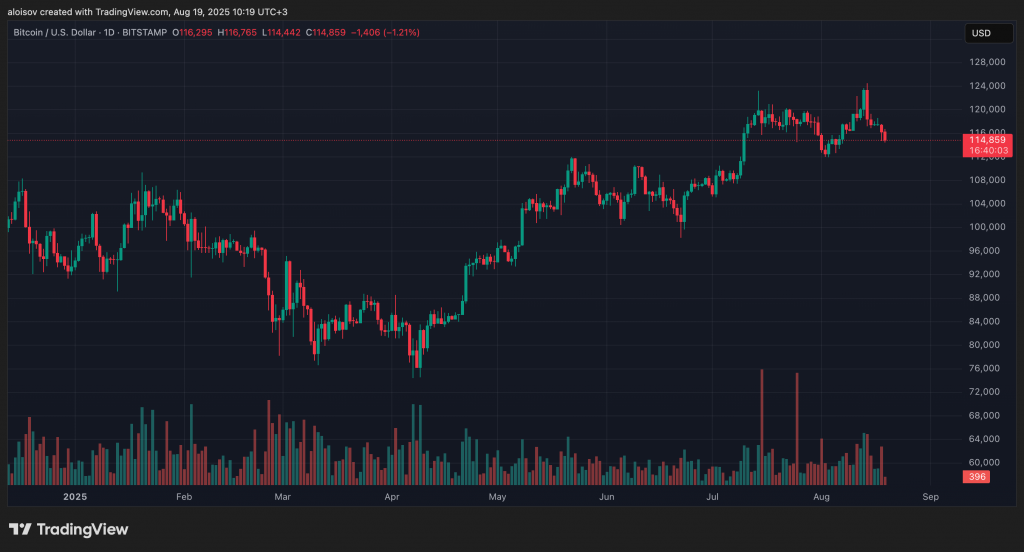
1-дневный график BTC/USD. Источник: Bitstamp

Трейдеры, уже настороженные слабостью рынка, продолжали прогнозировать новые минимумы для биткоина.

«Это, вероятно, худший сценарий для BTC сейчас. Он будет продолжать консолидироваться между $112 000-$120 000 в третьем квартале, в то время как альткоины пойдут выше», — написал трейдер BitBull в соцсети X.
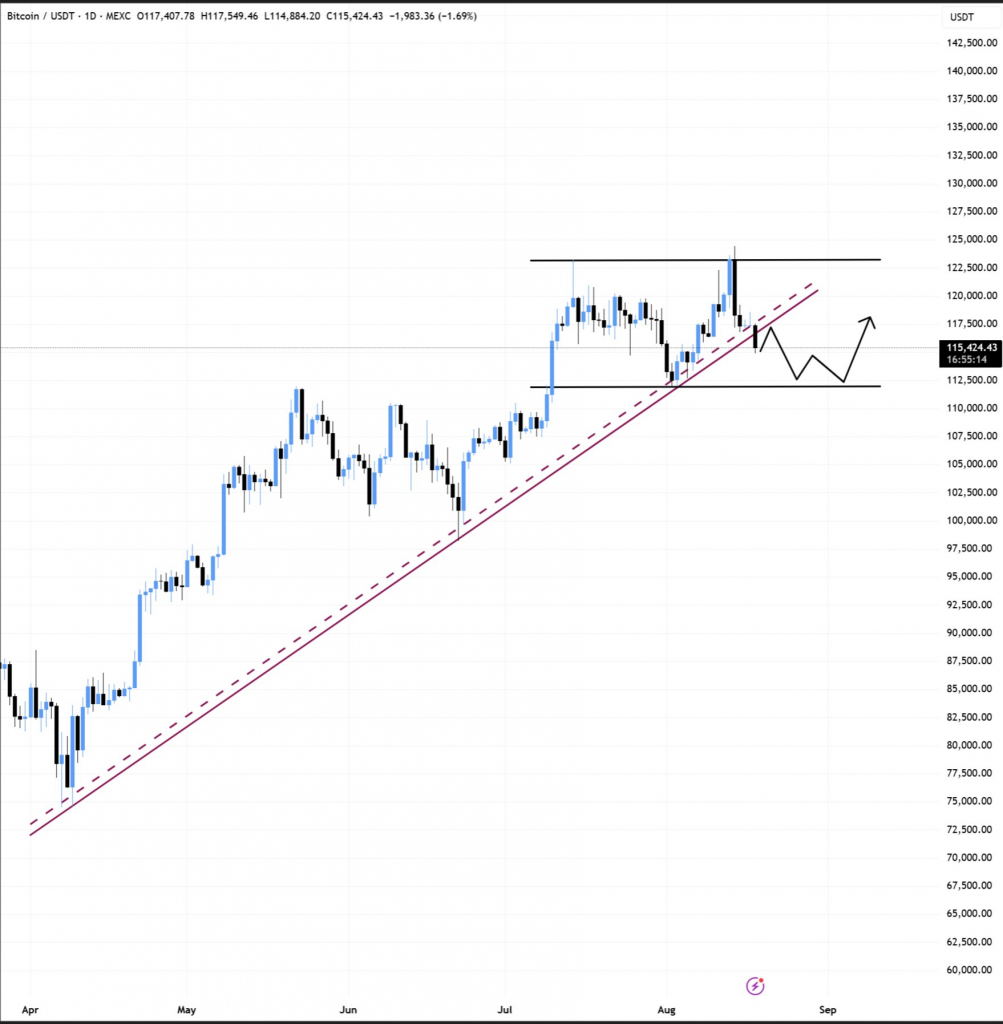
1-дневный график BTC/USD. Аналитика: BitBull

Криптотрейдер, аналитик и предприниматель Михаэль ван де Поппе (Michaël van de Poppe) согласился с этим мнением.

«Если биткоин не пробьет $116 800, я предполагаю, что мы увидим зачистку минимумов, и это будет момент, когда все скажут ’начало медвежьего рынка‘, тогда следует покупать», — резюмировал он.
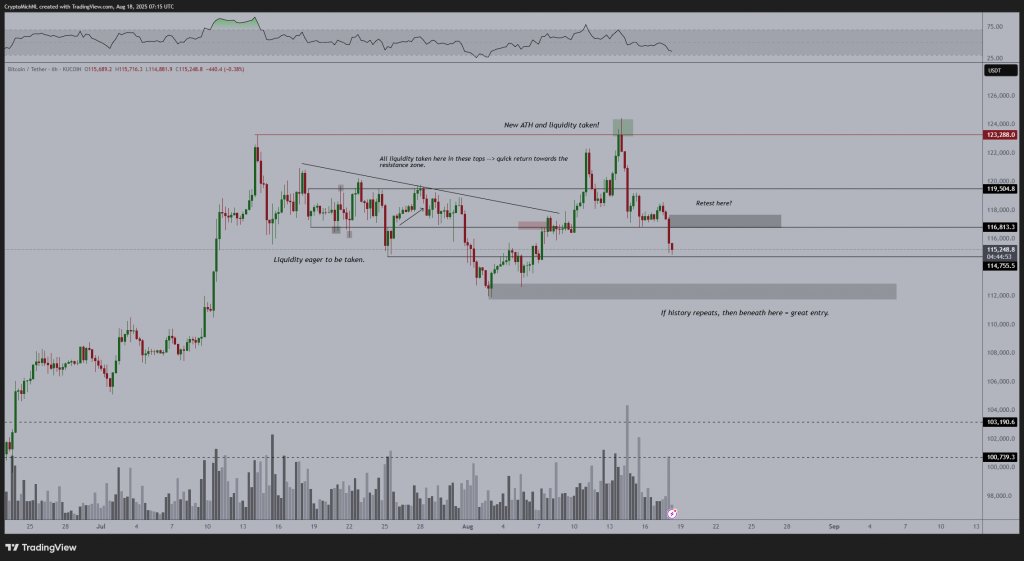
6-часовой график BTC/USD. Аналитика: Михаэль ван де Поппе

Джексон-Холл и снижение ставок

Рассматривая причины падения, торговая фирма QCP Capital указала на макроэкономические факторы. Ежегодный симпозиум Федеральной резервной системы США в Джексон-Холе на этой неделе традиционно заставляет трейдеров фиксировать прибыль, отметила компания, в то время как инфляция остается горячей темой.

По мнению QCP Capital, наиболее вероятно движение в диапазоне: падения к отметке $112 000 будут привлекать покупателей, а ралли до $120 000 будет ограничено продажами, по крайней мере до пятницы, 22 августа (17:00 МСК), когда выступит председатель ФРС Джером Пауэлл (Jerome Powell).

14 августа данные по индексу цен производителей оказались выше ожиданий — рост составил 0,9% в месячном выражении против прогноза в 0,2%. Это осложнило политические рамки ФРС, поэтому рынок будет искать намеки на позицию регулятора перед сентябрьским заседанием. В прошлом году Пауэлл использовал Jackson Hole для сигнала о смягчении политики, но в этом году тарифы Трампа и политическое давление создают гораздо более спорный фон.

Lecturas Relacionadas

The Five Paradoxes of Artificial Intelligence

**Five Paradoxes of Artificial Intelligence** Artificial intelligence (AI) is an era filled with paradoxes, which we navigate as we advance. **1. The Prediction Paradox** AI experts, from pioneers like Marvin Minsky to contemporary figures like Geoffrey Hinton and Demis Hassabis, have a history of inaccurate forecasts regarding AI's capabilities and timelines, such as achieving human-level machine intelligence or surpassing radiologists. Predictions about Artificial General Intelligence (AGI) vary wildly between optimistic entrepreneurs and skeptical academics, highlighting the inherent unpredictability of technological futures. **2. The Employment Quantification Paradox** Despite numerous studies from institutions like the OECD, IMF, and McKinsey attempting to quantify AI's impact on jobs, estimates of affected employment range from 0.4% to 67%, revealing vast inconsistencies. This paradox arises because isolating AI's effect from other economic, social, and technological factors is virtually impossible, and forecasts depend on static assumptions about a dynamically evolving technology. **3. The Productivity Paradox** While AI is a transformative General Purpose Technology, significant productivity growth has not yet materialized in major economies like the EU and has only matched historical averages in the US. This disconnect between rapid innovation and slow productivity gains, reminiscent of the "Solow Paradox" from the computer age, is often explained by time lags. History shows it takes decades for such technologies to diffuse and trigger complementary innovations that boost productivity. **4. The Data Value Paradox** Data is hailed as the "new oil" and critical for AI, yet its economic value is paradoxical. Its worth is realized only in use, not in straightforward trade. Despite policy emphasis and initiatives for data asset recognition on corporate balance sheets in China, the monetized value remains negligible—accounting for only about 0.06% of major telecom operators' total assets—highlighting the gap between perceived utility and financial valuation. **5. The Industrial Revolution Paradox** For decades, nearly every major new technology, from the internet and nanotechnology to blockchain and now AI, has been proclaimed as the driver of a "Fourth Industrial Revolution." This constant reassignment suggests prior labels were premature. True industrial revolutions are typically identified in hindsight, not in real-time. Furthermore, the coexistence of such a proclaimed transformative revolution with ongoing economic crises would be historically anomalous. Whether AI truly defines a new industrial revolution remains a narrative for the future to decide.

marsbitHace 1 min(s)

The Five Paradoxes of Artificial Intelligence

marsbitHace 1 min(s)

Experts Warn of Mass Crypto Hacks Using AI Agents

Experts warn that AI agents could dramatically lower the cost and scale of attacks against cryptocurrency holders. Speaking at the Wyoming Blockchain Symposium, industry figures noted that automation allows malicious actors to simultaneously search for vulnerabilities in wallets, passwords, and networks across a vast number of potential victims. Ryan Kirkly, co-founder and CEO of Global Settlement Network, criticized the industry for often viewing autonomous agents only as beneficial tools while underestimating their offensive potential. Data from TRM Labs shows the crypto industry experienced a record 207 hacks in the first half of 2026, causing $972 million in losses, with the number doubling from the same period in 2025. Vice President of Technical Operations at Web3 Foundation, Bill Labun, agreed that the efficiency of autonomous systems also benefits attackers. While defenders like the Ethereum Foundation are using AI agents for security audits, the need for human verification remains high due to false positives. A major concern is granting AI agents direct access to financial tools and personal data. New services like MetaMask's Agent Wallet, which allows AI to manage assets within set limits, introduce risks such as prompt injection attacks. Panelists also highlighted risks from metadata leakage, which can compromise privacy even on private networks, and the unresolved issue of legal liability for an AI agent's autonomous and potentially irreversible actions. Lack of user trust, due to AI's tendency to "hallucinate" or generate incorrect information, was cited as a key barrier to widespread adoption.

cryptonews.ruHace 2 min(s)

Experts Warn of Mass Crypto Hacks Using AI Agents

cryptonews.ruHace 2 min(s)

American economic magazine Forbes stated that bitcoin could become a neutral reserve asset for the global economy!

American business and economic magazine Forbes has suggested that Bitcoin could potentially play a significant role as a neutral reserve asset in the global financial system. According to the publication, Bitcoin might offer an alternative to the growing debates surrounding the US dollar's status as the world's reserve currency and the current system's reliance on US government bonds. Forbes notes that the dollar's reserve status grants the US significant advantages but also highlights the inherent "Triffin dilemma," where the US struggles to balance its domestic economic needs with global demand for the reserve currency. The current system draws global capital to the US, allowing for cheaper imports but weakening domestic competitiveness and worsening the trade deficit. The post-gold standard system has been sustained by US bonds, yet fundamental contradictions remain. The magazine argues that stablecoins cannot fully address the reserve asset issue as they are largely backed by US Treasuries. While gold is a neutral reserve asset, it has limitations regarding mobility, verification, and transactional efficiency. In contrast, Bitcoin, with its fixed supply, lack of need for state credit guarantees, and ease of global verification and transfer, is presented as a potential next-generation neutral reserve asset. Forbes states that while the US dollar will continue to be used in international trade, Bitcoin could eventually assume the reserve asset role, reducing the global economy's dependence on any single country's debt instruments. The article also acknowledges that hurdles like price volatility and limited institutional adoption must be overcome. *This is not investment advice.

cryptonews.ruHace 3 min(s)

American economic magazine Forbes stated that bitcoin could become a neutral reserve asset for the global economy!

cryptonews.ruHace 3 min(s)

Trading

Spot
活动图片