支持率超97%,谁是LayerZero收购Stargate的最大受益者?

Odaily星球日报Publicado a 2025-08-18Actualizado a 2025-08-18

原文来自matt

编译|Odaily 星球日报 Golem(@web 3_golem

编者按:8 月 18 日上午,LayerZero 基金会关于收购 Stargate 的提案已开始投票,目前支持率为 97.09%,投票将于 8 月 24 日结束。从当前票数看,LayerZero 成功收购 Stargate 已是板上钉钉。那么,谁将是这场收购的最大受益者?

提案概要

LayerZero 希望收购 Stargate 代币及其金库(具体而言,该金库支持每个 STG 代币的价值为 0.1444 美元),从而终止 Stargate DAO,并将其与由 ZRO 驱动的经济体合并。收购价格为每个 STG 为 0.1675 美元,1 ZRO=0.08634 STG。

该提案依旧遵循与 Stargate DAO 上发布的其他提案一样的标准程序,至少需要 120 万票,且投票通过的法定人数达到 70%。收购通过了,Stargate 未来产生的任何超额收入都将用于通过回购减少 ZRO 的流通供应量。

谁是收购的最大受益者?

在目前的情况下,LayerZero 和 ZRO 代币持有者似乎将从此次收购中获益最多,因为这是他们通过自有代币进行的流动性收购,这意味着:

  • 以比 Stargate 金库支持的 STG 价格溢价 16%进行收购,同时还能增加 ZRO 持有者的数量;
  • 收益来自协议产生的费用,根据 DefiLlama 数据,Stargate 协议年收益为 174 万美元。这些费用将用于在公开市场上回购 ZRO;
  • 将 ZRO 代币经济学与 LayerZero 擅长的跨链业务垂直整合,并通过回购提升其效用。

但 STG 和 veSTG(锁定的 STG)持有者能获得什么呢?其实并不多。

由于 ZRO 代币近期价格上涨,导致折扣变小,而由于市场波动,STG 的溢价较小,且价格下限明确。经过一段时间讨论,LayerZero 决定将 Stargate 六个月的收入支付给 veSTG 持有者,因为他们在锁定期结束前无法解锁代币。

STG 持有者的抱怨

这里有很多值得探讨的地方,但我认为一切都归结于一个词:妥协。在当前形势下,LayerZero 有望获得更多收益,而 Stargate 代币持有者则至少不会感到满意。
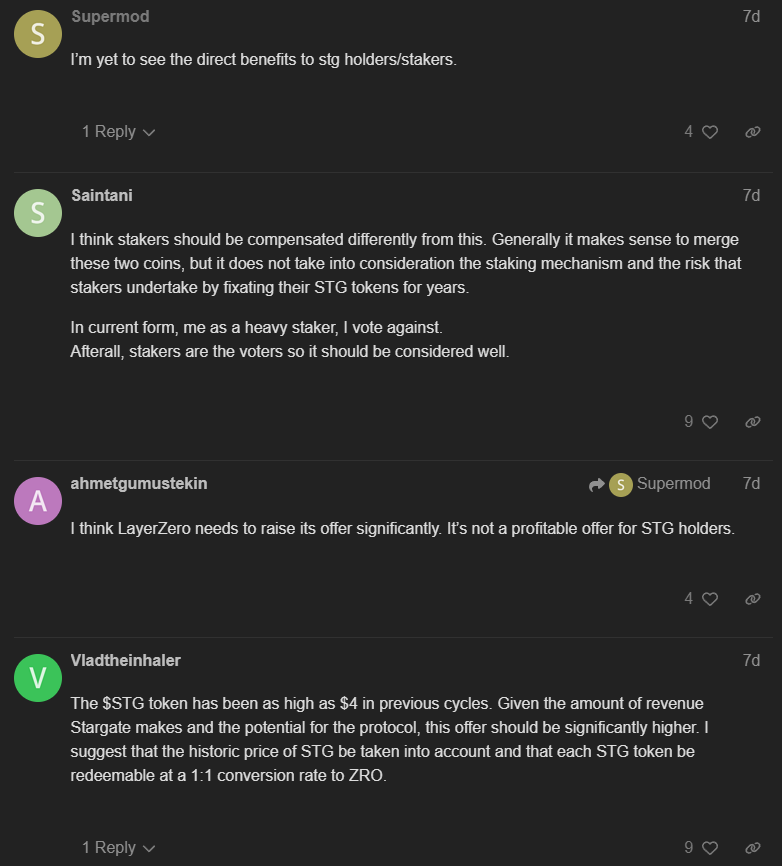
STG 持有者的不满

以下是三个主要问题和不确定性:

  • LayerZero 应该以何种溢价收购 STG 代币?
  • 对于 STG 持有者来说,哪个是“两害相权取其轻”的选择?是永久性地抛售代币,还是选择更安全且没有太多收益的选择?
  • 鉴于平均锁定期约为一年,而如果提案通过,他们只能获得六个月的补偿,那么现在对 veSTG 持有者的激励机制是什么?

STG 的 FDV 仅比 ZRO 略低 10%,而价值 810 万美元的 STG 被锁定为 veSTG。许多 STG 持有者要求 ZRO 和 STG 进行 1:1 兑换,但这不太合理,因为这意味着他们能立即获得 12 倍收益,而 LayerZero 必须投入全部 FDV 来收购一家资金雄厚但目前收入不高的公司。

收购有望实现双赢

虽然 LayerZero 团队应该考虑重新评估支付给 STG 持有者的溢价,并为质押者提供更好的收入分成计划,但此次收购对 Stargate 项目本身来说并非灾难性的。

因为 DAO 主要依靠收入和代币发行来融资,而像 STG 这样的代币已经从历史高点下跌了 95%以上,在年收入只有 200 万美元的情况下,Stargate 几乎没有进一步扩张的空间。此外,Stargate 已经依赖于 LayerZero 的基础设施,因此借助 LayerZero 的技术栈和资金支持,Stargate 可以更轻松地交付和扩展更多功能。

这项收购对 Stargate 来说很有意义。不过话虽如此,STG 持有者对 LayerZero 的留存率和忠诚度将在很大程度上取决于团队如何处理此事。否则,LayerZero 可能会失去一大批新的潜在忠实 ZRO 持有者和 Stargate 利益相关者,这些用户通常是从项目启动之初就一直支持着 Stargate。

但这并不是一次掠夺性收购,因为 LayerZero 现阶段的收益肯定远超 STG 和 veSTG 代币持有者。

Lecturas Relacionadas

Robots Begin to 'Consume Data': The Hidden Production Chain from Indian Data Factories to Billion-Dollar Humanoid Robots

Robots have started to 'consume data,' driving the formation of a new industrial supply chain focused on producing training data for embodied AI. Unlike large language models, which are trained on vast internet text corpora, embodied AI models face a 'data desert' in the physical world. This has created a massive demand for first-person perspective video data (Ego Data), captured by workers wearing cameras in places like Indian garment factories. Companies like Neocambrian AI are establishing 'data factories' where workers perform standardized tasks (e.g., sorting clothes, kitchen organization) to generate thousands of hours of video. Research, such as NVIDIA's EgoScale, demonstrates that scaling this human demonstration data predictably improves robot performance, particularly for dexterous manipulation. This has validated a training path combining large-scale human data for pre-training with smaller amounts of robot-specific data for fine-tuning. The value of different data types varies significantly, forming a 'data pyramid.' The base consists of low-cost, large-scale internet and Ego Data. Higher layers include more expensive motion-capture data (e.g., from data gloves), simulation/synthetic data, and the most costly and scarce layer: real robot teleoperation data. This demand has spawned a layered ecosystem of data suppliers: low-cost data factories, motion capture and alignment specialists, robot-native teleoperation service providers, simulation data companies, and platforms aiming for data standardization. Robot companies themselves are adopting a 'layered procurement' strategy: outsourcing generic Ego Data while building in-house capabilities for robot-specific adaptation data and the critical deployment/failure data generated in real-world applications. The industry is shifting focus from hardware and basic mobility to the data pipelines required for general-purpose capability. While parallels exist to data labeling companies like Scale AI in the LLM boom, the physical complexity of robot data—involving action success ambiguity and sim-to-real gaps—requires more integrated solutions for data collection, annotation, and a continuous feedback loop. The race is on to build the data engines that will teach robots to operate reliably in the unstructured real world.

marsbitHace 43 min(s)

Robots Begin to 'Consume Data': The Hidden Production Chain from Indian Data Factories to Billion-Dollar Humanoid Robots

marsbitHace 43 min(s)

Spicy Commentary | Michael Saylor's 'Player Talk'; 60-Year-Old Aunt Liquidated After 'Scamming a Young Man'

**"Spicy Commentary": Three Tales of Crypto's Wild Week** This week's "Spicy Commentary" column highlights three dramatic stories from the cryptocurrency world. First, **MicroStrategy's Michael Saylor** addressed the controversy over his company potentially selling Bitcoin. At the BTC Prague event, he clarified, "I never said the company can't sell Bitcoin. I told *you* never to sell *your* Bitcoin." This "do as I say, not as I do" stance was criticized by netizens as peak linguistic gymnastics, noting a history of him previously stating the company would "never" sell. Second, a **bizarre fraud case** emerged from Beijing. A 60-year-old woman, obsessed with getting rich from crypto but unwilling to risk her own savings, posed online as the 20-something "god-daughter" of a high-ranking official. She catfished a young man, convincing him to give her over 200,000 yuan for fabricated emergencies. She then invested all the stolen money into cryptocurrency with 10x leverage, only to lose everything in a market crash. The woman was sentenced to four years in prison for fraud. Finally, a **sobering trader's tale** surfaced on Reddit. A user posted "Tale of a crypto trader," confessing their net worth had plummeted from a peak of $45 million to roughly $17,200, primarily due to holding meme coins too long. The post, described as a crypto "book of confessions," sparked reactions ranging from sympathy to critique about greed, poor risk management, and the perils of treating meme coins as long-term investments instead of taking profits. The column concludes that this week featured masterful rhetoric, elaborate scams, and extreme financial volatility, stitching together another chapter in crypto's unpredictable theater.

Foresight NewsHace 1 hora(s)

Spicy Commentary | Michael Saylor's 'Player Talk'; 60-Year-Old Aunt Liquidated After 'Scamming a Young Man'

Foresight NewsHace 1 hora(s)

Tremble Humans, AI Continues Its Accelerated Sprint

Trembling, Humans: AI Continues Its Accelerated Sprint Yes, AI is still rapidly accelerating. While deep learning seemed to stall quickly in its early years, large models after years of development show no sign of hitting their ceiling. At the Zhiyuan Conference 2026, the focus is on enabling AI to move from the digital world into the physical world. Scaling Law remains effective, continuing to drive advancements in both large language models and multimodal models. The industry is now entering a phase of pursuing World Models, though unresolved technical paths and data issues mean this exploration may take 3-5 more years. Concurrently, breakthroughs in Agents are accelerating AI's real-world application in fields like healthcare and meetings. Making Agents truly useful requires key hardware-software co-design, evident from the strong presence of chip vendors at the conference. We stand at a new historical threshold where AI is becoming a foundational force reshaping the world. The first day of the conference highlighted AI's evolution from "knowing how to chat" to "knowing how to work." Scaling Law persists, World Models are the next key battleground, and Agents are transitioning from usable to好用 (user-friendly). Scaling Law is not ending but diversifying. New models like Anthropic's Fable 5 demonstrate scaling through parameter size, synthetic data, and reinforcement learning. Advancements in AI Coding and Agent deployment are enabling a trend of AI self-evolution, potentially allowing AI to take over digital world iterations. World Models represent the next frontier for large models extending into the physical realm, but no current model is truly impressive at solving real-world problems. Technical consensus is lacking, with debates on data sources (video, simulation, real-world). Different approaches are emerging: language-centric, pixel-centric, 3D-structure-centric, and visual-representation-centric models. Zhiyuan Institute is exploring a fifth path: unified latent space modeling fusing language and visual representations, and introduced its own under-development World Model, Physis-v0.1. On the product side, Agents are key to bringing AI into daily life. Since 2025, the "Year of the Agent," products have become more proactive and capable of complex tasks. Zhiyuan showcased four vertical Agents for cardiac diagnosis, autonomous research, meeting summarization, and protein risk discovery. However, technical challenges remain, particularly in context engineering like memory and orchestration. "Harness" – the engineering framework around an Agent – is crucial for maximizing its capabilities by clarifying intent, designing workflows, and incorporating validation and feedback. In summary, AI's breakneck pace continues on multiple fronts: foundational model scaling, the ambitious pursuit of World Models for physical understanding, and the ongoing refinement of practical Agents. The journey from capable to truly reliable and useful AI systems is well underway.

marsbitHace 1 hora(s)

Tremble Humans, AI Continues Its Accelerated Sprint

marsbitHace 1 hora(s)

The Backside of Musk's Trillion-Dollar Fortune: 85% Can't Be Sold

Elon Musk becomes the world's first trillionaire, driven by SpaceX's IPO valuing the company at $1.77 trillion. However, his vast wealth is largely illiquid: he holds over 85% voting control, likely through super-voting shares that are subject to lock-ups and selling restrictions. While his net worth surpasses $1 trillion across SpaceX, Tesla, and private holdings, only a tiny fraction (potentially under 2% annually) could be converted to cash without jeopardizing control and market confidence. SpaceX's IPO also creates paper millionaires for roughly 4,400 employees, but their holdings face lock-up periods, exercise costs, and taxes, delaying and reducing actual cash proceeds. Only 4.2% of total shares are initially available for public trading, making the stock price highly sensitive to limited net buying or selling pressure. A major test will come when lock-ups expire for the remaining 96% of shares. The article contrasts SpaceX's wealth distribution with potential AI IPOs. Anthropic and OpenAI could generate employee wealth pools 20 times larger than SpaceX's in paper value, due to their higher valuations relative to revenue and potentially more distributed ownership. However, sustaining those high price-to-sales multiples post-IPO is uncertain. A key financial puzzle for SpaceX investors is its xAI unit. While it has locked in an estimated $26 billion in annual compute revenue from clients like Anthropic and Google, the unit reported a $6.4 billion loss in 2025. More critically, estimated annual capital expenditures of ~$30.8 billion exceed that revenue. The long-term viability of SpaceX's AI narrative hinges on whether this compute income can eventually cover the unit's massive ongoing investments and losses.

链捕手Hace 1 hora(s)

The Backside of Musk's Trillion-Dollar Fortune: 85% Can't Be Sold

链捕手Hace 1 hora(s)

Trading

Spot
Futuros
活动图片