Аналитик предупредил о возможной коррекции биткоина ниже $117 000

cryptonews.ruPublicado a 2025-01-11Actualizado a 2025-08-12

12 августа цена цифрового золота упала на 2% — с $122 000 до $118 000. Аналитик и основатель MN Trading Михаэль ван де Поппе назвал это движение «довольно некрасивой дневной свечой» и допустил снижение котировок до $116 800.

I don't like this daily candle on #Bitcoin.

It has taken all the liquidity on the highs and immediately inversed towards the range high resistance.

Quite ugly daily candle.

Wouldn't be surprised if we'll test $116.8K before continuing. pic.twitter.com/BiYtBLEtfG

— Michaël van de Poppe (@CryptoMichNL) August 11, 2025

Ранее биткоин вырос до $122 150 и приблизился к историческому максимуму на $123 100, достигнутому 15 июля. Инвесторы ожидали нового рекорда, но цена развернулась вниз.

«Он [биткоин] забрал всю ликвидность на максимумах и мгновенно развернулся к верхней границе диапазона сопротивления», — пояснил ван де Поппе.

По данным CoinGlass, падение на 1,75% до прогнозируемого аналитиком уровня может спровоцировать ликвидации лонгов на $1,63 млрд. Несмотря на это, эксперт сохраняет оптимизм и ожидает дальнейшего роста биткоина.

По словам криптотрейдера под псевдонимом Rekt Capital, пробитие отметки $126 000 может поднять курс цифрового золота еще выше.

#BTC

If Bitcoin is able to convincingly break ~$126,000 then chances are price will go a lot higher and quickly$BTC #Crypto #Bitcoin

— Rekt Capital (@rektcapital) August 11, 2025

Рыночные настроения также остаются позитивными. Индекс страха и жадности составляет 68, что соответствует зоне «жадности.
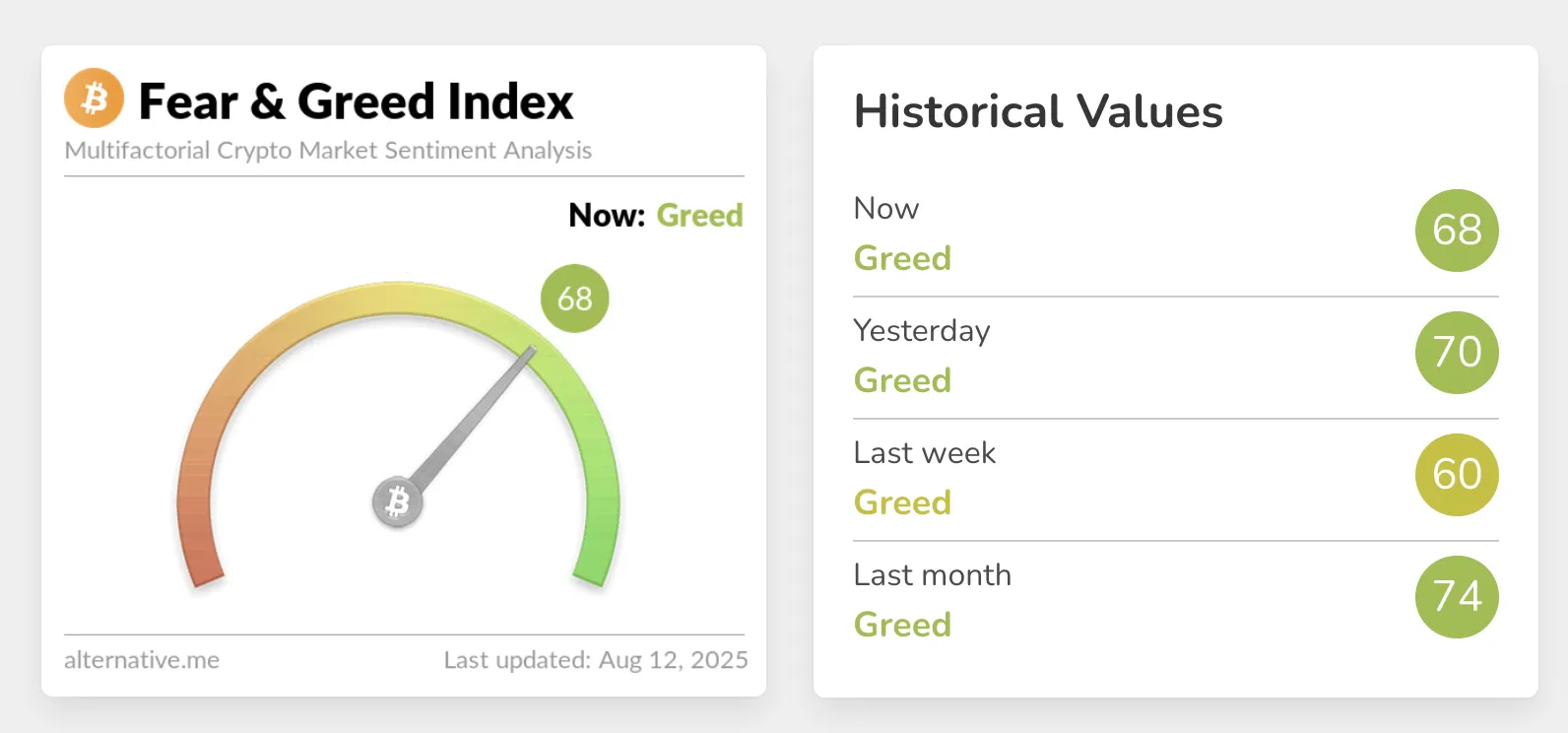
Индекс страха и жадности крипторынка. Источник: Alternative.me.

Тем временем спотовые биткоин-ETF продолжают демонстрировать устойчивые притоки. За последние сутки фонды привлекли $178,1 млн.
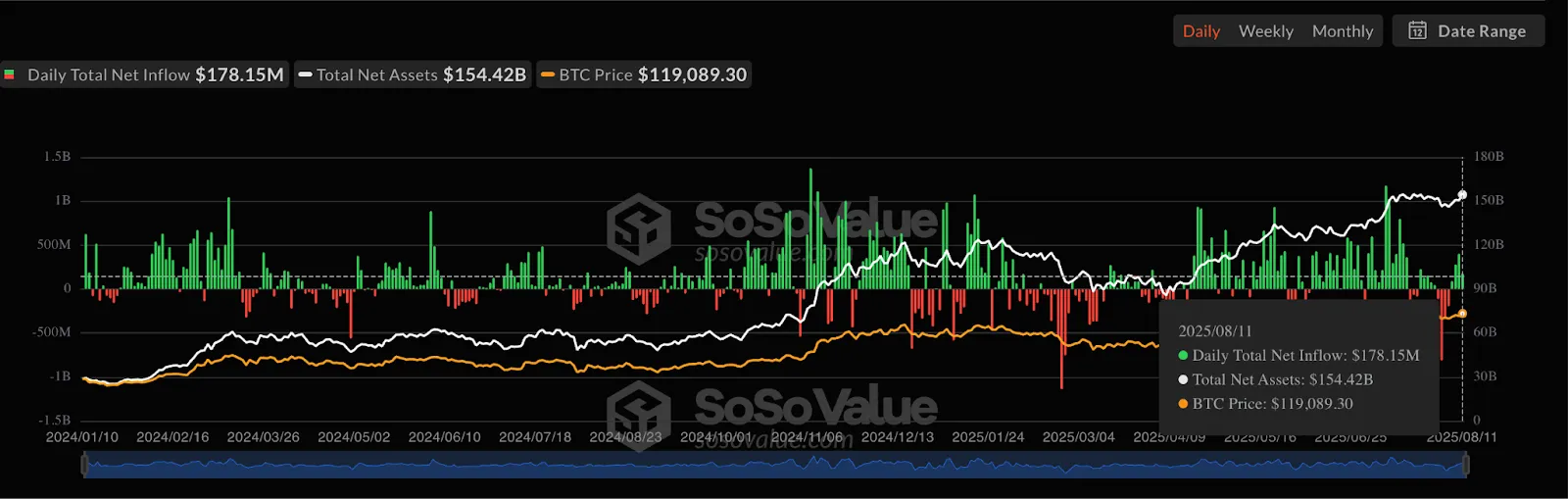
График оттоков и притоков по спотовым биткоин-ETF. Источник: SoSoValue.

Напомним, основатель Capriole Investments Чарльз Эдвардс оценил справедливую стоимость цифрового золота в $167 800.


Lecturas Relacionadas

Bitwise Chief Investment Officer: STRC Plunge is a Bottom Signal, Bull Market to Start in Autumn

Bitwise CIO: STRC's Plunge Signals Market Bottom, Bull Run Likely This Fall Bitwise CIO Matt Hougan analyzes the recent sharp decline of Strategy's perpetual preferred shares (STRC) and its implications for the bitcoin market. STRC, a product designed for stable, high-yield income, fell dramatically from its $100 target to $75 amid concerns about Strategy's ability to maintain dividends as bitcoin prices dropped. While Strategy's overall balance sheet remains strong, with ample assets to cover liabilities, market panic stemmed from its right to suspend STRC dividends. In response, Strategy introduced a new framework, committing to sell bitcoin as needed to fund dividends and allowing STRC to float freely, abandoning the $100 peg mechanism. This shift marks a change in Strategy's role from a consistent net buyer to a more dynamic participant in the bitcoin market. Hougan views the STRC volatility and related sell-off in MicroStrategy (MSTR) stock as classic late-cycle behavior, where mismatched leverage is being purged from the system. He draws parallels to the GBTC premium unwind after the 2021 bull market. This necessary deleveraging, he argues, is a precursor to finding a market bottom. Key bottoming signals to watch include MSTR trading at a discount to its net asset value (NAV), crypto fear & greed indices hitting extreme lows, and sustained negative bitcoin funding rates. Hougan concludes that as excess leverage is cleared, the market is nearing its bottom, setting the stage for a new bull cycle to begin in the autumn. The next major wave of buyers, he believes, will be institutional investors like banks, asset managers, and pension funds.

marsbitHace 48 min(s)

Bitwise Chief Investment Officer: STRC Plunge is a Bottom Signal, Bull Market to Start in Autumn

marsbitHace 48 min(s)

The Largest Upgrade Since The Merge? How Glamsterdam Will Affect Ethereum?

Ethereum's next major upgrade, Glamsterdam (combining consensus layer "Gloas" and execution layer "Amsterdam"), is scheduled for late 2026 and considered the most significant overhaul since The Merge. It aims to fundamentally enhance L1 performance and architecture to prepare for substantial capacity increases. The upgrade centers on three core changes: 1. **Enshrined PBS (ePBS - EIP-7732):** Integrates the Proposer-Builder Separation directly into the protocol, eliminating reliance on external relays. This extends the window for processing execution payloads, allowing nodes more time to handle larger blocks and more data, paving the way for a higher Gas Limit. 2. **Block-Level Access Lists (BALs - EIP-7928):** Provides a pre-declared "map" in the block header of all state data (accounts, storage) that transactions will access and modify. This enables potential parallel transaction processing and faster state synchronization for nodes. 3. **Gas Repricing (EIP-8037):** Overhauls the gas model to more accurately reflect the real resource costs for nodes. It separates computation costs from state storage costs, making operations that create permanent state data (like new accounts) more expensive, while computation-heavy operations become relatively cheaper. These changes work together to solve the trilemma of scaling: giving nodes more time to process larger blocks (ePBS), reducing execution bottlenecks (BALs), and controlling unsustainable state growth (Gas Repricing). The goal is a credible path to a higher Gas Limit (e.g., 200M gas) without compromising decentralization by overburdening node hardware. For users: * Transaction fees for simple transfers may decrease and become more stable due to increased block space, but state-intensive operations (contract deployment) may cost more. * Gas estimation by wallets will improve in accuracy. * L2 data posting costs could become more stable long-term due to increased Blob capacity. * EIP-7708 will standardize logs for ETH transfers, improving tracking for wallets and exchanges. Node operators must upgrade clients, but ETH holders need take no action. In essence, Glamsterdam doesn't just raise the block size limit; it re-engineers Ethereum's core block production, execution, and economic models to enable sustainable, decentralized scaling.

marsbitHace 1 hora(s)

The Largest Upgrade Since The Merge? How Glamsterdam Will Affect Ethereum?

marsbitHace 1 hora(s)

Trading

Spot
活动图片