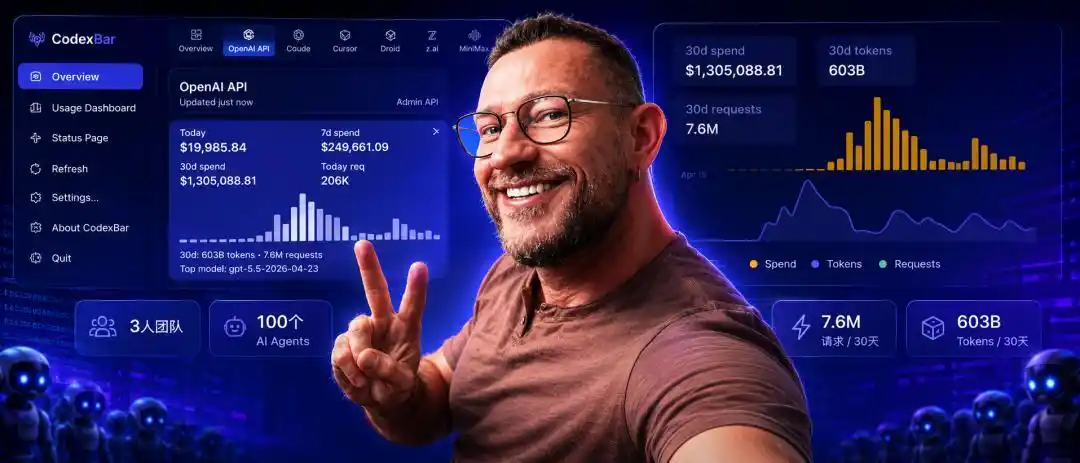
3 People with 100 AI Programmers, Burning Through $1.3 Million a Month! OpenAI: I'll Foot the Bill

marsbitPublicado a 2026-05-17Actualizado a 2026-05-17

Resumen

In a striking demonstration of AI-powered development, Peter Steinberger (creator of OpenClaw) shared that his three-person team spent $1.3 million in one month to run approximately 100 AI agents (primarily Codex instances). OpenAI covered the cost. The expenditure consumed 6.03 trillion tokens across 7.6 million requests. Steinberger argues that, with "fast mode" disabled, the cost falls below that of a single engineer while providing significantly greater output. This "cloud programmer army" handles core but tedious software engineering tasks: reviewing pull requests, finding security vulnerabilities, deduplicating issues, fixing bugs, monitoring benchmarks, and even generating PRs after meetings. This shifts AI's role from merely writing code to maintaining the entire collaborative fabric of a project. Steinberger's tool, CodexBar (a macOS menu bar app), tracks usage and costs across various AI coding services, highlighting how token consumption is becoming a key metric—a new "means of production." The experiment poses a profound question: if token cost ceases to be a barrier, how will software development transform? As model prices fall, the capability for small teams to leverage large numbers of AI agents could become commonplace, fundamentally altering the scale and speed of development. The future, Steinberger suggests, is arriving rapidly.

Peter Steinberger

Editor: Solomon

[New Zhiyuan Report] 3 people, 100 AI agents, burning through $1.3 million a month — The father of OpenClaw has turned software development into an "AI assembly line," with OpenAI picking up the tab.

While others show off their pay stubs, he shows off the bill — $1.3 million a month!

That's nearly 9 million RMB per month. It's left netizens utterly dumbfounded.

OpenClaw father Peter Steinberger casually posted a screenshot on X.
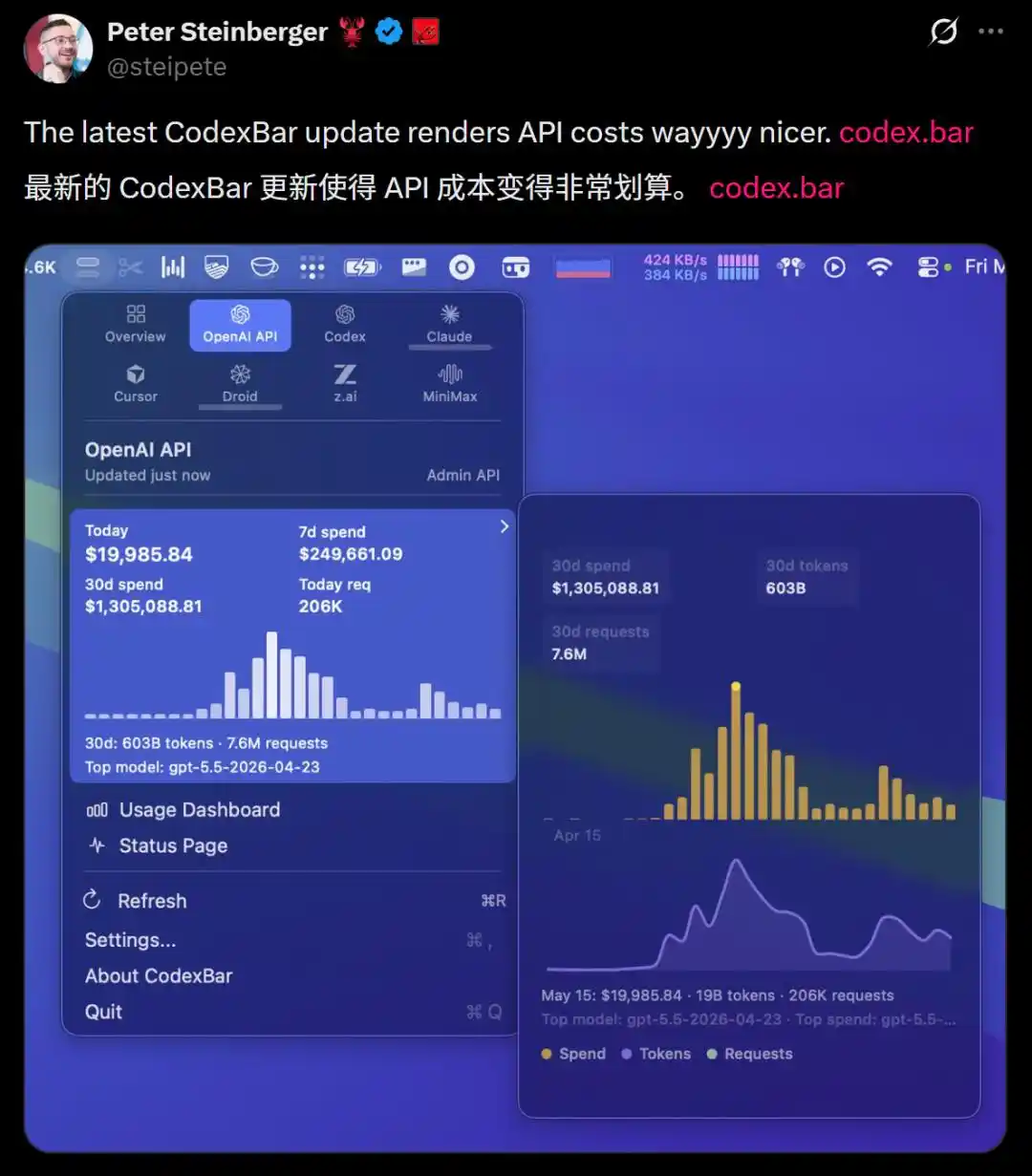
Peter Steinberger

But the numbers on the screenshot were anything but casual:

30-day spend: $1,305,088.81. Consumed 603 billion tokens. Made 7.6 million requests.

You read that right, 1.3 million U.S. dollars. And it's not a quarterly AI budget for some big tech company — it's the monthly usage of a three-person team.

Even more explosive: OpenAI is reimbursing this cost.

The comment section instantly went wild.

Some were amazed, some skeptical, some whipped out their calculators to figure out "how many programmers this equals."

Steinberger himself calmly responded: "With fast mode off, my cost is less than an engineer, and it really helps a lot more."

Translation: — It's genuinely cost-effective!

Other netizens were shocked by the $400k/month engineer — "The San Francisco job market is insane."
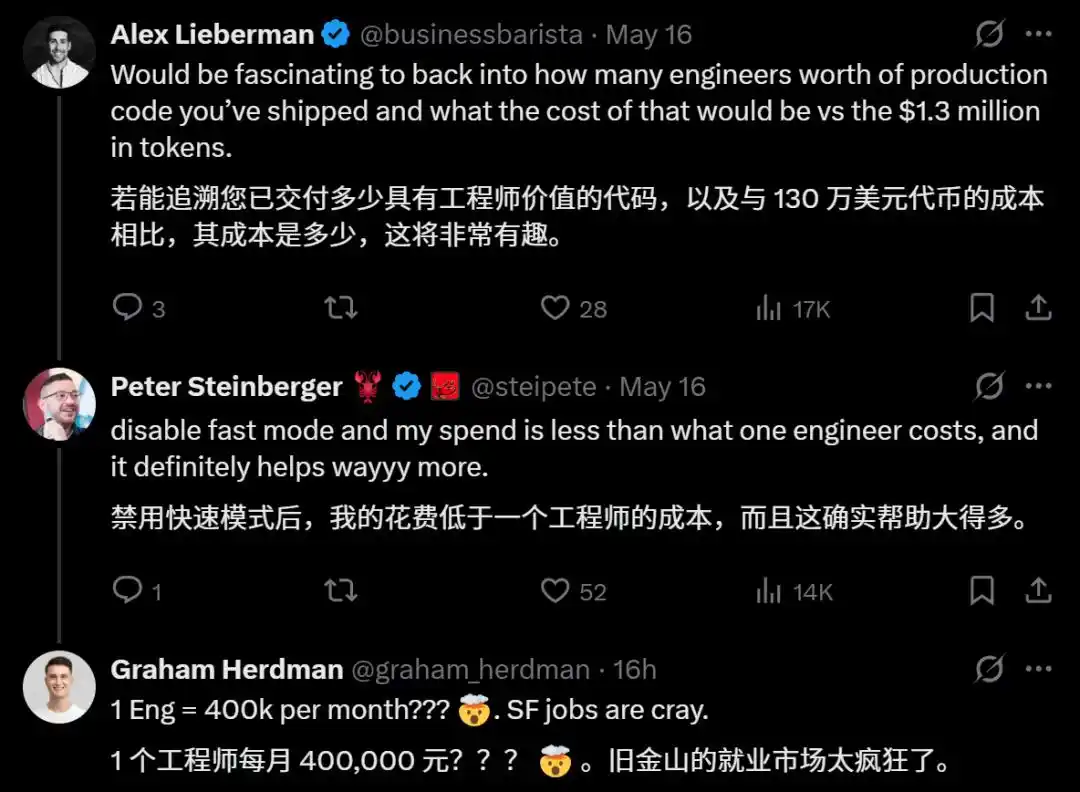
Netizen comment
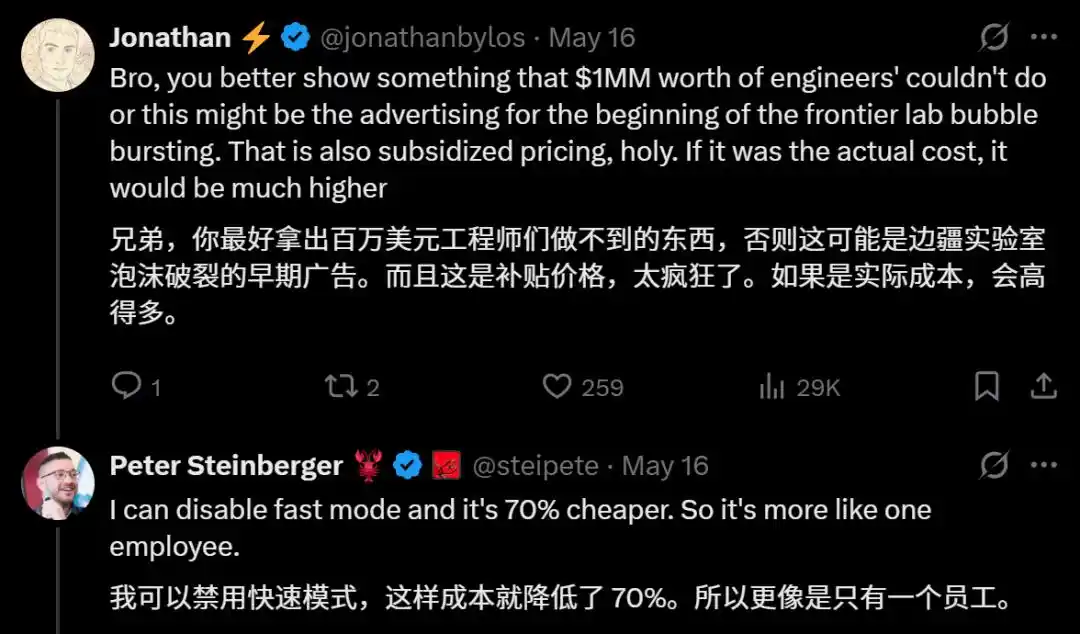
Netizen comment

Others were curious about where this massive token usage went.

Peter responded that most was used for OpenClaw development.
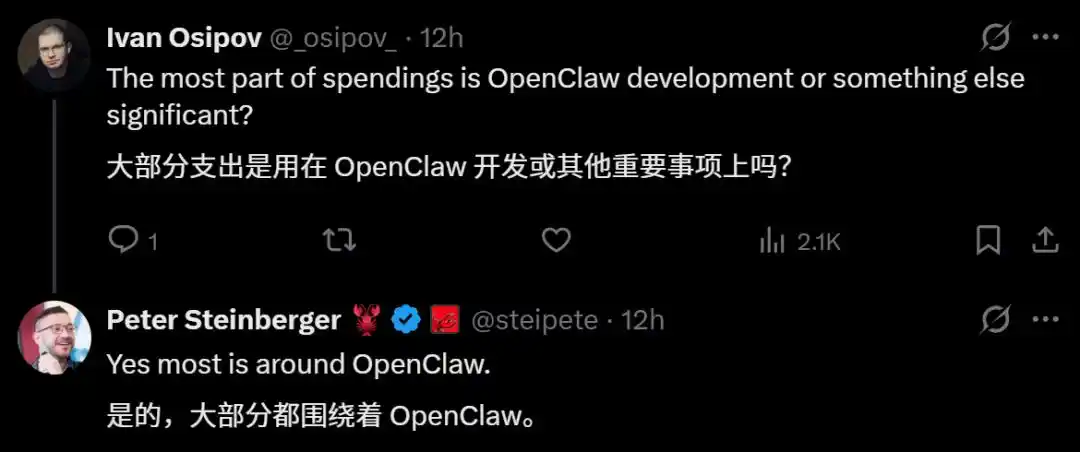
Netizen comment

A Cloud-Based Programmer Army

The most outrageous thing is that Pete's small team only has 3 people.

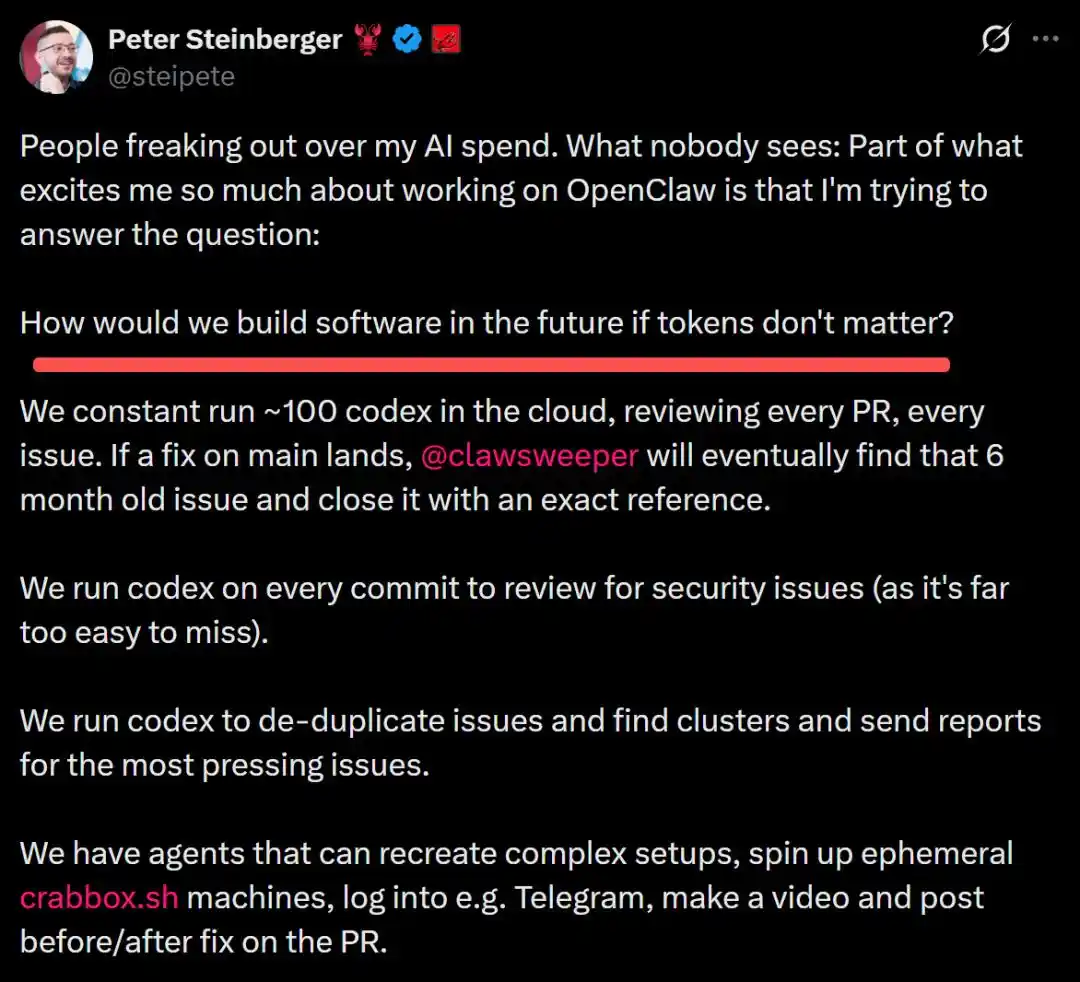
They have about 100 Codex instances running long-term in the cloud, handling the dirtiest, most grueling, most mind-numbing work in software engineering —

Reviewing PRs, finding security vulnerabilities, deduplicating issues, fixing bugs, monitoring benchmarks, posting to Discord upon discovering regressions, even opening PRs directly after listening to meetings.

Thus, AI isn't just "helping you write code," but is infiltrating every crevice of software collaboration.

This is terrifying.

Because what's truly expensive in software development is communication, comprehension, context switching, review, regression, fixes, waiting, and repetitive tasks.

In the past, a team spent a huge amount of time each day on these things that don't seem like "creation" but without which the project would rot.

Now, Peter has tossed all these processes to a bunch of AI agents at once.

This is AI starting to maintain the nervous system of an organization for you.

Illustration

There's another important detail in this screenshot: it's not the OpenAI backend, but CodexBar made by Peter.

CodexBar is a macOS menu bar tool for tracking usage windows, credits, costs, and reset times for various AI programming tools.

It supports a bunch of services like Codex, Claude, Cursor, Gemini, Copilot, etc.

What used to be in a programmer's menu bar? CPU, memory, battery, network speed.

Now there's one more thing: tokens. Tokens are becoming a new "means of production."

CodexBar

A Final Word

$1.3 million a month, 3 people, 100 AI agents.

Ponder this set of numbers — three living humans, leading a hundred digital employees who don't eat, sleep, or demand raises, doing the work of an entire engineering team.

Some felt invigorated after reading this: AI finally isn't just a decorative vase for chatting! Others felt a chill down their spine: Wait, so what do we coders do in the future?

But honestly, what keeps me up at night is Steinberger's casual remark: "I'm exploring what software development would look like if token cost wasn't an issue."
Peter Steinberger

Everyone, he said "if."

The problem is, this "if" is visibly turning into "when" at an astonishing speed.

The work that costs $1.3 million today, after one price cut for models, becomes $130k. Another cut, $13k.

On that day, having 100 AI agents working simultaneously is no longer a game exclusive to Silicon Valley big shots, but a basic operation for any three-person startup team.

Three young people in a garage, holding a hundred tireless AI programmers — this image, just thinking about it is absurd.

Peter Steinberger has revealed the bottom card.

On the card it says: The future is already knocking, and it doesn't plan to wait for you to be ready.

References:

https://the-decoder.com/for-1-3-million-a-month-openclaw-founder-peter-steinberger-runs-100-ai-agents-that-code-review-prs-and-find-bugs/

https://x.com/steipete/status/2055346265869721905

https://developers.openai.com/codex/speed

This article comes from the WeChat public account "New Zhiyuan", author: New Zhiyuan

Preguntas relacionadas

QHow much money did the three-person team spend on AI development in one month, and who covered the cost?

AThe three-person team spent $1,305,088.81 (approximately 1.3 million USD) in one month on AI development, and the cost was covered by OpenAI.

QWhat is the name of the tool Peter Steinberger created to track AI development costs and usage?

APeter Steinberger created a tool called CodexBar, a macOS menu bar application that tracks usage windows, credits, costs, and reset times for various AI programming tools like Codex, Claude, Cursor, Gemini, and Copilot.

QApproximately how many AI agents (instances) does Peter Steinberger's team run for development tasks?

APeter Steinberger's team runs approximately 100 AI Codex instances to perform various development tasks.

QWhat kinds of software development tasks do the AI agents in the article handle?

AThe AI agents handle tasks such as reviewing pull requests (PRs), finding security vulnerabilities, deduplicating issues, fixing bugs, monitoring benchmarks, reporting regressions to Discord, and even opening PRs after listening to meetings.

QWhat is the core implication Peter Steinberger highlights regarding the future of software development with AI?

APeter Steinberger highlights that the core implication is exploring what software development would look like if token cost were not a limiting factor, suggesting a future where small teams can leverage large numbers of AI agents as a standard practice, dramatically changing the development landscape.

Lecturas Relacionadas

Morning Post | Michael Saylor Releases Bitcoin Tracker Info; Aave Publishes Kelp rsETH Bridge Attack Post-Incident Investigation; Gravity Bridge Announces Service Suspension Following Attack

ChainCatcher Daily Summary - June 1, 2026 In regulatory news, the U.S. OCC granted preliminary conditional approval for Laser Digital to establish a federally regulated trust bank. In Vietnam, a draft law amendment proposes allowing SMEs to use digital and virtual assets as loan collateral. Hong Kong's SFC chairman reported that trading volume on the city's 12 licensed virtual asset platforms grew nearly 300% YoY in Q1 2026. Notable incidents include the Cosmos ecosystem cross-chain bridge Gravity Bridge pausing services after an attack. Aave published a post-mortem on the April 18th Kelp rsETH bridge attack, attributing it to a third-party bridge infrastructure vulnerability via an RPC poisoning attack, not the Aave protocol itself. In market developments, MicroStrategy's Michael Saylor hinted at a potential upcoming Bitcoin purchase announcement. Fed Governor Waller commented that widespread stablecoin adoption could amplify the impact of U.S. monetary policy. Meanwhile, sentiment analysis from Santiment indicates a record-high Bitcoin long/short ratio of 2.23, potentially signaling a short-term price correction, while Ethereum shows signs of FUD among commentators. In legal matters, the SEC sued the founder of Privvy Investments for an alleged $12.3 million crypto AI trading bot scam. In China, a Qingdao man was sentenced to 10 years and 9 months for stealing 107 BTC by obtaining a victim's wallet seed phrase. Top trending meme tokens on ETH, Solana, and Base networks for the past 24 hours are also listed.

链捕手Hace 41 min(s)

Morning Post | Michael Saylor Releases Bitcoin Tracker Info; Aave Publishes Kelp rsETH Bridge Attack Post-Incident Investigation; Gravity Bridge Announces Service Suspension Following Attack

链捕手Hace 41 min(s)

Alibaba 'Stocks Up', ByteDance 'Trains'

"In late May, two closely timed events in China's AI industry clearly revealed the divergent strategic approaches of two tech giants: Alibaba and ByteDance. Alibaba is aggressively integrating AI into its existing commercial ecosystem, prioritizing immediate monetization. Its Qwen App now fully integrates with Taobao, leveraging the platform's 4-billion-item database for AI-powered shopping features like virtual try-on and price comparison. Internally, Alibaba has reorganized to incentivize AI-driven business growth, notably through the 'Agentic Commerce Trust Protocol' to enable AI-agent transactions. Financially, it emphasizes ROI, with CEO Daniel Wu stating every AI chip purchased is generating revenue. Alibaba's strategy bets that foundational AI model capabilities won't be leapfrogged in the next five years, allowing its 'AI-as-a-utility' approach to succeed. In stark contrast, ByteDance's Seed division focuses on pushing the frontiers of AGI with a long-term, research-oriented mindset. Its video generation model, Seedance 2.0, topped international benchmarks. The division, led by researchers Wu Yonghui and product head Zhu Wenjia, is tasked with 'exploring the upper limits of intelligence,' even considering open-sourcing its models—a rare move among Chinese firms. ByteDance is investing heavily, with reports of its 2026 capital expenditure plan being nearly triple that of 2024, funded by its substantial private profits. This allows it to pursue projects like an 8-month research paper questioning if video models are true 'world models,' devoid of immediate commercial pressure. The core divergence is less about corporate philosophy and more about structural constraints. As a publicly traded company, Alibaba is bound to quarterly financial expectations, forcing a pragmatic, revenue-focused AI integration. As a private entity, ByteDance has the luxury to fund long-term, high-risk foundational research without answering to public markets. The article concludes that the true determinant of a Chinese company's AI path is its IPO status, suggesting that if ByteDance were public, or if Alibaba were private, their strategies might well be reversed."

marsbitHace 2 hora(s)

Alibaba 'Stocks Up', ByteDance 'Trains'

marsbitHace 2 hora(s)

Why More AI Agents Does Not Equal Higher Productivity?

Editor's Note: As AI Agents become cheaper and easier to use, a new constraint emerges: the cost isn't in launching more Agents, but in the human attention required to manage, judge, and integrate their outputs. This hidden cost is called the "orchestration tax." The article argues that a developer's cognitive bandwidth is the key bottleneck—a serial, non-parallelizable resource akin to a Global Interpreter Lock (GIL). While many Agents can run concurrently, their results ultimately require human judgment for review, conflict resolution, and final integration. Therefore, more Agents don't automatically mean higher productivity; they can simply create longer queues, lead to cognitive fatigue, and create the illusion of busyness without real output. The core solution is to design workflows around this scarce human attention. Key strategies include: scaling the number of Agents to match review capacity (not UI capacity), categorizing tasks (delegating independent ones, keeping complex judgment-heavy ones serial), batch reviewing results to minimize context-switching costs, automating verifiable checks to reserve human judgment for critical decisions, and protecting focused, uninterrupted thinking time. Ultimately, the critical skill is not launching many Agents, but architecting systems that respect the fundamental limit of human attention. Unpaid "orchestration tax" accumulates as both technical and cognitive debt, undermining system understanding and quality. True productivity comes from thoughtfully managing the single-threaded resource—your focus.

marsbitHace 3 hora(s)

Why More AI Agents Does Not Equal Higher Productivity?

marsbitHace 3 hora(s)

Trading

Spot
Futuros

Artículos destacados

Cómo comprar BILL

¡Bienvenido a HTX.com! Hemos hecho que comprar Billions Network (BILL) sea simple y conveniente. Sigue nuestra guía paso a paso para iniciar tu viaje de criptos.Paso 1: crea tu cuenta HTXUtiliza tu correo electrónico o número de teléfono para registrarte y obtener una cuenta gratuita en HTX. Experimenta un proceso de registro sin complicaciones y desbloquea todas las funciones.Obtener mi cuentaPaso 2: ve a Comprar cripto y elige tu método de pagoTarjeta de crédito/débito: usa tu Visa o Mastercard para comprar Billions Network (BILL) al instante.Saldo: utiliza fondos del saldo de tu cuenta HTX para tradear sin problemas.Terceros: hemos agregado métodos de pago populares como Google Pay y Apple Pay para mejorar la comodidad.P2P: tradear directamente con otros usuarios en HTX.Over-the-Counter (OTC): ofrecemos servicios personalizados y tipos de cambio competitivos para los traders.Paso 3: guarda tu Billions Network (BILL)Después de comprar tu Billions Network (BILL), guárdalo en tu cuenta HTX. Alternativamente, puedes enviarlo a otro lugar mediante transferencia blockchain o utilizarlo para tradear otras criptomonedas.Paso 4: tradear Billions Network (BILL)Tradear fácilmente con Billions Network (BILL) en HTX's mercado spot. Simplemente accede a tu cuenta, selecciona tu par de trading, ejecuta tus trades y monitorea en tiempo real. Ofrecemos una experiencia fácil de usar tanto para principiantes como para traders experimentados.

144 Vistas totalesPublicado en 2026.05.07Actualizado en 2026.05.12

Cómo comprar BILL

Discusiones

Bienvenido a la comunidad de HTX. Aquí puedes mantenerte informado sobre los últimos desarrollos de la plataforma y acceder a análisis profesionales del mercado. A continuación se presentan las opiniones de los usuarios sobre el precio de BILL (BILL).

活动图片