代币化股票市场规模有望增长 2600 倍,谁将收益?

coinvoicePublicado a 2025-07-28Actualizado a 2025-07-29

撰文:Tiger Research

编译:AididiaoJP,Foresight News

摘要

市场机遇:代币化股票市场目前规模为 5 亿美元,但如果全球股票中能够有 1% 的市场实现代币化,到 2030 年市场规模可能达到 1.34 万亿美元。这意味着 2,680 倍潜在增长,主要驱动力是 2025 年监管明确性和成熟的基础设施的双重推动。

价值主张:代币化股票支持全天候全球交易,并允许代币化股票所有权。其关键差异化在于与去中心化金融(DeFi)的整合,使投资者能够在不抛售股票的情况下,将其作为抵押品用于借贷和获取收益。

成功原因:与其他需要从零创造需求的现实世界资产(RWA)不同,代币化股票直接切入规模达 134 万亿美元的全球股票市场,并针对明确的痛点。现有需求与可解决的痛点相结合,使其成为最具大规模采用潜力的 RWA 类别。

加密行业和传统金融的融合:边界模糊化

传统金融与加密行业正在相互靠拢。

一方面花旗集团和美国银行等机构正在准备发行稳定币。另一方面,Injective 和 Backed Finance 等项目正在将苹果和特斯拉等股票代币化并上链。

随着传统机构采用加密技术,以及 Web3 项目将股票代币化,两个行业之间的边界正在逐渐消失。

这种融合在美国“加密周”之后加速。“加密周”是一段以数字资产为重点的监管活动期,《GENIUS 法案》的通过将稳定币纳入联邦监管框架。华尔街与 DeFi 之间不再是竞争关系,而是日益相辅相成。

传统金融有明确的动力整合加密技术。除了潜在的创新外,加密市场已证明其盈利能力,而传统金融品牌可以提供加密行业目前缺乏的信任。但反方向的逻辑即加密平台为何要代币化股票则不那么明显。市场仍处于早期阶段,动机多种多样且具有投机性。

本报告通过分析代币化股票市场的结构及其主要参与者,探讨这一问题。

什么是代币化股票市场?

代币化股票市场是指将传统股票转换为区块链上的数字代币。这些代币旨在反映标的股票的价值,但通常不附带股东权利。大多数代币化股票以衍生品形式存在,而非直接持有股票。
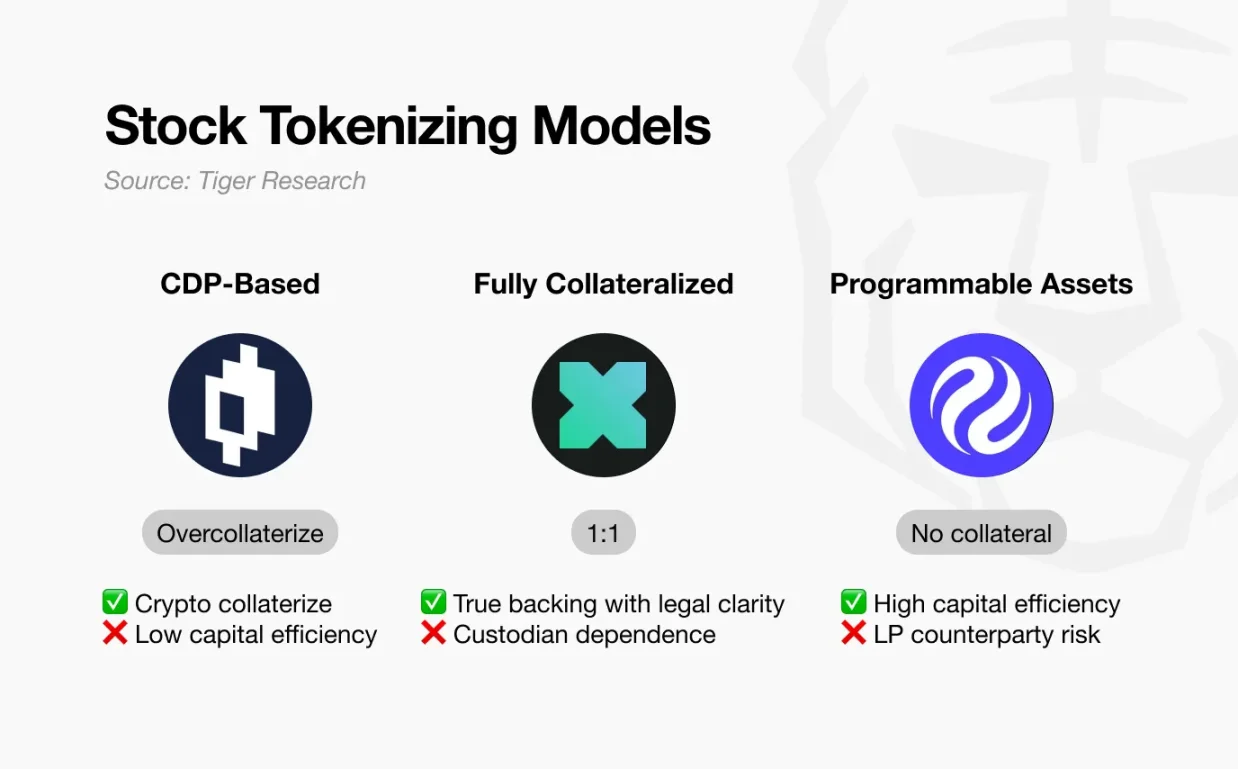
尽管第一波代币化股票在 2021 年就已出现,但大多数早期模型(如 Mirror Protocol)由于低效率和系统性风险(尤其是在 Terra 等生态系统中)未能实现规模化。近期的方法引入了改进机制,具有更强的资本动态和合规框架,以 Injective 和 xStocks 为代表。

代币化股票的关注度随着 RWA(现实世界资产)趋势的兴起而急剧增长,RWA 已成为加密市场的关键叙事。

除了这些直接优势外,代币化股票通过可组合性实现了新的用例。由于它们存在于传统监管框架之外,可以作为借贷协议的抵押品,或在 DeFi 应用中生成收益。

例如印度尼西亚的投资者若想获得特斯拉股票的敞口,传统方式需要开设外国经纪账户、填写文件并支付货币转换费用,且只能在有限的交易时间内操作。通过代币化股票,同一投资者可以通过智能手机即时购买特斯拉代币,并将其部署于 DeFi 协议中用于借贷、提供流动性或生成收益。

可行情景:全球股票 1% 的代币化
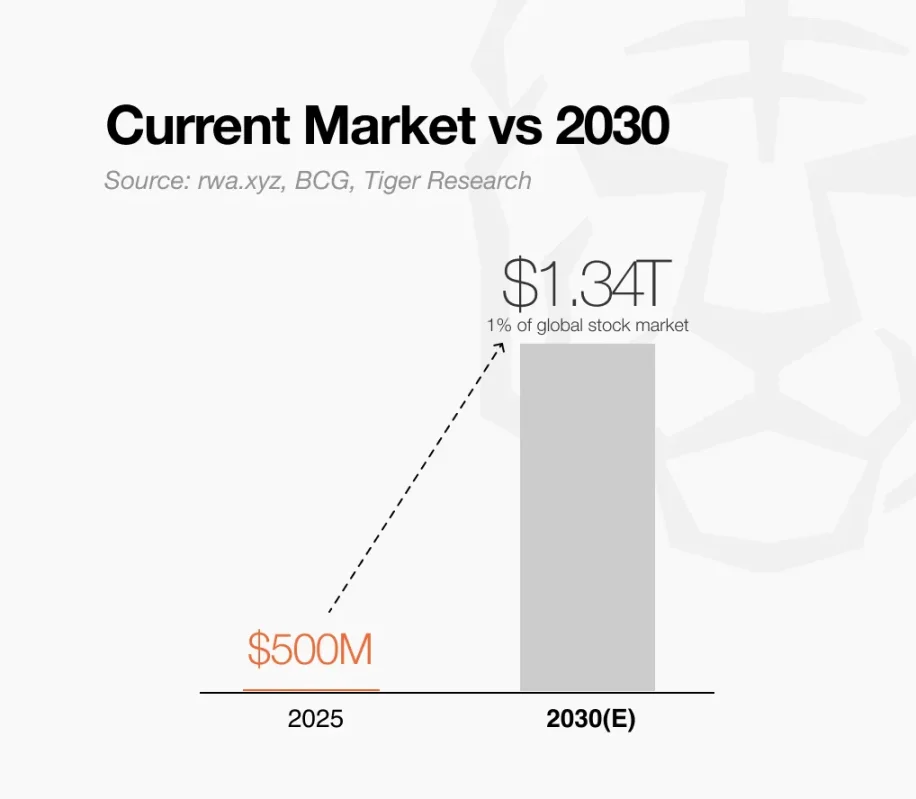
代币化股票市场仍处于早期阶段。根据 rwa.xyz 的数据,当前市场规模约为 5 亿美元。与 134 万亿美元的全球股票市场相比,这一数字仅占 0.0004%。然而如果未来十年内全球股票中仅有 1% 实现代币化,市场规模可能增长至 1.34 万亿美元,是目前规模的 2,680 倍。

2025 年的转折点

2025 年下半年可能成为关键转折点。尽管仍处于早期阶段,但 Solana 生态系统内的代币化股票交易量在一个月内从 1,500 万美元飙升至 1 亿美元,增长 566%。

更重要的是受监管参与者的入场。主要金融科技公司正在全球范围内扩展代币化服务,Robinhood 宣布在欧洲推出相关业务。随着市场从北美扩展到欧洲和亚洲,监管明确性将成为催化剂。特别是一旦股票代币化在欧盟的 MiCA 框架下启动,市场预计将迅速扩大。

2030 年成功的条件

到 2030 年实现全球股票市场 1% 的代币化需要明确的理由。投资者必须有强烈的动力从传统系统转向代币化平台。这一转变只有在四个关键条件共同作用下才会发生。

第一,必须证明成本节约。

理论上,经纪、结算和管理费用可减少 50%-70%,这需要在实践中得到验证。如果代币化能显著降低外汇和跨境交易成本,将为全球投资者提供强有力的替代方案。

第二,全天候交易的实用性需得到验证。

代币化股票应支持亚洲、欧洲和美国市场的连续交易。通过消除传统交易所的时间限制,它们可以提供更高的流动性,并实时响应全球事件,从而提高整体交易效率。

第三,基于 DeFi 的二次收益生成必须成为核心功能。

代币化股票不仅应作为可交易资产,还应成为 DeFi 协议的基础组成部分。如果投资者能将其用于抵押借贷、基于 AMM 的期权、流动性提供和自动化投资组合策略,他们就能在不抛售的情况下获得额外收益。随着这些机制的成熟,它们将强化代币化的主要优势成本效率、可访问性和连续交易使脱离传统系统的吸引力日益增强。

代币化股票市场的关键参与者
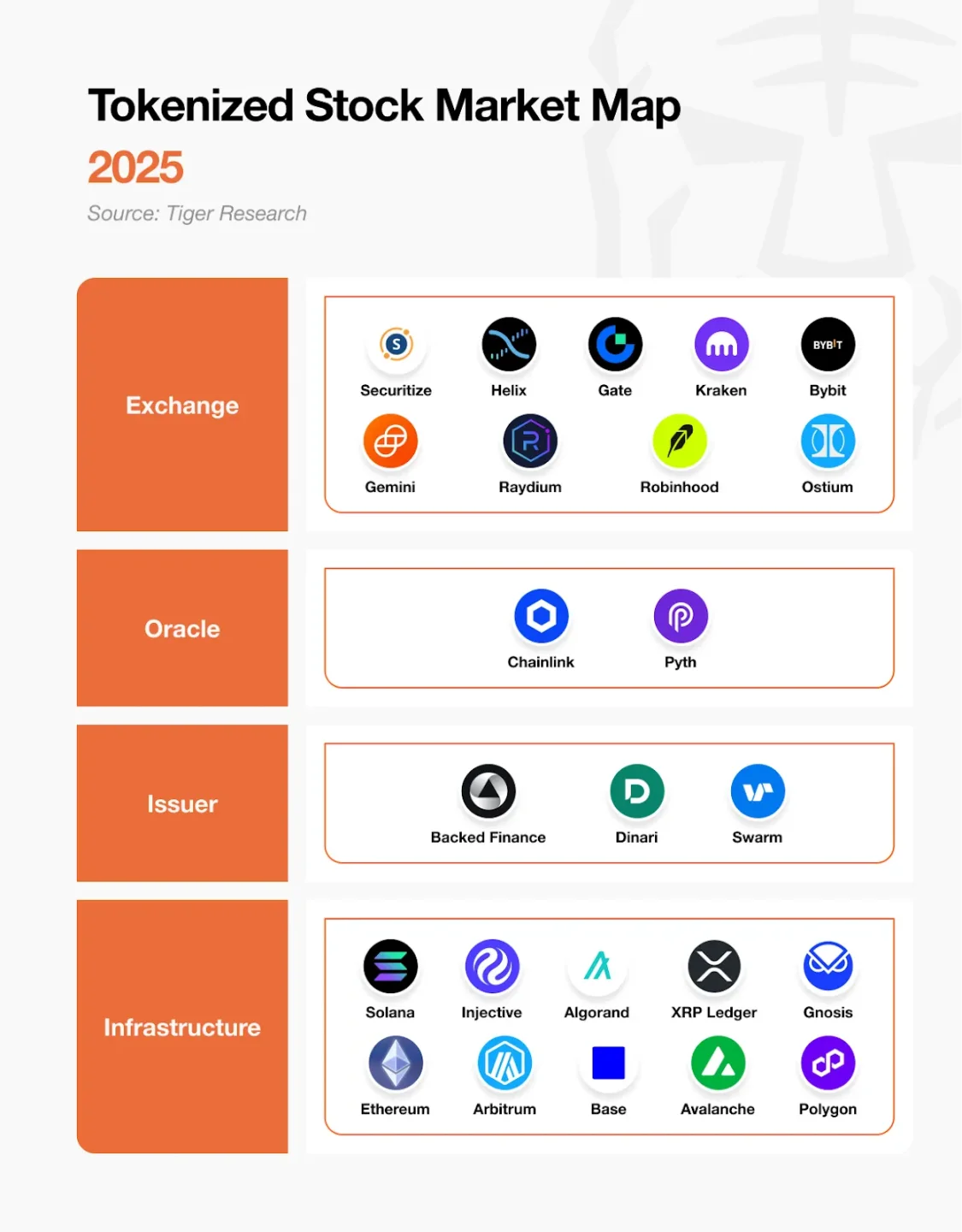
代币化股票市场建立在四个协调运作的核心层级之上。

最底层是基础设施层,提供所有交易发生的区块链网络。其上是发行方,负责创建传统股票的代币化表示。为了确保准确的价格跟踪,预言机提供实时市场数据并维护与标的资产的链接。最后交易所允许投资者买卖代币化股票。

一个功能完善的代币化股票生态系统需要所有四个层级。缺少任何一层,系统都将缺乏安全发行、定价和交易的必要组件。

代币化的实践

假设一位投资者希望通过代币化形式获得苹果($AAPL)股票的敞口。他们可以在 Helix 上以高达 25 倍杠杆交易 iAAPL,在 Kraken 上购买 Backed Finance 发行的 $xAAPL 现货代币,或作为欧洲居民通过 Robinhood EU 全天候访问美国股票。每家交易所都在不同的监管环境和交易模式下运作,满足不同投资者的需求。

为了使代币化股票准确反映真实股票价格,可靠的市场数据至关重要。例如,Chainlink 从纳斯达克获取苹果股票的实时价格并上传至链上。它还提供储备证明,验证每个代币是否以 1:1 的比例由相应的苹果股票支持。这确保了投资者可以信任代币的价格完整性。

发行方将传统股票转换为代币化资产。Backed Finance 在瑞士银行托管实际的苹果股票,并以 1:1 的比例发行 $xAAPL 代币。相比之下,Injective 的 $iAAPL 使用 iAssets 而不持有标的股票,通过预言机数据合成跟踪价格,实现无需实物结算的杠杆交易。这两种方法代表了将传统股票与区块链基础设施连接的不同路径。

所有交易和代币转移均在区块链网络上进行。在 Solana 上,Backed Finance 的 xStocks 以低延迟和最低费用交易。Injective 支持基于订单簿的高性能交易。在以太坊和 Arbitrum 上,Dinari 的 dShares 在美国监管合规下运作。每条链提供不同的技术能力,以满足代币化股票平台的基础设施需求。

代币化股票市场的主要参与者

代币化股票市场的关键参与者基于不同的策略和能力塑造生态系统。以下是主要公司及其当前定位的总结:

Injective:代币化股票永续合约领域的领导者。截至 2025 年上半年,累计交易量超过 10 亿美元。通过其 Helix DEX,提供高达 25 倍的杠杆,推动衍生品领域的流动性。

xStocks(Backed Finance):占据市值前 10 的代币化股票的 80%。采用 1:1 支持模型,股票托管于瑞士银行,并在 Solana 生态系统中广泛采用。

Robinhood:2025 年扩展至欧洲,提供超过 200 种代币化的美国股票和私人股票。在 Arbitrum 上提供零费用交易,支持 24/5 交易。

Gemini:与 Dinari Global 合作,为欧盟投资者提供 60 多种代币化股票。符合 MiFID II,在欧洲监管框架内提供服务。

Securitize:代币化现实世界资产的领先者,包括美国国债代币如 $BUDIL。还提供总计 3.12 亿美元的股票代币化产品,其中最大的单一资产部署在 Algorand 上。

Chainlink:提供关键的数据基础设施,包括实时股票和 ETF 价格馈送,以及资产支持的储备证明验证。

代币化股票在 RWA 市场中的作用

有限但最具可行性的细分市场

代币化股票只是更广泛的现实世界资产(RWA)市场中的一个细分领域。如果没有监管明确性,其采用将受到限制。然而这一障碍已经开始松动。Robinhood 已宣布在欧洲提供代币化股票服务,其他主要平台也在跟进。随着更多司法管辖区与这些发展保持一致,监管接受度可能会扩大。

已验证的需求与明确的痛点

这一市场的优势在于其基本面。股票已经是广泛交易的资产,需求明确。同时交易过程长期存在低效问题,尤其是在访问、结算速度和地理限制方面。已验证的需求与可解决的痛点相结合,使股票成为代币化的理想起点。

与其他需要首先生成需求的 RWA 类别不同,代币化股票直接建立在 134 万亿美元的全球股票基础上。代币化的案例因其切实优势而增强:更低的成本、更广泛的访问、全天候交易和 DeFi 整合。随着监管框架的成熟,这些优势将推动代币化股票的加速采用。


声明:本内容为作者独立观点,不代表 CoinVoice 立场,且不构成投资建议,请谨慎对待,如需报道或加入交流群,请联系微信:VOICE-V。
来源:Foresight News

Lecturas Relacionadas

AI Agents Also Need 'Credit Checks': ERC-8126 is Filling the Gap in On-chain Trust

The article discusses ERC-8126, a proposed standard designed to address the lack of trust and verification for AI Agents operating on-chain. While ERC-8004 provides AI Agents with a basic on-chain identity (answering "Who are you?"), it does not guarantee trustworthiness. ERC-8126 aims to fill this gap by establishing a verification layer (answering "Are you reliable?"). It standardizes how independent verification providers can assess an agent's associated risks across five key areas: Token/Contract Verification (ETV), Media Content Verification (MCV), Solidity Code Verification (SCV), Web Application Verification (WAV), and Wallet Verification (WV). These providers generate a standardized risk score (0-100) and proofs based on their checks, without acting as a single authoritative certifier. This allows wallets, marketplaces, dApps, and other agents to consume these risk signals—for example, to display warnings, filter listings, or make interaction decisions. The standard also incorporates concepts like Private Data Verification (PDV) and Zero-Knowledge Proofs (ZKP) to allow verification without exposing sensitive underlying data. Positioned alongside ERC-8004 (Identity) and ERC-8183 (Commerce for agents), ERC-8126 represents a step toward building a verifiable and accountable infrastructure for the emerging on-chain AI Agent economy, shifting trust assessment from purely user-based judgment to standardized, consumable signals.

marsbitHace 16 min(s)

AI Agents Also Need 'Credit Checks': ERC-8126 is Filling the Gap in On-chain Trust

marsbitHace 16 min(s)

Rented Conviction: How Much Real Money Is Behind the Bitcoin ETF Flows

Borrowed Belief: How much of Bitcoin ETF flows are real money? Weekly Bitcoin ETF flows, often interpreted as a measure of institutional conviction, are heavily influenced by a hidden arbitrage trade rather than genuine directional buying. A cash-and-carry arbitrage, where traders buy the ETF while simultaneously shorting Bitcoin futures on the CME to lock in a basis spread (the price difference between futures and spot), drives roughly half of the week-to-week flow volatility. This delta-neutral activity appears as ETF inflows but is unrelated to price views. Data shows a strong correlation (0.70) between weekly ETF inflows and increases in hedge fund short positions on CME futures, while Bitcoin’s weekly price returns have almost no explanatory power. However, this arbitrage activity dominates short-term *fluctuations*, not the cumulative *stock* of investments. Of the total ~$55 billion in net ETF inflows since launch, only about $1 billion currently represents net arbitrage exposure. The vast majority consists of steady, directional buying averaging around $400 million per week. The arbitrage trade has been unwinding for two years, with hedge fund short positions peaking near $14 billion in late 2024 and declining to ~$4.5 billion. Recent ETF outflows partly reflect this ongoing unwind as the basis compresses, not a loss of faith in Bitcoin. Thus, ETF flows overstate the *volatility* of belief, not its *level*. The headline number is more a gauge of arbitrage desk activity than conviction. For accurate interpretation, monitor the CME basis relative to Treasury yields and hedge fund net shorts—these reveal how much of the reported “demand” is truly directional.

marsbitHace 18 min(s)

Rented Conviction: How Much Real Money Is Behind the Bitcoin ETF Flows

marsbitHace 18 min(s)

Borrowed Faith: How Much of the Bitcoin ETF Flows Are Real Money

"Rented Faith: How Much of Bitcoin ETF Flows Are Real Money?" Bitcoin ETF inflows are often seen as a barometer of institutional conviction. However, week-to-week analysis reveals they are primarily driven by a hidden arbitrage trade rather than directional bullishness. This is the cash-and-carry trade: buying the ETF while simultaneously shorting Bitcoin futures on the CME to lock in the price difference (basis). This delta-neutral activity registers as ETF inflows but reflects a rate-seeking, not price-betting, strategy. Data shows weekly ETF flow volatility is closely tied to hedge fund ("leveraged funds") short positions on CME futures, with a correlation of 0.70. About half of weekly flow variation can be explained by this single factor. In contrast, Bitcoin's weekly price changes have no statistically significant power to predict flows. Crucially, while this arbitrage trade dominates weekly *fluctuations*, it is not the main component of the cumulative *stock*. Of the ~$55 billion total net inflow, the estimated net arbitrage position is only about $1 billion. The vast majority is steady, directional buying averaging ~$400 million per week. Thus, ETF flows overstate the *volatility* of belief, not its *level*. The "rented" arbitrage capital churns, while "owned" directional capital forms the bedrock. This arbitrage trade has been unwinding for two years, with hedge fund shorts peaking at ~$14 billion in late 2024 and falling to ~$4.5 billion. Recent outflows align with basis compression, signaling the trade's exit, not a loss of faith. For Ethereum ETFs, the same dynamic is weaker due to negative carry from forgone staking yield. The key takeaway: To interpret ETF flows, watch the basis vs. Treasury yields and CME hedge fund net shorts. They reveal how much of the weekly "demand" headline is driven by rented, rate-seeking capital versus real conviction.

链捕手Hace 32 min(s)

Borrowed Faith: How Much of the Bitcoin ETF Flows Are Real Money

链捕手Hace 32 min(s)

Trading

Spot
Futuros
活动图片