Stablecoins Accumulate an Extra $4B After GENIUS Act – Join the Crypto Revolution With Best Wallet

bitcoinistPublicado a 2025-07-25Actualizado a 2025-07-25

Resumen

The GENIUS Act was passed just a week ago, and already, $4 billion has poured into stablecoins. This surge shows...

Trusted Editorial content, reviewed by leading industry experts and seasoned editors. Ad Disclosure

The GENIUS Act was passed just a week ago, and already, $4 billion has poured into stablecoins. This surge shows just how quickly stablecoins are gaining traction, confirming their role as a major player in the digital asset space.

Not only is this stablecoin bill a green light for the industry, but it also signals a new era for cryptocurrencies and wallets.

With clearer regulations and increased institutional interest, we’re entering a phase where crypto could become a mainstream financial tool.

And Best Wallet is stepping up at the perfect time. This non-custodial crypto wallet offers a secure and seamless way to manage fiat-backed cryptos, alongside other digital assets, as institutional adoption takes off.

GENIUS Act Pushes Stablecoin Market Cap to $270B+

Since the GENIUS Act has been in effect, the total stablecoin market has surpassed $270B, partly driven by over $4B in new inflows.

Fiat-backed stablecoins, such as $USDT and $USDC, are thriving, accounting for 85% of the entire stablecoin market.

Under the GENIUS Act, issuers of these cryptos must maintain full reserves, undergo regular audits, and hold a legitimate license—measures designed to enhance trust and boost credibility in the crypto sector.

It’s a major advancement since algorithmic stablecoins (which are now banned) came into play, as they’ve proven vulnerable in the past. Just look at the Terra collapse, for instance.

Yes, crypto-backed stablecoins like $DAI are still relevant, as evidenced by its $5.36B market cap. But fiat-backed ones are taking over the spotlight.

Major institutions are taking notice, and Anchorage Digital is leading the charge. As the only federally chartered U.S. crypto bank, Anchorage is teaming up with Ethena Labs to launch its stablecoin issuance platform, set to introduce the highly anticipated $USDtb stablecoin.
Anchorage Digital stablecoin platform
Source: X (Anchorage Digital)

Yesterday, asset management titan WisdomTree also introduced $USDW, a regulated, dollar-backed stablecoin designed to enable dividend-paying tokenized assets.

TradFi companies aren’t sitting on the sidelines, either. Several major banks, including Bank of America and Citibank, are preparing to launch their own stablecoins once the regulatory dust settles.

This rapid shift in market sentiment provides Best Wallet with the ideal environment to thrive. As digital assets, mainstream and stablecoins have become a core part of finance, and you’ll need a secure and simple wallet to hold.

Best Wallet Secures Stablecoin Investments

Best Wallet makes it easy to buy, store, send, and swap fiat-backed stablecoins like $USDT, plus other major cryptos – like $ETH and $BTC – without giving up custody or control.

It’s multi-chain, multi-wallet, and fully private. It doesn’t require KYC or middlemen. Hence, it’s our #1 anonymous crypto wallet.

And it has lots of attractive features in the pipeline to help you up your trading stance. This includes exclusive wallet market insights so you can buy, sell, and manage crypto more effectively.
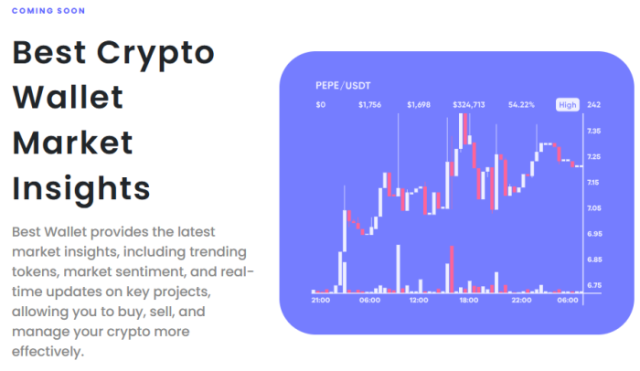
Best Wallet market insights
Source: Best Wallet

One of its most standout upcoming developments, however, is Best Card. Once launched, the crypto debit card will enable you to spend your crypto on the move,hassle-free.

Not forgetting that Best Wallet’s also preparing to support over 60 blockchain networks, debut its own NFT gallery, rewards hub, and in-app crypto news feed.

And all of these developments couldn’t come at a better time – just as regulation clears and crypto goes mainstream.

To get the most out of the Best Wallet ecosystem, however, you’ll want to purchase $BEST, its native token. Then, you can also enjoy governance rights, lower transaction fees, higher staking rewards (currently at a 96% APY), and easier access to the best crypto presales.

The demand for the token is already evident. $BEST has raised over $14M in presales, backed heavily by crypto whales, with three in particular injecting $49.5K, $25K, and $18.7K into the project.

$BEST to Triple in Price as Stablecoins Go Mainstream

The writing is on the wall: regulation is here, institutions are on board, and stablecoins are quickly becoming a key asset in modern finance.

As this new chapter in regulated digital finance unfolds, the tools you use to interact with crypto are more essential than ever.

Best Wallet is positioning itself as a major player in the space, thanks to its unwavering focus on privacy, flexibility, and powerful trading features.

Still, to get the most out of this non-custodial wallet, you’ll want to purchase $BEST, and you can do just that for as little as $0.025385. Though it’s best to act fast for 183% less, as the upcoming app developments could propel it to $0.072.

This isn’t investment advice. DYOR and don’t invest more than you’d be sad to lose.

Editorial Process for bitcoinist is centered on delivering thoroughly researched, accurate, and unbiased content. We uphold strict sourcing standards, and each page undergoes diligent review by our team of top technology experts and seasoned editors. This process ensures the integrity, relevance, and value of our content for our readers.

Leah is a British journalist with a BA in Journalism, Media, and Communications and nearly a decade of content writing experience. Over the last four years, her focus has primarily been on Web3 technologies, driven by her genuine enthusiasm for decentralization and the latest technological advancements. She has contributed to leading crypto and NFT publications – Cointelegraph, Coinbound, Crypto News, NFT Plazas, Bitcolumnist, Techreport, and NFT Lately – which has elevated her to a senior role in crypto journalism. Whether crafting breaking news or in-depth reviews, she strives to engage her readers with the latest insights and information. Her articles often span the hottest cryptos, exchanges, and evolving regulations. As part of her ploy to attract crypto newbies into Web3, she explains even the most complex topics in an easily understandable and engaging way. Further underscoring her dynamic journalism background, she has written for various sectors, including software testing (TEST Magazine), travel (Travel Off Path), and music (Mixmag). When she's not deep into a crypto rabbit hole, she's probably island-hopping (with the Galapagos and Hainan being her go-to's). Or perhaps sketching chalk pencil drawings while listening to the Pixies, her all-time favorite band.

Lecturas Relacionadas

Doubao and Qwen Will Discontinue Agent Functionality on July 15

On July 4th, Doubao and Tongyi Qianwen announced the impending shutdown of their user-created "AI Agent" features. Doubao confirmed its agent feature will be taken offline on July 15, directing users to ByteDance's CatBox app for similar needs. On the same day, Tongyi Qianwen notified users, specifying that personalized interactive agents and user-built agent functions will cease on July 10, with all agent features and services completely deactivated by July 15. After this date, access to agent configurations and historical chat records will be lost. This adjustment impacts core user scenarios like role-playing, personal assistants, and vertical tool agents. The shutdown date coincides with the official implementation of China's "Interim Measures for the Administration of Artificial Intelligence Human-like Interactive Services" on July 15. The new regulations impose strict rules on "human-like emotional interaction services," requiring platforms to implement measures like anti-addiction systems, minor verification, and content moderation. This move is widely seen as a proactive step by the platforms to align with regulatory timelines and mitigate compliance risks. Additionally, commercial challenges are a key driver. Analysis suggests that casual, human-like chat agents generate high-frequency, low-value interactions, leading to high computational costs with poor monetization. As the AI application market shifts from user growth to proving value, sustaining such "high-cost, low-efficiency" user-generated content becomes difficult. Both platforms have outlined transition plans. Doubao will allow data viewing and self-backup for a period after shutdown, with data scheduled for permanent deletion by October 15. Tongyi Qianwen similarly advised users to save important content via copying or screenshots before the deadline. This strategic retreat from C-end agent features signals a broader market shift. Compliance capability and sustainable business models are replacing user scale and feature richness as the new core competitive dimensions. Tongyi Qianwen's recent move to fully open its Agent and Skill platforms to third-party enterprises and developers further underscores a strategic pivot from low-value C-end services to high-value B-end enterprise scenarios.

marsbitHace 44 min(s)

Doubao and Qwen Will Discontinue Agent Functionality on July 15

marsbitHace 44 min(s)

Why Did Codex and ChatGPT Merge? What's Next for Codex? OpenAI Core Leader Answers Everything

In 2026, OpenAI's Codex saw explosive growth, with weekly active users surging over 5x to 5 million since January, driven largely by the February launch of its desktop app. Codex desktop lead Andrew Ambrosino explains key shifts behind its evolution. A core change is the inversion of development costs: implementation is now cheap, while curation and taste—judging which of many AI-generated prototypes is valuable—have become the new scarcities. Ambrosino defines taste as a blend of aesthetics, systems thinking, direction, and semantic coherence in interaction. He notes AI still struggles with design because evaluating it requires human cultural context and abstract reasoning about how components relate—capabilities beyond current models. Timing is critical: the same Codex app would have failed months earlier; success hinges on the model's capabilities at launch. Roles are blurring within his team, with engineers, designers, and PMs overlapping significantly. However, Ambrosino cautions against eliminating specialized roles entirely, as each field retains deep expertise. On AI-assisted development, the focus has shifted from measuring code written by AI to distinguishing between supervised and unsupervised generation. A current challenge is teaching models to simplify code, not just add complexity. The merger of Codex and ChatGPT stems from observed user behavior: non-developers adopted Codex for general knowledge work despite its developer-centric interface. This revealed a collapsing boundary between specialized tools and universal assistants. The vision is a "home base" that orchestrates tasks across external professional tools (like Excel or Premiere Pro) via connectors, rather than rebuilding everything internally. An internal example showed Codex helping edit video by interacting with Premiere Pro's files and even writing a plugin for it. The future direction is a unified, extensible platform that serves as a central hub for automating and managing work across any specialized tool the user employs.

marsbitHace 54 min(s)

Why Did Codex and ChatGPT Merge? What's Next for Codex? OpenAI Core Leader Answers Everything

marsbitHace 54 min(s)

Trading

Spot
活动图片