Pump.fun отправляет 13,75 млрд токенов PUMP в Wintermute, цена падает на 22%

cryptonews.ruPublicado a 2025-02-15Actualizado a 2025-07-15

  • Pump.fun перевел 13,75 млрд токенов PUMP на сумму около 55 млн долларов США маркет-мейкеру Wintermute.
  • Рынок негативно отреагировал на эту новость, в результате чего стоимость токена PUMP упала более чем на 22% за 24 часа.
  • Этот шаг, вероятно, обеспечит ликвидность для листингов на основных биржах, несмотря на краткосрочное падение цен.

Pump.fun, платформа запуска Memecoin, перевела 13,75 млрд токенов PUMP на сумму около 55 млн долларов США в крупную криптовалютную компанию Wintermute. Однако вместо ралли эта новость спровоцировала резкое падение цены токена на 22,65%, поскольку рынок отреагировал неопределённо.

Масштабное движение, впервые отмеченное он-чейн-аналитиком ai_9684xtpa, предполагает стратегическое согласование между двумя организациями, но оно бросает тень на краткосрочное направление цены токена.

Читайте также: Pump.fun завершил ICO, собрав 500 миллионов долларов: вот основные подробности

Стратегический шаг к ликвидности

Время транзакции имеет решающее значение. Она последовала за несколькими небольшими тестовыми переводами всего 10 токенов PUMP на Wintermute и другие кошельки, что указывает на то, что этот крупный перевод был заранее спланированным и скоординированным событием.

Wintermute 果然收到做市代币了,TGE 倒计时了!💊

10 分钟前,项目方向 Wintermute 转移了 137.5 亿枚 PUMP,按公售价格 $0.004 算价值 5500 万美元https://t.co/yhS1cga6rY https://t.co/I0zLxjPXwt pic.twitter.com/RoyP61dxAS

— Ai 姨 (@ai_9684xtpa) July 14, 2025

Отправка большого пакета токенов маркет-мейкеру, такому как Wintermute, обычно является шагом, предпринимаемым проектами для обеспечения высокой ликвидности для предстоящих листингов на крупных централизованных биржах. Хотя долгосрочная цель, по всей видимости, заключается в подготовке токена к более широкой торговле, немедленная реакция рынка была негативной.

Читайте также: Токен PUMP от Pump.fun был распродан всего за 12 минут и собрал $600 млн.

Реакция рынка: цена падает на 22% из-за резкого роста объёма

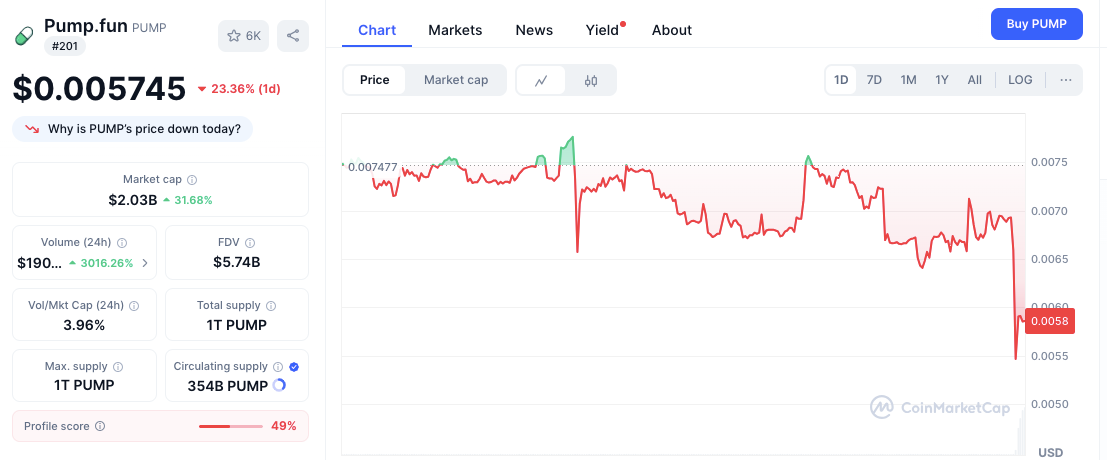
Вскоре после обнаружения перевода цена PUMP резко упала. На момент публикации она торгуется на уровне $0,005857, снизившись на 22,65% за последние 24 часа. Цена установила новый краткосрочный диапазон между дневным минимумом около $0,0055 и максимумом на $0,007477, и этот диапазон теперь определяет ближайшую техническую границу токена.

Если токен превысит $0,0075, это может указывать на попытку восстановления. Однако падение ниже $0,0055 может спровоцировать более глубокий откат.
Источник: CoinMarketCap

Кроме того, объём торгов вырос более чем на 2200%, достигнув 147,2 млн долларов за 24 часа. Такой скачок подтверждает повышенный интерес трейдеров, но также указывает на возможное спекулятивное поведение. Участникам рынка следует опасаться ложных пробоев и потенциальной фиктивной торговли в периоды экстремальной активности.

Метрики и настроения более широкой платформы
Источник:DefiLlama

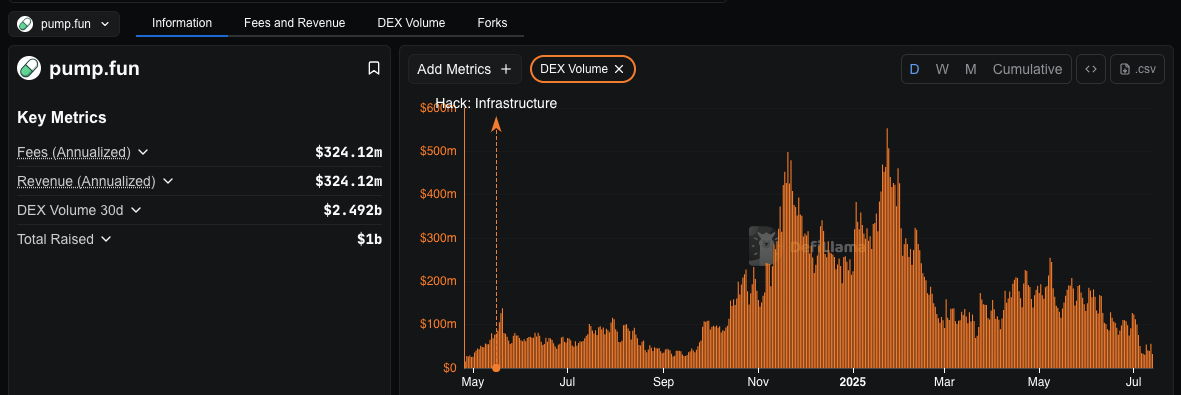
Несмотря на снижение цен, фундаментальные показатели Pump.fun выглядят сильными. Годовой доход платформы составляет 324,12 млн долларов США при равных комиссиях, что свидетельствует об эффективности работы.

За последние 30 дней объём торгов на децентрализованной бирже (DEX) составил 2,492 млрд долларов. Более того, проект привлёк более 1 млрд долларов, что свидетельствует о существенной поддержке инвесторов.

Если проанализировать исторические тенденции, то можно отметить, что в период с ноября 2024 года по январь 2025 года на платформе наблюдался значительный скачок объемов. Это совпало с ростом участия розничных продавцов и достижением важных этапов проекта.

Примечательно, что в мае 2024 года взлом инфраструктуры, известный как «маркированный», кратковременно потряс рынок, вызвав резкий скачок объёмов. Однако платформа быстро восстановилась, что подтвердило её устойчивость.


Criptos en tendencia

Lecturas Relacionadas

Examining the Open USD Partner Lineup: Follow Who's Joining to See Where the Money Flows

**Title: Deciphering the Open USD Partner Roster: Following the Money** The launch of Open USD is notable less for the stablecoin itself and more for its expansive list of over 140 founding partners, which reads like a "who's who" of global finance and tech. This coalition, including asset managers like BlackRock, card networks Visa and Mastercard, banks (BNY Mellon, Standard Chartered, etc.), tech giants (Google, IBM), merchants (Shopify), and crypto firms (Coinbase, Ripple, Aave, MetaMask), signals a strategic shift. The diverse membership reveals that stablecoins are increasingly viewed not as products to compete over, but as shared infrastructure too critical to be left to any single entity. Each partner category has distinct motives. Asset managers like BlackRock seek to manage the large, sticky cash reserves, a lucrative fee-generating opportunity. Merchants like Shopify aim for lower-cost settlement and potential yield on balances. Banks join defensively to retain custody and settlement roles, fearing deposit outflows to stablecoins. Tech companies bet on programmable money for future machine-to-machine commerce. Crypto firms gain mainstream legitimacy and distribution channels. Remarkably, the consortium includes direct competitors (Visa vs. Mastercard, Coinbase vs. Ripple), indicating that the fear of exclusion from this emerging financial layer outweighs competitive rivalries. However, this shared governance could also lead to slow decision-making. The roster's composition is the real message: it represents a collective bet that a widely accepted, consortium-owned stablecoin is preferable to proprietary versions or having none at all. For incumbents like Circle and Tether, this alliance poses a significant threat, as potential clients have collectively chosen to build their own alternative. The absence of major U.S. retail banks (busy with their own tokenized deposit networks) is equally telling. In essence, the partner list maps where the industry believes value and risk will flow in a tokenized dollar future, marking stablecoin's evolution from a product to a utility.

Foresight NewsHace 8 min(s)

Examining the Open USD Partner Lineup: Follow Who's Joining to See Where the Money Flows

Foresight NewsHace 8 min(s)

IOSG: Q-Day Countdown, Will Quantum Computing End Cryptocurrency?

IOSG: The Q-Day Countdown – Will Quantum Computing End Cryptocurrency? This analysis explores the looming threat quantum computing poses to blockchain technology. Quantum computers, leveraging Shor's algorithm, could theoretically break the elliptic curve cryptography (ECC) underpinning cryptocurrencies like Bitcoin and Ethereum. The article outlines a hypothetical "Q-Day" scenario where exposed public keys from dormant assets are compromised, leading to fund theft and a deep governance crisis. The core risk is not the complete erasure of blockchains but a systemic reset of public-key cryptography. Bitcoin faces significant challenges due to its "code-is-law" ethos and the immense social consensus required for migration. Its primary vulnerability lies in legacy UTXOs with publicly exposed keys. Ethereum's path involves a more complex, full-stack cryptographic agility upgrade across execution, consensus, and data layers. The industry has a limited "engineering comfort window" of 5-8 years to coordinate a migration to post-quantum cryptography (PQC), such as lattice-based or hash-based signatures. While the existential threat is often overstated, the real bottleneck is the immense coordination required across protocol developers, node operators, wallet providers, exchanges, and custodians. Market repricing of crypto assets may occur well before an actual Q-Day if quantum hardware roadmaps accelerate or regulatory pressure mounts. The article concludes that quantum computing is not a doomsday weapon but a severe stress test for blockchain's foundational security model and governance structures.

marsbitHace 37 min(s)

IOSG: Q-Day Countdown, Will Quantum Computing End Cryptocurrency?

marsbitHace 37 min(s)

Why 2026 could redefine Ethereum, Solana, Base and Avalanche

Blockchain infrastructure is undergoing a major coordinated transformation, driven by institutional demand for reliability, compliance, and predictable settlement. Over $30 billion in Real-World Assets (RWA) on-chain has exposed network weaknesses. Major blockchains are responding with foundational upgrades, moving beyond incremental speed improvements. Ethereum's "Glamsterdam" upgrade, planned for H1 2026, will significantly increase gas limits and introduce features like PBS (pre-blocked state) for enhanced settlement and parallel execution. Solana's "Alpenglow," targeting a mainnet launch in H2 2026, focuses on reducing finality time dramatically and freeing network resources to improve reliability. Beyond speed, compliance is critical. Base's "Beryl" upgrade in Q3 2026 will introduce a standardized, regulatory-compliant token framework (B20). Avalanche's "Octane" upgrade aims to boost transaction processing and reduce costs for enterprise applications. Even Bitcoin is evolving with the potential activation of OP_CAT by late 2026/early 2027. The competition is shifting. While technical upgrades are widespread, institutions will ultimately allocate capital based on proven execution, operational resilience, and regulatory compatibility during market stress. Ethereum currently leads in tokenized assets, while networks like Base and Solana are strengthening their institutional offerings. The blockchain that best delivers reliable, compliant, and uninterrupted service is poised to attract the greatest share of future institutional capital.

ambcryptoHace 1 hora(s)

Why 2026 could redefine Ethereum, Solana, Base and Avalanche

ambcryptoHace 1 hora(s)

Trading

Spot

Artículos destacados

Cómo comprar FUN

¡Bienvenido a HTX.com! Hemos hecho que comprar FUNTOKEN (FUN) sea simple y conveniente. Sigue nuestra guía paso a paso para iniciar tu viaje de criptos.Paso 1: crea tu cuenta HTXUtiliza tu correo electrónico o número de teléfono para registrarte y obtener una cuenta gratuita en HTX. Experimenta un proceso de registro sin complicaciones y desbloquea todas las funciones.Obtener mi cuentaPaso 2: ve a Comprar cripto y elige tu método de pagoTarjeta de crédito/débito: usa tu Visa o Mastercard para comprar FUNTOKEN (FUN) al instante.Saldo: utiliza fondos del saldo de tu cuenta HTX para tradear sin problemas.Terceros: hemos agregado métodos de pago populares como Google Pay y Apple Pay para mejorar la comodidad.P2P: tradear directamente con otros usuarios en HTX.Over-the-Counter (OTC): ofrecemos servicios personalizados y tipos de cambio competitivos para los traders.Paso 3: guarda tu FUNTOKEN (FUN)Después de comprar tu FUNTOKEN (FUN), guárdalo en tu cuenta HTX. Alternativamente, puedes enviarlo a otro lugar mediante transferencia blockchain o utilizarlo para tradear otras criptomonedas.Paso 4: tradear FUNTOKEN (FUN)Tradear fácilmente con FUNTOKEN (FUN) en HTX's mercado spot. Simplemente accede a tu cuenta, selecciona tu par de trading, ejecuta tus trades y monitorea en tiempo real. Ofrecemos una experiencia fácil de usar tanto para principiantes como para traders experimentados.

265 Vistas totalesPublicado en 2025.06.25Actualizado en 2026.06.02

Cómo comprar FUN

Discusiones

Bienvenido a la comunidad de HTX. Aquí puedes mantenerte informado sobre los últimos desarrollos de la plataforma y acceder a análisis profesionales del mercado. A continuación se presentan las opiniones de los usuarios sobre el precio de FUN (FUN).

活动图片