В иске Genesis утверждается, что в DCG игнорировали предупреждения о рисках

cryptonews.ruPublicado a 2025-04-25Actualizado a 2025-06-25

Недавно обнародованная жалоба обанкротившегося криптокредитора Genesis раскрывает внутренние коммуникации в его материнской компании Digital Currency Group (DCG), свидетельствующие о том, что руководители знали о финансовых злоупотреблениях и надвигающихся юридических рисках, связанных с их контролем над Genesis.

Согласно заявлению, поданному в Канцелярию суда штата Делавэр, финансовый директор DCG Майкл Крэйнс признал риск того, что Genesis может считаться «альтер эго» DCG.

В конфиденциальной записке, представленной бывшему генеральному директору Genesis Майклу Моро и другими руководителям, Крэйнс изложил соображения по подготовке к юридическим аргументам, которые может выдвинуть будущий истец, если Genesis рухнет. Записка, приложенная к жалобе, отражает претензии, которые сейчас являются центральными в иске.

«Вопрос, который у меня на уме, звучит так: «Если Genesis каким-то образом взорвет себя, может ли это каким-то образом погубить DCG, нанеся огромный ущерб ее совету директоров и акционерам?» Мои предварительные соображения здесь таковы», — написал Крэйнс Моро, дав понять, что они готовятся к неминуемому судебному разбирательству.
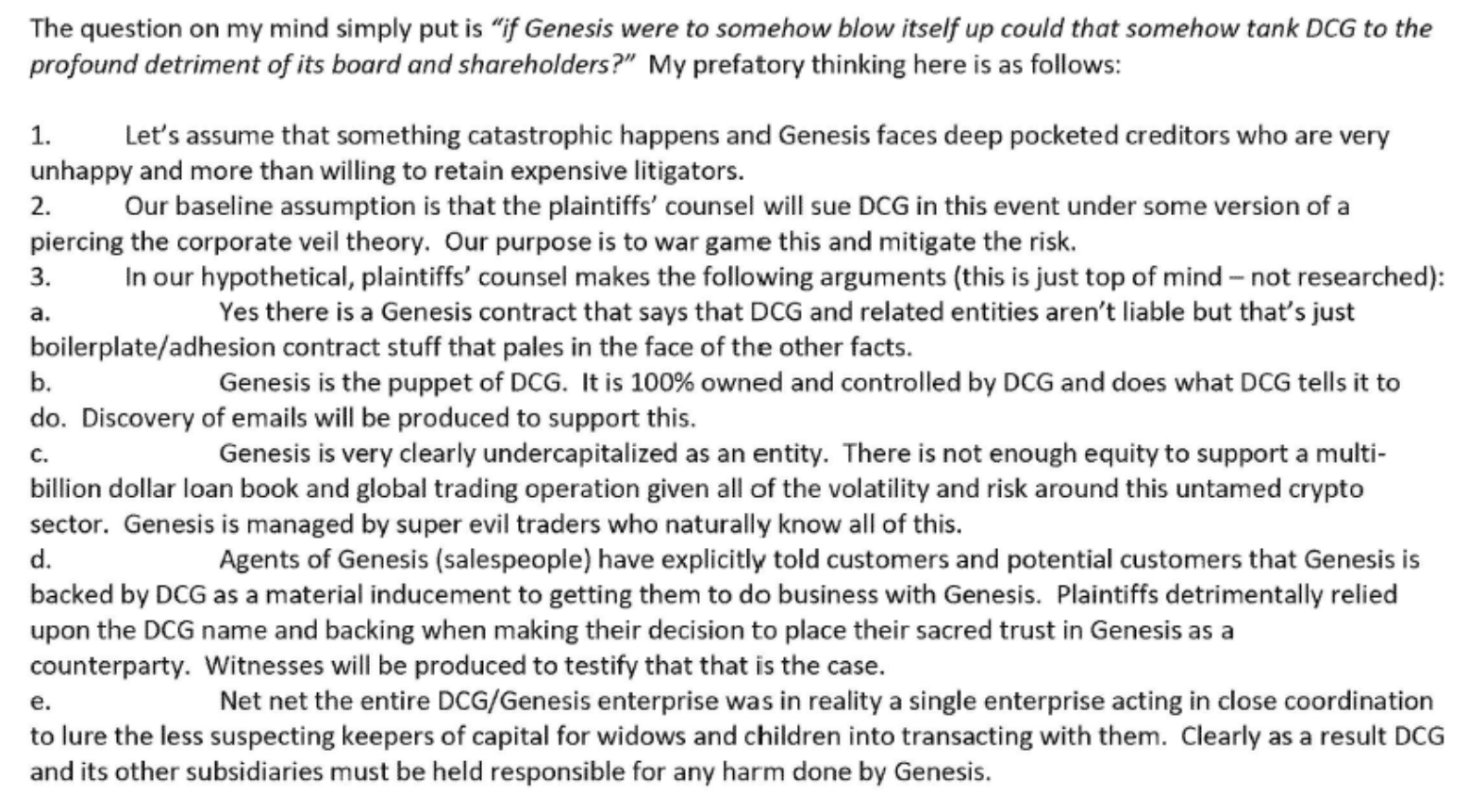
Записка, которую Крэйнс написал Моро. Источник: Genesis.

DCG проигнорировал предупреждения о рисках

В заявлении также раскрывается, что DCG наняла сторонних консультантов по рискам, которые выдавали предупреждения, которые либо игнорировались, либо учитывались слишком поздно. Внутренние документы показывают, что DCG признала, что Genesis «летела вслепую», когда ее кредитный портфель раздулся с 4 миллиардов долларов до 12 миллиардов долларов.

Внешние аудиторы еще в 2020 году выявили «существенные недостатки и слабости» в системе финансового контроля Genesis.

Сторонние консультанты по рискам выносят DCG серьезные предупреждения. Источник: Genesis.

В Genesis был сформирован так называемый комитет по риску «заражения», чтобы смягчить воздействие. Однако его первое заседание состоялось лишь через девять месяцев после одобрения советом DCG. Сообщается, что Крейнс пошутил, что задержка «просто немного облегчила мне будущую дачу показаний».

В жалобе также описывается токсичная корпоративная культура, в которой от сотрудников Genesis ожидалось, что они будут служить интересам DCG в ущерб надлежащему управлению.

Один из инсайдеров написал, что DCG поддерживала Genesis в живых, «чтобы она могла разграбить баланс… поддержать Genesis, создать вид стабильности, а затем занять, пока они могли бы, чтобы получить из нее наличные». Сотрудники Genesis внутри компании называли обстановку в фирме «культурой подчинения».

«Это не просто технические споры по поводу внутрифирменного учета, — заявил Комитет по надзору за судебными разбирательствами Genesis. — Жалоба Делавэра раскрывает преднамеренную схему DCG и Барри Силберта по разграблению Genesis в момент ее краха».

Публичный обман и спорные транзакции

В иске также утверждается, что имел место публичный обман. Персоналу Genesis было приказано читать заготовленные сообщения после краха Three Arrows Capital (3AC), в то время как руководители DCG, включая Барри Силберта, ретвитнули посты, в которых преуменьшался кризис.

Кроме того, жалоба проливает свет на две спорные сделки. Они включают в себя вексель от 30 июня 2022 года и сделку «туда и обратно» от сентября 2022 года, обе из которых были оформлены как попытки скрыть неплатежеспособность и ввести в заблуждение кредиторов.

Genesis пытается взыскать более 3,3 млрд долларов с DCG, Силберта и других инсайдеров.

Lecturas Relacionadas

Soaring Export Data for Memory Chips, Market Is Redefining the Valuation Anchor for Memory Stocks

Korean storage export data for the first 20 days of June shows substantial year-on-year increases in both value and price-per-kilogram for categories like DRAM, NAND, and SSDs. This signals a potential shift beyond simple demand recovery, indicating rising prices and a product mix shift towards higher-value items, possibly influenced by AI infrastructure needs. A key point is that the surge in price-per-kilogram is not simply a uniform chip price hike. It reflects a combination of actual price increases and, more importantly, an export structure increasingly dominated by high-value-density products like HBM (High-Bandwidth Memory) and advanced DRAM, which are critical for AI servers. This suggests AI-driven demand may be spilling over from just HBM into broader memory markets. SK Hynix stands to benefit directly due to its leading HBM position. For Samsung and Micron, the implication is potential for greater margin elasticity if the tightness in high-end memory spreads to enterprise SSD and NAND prices. However, the storage sector remains cyclical. Risks include supply expansion, inventory changes, and potential slowdowns in broader AI capital expenditure. Ultimately, while the strong export data supports upward revisions for storage company earnings and fuels discussion of an "AI infrastructure bottleneck premium," a definitive valuation shift from a cyclical to a structural story depends on upcoming quarterly reports. Investors need confirmation from SK Hynix, Samsung, and Micron that improvements in average selling prices, product mix, and, crucially,毛利率 are sustained over multiple quarters.

marsbitHace 35 min(s)

Soaring Export Data for Memory Chips, Market Is Redefining the Valuation Anchor for Memory Stocks

marsbitHace 35 min(s)

Why Does SpaceX Have Such a High Valuation Ceiling? The Answer Lies in Musk's Business Blueprint

SpaceX achieved a record-breaking IPO on June 12, 2026, with its market cap surging past $2.1 trillion. This valuation reflects its central role within Elon Musk's expansive, interconnected technological ecosystem. The article details how four core components form a synergistic closed-loop system: 1) **The "Brain" (xAI & Orbital Compute):** xAI provides AI models and massive ground/space-based supercomputing for simulation and decision-making across the system. 2) **The "Neural Logistics Core" (Starlink & Starship):** Starlink's low-latency satellite network enables global data transmission, while Starship's low-cost, reusable launch capacity aims to make large-scale space deployment economically viable. 3) **The "Physical Body" (Tesla & Optimus):** Tesla's manufacturing prowess and energy products support hardware production and power, pivoting toward mass-producing the Optimus humanoid robot for terrestrial and potential space-based labor. 4) **The "Human Interface" (Neuralink & X):** Neuralink seeks direct brain-computer communication, and the X platform provides real-time societal data. Together, these elements create three reinforcing "flywheels": manufacturing/logistics, data-driven iteration, and energy/compute/network synergy. This integrated approach promises lower costs, faster innovation cycles, and potential infrastructure-as-a-service offerings. However, it also concentrates technical, regulatory, and corporate governance risks. Ultimately, SpaceX's high valuation stems from its position as the indispensable infrastructural backbone—handling space transport, global communications, and future orbital computing—tying together Musk's entire vision for a self-reinforcing technological empire.

marsbitHace 40 min(s)

Why Does SpaceX Have Such a High Valuation Ceiling? The Answer Lies in Musk's Business Blueprint

marsbitHace 40 min(s)

Snap, Unprofitable for Nine Years, and a Decade-Long AR Obsession Without Return

Snap's AR Obsession: A Decade of Betting Against the Odds On June 16, Snap CEO Evan Spiegel unveiled the new AR glasses, Specs, priced at $2,195, causing the company's stock (SNAP) to plummet nearly 10%. The launch was met with intense criticism online, with investors questioning why a consistently unprofitable company would stake its future on an expensive product its core young user base can't afford. Snapchat, known for pioneering features like ephemeral Stories and popular AR lenses (like the iconic dog filter), has a history of innovation often copied by rivals like Instagram and Meta. Despite this, it has struggled to translate first-mover advantage into commercial success. Since its 2017 IPO, Snap has reported annual net losses, with a Q1 2026 loss of $89 million. Its stock is down 94% from its 2021 peak, hampered by iOS privacy changes, competition, and a young demographic less attractive to major advertisers. In this challenging context, Spiegel is doubling down on AR. He calls 2026 a "crucible moment," having recently laid off 16% of staff while reportedly investing over $3.5 billion cumulatively in its AR glasses line over nearly a decade. The new Specs represent a significant leap from the 2016 camera-focused Spectacles, offering true AR overlays, gesture control, and standalone operation. However, at $2,195, it faces tough comparisons. While more advanced than Meta's $799 Ray-Ban smart glasses, critics point to its heavier weight, short battery life, and features largely replicable by a smartphone. Facing pressure from investors to cut losses on the Specs project, Spiegel has refused, framing it as essential to Snap's long-term vision. The company finds itself in a paradoxical position: cutting costs while heavily funding a decade-long, unproven bet. Some see Specs as an awkward but necessary step in AR's evolution, akin to early mobile phones. Whether Spiegel is a visionary outlier or a gambler destined to fail remains an open question, highlighting the tension between long-term ambition and short-term market demands.

marsbitHace 1 hora(s)

Snap, Unprofitable for Nine Years, and a Decade-Long AR Obsession Without Return

marsbitHace 1 hora(s)

Annualized Revenue Exceeds $20 Billion, Kalshi Aims to Become the First Prediction Platform IPO?

Kalshi, a leading U.S. prediction markets platform, is reportedly in early, informal discussions for an Initial Public Offering (IPO). The company's annualized revenue now exceeds $2 billion, fueled by its dominance of over 90% of the domestic prediction market activity. This growth stems from a surge in trading volume—reaching a total of $52.7 billion—and an increase in fee rates, largely driven by sports event contracts like the NBA playoffs and the 2026 FIFA World Cup. Monthly active users are approximately 2 million. Kalshi recently raised $1 billion in a funding round led by Coatue Management, valuing the company at $22 billion. It has also expanded its offerings to include Bitcoin perpetual contracts and plans to launch a dedicated trading platform, Kalshi Pro. However, Kalshi's path to an IPO faces significant regulatory hurdles. The core risk involves jurisdictional conflicts, as multiple U.S. states are challenging its operations under local gambling laws. For instance, Arizona has filed criminal charges against the platform, while states like Kentucky have filed lawsuits. Kalshi and the Commodity Futures Trading Commission (CFTC) argue that its event contracts fall under exclusive federal jurisdiction as "swaps." The outcomes of these ongoing legal battles could critically impact Kalshi's core revenue and its IPO timeline. Analysts suggest that while an IPO could theoretically occur by late 2026, a more likely timeframe is late 2027 or 2028, contingent on resolving legal issues and favorable market conditions. If successful, its fundraising could significantly exceed $1 billion, given its current valuation and revenue multiple.

Foresight NewsHace 1 hora(s)

Annualized Revenue Exceeds $20 Billion, Kalshi Aims to Become the First Prediction Platform IPO?

Foresight NewsHace 1 hora(s)

Trading

Spot
Futuros
活动图片