Internet Computer (ICP) Beats ETH, ADA To Claim Top Spot In Key Metric

bitcoinistPublicado a 2025-06-18Actualizado a 2025-06-18

Resumen

Data shows Internet Computer has become the number one ranked coin in this metric, ahead of the likes of Ethereum...

Trusted Editorial content, reviewed by leading industry experts and seasoned editors. Ad Disclosure

Data shows Internet Computer has become the number one ranked coin in this metric, ahead of the likes of Ethereum (ETH) and Cardano (ADA).

Internet Computer Is Number One Ranked On Dev Activity List

In a new post on X, the analytics firm Santiment has shared how the top cryptocurrencies in the sector have ranked up in terms of the Development Activity metric over the past month. The Development Activity measures, as its name suggests, the amount of work that the developers of a digital asset project are putting into their public GitHub repositories.

The indicator makes this measurement in terms of ‘events,’ where an event occurs whenever the developer takes any action on the repository, like pushing a commit, creating an issue, or creating a pull request.

The reason the metric doesn’t simply take the number of commits as the gauge for development work done is that many projects in the sector are forks (that is, copies until a certain point) of another project.

Forks inherit the commits from the prior project, but these commits naturally don’t represent the work done by the new developer. The entire act of forking counts as just one event in the analytics firm’s methodology, with past events not transitioning over, so the indicator provides a ‘true’ representation of the developer’s work.

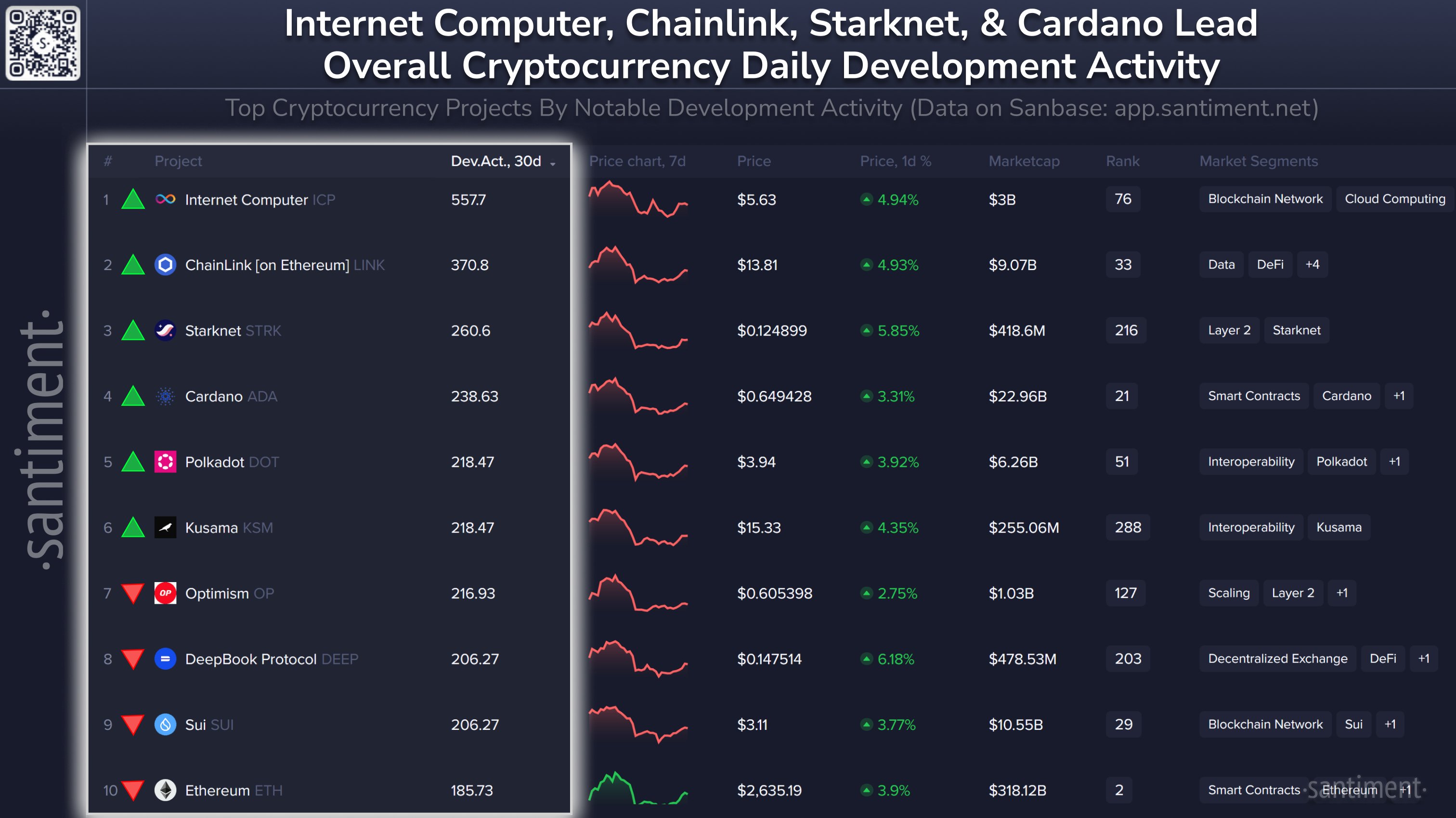
Now, here is the table shared by Santiment that shows the top 10 cryptocurrencies in this indicator over the last month:
Internet Computer (ICP) Dev Activity

Looks like ETH is currently dead last on the list | Source: Santiment on X

As is visible above, Internet Computer has been the number one coin in Development Activity during the past month, with the metric’s value standing at 557.7 right now. Chainlink (LINK) has taken the second spot with a value of 370.8 and Starknet (STRK) the third position with 260.6.

Despite being larger in market cap, Cardano has finished in fourth with the indicator sitting at 238.63. Even more notable, however, is Ethereum’s position. The coin is the second largest in the entire sector, but has finished last out of the listed cryptocurrencies, with a value of just 185.73.

Now, what does Development Activity signify for an asset? A high value of the metric can suggest the developers of the project are committed to it. While certainly not the only factor to watch for, it can be a sign that the project could be around in the long term and isn’t just another rug-pull.

Internet Computer being above the rest in the metric implies its developers are working hard at improving the network. Though, while this can be a positive indication for the future, this behind-the-scenes work usually doesn’t directly translate to the price, at least not immediately.

ICP Price

At the time of writing, Internet Computer is floating around $5.26, down over 10% during the past week.

Internet Computer Price Chart

The price of Internet Computer seems to have moved sideways over the last month | Source: ICPUSDT on TradingView
Featured image from Dall-E, Santiment.net, chart from TradingView.com
Editorial Process for bitcoinist is centered on delivering thoroughly researched, accurate, and unbiased content. We uphold strict sourcing standards, and each page undergoes diligent review by our team of top technology experts and seasoned editors. This process ensures the integrity, relevance, and value of our content for our readers.

Keshav is a Physics graduate who has been employed as a writer with Bitcoinist since June 2021. He is passionate about writing and through the years, he has gained experience working in a variety of niches. Keshav holds an active interest in the cryptocurrency market, with on-chain analysis being an area he particularly likes to research and write about.

Lecturas Relacionadas

Understanding x402 and MPP: Two Approaches to Agent Payments

Stripe's MPP and x402 represent two competing approaches to enabling machine-to-machine payments, both leveraging the long-dormant HTTP 402 status code ("Payment Required"). x402, led by Coinbase, is a minimalist protocol that embeds payment directly into HTTP requests. It requires no accounts, API keys, or intermediaries. A server returns a 402 response with payment details; the client pays on-chain and resubmits the request with a proof. It's open-source, chain-agnostic (currently supporting Base, Polygon, Solana), and designed for open, permissionless systems. However, current usage is low, with small microtransactions. MPP, developed by Stripe and Tempo, is a full-stack solution built for high-frequency agent transactions. Its core innovation is sessions, allowing an agent to pre-authorize a spending limit and make numerous micro-payments within it without repeated on-chain transactions. It runs on the Tempo blockchain, optimized for high throughput and sub-second confirmations. Crucially, it integrates with Stripe's existing compliance, risk, and fiat infrastructure, including support for credit cards via Shared Payment Tokens (SPTs). While x402 offers simplicity and decentralization, MPP provides scalability and enterprise-grade features. Stripe supports both, aiming to capture agent payment flows regardless of the underlying protocol. The ecosystem is still experimental, but major players like Google, Visa, and Anthropic are involved. The choice depends on the use case: x402 for open, long-tail applications, and MPP for commercial, high-volume scenarios.

marsbitHace 37 min(s)

Understanding x402 and MPP: Two Approaches to Agent Payments

marsbitHace 37 min(s)

The Use of Humans: Agentic Wallet and the Next Decade of Wallets

The article "The Use of Humans: Agentic Wallet and the Next Decade of Wallets" discusses the evolution of digital wallets in the age of AI agents. It argues that as software users shift from humans to autonomous agents, traditional wallet security models—relying on human confirmation, signatures, and private key management—become inadequate. The core proposition is that Agentic Wallets must serve two masters: humans, who set rules and retain ultimate control, and agents, which require constrained autonomy to execute transactions efficiently. The wallet thus evolves from a simple asset container into a permission and execution system that allows agents to operate within predefined boundaries (e.g., budget limits, approved assets, whitelisted addresses). The article identifies key challenges: current wallets are designed for human interaction, not agentic speed and scale. It outlines four tiers of agent autonomy—from human-controlled to fully autonomous—and emphasizes "bounded autonomy" as the pragmatic near-term solution. A four-layer architecture is proposed: account isolation, permission rules, execution primitives for agents, and governance tools (logging, alerts, veto mechanisms). Critical enabling technologies include standardized Skills (for链上 operations), policy engines, session keys for limited delegation, and audit trails. Current solutions from players like Coinbase, Safe, Privy, and Polygon are noted, but face gaps in portable identity/reputation, unified policy standards, adversarial security (e.g., prompt injection), and cross-chain functionality. The future direction involves a "Wallet Policy Plane" that sits between agent intent and on-chain execution, performing real-time policy checks, risk scoring, and identity verification—akin to Stripe's payment infrastructure. Ultimately, the wallet's role shifts from a front-end gatekeeper to an embedded control layer enabling secure, scalable agentic economies.

marsbitHace 59 min(s)

The Use of Humans: Agentic Wallet and the Next Decade of Wallets

marsbitHace 59 min(s)

Trading

Spot
Futuros

Artículos destacados

Cómo comprar ICP

¡Bienvenido a HTX.com! Hemos hecho que comprar Internet Computer (ICP) sea simple y conveniente. Sigue nuestra guía paso a paso para iniciar tu viaje de criptos.Paso 1: crea tu cuenta HTXUtiliza tu correo electrónico o número de teléfono para registrarte y obtener una cuenta gratuita en HTX. Experimenta un proceso de registro sin complicaciones y desbloquea todas las funciones.Obtener mi cuentaPaso 2: ve a Comprar cripto y elige tu método de pagoTarjeta de crédito/débito: usa tu Visa o Mastercard para comprar Internet Computer (ICP) al instante.Saldo: utiliza fondos del saldo de tu cuenta HTX para tradear sin problemas.Terceros: hemos agregado métodos de pago populares como Google Pay y Apple Pay para mejorar la comodidad.P2P: tradear directamente con otros usuarios en HTX.Over-the-Counter (OTC): ofrecemos servicios personalizados y tipos de cambio competitivos para los traders.Paso 3: guarda tu Internet Computer (ICP)Después de comprar tu Internet Computer (ICP), guárdalo en tu cuenta HTX. Alternativamente, puedes enviarlo a otro lugar mediante transferencia blockchain o utilizarlo para tradear otras criptomonedas.Paso 4: tradear Internet Computer (ICP)Tradear fácilmente con Internet Computer (ICP) en HTX's mercado spot. Simplemente accede a tu cuenta, selecciona tu par de trading, ejecuta tus trades y monitorea en tiempo real. Ofrecemos una experiencia fácil de usar tanto para principiantes como para traders experimentados.

145 Vistas totalesPublicado en 2024.12.12Actualizado en 2025.03.21

Cómo comprar ICP

Discusiones

Bienvenido a la comunidad de HTX. Aquí puedes mantenerte informado sobre los últimos desarrollos de la plataforma y acceder a análisis profesionales del mercado. A continuación se presentan las opiniones de los usuarios sobre el precio de ICP (ICP).

活动图片