29 Million Impressions, Only $71 Earned: How to Make Money from Traffic on X Platform?

marsbitPublicado a 2025-12-26Actualizado a 2025-12-26

Resumen

An experiment on X platform revealed that chasing high exposure metrics does not translate to meaningful revenue. After generating 28.9 million impressions and gaining 37.5k followers through aggressive tactics like spamming comments and piggybacking on popular accounts, the author earned only $71.49. The key insight is that exposure is a vanity metric—it doesn’t drive earnings. What matters is engagement from paid verified users. Comments and reposts from premium users carry the most weight, while likes and free user interactions contribute little. The platform’s algorithm filters out bot-driven activity, making inflated exposure worthless. The author also experienced negative side effects: bot followers diluted audience quality, reduced trust with the algorithm, and increased the risk of being flagged as spam. The recommended strategy shifts focus to quality over quantity: aim for 3-5% engagement rates, prioritize comments from verified users (45-50% of total followers), and create original content. Sustainable monetization comes from building a genuine community, not chasing empty metrics.

Written by: MAD Vincent

Compiled by: Chopper, Foresight News

I did exactly what they said: frantically spammed comments, closely followed top accounts to ride on their traffic, and jumped on every trending topic, chasing impressions like chips in a bull market.

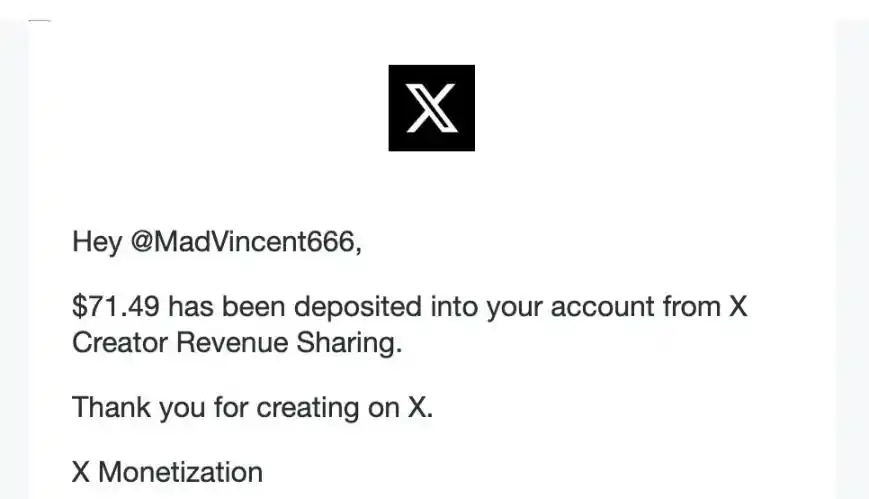
After 29 million impressions, the X platform paid me $71.49.

This is a warning. As of 2025, those still chasing impressions on the X platform are neither seizing the initiative nor working hard—they are merely the exit liquidity for bot traffic.
The Lie Everyone Believes

At some point, the crypto community (CT) reached a consensus: "The higher the impressions, the more money you make." This was half-true in the past. But by 2025, it has become a complete fallacy.

Today, impressions are nothing but a vanity metric: they look glamorous and addictive but are utterly useless for actual earnings. They can make your data panel as beautiful as a bull market chart, but the corresponding bank deposit is pitifully small, akin to a forgotten small wallet.

I learned this lesson the hard way.
My Personal Experiment (A.K.A. How I Got Rugged)

In mid-December 2025, I launched this aggressive traffic experiment: posting over 200 comments daily, specifically targeting top accounts' posts to蹭热度 (ride on their popularity), without limiting myself to any vertical, aiming for an all-out "indiscriminate bombardment."

Movies, gaming, politics, cryptocurrency, memes, sports... as long as it was a hot topic, I jumped in to comment.

Soon, my actions echoed across the platform: "Bro, I see you everywhere," "The algorithm must love you," "This data is explosive growth."

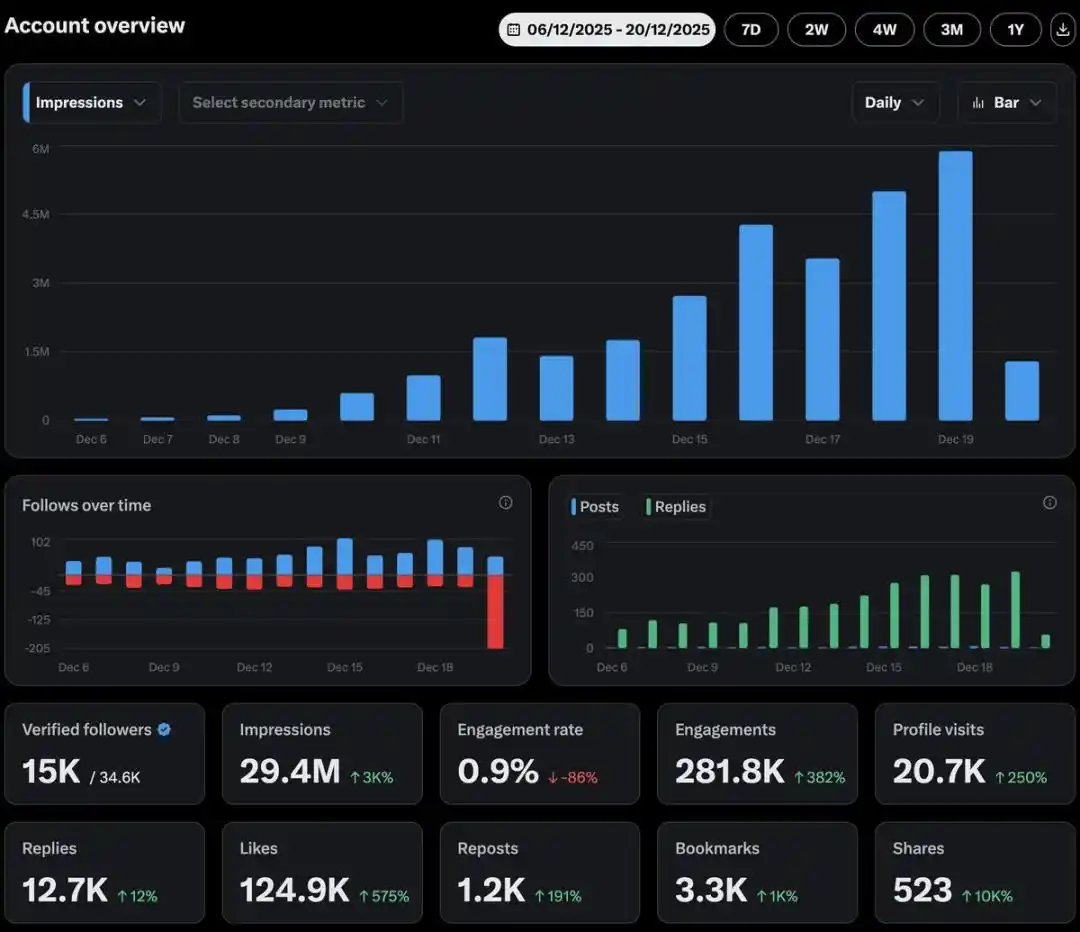
Now, let's look at the specific results: 28.9 million impressions, 267.7k engagements, 119.5k likes, 11.8k comments, 3.1k bookmarks, 20k profile visits, 37.5k followers, with verified users accounting for about 41%.

On average, I only posted 4 original pieces of content per day, with the rest of the traffic全靠 "comment section蹭热度 (riding on popularity)." Looking solely at the data panel, it was a crushing advantage. But when payday came, the deposit was only $71.49.

It was then that I fully understood: impressions don't make money; high-quality interactions from paying users are what matter.

The monetization logic of the X platform has long changed. It no longer rewards exposure but rather who interacts with you.

If your engagement data doesn't come from paying verified users, it's no different from having no engagement at all.

The Real Rules of X Platform Monetization in 2025

There's no mystery behind this; it's just that many are unwilling to accept reality. The real monetization rules are as follows.

Only engagement types from paying verified users count towards monetization: comments, reposts, bookmarks, likes, and the engagement must occur within monetizable reply posts.

Some engagement types are无效 for monetization: free user engagement, bot traffic, skyrocketing impressions without paying user participation, "fake viral" posts without paying user engagement.

One comment from a paying verified user might be worth far more than 100 bot likes.

Additionally, engagement has varying weights; not all are equal. Comments and reposts carry the highest weight, followed by bookmarks, with likes being the lowest.

So, if your engagement data shows the following characteristics: many likes, few comments, low verified user ratio—then your account may look popular but has no monetization value.

The Unmentioned Bot Traffic Trap

Riding on the popularity of top accounts' comment sections seems like a shortcut to gaining followers, but it's actually a distribution engine for bot traffic.

Here's what really happens: your comment gets pushed to a bot network → impressions skyrocket → engagement data appears healthy → at settlement, the platform filters out all invalid traffic.

This is why the absurd result of "29 million impressions, only $71 earned" occurs. This isn't a system glitch; it's the precise execution of platform rules.

This Playstyle Is Ruining Your Account

This is not only an extremely low ROI practice but also causes irreversible damage to your account.

Bot Follower Pollution

In just a few days, my account gained over 2500 bot followers. These bots lower:

  • The account's verified user ratio

  • The platform's trust rating for you

  • Future settlement amounts

Audience Dilution

Your followers are no longer a targeted audience but have become worthless "noise." The platform understands this, advertisers understand this, and ultimately, your earnings will reflect this directly.

Algorithmic Downgrade Penalty

Posting 200+ comments daily →极易触发限流 (easily triggers rate-limiting). Content lacks vertical focus →无法向算法传递清晰的账号标签 (unable to convey clear account labels to the algorithm). Ultimately, your account will be flagged by the algorithm as a "suspected spam account."

Creator Burnout

You think you're dominating the platform's hot list, but then the bank deposit notification hits you like a ton of bricks. Most creators give up at this very moment.

What I Did

I completely overturned my previous strategy: cleaned up 2500 bot followers, removed 5000 zombie followers, stopped the comment-section popularity riding, and focused on building a genuine follower community.

In the short term, account metrics确实下滑了 (did decline), but the long-term health of the account is recovering.

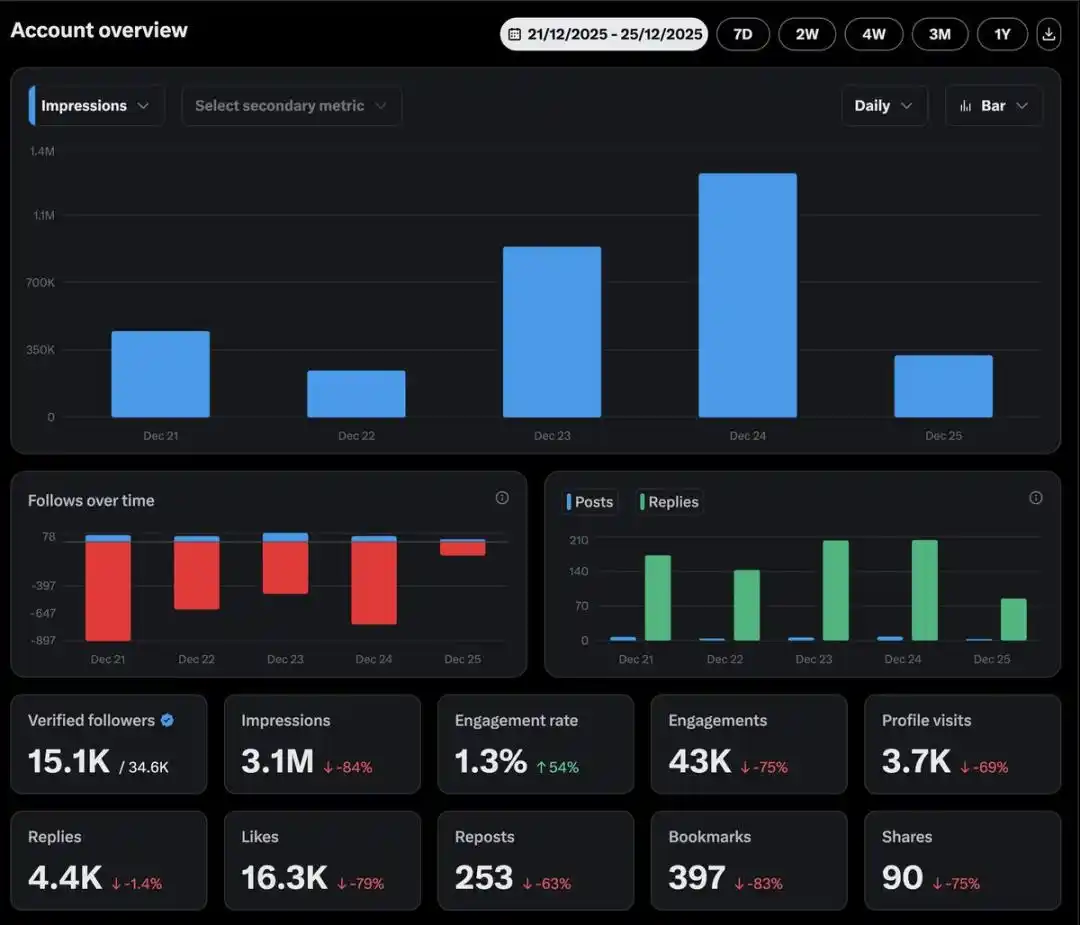
In the next settlement cycle, my account data showed new characteristics: lower impressions, higher quality engagement (check the engagement rate percentage), more precise follower growth, and significantly reduced creative pressure.
The Core Metrics Actually Worth Focusing On

If you want to make money on the X platform, aim for the following goals:

  • 3%-5% engagement rate

  • High-engagement posts dominated by comments

  • 45%-50% verified user ratio

  • Consistent output of original content

Having fewer impressions is okay; having high-quality user interaction is key. Achieve these, and you'll go from "Why are my earnings so terrible?" to "So this is how you achieve stable monetization."

The Final Truth

Impressions are like the siren's song: they make you think you've seized the initiative, make you feel like you're the platform's focus, and give you an illusion of "importance."

But they don't bring a single cent of profit. What monetizes is high-quality interaction from paying users. In 2025, the X platform will not reward "traffic speculators"; it will only reward "content builders."


Preguntas relacionadas

QWhat was the author's total earnings from 29 million impressions on X platform?

AThe author earned only $71.49 from 29 million impressions on the X platform.

QAccording to the article, what is the key factor for actual monetization on X platform in 2025?

AHigh-quality interactions from paid verified users, not just high impression counts, are the key to actual monetization.

QWhat negative consequences did the author experience from chasing impressions via comment spamming?

AThe author gained over 2500 bot followers, diluted their audience, risked algorithm downgrades, and experienced psychological burnout.

QWhat types of user interactions are considered most valuable for monetization on X platform?

AComments and reposts from paid verified users carry the highest weight for monetization, followed by bookmarks, with likes being the least valuable.

QWhat core metrics should creators focus on to achieve stable earnings on X platform according to the article?

ACreators should aim for a 3%-5% engagement rate, high-quality interactions like comments, 45%-50% verified user ratio, and consistent original content output.

Lecturas Relacionadas

Fei-Fei Li's Team Clarifies the Concept of 'World Models', Sora Merely a Renderer

"World Models" has become a widely used yet confusing term in AI. To address this, a team led by Fei-Fei Li and World Labs proposed a functional taxonomy based on the Partially Observable Markov Decision Process framework. This taxonomy categorizes systems called "world models" into three distinct projections: Renderers, Simulators, and Planners. Renderers, like OpenAI's Sora and other video generation models, focus on producing photorealistic visual outputs for human perception. They prioritize visual fidelity over physical accuracy. Simulators, such as NVIDIA Omniverse, aim to compute precise future environmental states for computational tasks like engineering analysis or digital twins. Planners, like Vision-Language-Action models, take in observations and goals to output executable actions for robots or agents. The article clarifies that most current "world models," including Sora, are primarily Renderers. They generate convincing visuals but lack the core ability to simulate state transitions based on actions, a key requirement for a true world model in classic reinforcement learning definitions. This conceptual confusion has practical implications, leading to potential misalignment in technology selection, investment, and public understanding of AI capabilities. Clear categorization is crucial. It helps enterprises avoid costly mistakes (e.g., using a renderer for robot training), allows investors to accurately assess markets, and enables researchers to build comparable benchmarks. While future systems may integrate these functions, recognizing current boundaries is essential for honest assessment and progress.

marsbitHace 1 hora(s)

Fei-Fei Li's Team Clarifies the Concept of 'World Models', Sora Merely a Renderer

marsbitHace 1 hora(s)

Bloomberg Uncovered: How Do China's Wealthy Circumvent the Annual $50,000 Limit to Transfer Assets?

**Summary: How Wealthy Chinese Circumvent $50,000 Annual Foreign Exchange Limits** Despite China's strict capital controls, including an annual $50,000 per person foreign exchange quota, an estimated $150 billion in funds still leaves the country annually via various gray and underground channels. This report outlines the evolution of China's "capital wall" and the methods used to bypass it. **The Evolving Capital Controls:** * **Foundation (1994):** The system of "current account convertibility with strict capital account controls" was established. * **Quota Set (2007):** The $50,000 individual annual forex purchase limit was formalized. * **Crackdown Begins (2015-2017):** Following market volatility, enforcement tightened. Banks were required to scrutinize transactions, and channels like using UnionPay cards for Hong Kong insurance premiums or buying overseas property were blocked. * **Digital & Legal Upgrades (2024-2026):** Enhanced algorithms now flag suspicious patterns (e.g., "smurfing"). The Common Reporting Standard (CRS) provides Chinese tax authorities with data on citizens' offshore accounts. Unlicensed cross-border brokers have been targeted. **Five Primary Methods for Moving Capital:** 1. **Underground Banking / "Hawala" (Duiqiao):** The largest-scale method. No money crosses borders. Clients pay RMB to a domestic account; an overseas associate deposits equivalent foreign currency into the client's offshore account. Risks include high fees, account freezes, and legal penalties. 2. **"Smurfing" or "Ant Moving":** Using multiple individuals' $50,000 quotas to pool funds for one offshore recipient. Increasingly detected by anti-money laundering algorithms. 3. **Trade Invoice Manipulation:** Businesses over-invoice imports or under-invoice exports via offshore shell companies, creating a pretext to transfer excess funds abroad under the guise of trade. 4. **Channel Migration:** After a crackdown on internet brokers, funds flow toward more compliant but costly channels like major banks' cross-border wealth management services or Qualified Domestic Institutional Investor (QDII) quotas. 5. **Structural Arrangements:** High-net-worth individuals use complex, high-cost legal structures involving offshore trusts, insurance, and investment migration programs to transfer asset ownership. **Regulatory Response: Focusing on People, Not Just Money** The current strategy extends oversight from enterprises to **individual residents**. Tools like CRS allow retroactive visibility into offshore assets. Cryptocurrencies, once seen as a potential loophole, are now actively monitored and prosecuted as an illegal channel. The underlying driver remains: with significant wealth concentrated among millions of affluent households seeking diversification amid domestic economic shifts, the incentive to move assets offshore persists despite regulatory barriers.

marsbitHace 1 hora(s)

Bloomberg Uncovered: How Do China's Wealthy Circumvent the Annual $50,000 Limit to Transfer Assets?

marsbitHace 1 hora(s)

Trading

Spot
Futuros
活动图片