Square & Steak ‘n Shake Lead with Bitcoin Payments – Best Wallet to Add Crypto Debit Card

bitcoinistPublicado a 2025-05-28Actualizado a 2025-05-28

Resumen

It turns out that Bitcoin ($BTC) isn’t just for the tech bros anymore but also for businesses, hamburger lovers, and...

Trusted Editorial content, reviewed by leading industry experts and seasoned editors. Ad Disclosure

It turns out that Bitcoin ($BTC) isn’t just for the tech bros anymore but also for businesses, hamburger lovers, and everyday spenders — aka, everyone.

Yesterday, Square, a payment platform by Block Inc., announced that it’ll soon enable businesses to accept $BTC and other crypto.

In other news, the popular American fast-food chain Steak ‘n’ Shake started accepting $BTC for payments two weeks ago.

And let’s not forget Best Wallet, a highly ranked secure crypto wallet that’ll soon launch its own crypto debit card.

Each of these developments highlights how $BTC is rapidly evolving from a speculative investment instrument to a practical currency built for real-world commerce.

Square Integrates Lightning for Low-Fee $BTC Payments

Square’s new hardware feature will enable merchants to accept cost-friendly and near-instant $BTC payments using the Lightning Network.

It began accepting $BTC payments at the Bitcoin Conference in Las Vegas (May 27 – 29). However, a full rollout is expected by the end of the year as part of its plan to reach all eligible sellers by 2026.
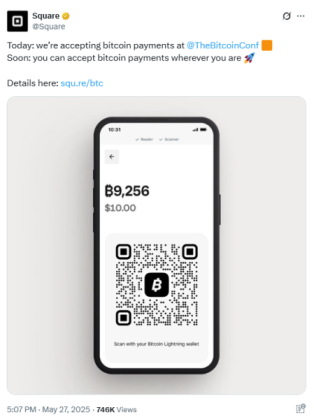
Square Bitcoin payments
Source: X (Square)

This isn’t Square’s first $BTC rodeo. It launched a Bitcoin Conversions feature last year, allowing merchants to automatically convert a portion of their daily sales into $BTC.

Additionally, its Cash App already lets you buy, sell, and send $BTC easily, and its self-custody crypto wallet, Bitkey Wallet, also supports the OG coin.

It has also launched Proto, which consists of Bitcoin mining tools and services, and Spiral, which supports open-source projects that promote $BTC as a tool for economic empowerment.

Stake ‘n’ Shake’s $BTC Payments Half Processing Fees

Square isn’t the only one on a mission to put $BTC to work in the real world. Stake ‘n’ Shake now accepts $BTC payments, claiming they’re faster and cheaper than traditional credit card payments.

Dan Edwards, the fast food chain’s COO, says the company saves approximately 50% in processing fees when customers pay with $BTC as opposed to credit cards.

Following the new payment method’s early success, Stake ‘n’ Shake is now pondering other ways to embrace cutting-edge technology to modernize its food service. Ideas include cyber-chefs, robotaxis, and drones.

Best Wallet to Add a Crypto Debit Card

Best Wallet is also pushing to make crypto available for use in daily life, and will soon launch Best Card, its own crypto debit card.

It’ll let anyone spend their crypto holdings in Best Wallet seamlessly at brick-and-mortar retailers.

This multi-chain wallet supports the best crypto presales and is getting set to accommodate over 60 blockchains – you’ll find everything you need to know in our full Best Wallet review.

Once launched, you can use your Best Card to spend $BTC and other digital assets for everyday purchases – from coffee to cab rides – without the friction of exchanges or conversions.

What’s more, you can earn cashback on every purchase, plus enjoy lower transaction fees when holding $BEST, the ecosystem’s native token.

Best Wallet to launch Best Card
Source: Best Wallet

You can buy #BEST on presale for just $0.025095. Our $BEST price prediction foresees the coin reaching $0.072 after being listed on crypto exchanges, an increase of some 186% from today’s price, so it’s best to get in now.

$BTC Is No Longer a Store of Value But Everyday Cash

$BTC is no longer just a store of value, but increasingly a payment method for everyday life.

With Square enabling low-cost $BTC payments, Stake ‘n’ Shake slashing fees by accepting crypto at the counter, and Best Wallet preparing to launch a fully-fledged crypto card, the future is here.

These developments highlight how $BTC is being integrated into real-world commerce to cut costs and give you more financial freedom. Whether for buying a burger or growing an investment portfolio, $BTC is going mainstream.

But as always, do your research before making any crypto investments; this article is not financial advice.

Editorial Process for bitcoinist is centered on delivering thoroughly researched, accurate, and unbiased content. We uphold strict sourcing standards, and each page undergoes diligent review by our team of top technology experts and seasoned editors. This process ensures the integrity, relevance, and value of our content for our readers.

Leah is a British journalist with a BA in Journalism, Media, and Communications and nearly a decade of content writing experience. Over the last four years, her focus has primarily been on Web3 technologies, driven by her genuine enthusiasm for decentralization and the latest technological advancements. She has contributed to leading crypto and NFT publications – Cointelegraph, Coinbound, Crypto News, NFT Plazas, Bitcolumnist, Techreport, and NFT Lately – which has elevated her to a senior role in crypto journalism. Whether crafting breaking news or in-depth reviews, she strives to engage her readers with the latest insights and information. Her articles often span the hottest cryptos, exchanges, and evolving regulations. As part of her strategy to attract crypto newcomers to the Web3 arena, she explains even the most complex topics in an easily understandable and engaging way. Further underscoring her dynamic journalism background, she has written for various sectors, including software testing (TEST Magazine), travel (Travel Off Path), and music (Mixmag). When she's not deep into a crypto rabbit hole, she's probably island-hopping (with the Galapagos and Hawaii being her go-to's). Or perhaps sketching chalk pencil drawings while listening to the Pixies, her all-time favorite band.

Lecturas Relacionadas

Is Ethereum Truly a "World Computer"?

Title: Is Ethereum Really a "World Computer"? Ethereum, envisioned as a "world computer" by its founder Vitalik Buterin, aims to be a decentralized platform for global applications. However, a recent analysis by Four Pillars raises questions about whether it is more accurately a "Western computer," based on the geographical distribution of its validators. Currently, the United States dominates with 38.19% of all validators, followed by Germany at 13.04%. Combined, these two countries account for over half of the network. In contrast, Asian representation is minimal, with Singapore holding only 3.15%. The concentration is partly due to affordable cloud hosting services like Hetzner and OVH in Europe and North America, as well as the prevalence of residential validators in the U.S., where individuals run nodes via home internet connections. When examining professionally operated validators, the distribution becomes more balanced. The U.S. share drops to 25.81%, while Asian countries like Singapore (7.28%), Hong Kong (6.44%), Japan (6.38%), and South Korea (4.59%) collectively approach the U.S. level. This shift reflects strategic deployments by institutions to meet regulatory requirements and reduce latency for local users. However, regions like South America, the Middle East, and Africa remain underrepresented. Ethereum's peer-to-peer network mechanisms, such as gossipsub, disadvantage areas with low node density, creating a feedback loop where delayed message propagation reduces validator performance and rewards. This imbalance challenges Ethereum's promises of censorship resistance and global accessibility. Despite these issues, opportunities exist for growth in underrepresented regions. As demand for localized staking infrastructure rises, early entrants in areas like the Middle East could establish dominant positions by offering compliant, low-latency solutions. The evolving validator landscape highlights both the structural challenges and the potential for Ethereum to move closer to its "world computer" ideal.

Foresight NewsHace 40 min(s)

Is Ethereum Truly a "World Computer"?

Foresight NewsHace 40 min(s)

WEEX TradFi Trading Competition Kicks Off, 50,000 USDT Prize Pool First-Come, First-Served, Open a Position and Get 5 U

WEEX Exchange Launches "TradFi Trading Competition" with a 50,000 USDT Prize Pool Amidst a crypto market downturn, WEEX Exchange highlights the growth of tokenized traditional finance (TradFi) assets as a key trend, allowing users to trade stocks, ETFs, and commodities using crypto. The platform has launched a "TradFi Trading Competition" from July 9th to 23rd, featuring a 50,000 USDT prize pool. The campaign offers three reward tiers: 1. **New User Bonus (25,000 USDT pool):** New users depositing ≥100 USDT, completing a specified spot trade, and one TradFi contract trade (margin ≥10 USDT) receive 200 USDT. 2. **Volume-Based Rewards (20,000 USDT pool):** All users can earn tiered bonuses for achieving TradFi contract trading volumes of 5,000 USDT (3 USDT), 20,000 USDT (10 USDT), and 100,000 USDT (50 USDT). Rewards are stackable. 3. **Participation Reward:** Any user opening a TradFi contract trade during the event receives 5 USDT instantly. The article promotes WEEX's TradFi features, which include trading tokenized shares of companies like NVIDIA and Tesla using USDT, 24/7 trading, fractional share investing starting from $5, and high leverage up to 100x for hedging. It positions these features as solutions to traditional investing barriers like high fees, strict trading hours, and high share prices. The summary concludes by encouraging users to join the competition and leverage WEEX's platform to access global TradFi markets.

marsbitHace 2 hora(s)

WEEX TradFi Trading Competition Kicks Off, 50,000 USDT Prize Pool First-Come, First-Served, Open a Position and Get 5 U

marsbitHace 2 hora(s)

Trading

Spot
活动图片