Coinbase Faces New Lawsuit Over Stock Drop Damages Following Data Breach

bitcoinistPublicado a 2025-05-26Actualizado a 2025-05-27

Resumen

Coinbase is facing a new class action lawsuit claiming that investors suffered significant losses over the years due to the...

Trusted Editorial content, reviewed by leading industry experts and seasoned editors. Ad Disclosure

Coinbase is facing a new class action lawsuit claiming that investors suffered significant losses over the years due to the crypto exchange’s “omissions,” which have affected the company’s stock price.

Coinbase Accused Of Key ‘Omissions’

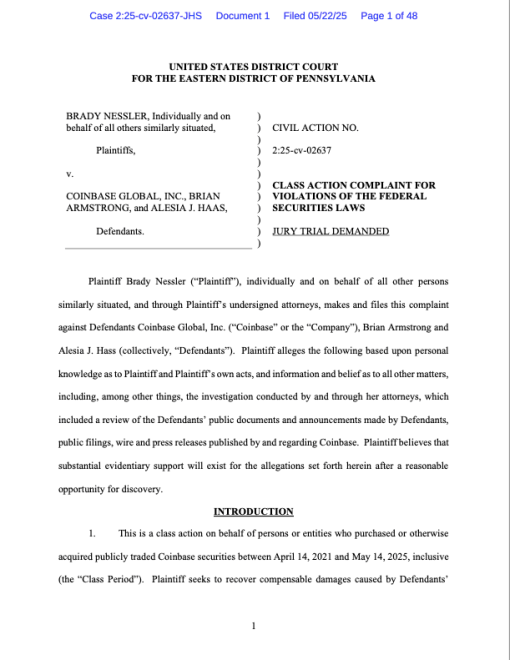
Last week, a Coinbase investor filed a class action lawsuit in the US District Court for the Eastern District of Pennsylvania against Coinbase, CEO Brian Armstrong, and CFO Alesia Hass, alleging that the company’s shareholders have suffered “significant losses and damages” over the past four years.

In the May 22 complaint, investor Brady Nessler, on behalf of persons or entities who purchased or otherwise acquired publicly traded Coinbase securities between April 14, 2021, and May 14, 2025, claims that the exchange has a long list of “wrongful acts and omissions” that have led to the “precipitous decline in the market value of the Company’s common shares” affecting the Plaintiff and other Class members.
coinbase

New lawsuit against crypto exchange Coinbase, Armstrong, and Hass. Source: CourtListener

Among the omissions, the lawsuit lists the company’s recent data breach and its failure to disclose that it breached its 2020 agreement with the UK’s Financial Conduct Authority (FCA).

In October 2020, the company’s UK subsidiary, Coinbase Payments (CBPL), signed a voluntary agreement to prevent onboarding clients considered “high risk” by the regulator and reduce potential criminal activity on the CBPL platform.

The lawsuit alleges that the company made several “materially false and misleading” statements at the time that omitted that Coinbase Payments, Ltd. (CBPL) had been found guilty by the UK regulator of having “inadequate anti-money laundering focused systems to prevent high-risk individuals from using its platform, and that CBPL then breached the Agreement designed to address those deficiencies, creating legal exposure.”

Notably, the price of the company’s common stock reportedly fell by $13.52 per share, a 5.52% decline, when a Reuters article titled “Coinbase UK unit fined for breaching financial crime requirements” was published during market hours on July 25, 2024. The FCA fined Coinbase’s UK subsidiary a $4.5 million penalty for breaching the voluntary agreement.

Data Breach Leads To Class Action Lawsuits

Moreover, the Class action suit argues that the recent data breaches also resulted in significant losses and damages for stockholders, highlighting the May 15 statement from the crypto exchange.

As reported by Bitcoinist, Brian Armstrong shared that threat actors bribed a handful of customer support contractors to access Coinbase’s internal tools, resulting in the breach of names, email addresses, limited transaction records, and partial Social Security numbers of 1% of the exchange’s users.

The hackers attempted to blackmail the exchange, demanding $20 million in Bitcoin (BTC) to return the sensitive customer data. However, Armstrong revealed they refused to pay the ransom.

The lawsuit states that, following the news, the price of Coinbase’s common stock fell by $19.85 per share, a 7.2% decline, to close at $244 on May 15, 2025. Since then, multiple lawsuits have been filed against the crypto exchange, and a US Department of Justice Investigation has been opened.

Based on this, Plaintiff seeks to “recover compensable damages caused by Defendants’ violations of the federal securities laws under the Securities Exchange Act of 1934 (the ‘Exchange Act’).”
Coinbase, bitcoin, btc, btcusdt

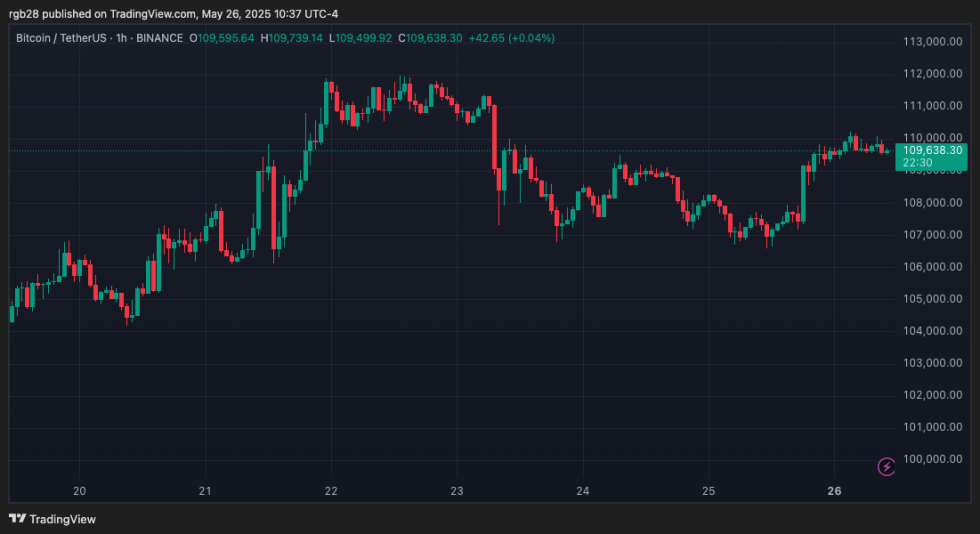
Bitcoin trades at $109,638 in the one-week chart. Source: BTCUSDT on TradingView
Featured Image from Unsplash.com, Chart from TradingView.com
Editorial Process for bitcoinist is centered on delivering thoroughly researched, accurate, and unbiased content. We uphold strict sourcing standards, and each page undergoes diligent review by our team of top technology experts and seasoned editors. This process ensures the integrity, relevance, and value of our content for our readers.

Rubmar is a crypto enthusiast who likes learning and improving constantly. She enjoys reporting on the latest news and developments in the crypto industry. Rubmar also enjoys scrapbooking, crafting, simulation games, and watching football.

Lecturas Relacionadas

WEEX TradFi Trading Competition Kicks Off, 50,000 USDT Prize Pool First-Come, First-Served, Open a Position and Get 5 U

WEEX Exchange Launches "TradFi Trading Competition" with a 50,000 USDT Prize Pool Amidst a crypto market downturn, WEEX Exchange highlights the growth of tokenized traditional finance (TradFi) assets as a key trend, allowing users to trade stocks, ETFs, and commodities using crypto. The platform has launched a "TradFi Trading Competition" from July 9th to 23rd, featuring a 50,000 USDT prize pool. The campaign offers three reward tiers: 1. **New User Bonus (25,000 USDT pool):** New users depositing ≥100 USDT, completing a specified spot trade, and one TradFi contract trade (margin ≥10 USDT) receive 200 USDT. 2. **Volume-Based Rewards (20,000 USDT pool):** All users can earn tiered bonuses for achieving TradFi contract trading volumes of 5,000 USDT (3 USDT), 20,000 USDT (10 USDT), and 100,000 USDT (50 USDT). Rewards are stackable. 3. **Participation Reward:** Any user opening a TradFi contract trade during the event receives 5 USDT instantly. The article promotes WEEX's TradFi features, which include trading tokenized shares of companies like NVIDIA and Tesla using USDT, 24/7 trading, fractional share investing starting from $5, and high leverage up to 100x for hedging. It positions these features as solutions to traditional investing barriers like high fees, strict trading hours, and high share prices. The summary concludes by encouraging users to join the competition and leverage WEEX's platform to access global TradFi markets.

marsbitHace 19 min(s)

WEEX TradFi Trading Competition Kicks Off, 50,000 USDT Prize Pool First-Come, First-Served, Open a Position and Get 5 U

marsbitHace 19 min(s)

Switching Chains for Another Shot at Success: Can It Really 'Change One's Destiny'?

Recent months have witnessed a wave of established blockchain projects migrating to new public chains, notably Base and Arbitrum, coupled with strategic pivots in their business models—essentially "re-starting" elsewhere. Examples include Sophon (moving from ZKsync to Base to cut $3M+ annual costs and focus on consumer apps), Moonbeam (shifting from Polkadot to Base to pursue decentralized AI), and Secret Network (planning a move from Cosmos to Arbitrum to explore privacy-AI integrations, though its token price plunged 30% post-announcement). A common thread is that these migrating projects are primarily layer-1 or layer-2 chains now seeking relevance in AI and real-world consumer applications. This trend highlights the relative stagnation of ecosystems like Polkadot and Cosmos, which are seeing significant outflows. However, the community remains skeptical about whether such chain-hopping truly enables a turnaround. Historical cases like y00ts NFTs (which moved from Solana to Polygon and back to Ethereum) and Synthetix (which retreated from a multi-chain strategy) show that migration often fails to deliver expected benefits and can add complexity. In today's more rational market, devoid of easy narrative or airdrop红利, simply changing chains is unlikely to be a silver bullet. For both migrating projects and destination chains, the real challenge lies not in attracting projects but in developing actual use cases that retain users.

marsbitHace 23 min(s)

Switching Chains for Another Shot at Success: Can It Really 'Change One's Destiny'?

marsbitHace 23 min(s)

Does Switching Chains to Re-entrepreneur Really "Change One's Destiny"?

Amid a recent wave of blockchain migrations, several established projects, including Sophon, Moonbeam, and Secret Network, are moving to new ecosystems like Base and Arbitrum. Unlike past migrations driven by hype or security, these moves are often accompanied by strategic pivots, such as shifting focus to consumer applications, AI, or privacy-AI integration, effectively representing a "re-startup" attempt. However, the crypto community has reacted cautiously. Following Secret Network's announcement of its planned migration to Arbitrum, its token price plummeted over 30% in 24 hours. While migrating to more cost-efficient, higher-traffic, or technologically suitable chains can be a pragmatic choice, history shows that such moves rarely guarantee success. Examples like the y00ts NFT project, which moved from Solana to Polygon and then to Ethereum, or Synthetix’s retreat from a multi-chain strategy, illustrate the challenges and often underwhelming results. The current market environment, characterized by greater user rationality and the partial validation of past narratives, makes a successful "pivot via migration" even more difficult. Simultaneously, destination chains themselves face challenges in demonstrating sustainable user adoption beyond merely attracting migrating projects. Ultimately, the competition is shifting from which chain can onboard the most projects to which can genuinely foster real-world application and retain users.

链捕手Hace 28 min(s)

Does Switching Chains to Re-entrepreneur Really "Change One's Destiny"?

链捕手Hace 28 min(s)

June Transaction Volume Doubles: x402 Ecosystem Continues to Expand, Content Monetization Narrative Faces Crucial Test

X402, a protocol for AI and data services, experienced significant growth in June. Its transaction volume doubled compared to May, primarily driven by the AI inference routing service BlockRun. The ecosystem expanded with new integrations: Apify enabled data scraping services, Exa extended its AI search to Solana, and Seal launched 'Hacks', a marketplace for automated AI agents. The protocol itself received crucial upgrades, including 'Builder Codes' for tracking and affiliate systems and 'Batch Settlement' to enable practical micropayments for high-frequency AI tasks. Major external validation came from tech giants. Amazon Web Services (AWS) launched a solution for AI traffic metering at its edge nodes. More significantly, Cloudflare opened its waitlist for a Content Monetization Gateway. This gateway allows websites to charge AI bots and other automated agents for accessing content, using x402 for stablecoin payments. This addresses a core internet monetization problem and represents x402's most promising path to mass adoption, though Cloudflare's CEO noted current blockchain scalability remains a critical hurdle. Current leading use cases are AI inference routing and paid data feeds. However, the large-scale real-world test with Cloudflare's gateway will be decisive in determining if x402 can transition from a useful tool to a fundamental infrastructure component for a new web economy where AI agents pay for the content they consume.

Foresight NewsHace 53 min(s)

June Transaction Volume Doubles: x402 Ecosystem Continues to Expand, Content Monetization Narrative Faces Crucial Test

Foresight NewsHace 53 min(s)

Trading

Spot
活动图片