«Ультимативный болотный актив». Журналисты The Economist разочаровались в криптовалютах

cryptonews.ruPublicado a 2025-05-16Actualizado a 2025-05-17

Цифровые активы, которые задумывались как аполитический инструмент, стали синонимом взяточничества и жадности. Об этом говорится в статье The Economist.
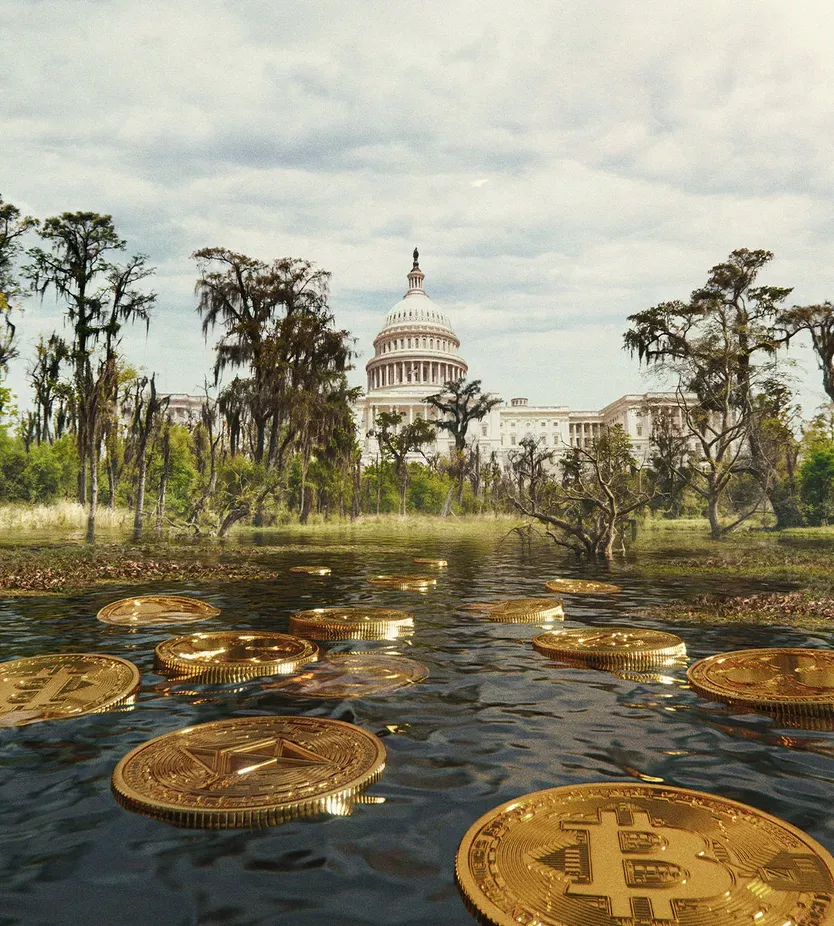
Обложка к статье. Данные: The Economist.

Заметка вышла под заголовком «Криптовалюта стала ультимативным болотным активом». Авторы отметил, что за последние несколько лет новое финансовое направление плотно укрепилось в американской общественной жизни.

«Криптоэнтузиасты помогают управлять регулирующими органами. Ведущие предприятия отрасли входят в число крупнейших доноров избирательных кампаний […]. Сыновья президента [США Дональда Трампа] рекламируют свои криптовалютные предприятия по всему миру. Крупнейшие инвесторы в мем-коины Трампа могут поужинать с ним. Активы первой семьи теперь оцениваются в миллиарды, что делает криптовалюту, возможно, крупнейшим источником ее богатства», — обратили внимание в издании.

Журналисты усмотрели в сложившейся ситуации иронию, поскольку биткоин изначально задумывался как «революция в финансах». Его последователи имели «высокие цели» по защите людей от инфляции и передаче власти розничным инвесторам.

«[Биткоин] был больше, чем актив: это была технология свободы», — заявили в The Economist.

Теперь изначальные идеи забыты, а криптовалюта способствует мошенничеству, отмыванию денег и другим преступлениям. По мнению авторов, индустрия также развила «грязные отношения» с исполнительной властью американского правительства, которые превосходят возможности Уолл-стрит или любой другой отрасли.

При этом различные юрисдикции вроде Евросоюза, Японии, Сингапура, Швейцарии и ОАЭ сумели в последние годы придать цифровым активам нормативную ясность без «безудержных конфликтов интересов». Кроме того, в некоторых частях развивающегося мира с высокой инфляцией и слабым банковским сектором криптовалюта по-прежнему выполняет «нечто вроде той роли, на которую когда-то надеялись ранние идеалисты».

«Все еще много спекуляций. Но криптовалюта постепенно начинает восприниматься более серьезно основными финансовыми фирмами и технологическими компаниями», — говорится в материале.

В качестве перспективного направления журналисты указали на токенизацию активов реального мира, которым уже занимаются крупные американские игроки, включая BlackRock и Franklin Templeton.

Наиболее распространенным вариантом использования цифровых активов по-прежнему остаются платежи — многие отраслевые фирмы уже применяют стейблкоины в некоторых расчетах.

Однако США рискуют упустить возможности, считают в издании. SEC под руководством Гэри Генслера скептически относилась к сектору, впутав криптокомпании в судебные разбирательства и запугав банки.

«Результатом является то, что криптовалюта в Америке нуждается в спасении от самой себя. Новые правила по-прежнему необходимы для гарантий того, что риски не выплеснутся на финансовую систему. Если политики, напуганные электоральной мощью отрасли, не смогут должным образом регулировать криптовалюту, долгосрочные последствия окажутся пагубными», — предупредили журналисты.

Напомним, сформированная Трампом в январе рабочая группа по рынкам цифровых активов обозначила в числе приоритетов разработку нормативно-правовой базы для стейблкоинов.

В мае законопроект о «стабильных монетах» (GENIUS Act) провалился на ключевом голосовании в Сенате США.


Lecturas Relacionadas

Gate Research Institute: ETF Outflows Suppress Risk Appetite, Two-Way System Navigates Weak Market

Gate Institute Research Report: May 2026 Crypto Market Review & Strategy Analysis In May 2026, the crypto market shifted from an early-month rally to a mid-month correction, concluding with low-volatility consolidation. BTC, ETH, and SOL peaked in early May before declining. The primary market dynamic was a divergence between weakening spot ETF inflows and persistently high leverage-driven perpetual trading volume. A dual-direction moving average cluster breakout strategy outperformed, returning +2.11% for an equally-weighted BTC/ETH/SOL portfolio. This contrasted with a -6.09% return for buy-and-hold and -3.65% for a long-only version of the strategy. Profits were primarily generated from short positions on ETH and SOL during the mid-to-late May downtrend, demonstrating the month's suitability for two-way trend trading. Market structure evolved in three phases: an initial surge (May 1-6), a failure and reversal (starting May 7), and low-volatility compression (May 22 onward). While stablecoin supply remained stable, significant outflows from mainstream BTC and ETH ETFs created selling pressure. Concurrently, high correlation with the S&P 500 (~0.6) and stronger performance from AI equities like Nvidia highlighted crypto's position as a high-beta risk asset within a broader risk-budget framework, lacking independent momentum. The successful strategy employed a 4-hour chart system using a cluster of six moving averages (EMA6,12,24 & SMA6,12,24). A breakout signal was triggered after the cluster width compressed below 2.2%. Trades were managed with a 2.5% fixed stop-loss, a 3:1 Risk/Reward (7.5%) take-profit, and an EMA12-based exit rule to control losses from false breakouts. The strategy's low win rate but high payoff from a few large trend moves was effective in May's conditions. The report concludes that for June, a disciplined, bidirectional approach remains superior to subjective directional bets. The framework should adapt signal weighting based on BTC's position relative to key EMAs, ETF flow trends, and the relative strength of the Nasdaq, prioritizing risk management and trend preservation.

marsbitHace 26 min(s)

Gate Research Institute: ETF Outflows Suppress Risk Appetite, Two-Way System Navigates Weak Market

marsbitHace 26 min(s)

Anthropic CEO's Latest Interview: On Technological Explosion, Safety Red Lines, and the Civilization Contract

Interview with Anthropic CEO Dario Amodei covers the intense pressures and ethical dilemmas of leading AI development. He describes the experience as "exponential growth," feeling constant acceleration akin to relativistic time dilation. The discussion delves into his departure from OpenAI, rooted in a fundamental loss of trust and divergent values rather than mere technical disagreements. Amodei emphasizes Anthropic's enterprise-focused business model, arguing it aligns better with safety and responsible deployment than consumer-facing, ad-driven models. He addresses critical issues like AI's impact on employment, advocating for proactive macroeconomic policies and a shift towards "doing more with the same resources" to avoid widespread job displacement. On safety and governance, he details Anthropic's cautious approach, including delaying the release of the powerful "Mythos" model due to its advanced cyber capabilities. He stresses the need for "human-in-the-loop" principles in military applications, setting red lines against autonomous weapons and mass surveillance. Amodei calls for industry collaboration among trustworthy actors to establish standards and advocates for a balanced regulatory framework with checks and balances, such as Anthropic's Long-term Benefit Trust, rather than corporate or government monopoly over the technology. He expresses geopolitical concerns, particularly regarding China, and a belief that AI should bolster liberal democracies. While acknowledging a non-zero risk of civilizational catastrophe from advanced AI, he asserts Anthropic's actions are aimed at significantly reducing that probability. The interview concludes with Amodei arguing that trust must be earned through concrete actions, like sacrificing commercial gain for safety, to distinguish Anthropic in a Silicon Valley landscape he criticizes for eroded public trust.

marsbitHace 30 min(s)

Anthropic CEO's Latest Interview: On Technological Explosion, Safety Red Lines, and the Civilization Contract

marsbitHace 30 min(s)

Trading

Spot
Futuros
活动图片