Dogecoin App Layer Coming As DogeOS Raises $6.9 Million — Why It Matters

bitcoinistPublicado a 2025-05-08Actualizado a 2025-05-08

Resumen

DogeOS, the new application layer that aspires to give Dogecoin full-fledged utility beyond tipping and trading, has closed a $6.9...

Trusted Editorial content, reviewed by leading industry experts and seasoned editors. Ad Disclosure

DogeOS, the new application layer that aspires to give Dogecoin full-fledged utility beyond tipping and trading, has closed a $6.9 million seed round led by Polychain Capital. The funding marks the first time an independent development stack focused exclusively on Dogecoin has attracted institutional backing at this scale, signaling what Polychain calls “a critical layer for the future of decentralized innovation.”

According to the official press release, the capital will be deployed to launch the DogeOS platform, expand developer tools and forge partnerships aimed at consumer adoption. The roadmap cites “X-native applications and integrations to support next-generation AI and DeFi” as early priorities, all of them settled natively in DOGE. By presenting itself as an “App Layer,” DogeOS positions Dogecoin as programmable infrastructure—something the original meme coin has generally lacked since its 2013 launch.

Jordan Jefferson, chief executive of MyDoge and now the public face of DogeOS, framed the initiative as the logical extension of Dogecoin’s culture-first success. “Dogecoin has always been about community and culture — DogeOS is bridging the gap between Dogecoin’s massive consumer community and real on-chain innovation,” he said. “With over half a million users trusting MyDoge as their preferred wallet, we’ve seen firsthand the community’s demand for native DOGE experiences. DogeOS delivers on that demand — unlocking new use cases, more creativity, and a future where DOGE is built into everything.”

Polychain’s participation gives the project a stamp of credibility among crypto-native investors known for infrastructure bets. “DogeOS is a game-changer for the Dogecoin ecosystem,” remarked Luke Pearson, a partner at the firm. “Its ability to support a diverse range of applications, from gaming to AI, positions it as a critical layer for the future of decentralized innovation. We’re excited to support DogeOS in building a network that truly belongs to its community.”

Why This Matters For Dogecoin

RootData, a market-intelligence service that tracks private-round activity, contextualized the raise in a thread on X. The service described DogeOS as “the ‘operating system’ of Dogecoin — a dev platform enabling consumer apps across DeFi, gaming, AI, and more, all powered by DOGE,” and argued that the round represents “serious institutional interest in Dogecoin’s next evolution — from memecoin to utility layer.” RootData noted that Dogecoin’s lack of smart-contract programmability has so far limited on-chain experimentation; DogeOS promises to “bridge that gap” with a tool-set designed to be “simple, fun, and deeply community-driven.”

In practice, DogeOS will introduce native yield opportunities and decentralized-finance primitives—yield farming, stablecoin integration and other mechanisms—that have historically been unavailable to DOGE holders. By converting DOGE from a “static, cultural asset” into a token that can participate directly in decentralized applications, DogeOS aims to reframe Dogecoin’s role within the broader crypto economy.

While the $6.9 million infusion is modest compared with the billion-dollar treasuries behind Ethereum-compatible layer-twos, its symbolic weight is notable. Polychain was among the earliest backers of both Cosmos and Polkadot; its thesis-driven investments tend to precede wider developer attention. For Dogecoin—a network sustained primarily by retail enthusiasm and Elon Musk mentions—the arrival of an infrastructure-oriented venture round could mark the start of a more sustained buildout.

Whether DogeOS can galvanize developers remains an open question, but the project has at least one leverage point: MyDoge’s existing base of more than 500,000 users, who will be able to access new applications from within a familiar wallet. The DogeOS team argues that this “captive audience” lowers the usual cold-start friction faced by emerging blockchains.

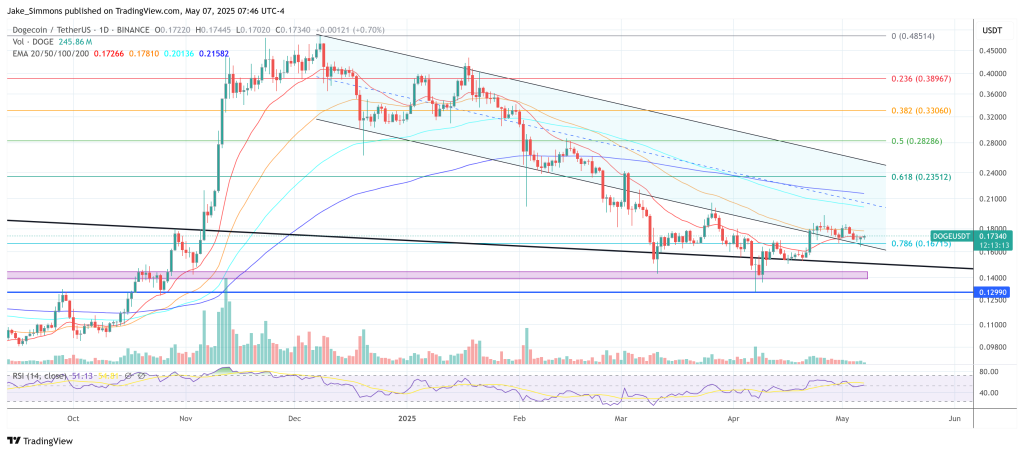
At press time, DOGE traded at $0.173.
Dogecoin price
DOGE remains inside the channel, 1-day chart | Source: DOGEUSDT on tradingView.com
Featured image created with DALL.E, chart from TradingView.com
Editorial Process for bitcoinist is centered on delivering thoroughly researched, accurate, and unbiased content. We uphold strict sourcing standards, and each page undergoes diligent review by our team of top technology experts and seasoned editors. This process ensures the integrity, relevance, and value of our content for our readers.

Jake Simmons has been a Bitcoin enthusiast since 2016. Ever since he heard about Bitcoin, he has been studying the topic every day and trying to share his knowledge with others. His goal is to contribute to Bitcoin's financial revolution, which will replace the fiat money system. Besides BTC and crypto, Jake studied Business Informatics at a university. After graduation in 2017, he has been working in the blockchain and crypto sector. You can follow Jake on Twitter at @realJakeSimmons.

Lecturas Relacionadas

Paradigm's New Playbook: Crypto in One Hand, AI and Robotics in the Other

Title: Paradigm's New Strategy: Crypto in One Hand, AI and Robotics in the Other On July 8, 2026, top-tier venture capital firm Paradigm announced the successful $12 billion close of its fourth fund, marking a strategic evolution beyond its pure-play crypto roots. While remaining committed to cryptocurrency, the firm is now formally extending its investment focus to include artificial intelligence, robotics, and other frontier technologies. This shift was foreshadowed by a subtle but significant change to its official social media description earlier in March, from "A research-driven crypto investment firm" to a broader "We build and invest in the companies and ideas shaping the frontier." The move is driven by the firm's recognition of transformative technological waves beyond crypto, particularly in AI and robotics, and a response to the shifting capital allocation landscape. Despite significant AI sector fundraising, Paradigm emphasizes its commitment remains grounded in deep technical rigor. A key intersection for Paradigm lies in AI Agents, where decentralized blockchain networks and stablecoins are seen as a natural financial infrastructure for autonomous digital operations. The firm is active in promoting open-source, decentralized AI (e.g., investing in Nous Research) and building agent-friendly blockchains (e.g., incubating Tempo). It is also developing tools like EVMbench (with OpenAI) and the Centaur AI Agent platform. Within its crypto stronghold, Paradigm will continue focusing on core infrastructure areas. These include derivatives and new liquidity layers (e.g., Hyperliquid), prediction markets (with plans for a proprietary trading terminal), and developer tools (continuing development of Reth and Foundry). In summary, Paradigm's expansion reflects a broader realignment in venture capital, where the intense capital concentration in AI and the search for exponential growth compel even crypto-native funds to broaden their narratives. However, this does not signify an abandonment of crypto; instead, the focus is sharpening on real-world financial applications like stablecoins, RWA, on-chain derivatives, prediction markets, and the convergence of Crypto and AI Agents.

Foresight NewsHace 27 min(s)

Paradigm's New Playbook: Crypto in One Hand, AI and Robotics in the Other

Foresight NewsHace 27 min(s)

The Preferred Stock Domino Effect: Strive Incurs a 7.08 Million Dollar Loss, Strategic Risk Spreading in a Chain Reaction

"Priority Stock Domino Effect": Strive's $7.08 Million Loss Reveals Chain-Reaction Risk in Bitcoin Reserve Sector Bitcoin reserve company-issued preferred shares are no longer just yield assets but a credit test for balance sheet health. While focus remains on Strategy, Strive, the 7th largest public Bitcoin holder, disclosed a tangible spillover effect: its holding of Strategy's (STRC) preferred shares lost $7.08 million in fair value over eight days, despite no change in share count. This exposes a clear cross-company risk transmission channel within the sector. Strive's filing shows its 505,000 STRC shares fell from ~$88.59 to ~$74.57 per share. While Strive remains solvent with 19,864 BTC and $141.7M cash, the loss signals that preferred stock risks can spread via inter-company holdings, shifting their perception from stable income to credit-like, high-risk assets dependent on issuer liquidity and dividend sustainability. In response, Strategy unveiled a "Digital Credit Capital Framework," raising STRC's annual dividend to 12%, mandating a 12-month cash reserve for dividends, and authorizing up to $1B each for STRC/common stock buybacks and a $1.25B Bitcoin sale plan to bolster reserves. This marks a shift to active credit risk management, formally incorporating potential Bitcoin sales to stabilize its capital structure. Third-party valuation tools, like Farside's calculator estimating STRC's net present value at ~$49.89, highlight that pricing now hinges critically on perpetual dividend sustainability and the issuer's ability to pay amid market volatility. Bitcoin's price (~$62k) remains below Strategy's average cost basis ($75,651), intensifying focus on reserve policies. The market faces two scenarios: 1) Contained risk, where STRC's discount narrows and stress is limited to Strategy; or 2) Systemic risk, where deep STRC discounts persist, dividend hikes fail, Bitcoin sales commence, and pressure spreads to other issuers like Strive's SATA shares. Key indicators to watch are STRC/SATA discount levels, dividend coverage credibility, equity issuance rates, and any actual Bitcoin divestment. Strive's future reports will be crucial in determining if its loss is an isolated event or the first sign of sector-wide credit risk contagion via preferred shares.

marsbitHace 31 min(s)

The Preferred Stock Domino Effect: Strive Incurs a 7.08 Million Dollar Loss, Strategic Risk Spreading in a Chain Reaction

marsbitHace 31 min(s)

Are the Frantic Acquisitions of Crypto Companies by Giants Good or Bad?

In a bear market, giants are actively acquiring crypto companies. Recent months have seen at least five major deals: Samsung Securities bought a 2% stake in Upbit operator Dunamu; Robinhood acquired WonderFi for $180 million to enter the Canadian market; Figure purchased Kiavi for $717 million to expand into on-chain real estate credit; Franklin Templeton bought 250Digital to launch Franklin Crypto; and Blockworks acquired data platform Messari at a steep discount—over 90% less than its 2022 $300 million valuation. These moves highlight a strategic shift. Cash-rich giants are consolidating resources at low cost, targeting companies with established compliance frameworks to navigate tightening global regulations. Acquisitions like WonderFi and the Upbit stake provide immediate market access and licensed user bases. Figure's deal signals real-world asset (RWA) tokenization moving from concept to large-scale implementation, with Kiavi's $7+ billion annual transaction volume being integrated into on-chain capital markets. Franklin Crypto's launch targets institutional investors like pension funds, offering them tailored, compliant crypto strategies. For these strategic players, bear markets present an ideal entry point: valuations are depressed, speculative noise is minimized, and they can acquire robust technology and compliance infrastructure at a fraction of the cost. This acquisition wave marks a transitional phase for crypto—from a wild frontier toward an institutional, regulated financial system. Giants are positioning themselves to capture future growth when macroeconomic conditions and liquidity improve, leaving latecomers behind.

marsbitHace 1 hora(s)

Are the Frantic Acquisitions of Crypto Companies by Giants Good or Bad?

marsbitHace 1 hora(s)

Trading

Spot
活动图片