SEC新掌门Paul Atkins:可能带给币圈的巨大利好

marsbitPublicado a 2025-04-23Actualizado a 2025-04-23

告别"监管时代",迎接"创新时代"

曾任Securitize董事,BlackRock支持的RWA代币化平台!!!

推动监管清晰,

拓宽投资者准入,

简化注册途径,

配合稳定币法案,

支持RWA上链

这都是市场期望的这位新sec掌门的施政方向

SEC

告别"执法时代",迎接"创新时代"

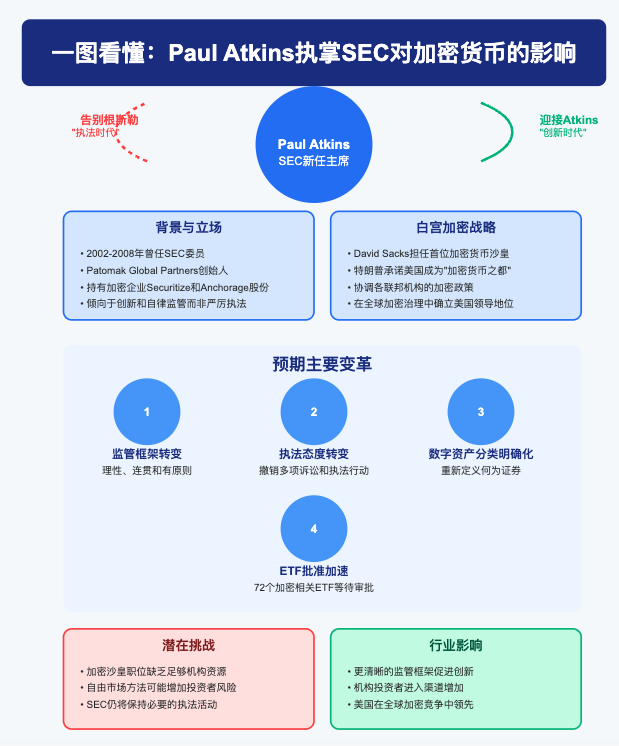
Atkins的上任标志着SEC监管风格的显著转变。与前任加里·根斯勒严厉执法的方式截然不同,Atkins以支持市场创新和自律监管而闻名。他在参议院听证会上明确表示,加密货币监管将是他的"首要任务",并承诺为数字资产提供"理性、连贯和有原则"的监管框架。

值得注意的是,特朗普政府上任后,SEC已开始撤销多项针对加密货币公司的诉讼和执法行动。

数字资产定义重新划分

Atkins将重新考虑哪些加密资产应被视为证券。

SEC之前已明确表示,工作量证明挖矿、流动性挖矿和美元支持的稳定币不受证券法约束。

Atkins的进一步转变可能为整个行业带来更大的确定性和发展空间。

加密ETF批准提速

在Atkins领导下,加密货币相关ETF的批准流程预计将大幅加速。目前有超过70个与加密相关的ETF正在等待监管决定,涵盖从XRP、莱特币到Solana等主流加密货币。这一变化将为机构投资者提供更多进入加密市场的渠道,有望带来更大的资金流入。

美国加密战略全面升级

Atkins还将和川普政府任命风险投资家David Sacks,首位白宫加密货币沙皇,配合协调,实现特朗普竞选承诺将美国打造成"地球上的加密货币之都"。

另外Atkins作为贝莱德投资的RWA项目高管,很可能会加速推动美股美债的RWA的上链进程,为数十万亿的美元美债资产链上流通打下基础。

未来展望

随着Atkins领导的SEC开始制定新的监管框架,我们可以预期未来几个月将出现更加明确的政策指导。这将改变未来几年甚至十几年的加密行业发展。

里面当然会有无数的行业机会,无论投资人还是创业者,我们都需密切关注,以便及时调整战略并把握新机遇。

Lecturas Relacionadas

Will There Be a Next Wave of Web3 Games? Veteran Player's Review: At the Peak of Hype, You Should at Least Sell Half

**Title: Is There Another Wave for Web3 Gaming? A Veteran Player's Review: When Hype Peaks, You Must Exit at Least Half** **Summary:** In an interview, veteran player "Earn Money Chicken" shares his journey and reflections on Web3 gaming. He transitioned from being a traditional in-game trader to a Web3 gamer, having profited from games like Mobox, StepN, and Seraph, but also experiencing significant losses. He defines himself primarily as a player, not an investor, attracted to Web3 games for the blend of earning potential, engaging gameplay, and the satisfaction of researching game mechanics. While he enjoys strategic "gambling" within games, he emphasizes it's not about zero-sum competition with other players. The interview explores the complex, often adversarial relationship between players, projects, and major investors (whales). The player's experience as a traditional game merchant helped develop his analytical mindset for spotting opportunities, but wasn't directly transferable. He identifies the core sources of profit in early Web3 gaming as **"era红利" (era-specific红利)** and strategic foresight, not just simple calculations. He warns that the biggest mistake ordinary players make is calculating their return-on-investment (ROI) period at peak hype, as asset and yield depreciation can trap them. Reflecting on his wins and losses, he now advocates for managing expectations. His most successful exit was from Seraph, where he sold at a relatively good time. The key problem with current Web3 games, he argues, is that most are not mature games first. A successful Web3 game must primarily be a **good, fun game** with a genuine player base willing to spend money for enjoyment, not just participants seeking profit. The blockchain element should solve problems within that context, not be the primary driver. While he believes the sector might see another speculative boom (possibly another strong "Ponzi" model attracting hype), a truly mature and sustainable Web3 game likely needs to come from a traditional major game studio. It would leverage a proven IP, mature content, a functional NFT trading system, and attract both traditional and crypto-native players, offering more normalized returns rather than extreme暴利. His final advice: Newcomers without prior experience should avoid the space now, as it's like searching for a diamond in the rough. For those remaining, the rule is: be brave when assets are low and overlooked, but **when everyone is talking about it (at peak hype), you must sell at least half your holdings.**

marsbitHace 40 min(s)
Will There Be a Next Wave of Web3 Games? Veteran Player's Review: At the Peak of Hype, You Should at Least Sell Half

marsbitHace 40 min(s)

The Most Hidden AI Winners

"The Most Under-the-Radar AI Winners" While core AI giants and their direct suppliers have dominated headlines, a group of seemingly unrelated, decades-old manufacturing companies have emerged as major beneficiaries. A key example is Japan's TOTO, famous for bathroom fixtures. Its stock soared 145% in a year, driven not by its mainstay toilet business but by its nearly 40-year-old semiconductor ceramic component unit. Specifically, TOTO manufactures electrostatic chucks—critical, hard-to-replace parts for advanced chip manufacturing processes like etching and EUV lithography. This segment, though only 9% of revenue, contributed over 54% of operating profit in FY2025 with a 43% margin. High barriers to entry, including deep know-how in high-purity ceramic sintering and long supplier certification cycles (5+ years), secure its position. This pattern repeats across industries. Nitto Boseki, a 128-year-old glass fiber maker, saw its stock rise 325% due to near-monopoly supply of T-glass, an essential low-expansion material for AI chip substrates. Similarly, Ajinomoto, the global MSG leader, commands 80-95% of the market for ABF film, a vital insulating layer in chip packaging. These "hidden" segments, often born from deep materials science expertise, are now bottleneck supplies in the AI hardware chain, enjoying pricing power and high margins. In China's A-share market, the theme combines this AI-driven demand with domestic substitution. Companies like Zhongci Electronic (advancing in electrostatic chucks) and Honghe Technology & Feilihua (in high-end electronic glass fabrics) are gaining traction. The investment thesis hinges on whether these domestic players can rapidly scale qualified capacity to capture the supply gap within the critical time window. Ultimately, these cases show that in the AI supply chain, high-profit concentrations exist not only at the cutting-edge tech frontier but also in indispensable, difficult-to-replicate materials and components. Market recognition often lags behind fundamental profit shifts, creating potential for significant re-ratings as traditional industrial firms are re-evaluated as key enablers of advanced semiconductor manufacturing.

marsbitHace 1 hora(s)

The Most Hidden AI Winners

marsbitHace 1 hora(s)

The Most Secretive Winners of the AI Boom

"The Most Hidden AI Winners" An unlikely group of companies are emerging as major beneficiaries of the AI boom, not from designing chips, but from supplying critical materials and components essential for advanced semiconductor manufacturing. These 'hidden winners' are traditional manufacturers whose deep expertise in materials science has become indispensable. Japanese companies are leading this trend. Toto, globally known for bathroom fixtures, has seen its stock surge 145% over the past year, driven by its 40-year-old semiconductor ceramics business, which now contributes over half of its operating profit. Its electrostatic chucks are vital for advanced chip production and require years of expertise to manufacture. Similarly, Nittobo, a 128-year-old textile firm, controls 90% of the market for T-glass, a low-expansion glass fiber essential for AI chip substrates. Ajinomoto, the world's largest MSG producer, dominates the market (80-95% share) for ABF insulating film used in chip packaging. The core insight is that chasing "advanced" chips paradoxically increases reliance on traditional, high-precision material science where supply cannot be quickly replicated. These materials are now critical bottlenecks in the AI supply chain. This trend is mirrored in China's A股 market, framed by the theme of 'import substitution'. Companies like Zhongci Dianzi (electrostatic chucks) and Honghe Technology (ultra-thin electronic cloth) are making progress, but face the test of scaling production and matching Japanese rivals' quality. The key tension lies in the slow change of market perception. While profit structures rapidly shift towards high-margin tech components, these firms retain their traditional industry classifications, creating a valuation gap that is gradually closing as their roles in the AI ecosystem become undeniable.

链捕手Hace 1 hora(s)

The Most Secretive Winners of the AI Boom

链捕手Hace 1 hora(s)

Trading

Spot
活动图片