没有利率永续,DeFi 永远拼不完整?

深潮TechFlowPublicado a 2025-04-21Actualizado a 2025-04-21

Resumen

DeFi 生态中缺失的一块拼图。


撰文:defiance
编译:zhouzhou,BlockBeats


编者按:DeFi 缺乏类似 CME 的利率永续合约工具,导致利率波动大、无法对冲风险。引入利率 perp 可帮助借贷双方锁定利率、实现套利与风险管理,并促进 DeFi 与 TradFi 融合,提升市场效率与稳定性。


以下为原文内容(为便于阅读理解,原内容有所整编):


在芝商所(CME),利率期货的日交易量超过一万亿美元。这个庞大的交易量主要来自银行和资产管理人,他们通过对冲浮动利率与已发放的固定利率贷款之间的风险来进行操作。


在 DeFi 中,我们已经建立了一个繁荣的浮动利率借贷市场,总锁仓价值超过了 300 亿美元。Pendle 的激励式订单簿在某个单一市场中的流动性超过了 2 亿美元,已经展示出市场对利率现货的强烈需求。


但我们仍然缺乏一个像 CME 利率期货那样的 DeFi 原生工具,用于为借贷双方对冲利率风险(IPOR 掉期不算,因为它太复杂了)。


要理解我们为什么需要这个工具,首先得了解 DeFi 中利率是如何运作的。


以 AAVE 为例,它的利率是基于供需动态调整的。但 AAVE 的供需并不是孤立存在的,而是嵌套在全球经济的大背景之下。


将 AAVE 的平滑化 USDC 浮动利率与 CME 的 10 年期国债期货价格作图对比后,我们就能看出这种宏观经济关联:
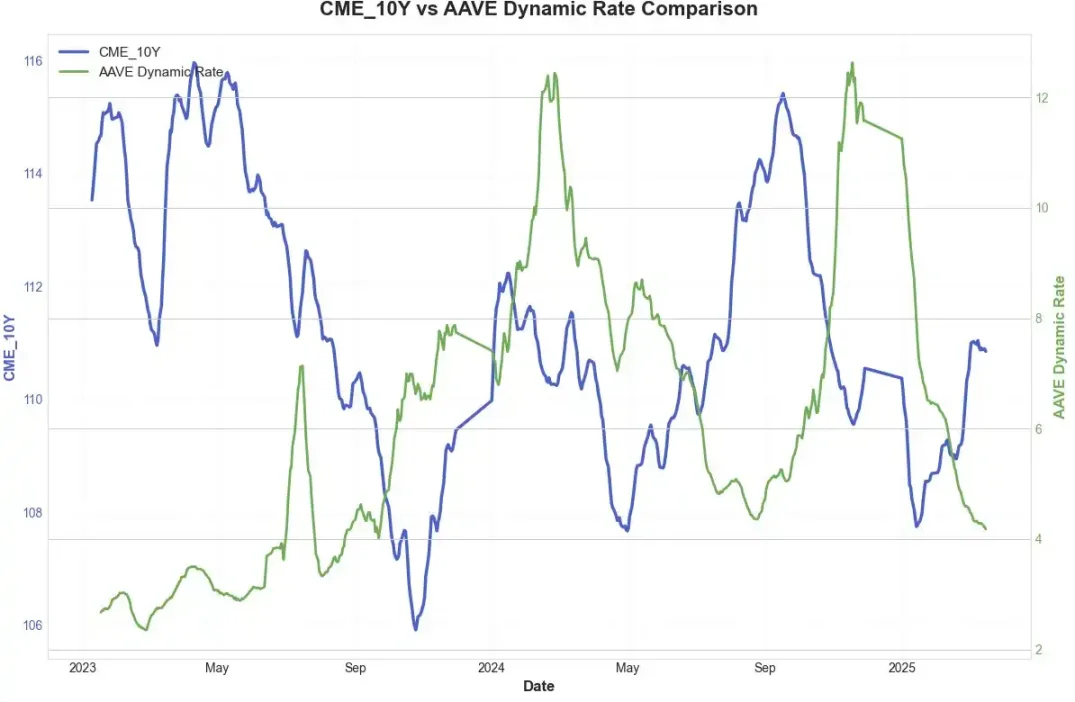

AAVE 的 USDC 利率走势与全球利率保持一致,但存在一定滞后。这种滞后的主要原因,是全球利率与 AAVE 利率之间缺乏即时联动机制。


也正因为这种断层,使得加密市场自身的供需动态在利率形成中扮演了更强的角色。当我们取消平滑处理,直接将 AAVE 的利率与全球 10 年期国债利率作图对比时,这种现象更加明显:
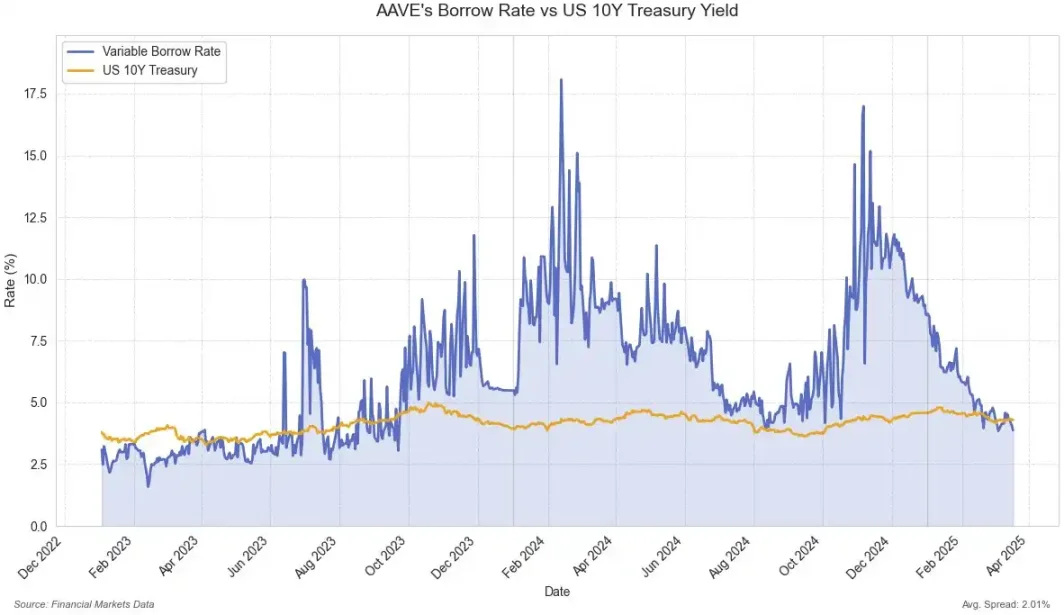

AAVE 的利率波动非常剧烈,而且在大多数时间里,它的利率相比美国 10 年期国债利率有着显著溢价。


这种溢价的根本原因,依然是这两个市场之间缺乏直接关联。如果 DeFi 和 TradFi 的利率之间有一个简单、双向的连接机制,能够对冲或套利,就能更好地把两个生态整合起来。
而 ** 利率永续合约(Perpetual Swaps)** 正是实现这一点的最佳方式。Perp 已经被市场验证过产品契合度(PMF),如果能建立一个涵盖 AAVE 利率和美国国债利率的永续市场,将带来巨大变革。


举个例子:


对借款人来说,他们可以做多一个锚定 AAVE 借款利率的利率永续合约。如果借款年化利率从 5% 飙升到 10%,这个永续合约的价格会上涨,从而对冲成本上涨的风险。


相反,如果利率下跌,借款变便宜了,但永续头寸亏损,这就像是支付了一笔「保险费」。这样一来,借款人等于通过借款 + 做多永续合约,锁定了一个有效的固定利率。
对稳定币出借人而言,他们可以做空一个基于稳定币出借利率的利率永续合约。如果出借收益下滑,永续合约的空头获利,抵消贷款收益减少带来的损失;如果收益上涨,空头亏损,但利息收入增加,形成对冲。


而且,这些合约还可以使用高杠杆。CME 上的利率市场,10 倍杠杆是常规配置。


拥有一个流动性良好的利率市场,还能在市场压力时减少踩踏式连锁反应。如果市场参与者提前做好对冲,就不会因为利率波动被迫大规模提款或平仓。


更重要的是,这也为真正长期固定利率贷款打开了大门——如果这个利率永续合约是完全 DeFi 原生的,那就可以被各种协议拿来做长期利率对冲,从而给用户提供固定利率贷款。
传统金融里,对冲利率风险是常规操作,大部分长期贷款背后都有利率对冲工具。


把这种机制引入 DeFi,不仅能提升效率,还能吸引更多 TradFi 玩家进入这个市场,真正打通 DeFi 和 TradFi 之间的桥梁。


我们可以让市场更高效,而这一切,只需要一个利率永续合约的出现。

Criptos en tendencia

Lecturas Relacionadas

UK Crypto Regulation Enters Countdown: What Changes Are in the FCA's New Rules?

UK Crypto Regulation Enters Countdown: Key Changes in FCA's New Rules The UK Financial Conduct Authority (FCA) has published its final crypto asset regulatory policy, marking a shift from consultation to implementation. The new regime, set to fully expand from October 25, 2027, moves crypto businesses from registration to authorisation. A critical window from September 30, 2026, to February 28, 2027, allows existing firms to apply for transitional provisions, enabling them to continue operating while their authorisation is reviewed. Existing registrations will not automatically convert. The rules cover a broad range of activities including stablecoin issuance, custody, trading platform operation, arranging deals, staking, and lending. Authorised firms must meet new prudential capital requirements, with permanent minimum capital ranging from £750,000 for proprietary trading to £75,000 for arranging deals. They must also hold a basic liquid asset buffer for operational resilience. Market integrity rules now apply to trading platforms and intermediaries, covering areas like insider trading and requiring best execution checks against at least three UK-authorised venues. Custodians face enhanced client asset protection rules (CASS 17), focusing on ownership, reconciliation, and private key management. For stablecoins, issuers must provide full backing from issuance and allow redemption at par value within a T+1 timeframe. Reserve assets are categorised into core (e.g., demand deposits) and expanded types, with specific liquidity requirements (ODDR and CBAR) to ensure redemption capacity. Systemically important stablecoin issuers may be jointly regulated by the FCA and the Bank of England. The FCA cautions that the rules do not eliminate the high-risk, speculative nature of most crypto assets but establish a more comprehensive financial regulatory framework for the industry.

Foresight NewsHace 7 min(s)

UK Crypto Regulation Enters Countdown: What Changes Are in the FCA's New Rules?

Foresight NewsHace 7 min(s)

From Pump.fun to Collector Crypt: Has Solana's Revenue Throne Changed Hands?

From Pump.fun to Collector Crypt: Is Solana’s Revenue Throne Changing Hands? Solana’s on-chain narrative is expanding from meme coins to tokenized trading cards. Previously, Pump.fun dominated consumer revenue on Solana. However, starting in Q2 2026, Pump.fun's quarterly revenue growth slowed, while Collector Crypt shows a stronger recent growth trajectory. Data indicates Pump.fun's Q1 revenue was $108.3M, dropping 36.1% to $69.2M in Q2 so far. Conversely, Collector Crypt's revenue grew 108.8%, from $12.3M in Q1 to $25.8M in Q2 to date, with recent weekly revenue hitting $5.1M. While Pump.fun remains larger in scale, Collector Crypt demonstrates stronger short-term momentum. Collector Crypt's model involves custodying graded physical trading cards, minting corresponding NFTs on Solana, and selling randomized packs. Revenue comes from pack sales, secondary market fees, and royalties. Its profitability, estimated around 4-5%, stems from bulk card purchases at a discount and a buyback system for users. However, a full-scale reversal in rankings hasn't occurred. Year-to-date, Pump.fun's revenue is ~$177.5M (with its ecosystem at ~$466.5M), vastly exceeding Collector Crypt's ~$38.1M. The shift is more about narrative and recent growth dynamics than total historical volume. Pump.fun relies on speculative token launches, while Collector Crypt focuses on collectibility, scarcity, and real-world asset backing. This highlights a broadening of Solana's consumer revenue sources beyond meme coins. The sustainability of Collector Crypt's growth depends on maintaining demand for randomized packs, expanding beyond Pokémon cards (currently dominant) into sports cards, and navigating potential regulatory scrutiny on "loot box" mechanics. In conclusion, Pump.fun remains the larger revenue engine, but Collector Crypt's rise signifies a diversification of Solana's consumer application revenue into tangible, collection-based scenarios alongside speculative meme coin activity.

链捕手Hace 7 min(s)

From Pump.fun to Collector Crypt: Has Solana's Revenue Throne Changed Hands?

链捕手Hace 7 min(s)

EF: Ethereum Is Becoming the Most Needed Neutral Infrastructure for Governments and Institutions

Ethereum Foundation's Global Policy Strategy team released a report titled "Ethereum for Governments and Institutions," positioning Ethereum as critical, neutral public infrastructure. It argues that current digital systems, controlled by centralized intermediaries, create single points of failure and trust risks. In contrast, Ethereum’s decentralized architecture offers a credible, neutral alternative for applications like digital identity, public records, and asset tokenization. The report highlights Ethereum's resilience, noting it has never experienced downtime since 2015. It is secured by approximately $76 billion in staked ETH, features a geographically diverse validator network, and maintains multiple independent client implementations. This design eliminates counterparty risk, as no single entity can alter rules or shut down the network. Compared to other blockchains assessed in a referenced OpenZeppelin report, Ethereum demonstrates superior economic security, lower validator participation barriers promoting decentralization, and a mature ecosystem with over 11,000 developers. Real-world implementations, such as decentralized identity projects in Bhutan and Buenos Aires and land registry systems in India, are cited as evidence of its practical utility for public sectors. The guide serves as a non-technical primer for policymakers, emphasizing the need for infrastructure that preserves sovereignty and enables coordination without reliance on centralized intermediaries.

Odaily星球日报Hace 17 min(s)

EF: Ethereum Is Becoming the Most Needed Neutral Infrastructure for Governments and Institutions

Odaily星球日报Hace 17 min(s)

After Snagging a Nobel Laureate, Anthropic Poaches Berkeley CS Department Head, Recruiting Four Top Talents in Two Weeks

In a stunning move, Anthropic has recruited Jelani Nelson, the chair of UC Berkeley's prestigious EECS Computer Science Division and a leading theoretical computer scientist, on a leave of absence. This follows a two-week hiring spree where Anthropic also secured Nobel laureate John Jumper and two key Gemini researchers from Google. Nelson's expertise in streaming algorithms, dimensionality reduction, and randomized algorithms—fundamentally about processing vast data with minimal resources—directly addresses core challenges in large language models: training efficiency, data compression, and computational complexity. His work on the Johnson-Lindenstrauss lemma underpins modern vector search and embedding compression. Anthropic's recruitment signals a strategic shift in the AI race from merely scaling models to optimizing foundational algorithms for efficiency. This "leave of absence" model, exemplified by figures like Fei-Fei Li, is becoming a mainstream talent pipeline, allowing scholars to retain academic positions while gaining industry access to unprecedented compute and real-world problems. The recent talent war has escalated from poaching between AI firms to raiding top university departments, with Berkeley being a prime target. As OpenAI and Anthropic near potential IPOs, offering pre-IPO equity, they are effectively becoming parallel research institutions. The competition's focus is now descending to the theoretical bedrock of algorithms.

marsbitHace 20 min(s)

After Snagging a Nobel Laureate, Anthropic Poaches Berkeley CS Department Head, Recruiting Four Top Talents in Two Weeks

marsbitHace 20 min(s)

Trading

Spot

Artículos destacados

Cómo comprar UNI

¡Bienvenido a HTX.com! Hemos hecho que comprar Uniswap (UNI) sea simple y conveniente. Sigue nuestra guía paso a paso para iniciar tu viaje de criptos.Paso 1: crea tu cuenta HTXUtiliza tu correo electrónico o número de teléfono para registrarte y obtener una cuenta gratuita en HTX. Experimenta un proceso de registro sin complicaciones y desbloquea todas las funciones.Obtener mi cuentaPaso 2: ve a Comprar cripto y elige tu método de pagoTarjeta de crédito/débito: usa tu Visa o Mastercard para comprar Uniswap (UNI) al instante.Saldo: utiliza fondos del saldo de tu cuenta HTX para tradear sin problemas.Terceros: hemos agregado métodos de pago populares como Google Pay y Apple Pay para mejorar la comodidad.P2P: tradear directamente con otros usuarios en HTX.Over-the-Counter (OTC): ofrecemos servicios personalizados y tipos de cambio competitivos para los traders.Paso 3: guarda tu Uniswap (UNI)Después de comprar tu Uniswap (UNI), guárdalo en tu cuenta HTX. Alternativamente, puedes enviarlo a otro lugar mediante transferencia blockchain o utilizarlo para tradear otras criptomonedas.Paso 4: tradear Uniswap (UNI)Tradear fácilmente con Uniswap (UNI) en HTX's mercado spot. Simplemente accede a tu cuenta, selecciona tu par de trading, ejecuta tus trades y monitorea en tiempo real. Ofrecemos una experiencia fácil de usar tanto para principiantes como para traders experimentados.

454 Vistas totalesPublicado en 2024.12.12Actualizado en 2026.06.02

Cómo comprar UNI

Discusiones

Bienvenido a la comunidad de HTX. Aquí puedes mantenerte informado sobre los últimos desarrollos de la plataforma y acceder a análisis profesionales del mercado. A continuación se presentan las opiniones de los usuarios sobre el precio de UNI (UNI).

活动图片