Tron против Ethereum. Почему идет борьба за стейблкоин USDT

RBK-cryptoPublicado a 2025-04-16Actualizado a 2025-04-16

Почему стейблкоины стали важной частью любой блокчейн-сети. Как стейблкоин USDT генерирует доходы для операторов различных блокчейнов

В первом квартале 2025 года объем транзакций в стейблкоинах достиг рекордных $2,04 трлн. Основная доля операций пришлась на токены USDT и USDC, а блокчейны Ethereum и Tron продолжают доминировать в их перемещении. Несмотря на схожие показатели объема и капитализации, есть существенная разница - USDT в Ethereum используется преимущественно для крупных переводов, тогда как Tron обрабатывает миллионы более мелких транзакций.

Ethereum (ETH) является второй по капитализации криптовалютой с показателем около $190 млрд. Tron (TRX) - является восьмой по капитализации криптовалютой с показателем $24 млрд. 

Ethereum является первопроходцем в разработке смарт-контрактов и крупнейшей блокчейн-сетью на рынке децентрализованных приложений как с точки зрения количества этих приложений, так и со стороны суммы пользовательских депозитов в них.

Tron известен тем, что его основатель Джастин Сан часто копирует популярные разработки, стараясь адаптировать их под основанный им блокчейн. Даже для запуска сети Tron разработчики использовали значительную часть кодовой базы Ethereum.

Джастин Сан на обложке Forbes. Как он помог Трампу заработать $400 млн

Объем транзакций в стейблкоинах за первые три месяца 2025 года достиг $2,04 трлн, что примерно на 40% больше, чем за тот же период прошлого года. По данным аналитической платформы платежного гиганта Visa, отслеживающего рынок стабильных токенов, более 61% объема ($1,246 трлн) пришлось на токен от компании Tether — USDT. На стейблкоин USDC от компании Circle пришлось $782 млрд (более 38%) объема транзакций, на остальные отслеживаемые активы — PYUSD, USDP, FDUSD пришлось всего $8,5 млрд (менее 1%).

Блокчейны Ethereum и Tron продолжают доминировать на рынке переводов стейблкоинов. Объем транзакций в стейблкоинах в этих сетях практически одинаков за первый квартал 2025 года — на первый приходится почти $780 млрд, в Tron около $770 млрд. На блокчейн Solana приходится почти $140 млрд. Остальной объем в $351 млрд распределен в семи различных блокчейнах, включая BNB Chain, Avalanche, Arbitrum, Optimism, POL, Base, Celo.

Стейблкоины — это криптовалютные токены, курс которых привязан к какому-либо активу, например к доллару, евро или унции золота. В качестве обеспечения привязки курса к базовому активу компании используют ценные бумаги, национальные валюты или другие криптоактивы.

Наиболее известные стабильные токены выпускаются компаниями Tether (USDT) и Circle (USDC), где первый имеет наибольшую капитализацию на рынке с показателем $144 млрд по данным Coinmarkecap на 15 апреля. Капитализация USDT, выпущенного на блокчейне Tron, составляет $68,7 млрд. На Ethereum показатель превысил $74 млрд.

Стейблкоины стали самой используемой криптовалютой. Что о них нужно знать

Различный характер

Несмотря на практически равные показатели капитализации USDT, использование этого стейблкоина в блокчейнах Ethereum и Tron имеет важные различия.

Ethereum лидирует с точки зрения количества крупных транзакций, особенно выше $10 млн — за последние 3 месяца таких переводов произошло более 37 тыс. В это же время в Tron показатель составил всего 6,35 тыс. операций. Зато Tron лидирует по операциям размером до $1 млн, несравнимо превышая показатели в Ethereum.
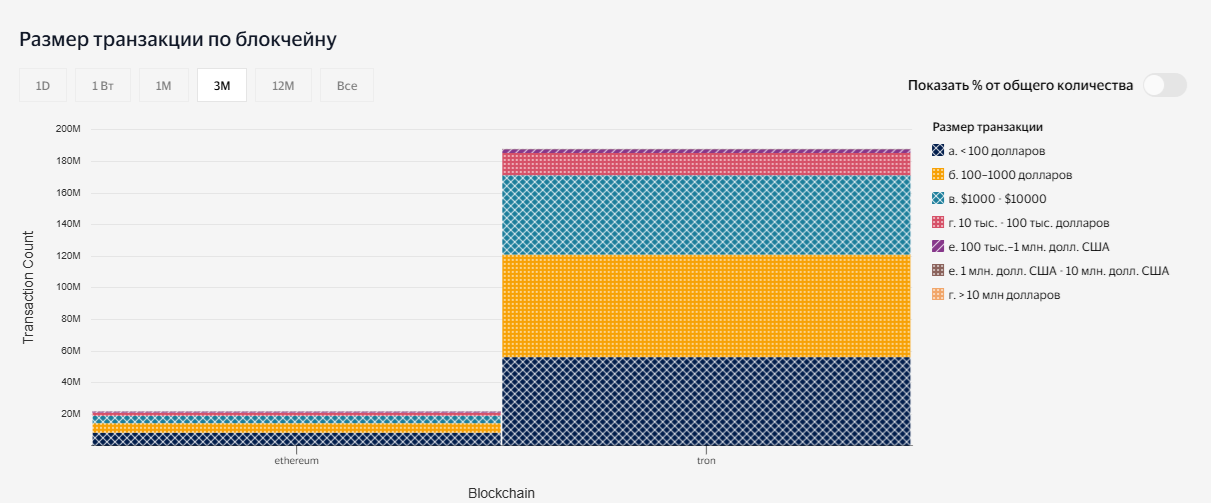
Количество транзакций USDT за прошедшие 3 месяца по размеру перевода в блокчейне Ethereum и Tron. Источник: Visa.

Таким образом, общее количество транзакций с USDT на Tron в десятки раз превышает количество на Ethereum. Так, например, за первый квартал 2025 года в Tron обработано около 130 млн USDT-транзакций. В то время как Ethereum зафиксировал только 11,1 млн.

Это важный аспект потому, что от количества транзакций в том или ином блокчейне зависят доходы операторов сетевых узлов, которые занимаются их обработкой. Это характерная особенность блокчейн-сетей, где фактически любая операция требует от пользователя уплаты комиссий, которые идут независимым операторам в качестве платы за проведение операции.

Если посмотреть на совокупные показатели доходов того или иного блокчейна с начала 2025 года по 15 апреля, по информации Token Terminal, то Tron является самой прибыльной сетью. Ее показатель превысил $950 млн, в то время как у Ethereum он составил около $156 млн.

Телеграм-канал «РБК-Крипто» — подпишитесь и будьте в курсе самых главных и актуальных новостей о криптовалюте.

Присоединяйтесь к форуму «РБК-Крипто» в Telegram для обсуждения новостей и тенденций криптомира.

По оценкам британского банка Standard Chartered, стейблкоины стали важнейшим элементом крипторынка, а весь их сектор может вырасти примерно в 10 раз до $2 трлн в течение следующих трех лет. Согласно информации Bloomberg, руководитель отдела исследований цифровых активов банка Джефф Кендрик основывает этот прогноз на позитивных изменениях в законодательстве США на счет стейблкоинов, привязанных к курсу доллара.

Дело в том, что бизнес модель двух крупнейших стабильных токенов USDT и USDC заключается в покупке государственных облигаций США, используемых в качестве обеспечения для выпуска криптоактивов. Эта же модель позволяет получать компаниям-эмитентам доход за счет процентных начислений за удержание ценных бумаг.

Кендрик предположил, что эмитенты стейблкоинов могут создать дополнительный спрос на государственные облигации США и «поглотить всю новую эмиссию казначейских векселей», которая запланирована на оставшуюся часть второго срока президента США Дональда Трампа

Что такое токеномика. Что учитывать при оценке криптопроекта

«Ясного тренда нет». Что будет с биткоином в ближайшую неделю

Криптопроект Трампа и ставка на ИИ. Главное из интервью главы Tether

Criptos en tendencia

Lecturas Relacionadas

Foundation Steps Back, Ethlabs Steps Forward: Ethereum Undergoes Its Largest Restructuring in History

On June 23rd, the Ethereum ecosystem witnessed two major shifts, signaling a significant governance realignment. First, former Ethereum Foundation researchers established Ethlabs, a new independent non-profit. Backed by major ETH holders like Bitmine and SharpLink, Ethlabs aims to address practical needs for institutional adoption, including faster settlement, native asset issuance, cross-chain transactions, and mainnet scaling. Secondly, the Ethereum Foundation announced a major restructuring, laying off 54 employees (20% of its staff) to become a leaner entity focused on protocol governance and maintenance rather than being the primary builder. This move represents a pivotal correction. Criticisms had mounted over the Foundation's perceived slowness, lack of clear strategy, and over-reliance on Vitalik Buterin's influence. Ethlabs emerges as a more execution-oriented, "industrialized" layer focused on market adoption—bridging the gap between research and real-world use. Notably, Vitalik Buterin is absent from its list of supporters, interpreted as an intentional step to avoid excessive personal endorsement and allow the organization to build independent credibility. The Ethereum Foundation's downsizing and redefinition mark a retreat from its former central coordinating role. It now aims to share the "privilege of stewarding Ethereum" with other emerging groups like Ethlabs, the Ethereum Applications Guild, and The Ethereum Economic Zone. Analysts frame this dual shift as the Foundation ensuring Ethereum remains "correct" (credibly neutral), while Ethlabs must prove it remains "effective" (competitive and attractive for capital and adoption). This addresses community "shareholder-like anxiety" about ETH's market performance. While risks exist—such as concerns over shifting from Foundation centrality to large-holder influence—the consensus is that the greater risk for Ethereum was inaction, caught between technical idealism and organizational inertia. These steps aim to create a more multi-stakeholder, execution-driven future for the network.

链捕手Hace 5 hora(s)

Foundation Steps Back, Ethlabs Steps Forward: Ethereum Undergoes Its Largest Restructuring in History

链捕手Hace 5 hora(s)

Second Half of U.S. Crypto Policy: The Clarity Act Aims for 60 Votes, CFTC's "One-Person Commission" Becomes Biggest Variable

In a pivotal year for US crypto policy, the "CLARITY Act" is advancing in the Senate but faces a high hurdle, needing 60 votes to pass. Key challenges include bridging partisan divides on ethics and swaying undecided Republican senators within a tight legislative calendar of only about 40 working days. The policy "second half" involves intense negotiations on a broader framework for Web3 and DeFi, including crypto tax reforms and the Blockchain Regulatory Certainty Act. A significant uncertainty is the understaffed CFTC, operating with four commissioner vacancies, which complicates regulatory clarity. Meanwhile, the departure of key "crypto champions"—SEC Commissioner Hester Peirce and Senator Cynthia Lummis—will impact ongoing policy efforts. Industry experts are cautiously optimistic but realistic. Sara K. Weed notes that while progress is being made, CLARITY is unlikely to pass this Congress, pushing agencies like the SEC and CFTC to provide more guidance. Sulolit Mukherjee suggests meaningful crypto tax legislation is more likely to be attached to larger must-pass bills. Rashan Colbert discusses the jurisdictional debate over prediction markets, emphasizing the need for a regulatory framework that fosters their development as financial tools rather than treating them broadly as gambling. The clock is ticking, but opportunities remain for substantive progress through continued bipartisan dialogue and pragmatic efforts.

marsbitHace 8 hora(s)

Second Half of U.S. Crypto Policy: The Clarity Act Aims for 60 Votes, CFTC's "One-Person Commission" Becomes Biggest Variable

marsbitHace 8 hora(s)

Dan Koe's New Essay: Escaping the Fate of the Wage Slave, How to Survive the AI Replacement Wave?

Dan Koe argues that the true threat in the AI era isn't technology itself, but a reliance on others for one's livelihood and happiness. The core problem is "wage slavery"—spending life on unfulfilling work. To survive and thrive, one must escape this by building their own enterprise. The key is developing five elements: Agency (initiative), Taste (discernment), Persuasion, Persistence, and Iteration. These boil down to problem-solving skills and experiential knowledge, which cannot be learned passively but only through doing your own projects. The solution is to become "unemployable" by shifting your identity. This requires: 1) Radically changing your environment to force growth, 2) Choosing a medium (like content creation) that provides real feedback through trial and error, and 3) Mastering either code or, preferably, media (content). Content creation is more valuable because its subjective nature and need for human perspective create a durable advantage over generic AI output. To start, define your life's work by answering foundational questions about your innate knowledge, unique abilities, and contrarian beliefs. Then, immediately act by publishing your first piece of content. The cycle of creating, receiving feedback, and iterating is the essential path to developing the skills needed for an independent, meaningful career and financial resilience.

marsbitHace 8 hora(s)

Dan Koe's New Essay: Escaping the Fate of the Wage Slave, How to Survive the AI Replacement Wave?

marsbitHace 8 hora(s)

Research Report Analysis: Morgan Stanley Details SanDisk SNDK, The Truth About Cloud Data Center Pricing Power and AI Inference Benefits

Morgan Stanley raised its price target for SanDisk (SNDK) from $1100 to $1750 on June 22, maintaining an Overweight rating. The upgrade is driven by AI inference demand reshaping the NAND market, particularly for KV Cache and context window storage in cloud data centers. These cloud clients exhibit price inelasticity and sign long-term contracts, granting SanDisk significant pricing power. SanDisk's New Business Model (NBM) agreements, covering over one-third of FY27 bit shipments with 3-5 year terms and fixed price/price collar structures, are crucial. They are projected to sustain gross margins around 80% even at floor prices, providing a buffer against cyclical downturns. Morgan Stanley forecasts gross margins to surge from 30.3% in FY25 to 86.7% in FY27e. With NAND supply expected to remain tight into 2026/2027 and cloud/data centers becoming the largest end-market, SanDisk holds supply-side pricing power. The company targets 15-19% bit growth via technology transitions, not capacity expansion. Revenue is projected to grow ~6.6x from FY25 to FY27, with EPS rising from $2.74 to $14.73, driven by high-margin cloud business. Key upside catalysts include faster enterprise SSD adoption and edge AI growth. Downside risks involve slower industry growth, competitor capex increases, market share loss, and competition from Chinese players like YMTC. The investment thesis rests on AI-driven structural demand, NBM's margin protection, and sustained supply tightness. The $1750 target implies ~28x FY27e P/E.

marsbitHace 9 hora(s)

Research Report Analysis: Morgan Stanley Details SanDisk SNDK, The Truth About Cloud Data Center Pricing Power and AI Inference Benefits

marsbitHace 9 hora(s)

Trading

Spot
Futuros

Artículos destacados

Cómo comprar TRX

¡Bienvenido a HTX.com! Hemos hecho que comprar TRON (TRX) sea simple y conveniente. Sigue nuestra guía paso a paso para iniciar tu viaje de criptos.Paso 1: crea tu cuenta HTXUtiliza tu correo electrónico o número de teléfono para registrarte y obtener una cuenta gratuita en HTX. Experimenta un proceso de registro sin complicaciones y desbloquea todas las funciones.Obtener mi cuentaPaso 2: ve a Comprar cripto y elige tu método de pagoTarjeta de crédito/débito: usa tu Visa o Mastercard para comprar TRON (TRX) al instante.Saldo: utiliza fondos del saldo de tu cuenta HTX para tradear sin problemas.Terceros: hemos agregado métodos de pago populares como Google Pay y Apple Pay para mejorar la comodidad.P2P: tradear directamente con otros usuarios en HTX.Over-the-Counter (OTC): ofrecemos servicios personalizados y tipos de cambio competitivos para los traders.Paso 3: guarda tu TRON (TRX)Después de comprar tu TRON (TRX), guárdalo en tu cuenta HTX. Alternativamente, puedes enviarlo a otro lugar mediante transferencia blockchain o utilizarlo para tradear otras criptomonedas.Paso 4: tradear TRON (TRX)Tradear fácilmente con TRON (TRX) en HTX's mercado spot. Simplemente accede a tu cuenta, selecciona tu par de trading, ejecuta tus trades y monitorea en tiempo real. Ofrecemos una experiencia fácil de usar tanto para principiantes como para traders experimentados.

1.8k Vistas totalesPublicado en 2024.12.10Actualizado en 2026.06.02

Cómo comprar TRX

Discusiones

Bienvenido a la comunidad de HTX. Aquí puedes mantenerte informado sobre los últimos desarrollos de la plataforma y acceder a análisis profesionales del mercado. A continuación se presentan las opiniones de los usuarios sobre el precio de TRX (TRX).

活动图片