Solana’s Price Plunges. Will Solaxy’s Layer-2 Solution Revive the Ecosystem?

bitcoinistPublicado a 2025-04-14Actualizado a 2025-04-14

Resumen

Solana's price declined sharply to begin April, declining 60% from its all-time high of $294.33 in mid-January. The sudden drop...

Trusted Editorial content, reviewed by leading industry experts and seasoned editors. Ad Disclosure

Solana’s price declined sharply to begin April, declining 60% from its all-time high of $294.33 in mid-January.

The sudden drop has raised concerns about the scalability and resilience of Solana, a leading meme coin ecosystem, and its native token $SOL, one of the top altcoins – but created an opportunity for Solaxy.

Is the latest plunge just another part of $SOL’s particularly volatile nature? Or are there deeper concerns resting beneath the surface?

Time for a closer analysis of $SOL’s performance, and a look at how Solaxy could be just the Layer-2 solution that Solana needs to succeed.

Solana’s Recent Challenges

In mid-January, $SOL reached an all-time high of $295.

By April 7, it briefly traded below $100 before recovering. It currently sits at roughly $133.

What caused the downturn? $SOL has seen wide swings before – the recent all-time-high was just barely higher than the previous one, which came two years earlier.
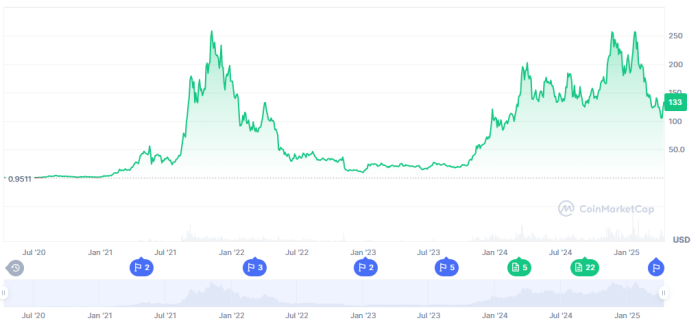
Solana all-time-price performance

On the broader market front, Donald Trump’s escalating trade war continues to send shockwaves through the market. Broader economic uncertainties have impacted investor confidence, leading to sell-offs.

One of the major drivers in Solana’s success as a network was new meme coins. $BONK, back in 2022, helped to kick-start $SOL’s price surge. But increased trading and speculation can lead to congestion of the Solana mainnet, causing transaction delays and failures.

In addition, Solana’s relationship with meme coins has cooled decidedly. Trading volume on the popular meme coin launchpad Pump.fun fell dramatically in Q1 2025, from $3B in January to $170M in early March; it was a paltry $38M in early April.

Top top it all, Ethereum founder Vitalik Buterin criticized Pump.fun for bringing projects with little to no value, hurting blockchain’s ‘social philosophy.’
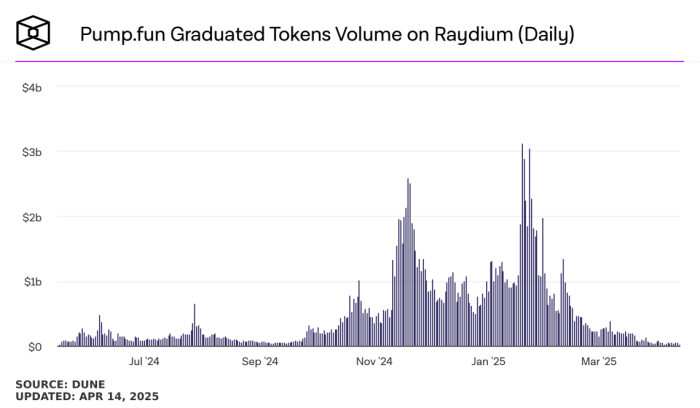
Pump.fun graduated tokens daily volume

To solve its meme coin blues – and perhaps reverse the price plunge – Solana needs some fresh innovation in the ecosystem.

Solaxy: Improved Scalability on Solana’s First-Ever Layer-2

Solaxy ($SOLX) is Solana’s first true Layer-2 (L2) scaling solution, designed to address the network’s congestion and scalability challenges and reinvigorate its meme coin ecosystem.

Solaxy handles transactions off the main chain, alleviating congestion and enhancing throughput with a rollup architecture much like Ethereum’s L2s.

Even better, Solaxy supports a cross-chain infrastructure connecting Solana and Ethereum, blending the latter’s reliability and scalability with Solana’s speed and lower transaction fees.
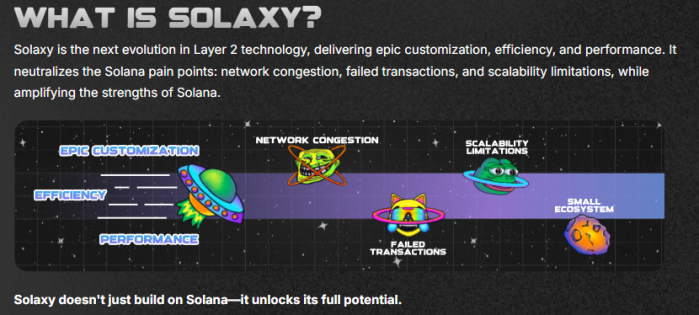
What is Solaxy

The utility token for Solaxy, $SOLX, is currently in the presale stage. You can learn how to buy $SOLX with our guide, but don’t delay – the presale continues to gain steam rapidly. It just passed the $30M mark, with tokens priced at $0.001694.

Solaxy’s ability to deploy a sophisticated Layer-2 solution comes at an ideal time. Our own analysis indicates that, on the back of a successful presale, $SOLX token price could reach $0.032 by the end of 2025.

Visit the Solaxy presale page to learn more.

Continued Interest in Solana Supports Solaxy’s Development

Solaxy deployment could have great timing. Despite the recent losses, at least one company – Renover – plans to build a Solana reserve. They’ve been buying the dip, with a recent purchase of over $11M bringing their total $SOL holdings to over 83K tokens.

The company’s CEO, Joseph Onorati, explained the rationale behind the move. He called Solana the ‘foundation of a high-performance financial system’ and a key strategic asset.

Renover aims to raise a total of $42M to fund a Solana reserve for the company. It’s proof of the positive reputation Solana has as both a cryptocurrency and a blockchain ecosystem.

It’s worth remembering that US President Donald Trump also included $SOL in the planned US Digital Assets Stockpile alongside other best altcoins like $XRP and $ETH.

Short-term losses shouldn’t hinder Solana’s continued ecosystem growth, and Solaxy could be in a perfect position to accelerate that expansion.

The Potential Impact of Solaxy on Solana’s Ecosystem

Solaxy’s development comes at a critical time for Solana. By addressing the network’s scalability issues, Solaxy could play a pivotal role in restoring confidence and attracting new projects to the Solana ecosystem, making it one of the best crypto to buy now.

All the information provided here is just that – information. Do your own research before making any investment decisions; this is not financial advice.

Solaxy could position Solana as a more robust platform, capable of supporting a resurgence of meme coins and high-demand applications, including DeFi and NFT projects.

Editorial Process for bitcoinist is centered on delivering thoroughly researched, accurate, and unbiased content. We uphold strict sourcing standards, and each page undergoes diligent review by our team of top technology experts and seasoned editors. This process ensures the integrity, relevance, and value of our content for our readers.

Bitcoinist is the ultimate news and review site for the crypto currency community!

Lecturas Relacionadas

The Truth About Global Payments, Exposed by Airwallex

Airwallex's founder, Jack Zhang, outlines the three primary paths in the global payments industry and explains why the company chooses the most demanding one: building its own global financial infrastructure. The article begins by highlighting a common industry problem: payment platforms appear homogenized on the surface, offering similar features like global acquiring and multi-currency accounts. However, their underlying capabilities differ vastly. Customers truly care about payment stability, compliance robustness, and reliable market entry support. Zhang identifies three strategic paths: 1. **Bypassing Traditional Systems (Web3/Crypto):** This path promises efficiency via stablecoins and blockchain settlement but struggles with mainstream adoption, significant regulatory friction, and a lack of competitive edge against established players, often leaving it with niche or non-compliant markets. 2. **Packaging Existing Infrastructure:** The most common route, where companies layer a modern interface over legacy banking and partner networks. While enabling fast expansion, it fails to solve core issues like dependency on correspondent banks and intermediary risk, merely postponing the need for solid foundations. 3. **Building Own Global Infrastructure:** The path chosen by Airwallex, Ant International, and others. It involves obtaining local licenses, establishing direct regulatory relationships, building local teams, and controlling the full technology stack. This "heavy" approach is slow and capital-intensive but aims to internalize complexity, providing customers with a "lighter" experience. The core argument is that for business clients, the highest cost isn't transaction fees but hidden risks like frozen accounts, payment delays, and regulatory shocks. By investing heavily in its own infrastructure, Airwallex seeks to absorb these complexities, offering customers greater stability, cost savings (beyond fees), and long-term certainty. This foundational investment, though initially slow, enables compound growth, as evidenced by Airwallex's accelerated revenue scaling. In conclusion, while shortcuts enable faster growth, mastering the most difficult aspects—owning the underlying infrastructure—creates durable value for customers and sustainable advantage for the payment provider.

marsbitHace 1 hora(s)

The Truth About Global Payments, Exposed by Airwallex

marsbitHace 1 hora(s)

The Truth About Global Payments, Revealed by Airwallex

The article discusses Airwallex's approach to global payments, highlighting the key challenges and different strategic paths in the industry. It begins by addressing common user questions about platform reliability, cryptocurrency payments, and the necessity of Airwallex's "heavy" infrastructure model. The core argument is that while many payment platforms appear similar on the surface—offering features like global acquiring and multi-currency accounts—their underlying capabilities differ drastically. The piece identifies three primary paths for global payment providers: 1. **Bypassing Traditional Infrastructure (Web3/Crypto):** This path promises efficiency through stablecoins and on-chain settlements but faces significant regulatory hurdles and offers little advantage over established players for mainstream use, often serving only niche or non-compliant markets. 2. **Aggregating/Packaging Existing Infrastructure:** The most common route, where companies layer a better user experience over legacy banking and partner networks. While fast to market, this approach does not solve fundamental issues like dependency on intermediaries, correspondent banking risks, and compliance fragility. 3. **Building Proprietary Global Infrastructure:** The path chosen by Airwallex and similar firms. This involves obtaining local licenses, building direct regulatory relationships, establishing local teams, and controlling the compliance and technology stack. This is the most difficult and capital-intensive route but aims to internalize complexity. Airwallex's strategy of "heavy" investment in its own infrastructure is framed not as inefficiency, but as a long-term bet to provide clients with greater stability, cost savings beyond fees, and certainty. The platform's "heaviness" absorbs risk and operational complexity, aiming to deliver a "lighter" experience for business customers. The article concludes that in global payments, while shortcuts enable faster growth, mastering the most difficult aspects—the underlying infrastructure—is what creates durable value for clients and sustainable competitive advantage.

链捕手Hace 1 hora(s)

The Truth About Global Payments, Revealed by Airwallex

链捕手Hace 1 hora(s)

Trading

Spot
Futuros

Artículos destacados

Cómo comprar LAYER

¡Bienvenido a HTX.com! Hemos hecho que comprar Solayer (LAYER) sea simple y conveniente. Sigue nuestra guía paso a paso para iniciar tu viaje de criptos.Paso 1: crea tu cuenta HTXUtiliza tu correo electrónico o número de teléfono para registrarte y obtener una cuenta gratuita en HTX. Experimenta un proceso de registro sin complicaciones y desbloquea todas las funciones.Obtener mi cuentaPaso 2: ve a Comprar cripto y elige tu método de pagoTarjeta de crédito/débito: usa tu Visa o Mastercard para comprar Solayer (LAYER) al instante.Saldo: utiliza fondos del saldo de tu cuenta HTX para tradear sin problemas.Terceros: hemos agregado métodos de pago populares como Google Pay y Apple Pay para mejorar la comodidad.P2P: tradear directamente con otros usuarios en HTX.Over-the-Counter (OTC): ofrecemos servicios personalizados y tipos de cambio competitivos para los traders.Paso 3: guarda tu Solayer (LAYER)Después de comprar tu Solayer (LAYER), guárdalo en tu cuenta HTX. Alternativamente, puedes enviarlo a otro lugar mediante transferencia blockchain o utilizarlo para tradear otras criptomonedas.Paso 4: tradear Solayer (LAYER)Tradear fácilmente con Solayer (LAYER) en HTX's mercado spot. Simplemente accede a tu cuenta, selecciona tu par de trading, ejecuta tus trades y monitorea en tiempo real. Ofrecemos una experiencia fácil de usar tanto para principiantes como para traders experimentados.

269 Vistas totalesPublicado en 2025.02.11Actualizado en 2025.03.21

Cómo comprar LAYER

Discusiones

Bienvenido a la comunidad de HTX. Aquí puedes mantenerte informado sobre los últimos desarrollos de la plataforma y acceder a análisis profesionales del mercado. A continuación se presentan las opiniones de los usuarios sobre el precio de LAYER (LAYER).

活动图片