RNDR 能否突破 12 美元?

金色财经Publicado a 2025-04-11Actualizado a 2025-04-11

在过去 24 小时内,Render [RNDR]经历了大幅上涨,达到 9 个月以来的最高点 11,853 美元。在此期间,涨幅达 40.16%。

该山寨币的交易量呈指数级增长,交易量增长 244.93%,达到 42.3 亿美元。同时,市值突破 50 亿美元大关。

在此期间,尽管 BTC 突破了 10 万美元大关,但Render 的表现仍优于比特币 [BTC] 。在其他 AI 代币中,互联网计算机协议 [ICP]下跌了 2.08%,Bittensor [TAO]下跌了 5.23%,NEAR 协议 [NEAR] 上涨了 2.7%。

其他主要代币如瑞波币[XRP]下跌9.71%,Solana[SOL]下跌0.70%,以太坊[ETH]上涨4.6%。

随着 Render 经历如此巨大的上升趋势,问题依然存在:山寨币能否保持其势头?

Render 能否维持涨势?

Render目前正在经历看涨情绪,具有强劲的上涨势头。

根据 Coinglass 的数据,Render 的未平仓合约 (OI) 在过去 24 小时内飙升至 1.7308 亿美元的历史新高。

当 OI 上升时,意味着更多投资者开设新仓位,而现有投资者则持有其交易。
hBF5yThjygsKPQsdMzRidYoBmnktgovM2pOqGIfz.jpeg

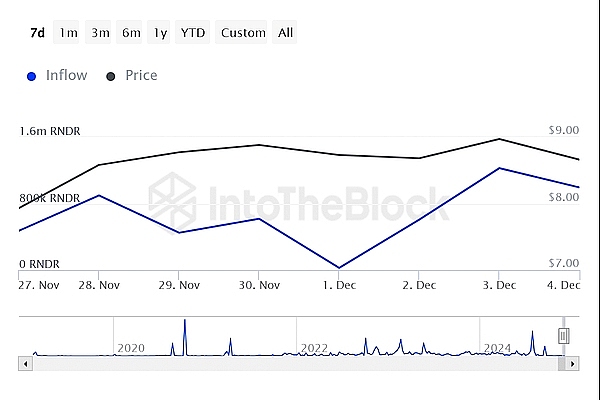
此外,自 12 月 1 日以来,大户流入资金激增 4627%,从最低 26.02 万增至最高 123 万。

这种激增表明鲸鱼正在通过增持来增加资金流入。因此,我们可以得出结论,持仓量的增加主要是由鲸鱼推动的,他们现在通过购买山寨币来显著提高交易量。
sbA4jbltUb2KKR5fp7RC96J0FUvu6H6c2ouoHxwT.jpeg

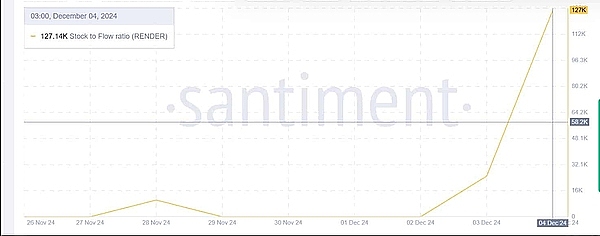
Render 的存量与流通量比率在过去一周内从 0 飙升至 127.14k。这一转变表明山寨币已从供过于求转变为稀缺。因此,由于兴趣增加,稀缺性导致价值上升。

一般来说,稀缺性增加会导致需求增加,这通常会导致价格上涨。
8AaUacltHSP7VHOmVPqoGyTwhqisGoT86tZeNLAi.jpeg

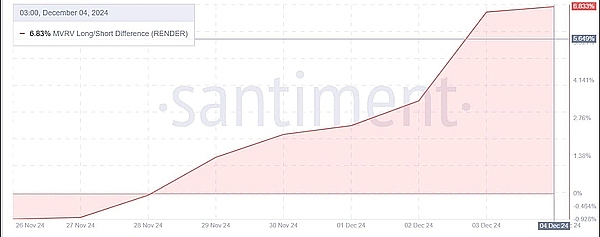
最后,Render 的 MVRV 多空差在过去一周持续上涨,截至发稿时从 0.04% 上涨至 6.83%。这一飙升意味着长期持有者的利润率大幅提高,尽管他们对山寨币的前景仍充满信心。

综上所述,Render 目前正经历看涨情绪,为山寨币的进一步上涨做好准备。

如果当前情况保持不变,Render 将在 12.095 美元附近遇到阻力。高于此水平,阻力很小,山寨币可能会创下历史新高。

Lecturas Relacionadas

When US Giants Collectively "Defect" to Chinese AI Models

When Silicon Valley Giants Turn to Chinese AI Models to Cut Costs A surprising trend is emerging: major U.S. tech companies are significantly reducing AI costs by switching to Chinese models. Coinbase, the largest U.S. cryptocurrency exchange, reportedly halved its AI spending after migrating to China's GLM-5.2 and Kimi 2.7 models, despite increasing usage. They achieved this through a sophisticated three-part strategy: implementing an automatic routing system to select the most cost-effective model per task, boosting cache hit rates from 5% to 60% to reuse computations, and employing "context engineering" to provide AI with more precise, less cluttered information. They are not alone. AI startup Lindy switched from Claude to DeepSeek, saving millions, while Snowflake's tests found GLM-5.2 solved 66% of coding tasks compared to Claude Opus's 67%—but at a fraction of the cost (output pricing is 5-7 times lower). While the top Western models may offer slightly better stability, the massive price differential is leading many businesses to reconsider their value proposition. This shift signals a deeper change in the AI industry, moving beyond pure performance benchmarks to a fierce cost competition. As pressure mounts, even OpenAI and Anthropic have begun slashing prices. For users, this means more choices, lower costs, and a crucial lesson: using multiple models based on task complexity, optimizing with caching, and keeping contexts lean are now key to leveraging AI efficiently and affordably.

marsbitHace 4 min(s)

When US Giants Collectively "Defect" to Chinese AI Models

marsbitHace 4 min(s)

BIS Report Compliance Watch: The Real Risks of Stablecoins Are Not Just 'De-pegging'

BIS Report Compliance Observations: The real risks of stablecoins go beyond "depegging" The BIS report "Anchoring trust in money: innovation beyond stablecoins" argues that while stablecoins and tokenization offer efficiency gains, their primary risk lies in fitting into an identifiable, monitorable, accountable, and regulatable financial system. Money's trust stems not just from technology but from institutional arrangements: a common unit of account, guaranteed redemption at par, liquidity support, regulatory frameworks, and financial integrity requirements. Stablecoins, operating on permissionless blockchains with pseudo-anonymity and non-custodial wallets, create systemic compliance gaps: unclear customer identity, incomplete fund origins, unexplained transaction purposes, fragmented cross-chain paths, and ambiguous liability. On-chain transparency does not equal compliance transparency. Public addresses don't reveal identity or intent. While blockchain analytics aid law enforcement, they cannot replace routine, large-scale AML/CFT controls. Effective compliance requires a closed-loop process encompassing customer onboarding, transaction monitoring, investigation, reporting, and audit. Stablecoin risks are not confined to the blockchain; they re-enter the traditional financial system via on/off-ramps, exchanges, and payment institutions. This forces banks to monitor client accounts for activity linked to virtual assets. The future direction is not to prohibit innovation but to embed rules into the technology. Tokenized finance should integrate with the existing two-tier monetary system, embedding compliance—like customer identification, pre-transaction screening, and auditable data trails—directly into the transaction flow. For compliance professionals, the key takeaway is that any new financial instrument must answer core questions: Who identifies the customer? Who monitors transactions? Who handles exceptions? Who is liable? Compliance is not the antithesis of innovation but the essential infrastructure for its sustainable growth.

链捕手Hace 5 min(s)

BIS Report Compliance Watch: The Real Risks of Stablecoins Are Not Just 'De-pegging'

链捕手Hace 5 min(s)

When American Giants 'Defect' to Chinese AI Models

Summary: The trend of major U.S. technology firms adopting more cost-effective Chinese AI models is gaining momentum. A prime example is Coinbase, the largest U.S. cryptocurrency exchange, which reportedly halved its AI expenditure by switching to Chinese models GLM-5.2 and Kimi 2.7, while its usage volume increased. This was achieved through a sophisticated cost-saving system featuring intelligent model routing (selecting the most suitable model per task), dramatically improving cache hit rates from 5% to 60%, and implementing "Context Engineering" to streamline prompts. This shift is not isolated. Other companies like the AI startup Lindy and data cloud firm Snowflake are making similar moves, drawn by the significant price disparity. For instance, GLM-5.2 costs $1.40/$4.40 per million tokens (input/output), compared to $5/$25 for Claude Opus 4.7. While top Western models may offer slightly higher stability or speed in complex tasks, the performance gap is narrowing, making the price difference harder to justify for many enterprise use cases. The implications are significant for both businesses and individual users. It highlights the importance of a multi-model strategy based on task requirements, the value of caching and reusing outputs, and the effectiveness of providing concise context. Ultimately, this migration signals a potential reshaping of the AI industry's pricing model, moving competition from pure performance benchmarks to practical cost-effectiveness, with increased choice and downward price pressure benefiting end-users.

链捕手Hace 12 min(s)

When American Giants 'Defect' to Chinese AI Models

链捕手Hace 12 min(s)

Trading

Spot
活动图片