Dogecoin Price To $10 Still In Play? Here’s What The Monthly Chart Is Saying

bitcoinistPublicado a 2025-03-31Actualizado a 2025-03-31

Resumen

A recent technical analysis of the monthly Dogecoin price chart suggests that the meme coin could be preparing for another...

Trusted Editorial content, reviewed by leading industry experts and seasoned editors. Ad Disclosure

A recent technical analysis of the monthly Dogecoin price chart suggests that the meme coin could be preparing for another parabolic rally. Based on this outlook, a crypto analyst predicts that DOGE could hit a price target of $10 or more before the end of 2025.  

Dogecoin Price Chart Shows Path To $10

According to X (formerly Twitter) crypto analyst Dima Potts, Dogecoin is apparently following patterns seen in previous 4-year cycles, where major price explosions occurred during the fourth year. Using this historical data, the analyst forecasts that the meme coin could hit a new price target above $10.

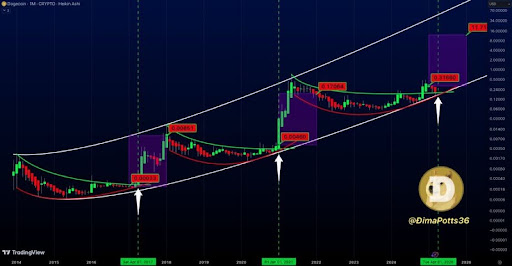
Sharing a monthly DOGE price chart using Heikin Ashi candlesticks, Potts highlights interesting patterns in Dogecoin’s past movements in 2017 and 2021. During these bull market periods, Dogecoin experienced parabolic rallies that saw its price surge as high as 37x from cycle lows. 

Potts highlights an intriguing pattern in which DOGE spends years in accumulation before breaking out into a parabolic trend. The chart uses curved green and red lines to outline these accumulation and breakout phases. 

The vertical green lines mark the points where this explosive move began, aligning closely with Bitcoin’s post-halving price rallies. Additionally, the purple boxes mark previous bull rallies, with each breakout signaling a clear move past the accumulation zone.
Dogecoin
Source: Dima Potts on X

The white arrow and vertical green line in Potts’ chart analysis show that Dogecoin is nearing the end of its current cycle, suggesting that another parabolic breakout could occur soon. If history were to repeat itself, the analyst predicts that Dogecoin could experience its next major breakout move in April 2025, continuing this explosive growth throughout the rest of the year. 

If the meme coin follows its past 37x growth pattern, its price could close the daily candle on December 31, 2025, to reach an all-time high of $11.71. Potts also highlights that $11.71 may not be the price peak of this market cycle, as each fourth year, Dogecoin has progressively delivered stronger price rallies. 

The analyst also notes that bullish factors like heightened institutional interest, increasing global adoption, and technological progress will be major contributors to Dogecoin’s bullish performance this cycle. 

Analyst Sees Demand Driving DOGE’s Next Rally

In other news, Ali Martinez, a prominent crypto analyst on X, predicts that Dogecoin could be on the verge of a strong price rally if demand increases. Based on the chart, the DOGE price has been moving within an Ascending Channel since 2015.

While the lower boundary of this Ascending Channel acts as a strong support, the mid-line represents a key resistance zone, and the upper boundary marks the potential peak of Dogecoin’s price movements. 

Currently, DOGE has been respecting these key support and resistance levels by bouncing off the 0.618 Fibonacci level. However, the chart suggests that a breakout above 0.786 Fib could trigger a rally toward 1.0 Fib or higher. This level aligns with a price range of $0.4 – $7.

Dogecoin
DOGE trading at $0.16 on the 1D chart | Source: DOGEUSDT on Tradingview.com
Featured image from Unsplash, chart from Tradingview.com
Editorial Process for bitcoinist is centered on delivering thoroughly researched, accurate, and unbiased content. We uphold strict sourcing standards, and each page undergoes diligent review by our team of top technology experts and seasoned editors. This process ensures the integrity, relevance, and value of our content for our readers.

Scott Matherson is a leading crypto writer at Bitcoinist, who possesses a sharp analytical mind and a deep understanding of the digital currency landscape. Scott has earned a reputation for delivering thought-provoking and well-researched articles that resonate with both newcomers and seasoned crypto enthusiasts. Outside of his writing, Scott is passionate about promoting crypto literacy and often works to educate the public on the potential of blockchain.

Lecturas Relacionadas

Retail Investors' 'Lead Brother' Serenity vs. Newly Minted Stock God Leopold: How Are the Two Top Hunters Mining AI's 'Physical Limits'?

The article profiles two prominent figures, Serenity and Leopold Aschenbrenner, who are gaining attention for their unconventional investment strategies focused on the physical constraints of the AI boom, moving beyond mainstream software narratives. Serenity, an anonymous online trader, advocates a "shiso leaf" theory. He targets small-cap companies with monopolies on critical, overlooked components in the AI hardware supply chain, such as specific semiconductor materials. His deep, technical analysis of bottlenecks in areas like co-packaged optics (CPO) has reportedly yielded massive returns, though his anonymity and focus on illiquid micro-cap stocks pose significant risks for followers. Leopold Aschenbrenner, a former OpenAI researcher, founded a multi-billion dollar hedge fund. His macro thesis argues that physical infrastructure—power grids, land, data centers—is the true bottleneck for AI growth, lagging far behind chip production. Consequently, his fund employs an infrastructure arbitrage strategy: heavily investing in storage and compute infrastructure companies while placing massive bearish bets (put options) against major semiconductor stocks, betting their valuations will correct as physical constraints become apparent. While their methods differ—Serenity drills into microscopic supply chain details, while Leopold takes a macroscopic, infrastructure-focused view—both share a core belief: the real power and investment alpha in the AI era lie in controlling scarce physical resources, not just software. The article concludes by noting the inherent risks in both approaches, such as liquidity issues for micro-caps and timing risks for macro bets, but suggests they signal a broader market re-evaluation of AI's foundational assets.

marsbitHace 3 hora(s)

Retail Investors' 'Lead Brother' Serenity vs. Newly Minted Stock God Leopold: How Are the Two Top Hunters Mining AI's 'Physical Limits'?

marsbitHace 3 hora(s)

Who Will Make Money in the Age of Agents?

In the Agents era of blockchain, traditional value capture theories face challenges. The "Fat Protocol" theory, dominant since 2016, suggested protocols capture most value as their tokens are essential for network use. However, the proliferation of interchangeable L1s, L2s, and modular layers has eroded protocol scarcity and pricing power. Conversely, the "Fat App" theory posits that applications capturing user relationships (like wallets and exchanges) become the primary value layer by controlling distribution and transaction flows. This aligns with the current "Great Repricing" cycle. Agents disrupt this logic. As software users, they lack brand loyalty, prioritize cost and efficiency, and switch between platforms seamlessly. This undermines the front-end UX moats that "Fat Apps" rely on. The article explores several potential futures: 1. **Headless Applications:** Current leading apps could strip their front-ends and become backend API infrastructure for Agents, preserving their role. 2. **Protocol Resurgence:** If integration becomes trivial, Agents might bypass aggregators and interact directly with protocols, reviving "Fat Protocol" dynamics. 3. **Pricing Power Collapse:** Agents' rational, frictionless routing could commoditize the entire stack, compressing margins toward cost and leaving little profit for intermediaries. 4. **Unprecedented Activity:** Agents may enable new, high-frequency, machine-to-machine economic activities, expanding the total value pie even if margins are thin. 5. **A New, Unnamed Model:** Historically, major tech shifts (like the internet's attention economy) create unforeseen business models. The Agents era may spawn entirely new ways to capture value. The most likely outcome is a coexistence where "Fat Apps" continue to serve human users valuing UX, while a separate, Agent-driven economy emerges governed by different rules—where loyalty is based on factors like liquidity, latency, and settlement guarantees rather than brand.

marsbitHace 4 hora(s)

Who Will Make Money in the Age of Agents?

marsbitHace 4 hora(s)

Trading

Spot
Futuros
活动图片