Высокая инфляция сдерживает биткоин: рынки сомневаются в ФРС

cryptonews.ruPublicado a 2024-09-28Actualizado a 2025-03-28

Данные впереди, но оптимизма нет
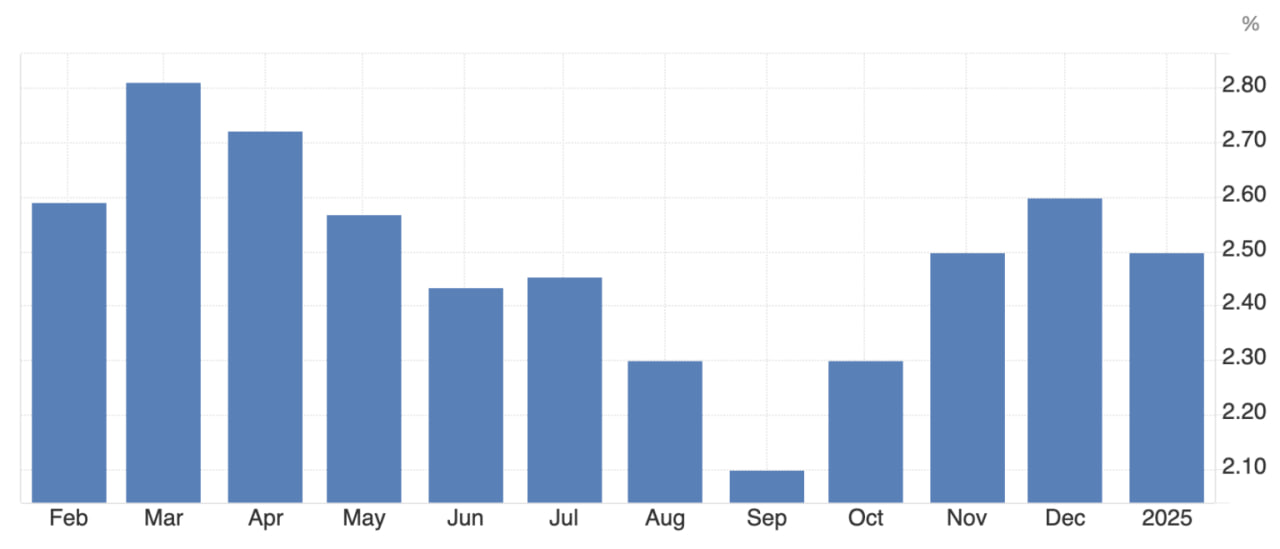
PCE за последний год

В пятницу США публикуют свежие данные по инфляции PCE — одному из ключевых индикаторов, за которым следит ФРС. Инвесторы внимательно смотрят на цифры, ведь они могут повлиять на решения по ставкам. А значит — и на курс Биткоин.

PCE (индекс потребительских расходов) отличается от CPI, но используется ФРС для оценки инфляционного давления. В январе показатель составлял 2,5% в годовом выражении — выше целевых 2%. Февраль, по прогнозам аналитиков, не принесет изменений.

Инфляция держится — а ФРС не торопится со ставками

Если инфляция снова окажется на уровне 2,5% — это сигнал. Цены остаются устойчивыми, а ставка, скорее всего, не снизится в ближайшее время.
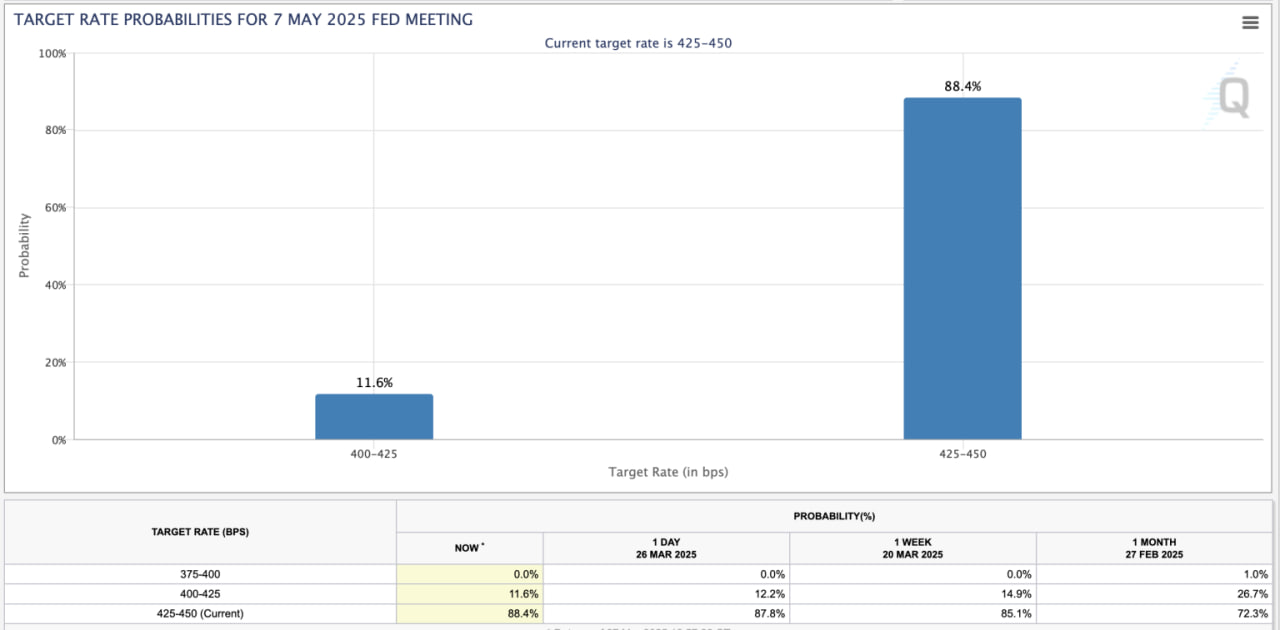
Инструмент CME FedWatchPCE за последний год

По данным CME FedWatch, сейчас рынок оценивает вероятность понижения ставки в мае всего в 11,6%. В июне — уже 58,4%. Но и это пока не дает уверенности.

Торговая политика Трампа может усугубить ситуацию

Есть и другой фактор давления. Экономисты предупреждают: статистика еще не отражает эффект от тарифов Дональда Трампа.

Часть пошлин уже действует — на китайские товары. В планах — ввести 25% тариф на импорт автомобилей. Плюс ограничения на сталь и алюминий. Это может усилить инфляционное давление и отложить снижение ставки еще дальше.

Ритейлеры могут начать поднимать цены. Это может вызвать новый виток инфляции и затруднить снижение ставок. Даже председатель ФРС Джером Пауэлл признал, что последствия могут быть «переходными». Но в ФРС Сент-Луиса с этим не согласны:

«Косвенные эффекты могут оказаться более длительными».

Что это значит для рынка

Для криптовалют рынок ставок — один из ключевых факторов. И пока он не даёт поводов для оптимизма. Если инфляция останется высокой, а ставки — на текущем уровне, это будет сдерживать рост BTC.

По мнению BitMEX-сооснователя Артура Хейса, Bitcoin в ближайшее время может вырасти до $110 000. А если пробьет ATH, «мы не оглянемся до $250 000». Но он сам признает: его прогнозы не всегда сбываются.

Пока же BTC с трудом удерживается ниже $90 000 и идёт к худшему марту с 2020 года. На фондовом рынке царит неопределенность, которую подогревает нестабильная повестка Белого дома. И это сказывается на всех рисковых активах.


Lecturas Relacionadas

Will the Ethereum Foundation Evolve into a 'Mascot'? Diversified Organizations Are Fragmenting Its Functions

The Ethereum Foundation (EF) is undergoing significant internal turmoil and functional erosion. Following its largest-ever layoff of 54 staff (20% of its workforce) and a major organizational restructuring announced in June, its Protocol Support Team has been officially dissolved. This comes alongside the high-profile resignation of key figures like co-executive director Xiaowei Wang, bringing senior departures this year to at least eight. Criticism of EF's rigid structure, opaque decision-making, and perceived lack of a clear value narrative for ETH has intensified within the community. The layoffs have catalyzed the emergence of independent, non-profit organizations like Ethlabs and Ethereum Institutional, founded by former EF researchers and members. These entities are now taking on core functions such as protocol research/development and institutional adoption, effectively fragmenting the EF's traditional leadership role. Concurrently, EF's security team is adapting to technological change, deploying specialized AI agents to audit Ethereum's codebase, which successfully discovered a critical vulnerability (CVE-2026-34219). While EF states AI complements rather than replaces researchers, it signals a potential future shift in its operational model. Faced with these challenges—internal restructuring, talent drain, the rise of competing organizations, and AI integration—the Ethereum Foundation appears to be stepping back from a central commanding role. Analysts and community observers speculate it may increasingly transition towards a symbolic "ecosystem mascot" function, while decentralized initiatives drive Ethereum's future growth and institutional adoption.

marsbitHace 22 min(s)

Will the Ethereum Foundation Evolve into a 'Mascot'? Diversified Organizations Are Fragmenting Its Functions

marsbitHace 22 min(s)

Nearly a Hundred Players Rush into Embodied Data: With 4.47 Billion Yuan in Financing in One Year, Who Can Really Make Money by 'Selling Data'?

The domestic embodied AI data industry has attracted nearly 100 players, with 70 focused on data collection and 27 on data infrastructure. In the past year, 15 independent embodied data service providers raised approximately 4.47 billion yuan. Despite this growth, the sector remains early-stage, fragmented, and faces significant challenges. Data collection methods are diverse, categorized into four main routes: teleoperation of real robots, human demonstration without a robot (using motion capture, exoskeletons, etc.), simulation synthesis, and distillation from internet videos. Most companies (43%) adopt hybrid approaches, combining multiple routes, as no single method can meet all training needs. Teleoperation alone is pursued by 31% of players, often by state-owned platforms and robot companies, while newer firms favor asset-light, no-hardware human demonstration. Independent data service providers now form the largest player group (40%), indicating the emergence of a distinct industry segment rather than just a subsidiary function for robot makers. Two-thirds of all players are "embodied-native" startups, while one-third are companies that pivoted from fields like AI data annotation, which are more prevalent in the data infrastructure layer. Current annual industry capacity is estimated at 1.6-1.8 million hours plus 70-80 million data points, with a short-term goal to increase this 15-20 fold within 1-3 years. Data collection factories are spread across 20 provinces in China, concentrated in the Yangtze River Delta, Beijing-Tianjin-Hebei, and Pearl River Delta regions. Financially, the 4.47 billion yuan raised in the past year pales compared to the 43.8 billion yuan raised by the broader embodied intelligence sector in just the first half of 2026, highlighting that data remains a less "sexy" bet for investors. The 15 funded independent providers show clear stratification: a top tier led by a unicorn (Lightwheel Intelligence, 3.1 billion yuan), a middle tier of 11 firms raising tens to hundreds of millions, and an early-stage tier of 3 companies. Sixty-nine investment institutions have participated, but none have made concentrated bets, reflecting uncertainty about viable business models. Over half of these funded companies are less than a year old, most are at pre-A or A rounds, and profitability remains largely unproven. In summary, the embodied data industry has become an independent track creating jobs and local economic activity. However, it is still nascent, with unformed consensus, unsolved problems, and unproven business models. The coming 1-2 years will be a critical validation window to see if companies can build sustainable, profitable businesses purely by "selling data."

marsbitHace 3 hora(s)

Nearly a Hundred Players Rush into Embodied Data: With 4.47 Billion Yuan in Financing in One Year, Who Can Really Make Money by 'Selling Data'?

marsbitHace 3 hora(s)

Dialogue with Multicoin Partner: The Crypto Market Has Bottomed Out, Favoring Three Cryptocurrencies in This Cycle

In a recent interview, Multicoin Capital managing partner Tushar Jain shared his views on the crypto market. He believes the market has bottomed and is at an inflection point, citing that negative news no longer causes significant price declines and application adoption continues to grow. Jain remains highly bullish on Solana, viewing it as the correct architectural choice for internet capital markets, particularly for spot and tokenized security trading. He is also positive on Hyperliquid, noting its leadership in decentralized derivatives trading. His investment approach focuses on concentrating capital in top convictions rather than equal allocation. A distinct opportunity he highlights is Zcash (ZEC), which he sees as a return to the industry's cypherpunk ethos and a potential top-five asset by market cap. For assets like Zcash without cash flows, his valuation framework is based on relative market cap ranking. Regarding investment strategy, Jain employs a "three-part" entry method to avoid timing pitfalls and emphasizes long-term "active management" over "active trading." He outlines four sources of investment edge: informational, analytical, behavioral/psychological, and structural. On portfolio management, the fund uses Bitcoin as its "cash," selling assets into Bitcoin during market euphoria to reduce beta risk and using Bitcoin to buy dips. Sales occur only if a better opportunity arises, the investment thesis breaks, or valuations become excessively overheated. While respectful of Ethereum's resilience, he questions its unclear scaling roadmap. Finally, Jain reaffirms his commitment to the thesis that blockchains will form the foundational architecture for future capital markets.

marsbitHace 3 hora(s)

Dialogue with Multicoin Partner: The Crypto Market Has Bottomed Out, Favoring Three Cryptocurrencies in This Cycle

marsbitHace 3 hora(s)

Trading

Spot
活动图片