JPMorgan sees yield-bearing stablecoins growing from 6% to 50% of market share

THE BLOCKPublicado a 2025-03-28Actualizado a 2025-03-28

Resumen

JPMorgan analysts forecast that yield-bearing stablecoins could rise from the current 6% to as much as 50% of the stablecoin market cap in the future.

JPMorgan analysts forecast that yield-bearing stablecoins could rise from the current 6% to as much as 50% of the stablecoin market cap in the future.

Yield-bearing stablecoins are attracting investors similarly to traditional money market funds, particularly in today’s high-interest-rate environment, the analysts said.

Yield-bearing stablecoins, including tokenized Treasurys, which offer interest returns similar to traditional financial products, could experience massive growth ahead, according to JPMorgan analysts.

Yield-bearing stablecoins currently make up just 6% of the total stablecoin market cap but could expand significantly, potentially capturing up to 50% of the market unless regulatory changes intervene, JPMorgan analysts led by managing director Nikolaos Panigirtzoglou wrote in a report released Wednesday.

The top five yield-bearing stablecoins — Ethena's USDe, Sky Dollar's USDS, BlackRock's BUIDL, Usual Protocol's USD0 and Ondo Finance's USDY— have seen rapid growth since the U.S. election in November, rising from around $4 billion to over $13 billion in combined market cap, Panigirtzoglou told The Block.

According to analysts, this growth is expected to continue. They added that the U.S. Securities and Exchange Commission's recent approval of Figure Markets' application for a yield-bearing stablecoin, YLDS, which is registered as a security, provides further momentum to this segment.
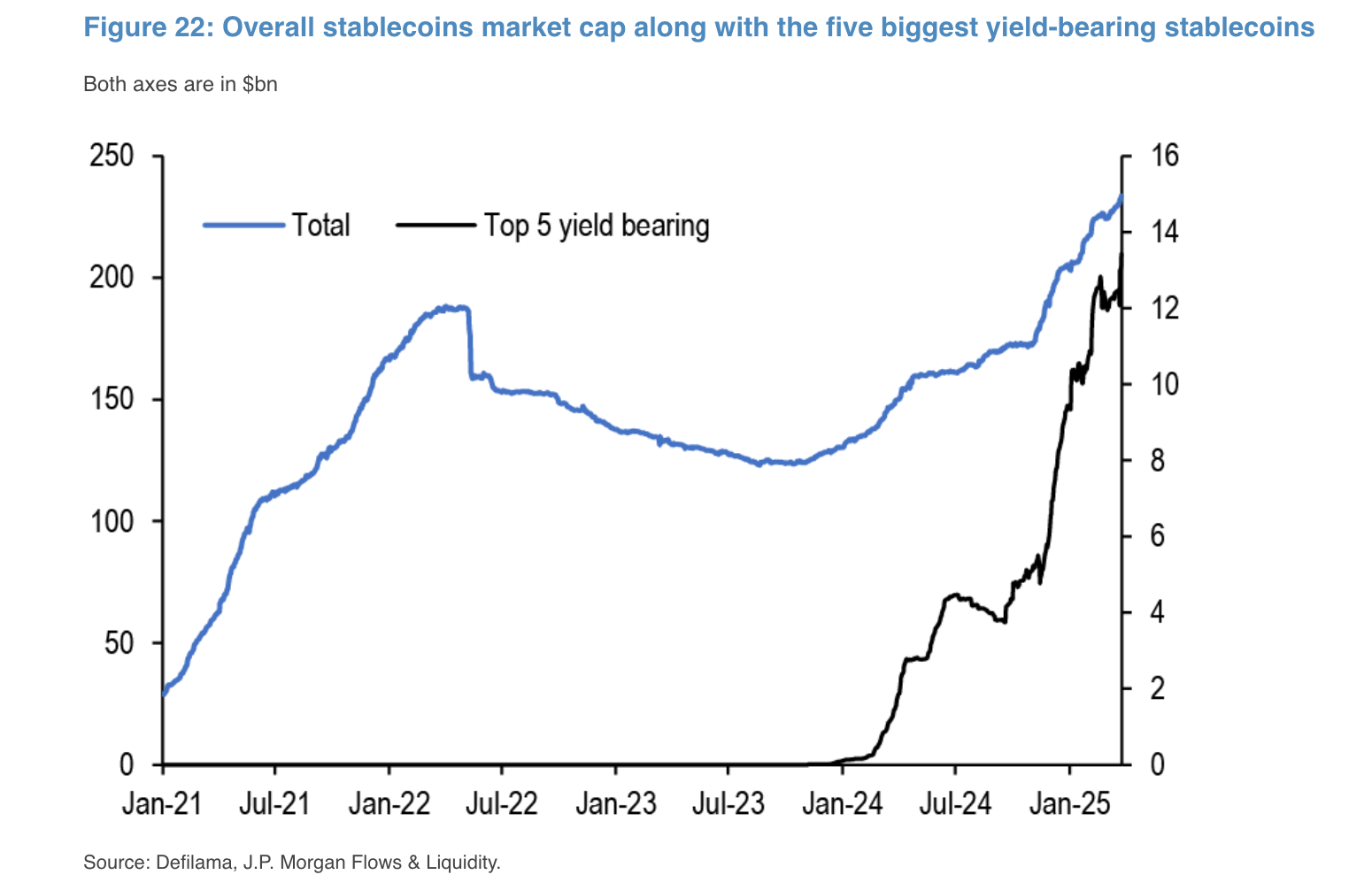
Traditional stablecoins, such as Tether's USDT and Circle's USDC, do not share reserve yields with their users because doing so would classify these assets as securities, according to the analysts. Such a classification would also impose additional compliance requirements, hindering their current seamless use as collateral within the crypto ecosystem, they said.

Why yield-bearing stablecoins are on the rise

The JPMorgan analysts identified several factors driving the rapid growth of yield-bearing stablecoins.

First, investors prefer these assets because they offer interest without requiring holders to engage in risky trading or lending activities or give up custody of their assets.

Second, major crypto trading platforms such as Deribit and FalconX now accept tokenized Treasurys as collateral, enabling traders to earn yield on posted collateral.

Additionally, crypto investors are increasingly turning to tokenized Treasurys in decentralized finance (DeFi) to obtain higher yields, as typical DeFi yields have significantly decreased from their peak levels of 2022. Projects like Frax Finance are also adopting tokenized Treasurys as underlying assets, further fueling this growth.

Despite this positive outlook, the JPMorgan analysts noted barriers. Yield-bearing stablecoins are classified as securities, subjecting them to regulatory restrictions that limit their adoption, especially among retail investors. Moreover, traditional non-yield-bearing stablecoins continue to hold a notable liquidity advantage.

With a combined market cap of around $220 billion across multiple blockchains and centralized exchanges, traditional stablecoins offer efficient, fast and low-cost transactions, even at large volumes. In contrast, yield-bearing stablecoins are newer, smaller and comparatively less liquid.

However, "This liquidity disadvantage could potentially be lessened over time as yield-bearing stablecoins gain further traction in the future in crypto derivative trading as source of collateral, in DAO treasuries, liquidity pools, and idle cash with crypto venture funds," according to the analysts.

As a result, over time, yield-bearing stablecoins could attract much of the idle cash currently sitting in traditional stablecoins, the analysts said. While the exact amount of this idle cash is difficult to estimate, it's unlikely to represent the majority of the stablecoin market, according to the analysts.


Lecturas Relacionadas

Wall Street Takes Over Bitcoin and Stablecoins, But Where Are the Real Profit Opportunities for Retail Investors?

Wall Street is taking over Bitcoin and stablecoins, but where can retail investors really make money now? The common narrative is that Wall Street's dominance via ETFs and regulated stablecoins has structurally ended the era of easy 100x returns from altcoins. While this is true for Bitcoin and stablecoins, which are becoming traditional financial products, it's only half the story. Other crypto sectors are failing for their own reasons. GameFi is largely dead, with 93% of projects failed. NFTs are at multi-year lows with most collections losing all value. Memecoins persist but overwhelmingly benefit insiders and whales at the expense of late retail buyers. These sectors aren't being consumed by TradFi; they've exhausted their growth narratives. The real opportunities for retail in the next 6-12 months lie elsewhere: 1. **Prediction Markets:** Platforms like Polymarket have seen explosive growth (21x in a year) with a genuine, active retail user base. The utility of forecasting events provides sustainable demand beyond mere speculation. 2. **DeFi Yield:** While the era of 1000% APY farms is over, sustainable yields of 4-8% are available through liquid staking, regulated stablecoin platforms, and RWA lending. 3. **Select Altcoins:** If Bitcoin breaks its all-time high, a selective altcoin season could emerge. The favorable bets would be on ETH, assets within the Base and Solana ecosystems with real users, and asymmetric opportunities in AI-crypto and DePIN presales. The most likely market scenario (45% probability) is sideways action, making asset selection far more critical than broad market momentum. The playbook has changed. Actionable steps: Focus time on prediction markets; use DeFi for reliable yield, not lottery tickets; only buy altcoins with genuine user bases; and avoid GameFi, random NFTs, and new memecoins. The "TradFi is eating crypto" story misses the growing sectors. The easy money era is over, leaving a niche, selective market that requires real understanding, but opportunities remain for those who adapt.

marsbitHace 5 min(s)

Wall Street Takes Over Bitcoin and Stablecoins, But Where Are the Real Profit Opportunities for Retail Investors?

marsbitHace 5 min(s)

A Trillion-Dollar Frenzy for Memory Sellers, Halved Profits for Memory Buyers

Summary: A stark divide has emerged in the tech industry. While memory chipmaker Micron's stock soared 19% in a single day, pushing its market cap over $1 trillion, smartphone manufacturer Xiaomi reported a 43% plunge in adjusted net profit. The core driver is a severe supply crunch in memory chips, particularly for AI applications. Wall Street analysts, led by UBS and its unprecedented 204% target price hike for Micron, argue that long-term agreements (LTAs) from AI cloud giants are fundamentally ending the sector's notorious boom-and-bust cycles, justifying a re-rating from cyclical to infrastructure-like valuations. However, the "storage" market is now fragmented into three tiers. The first, AI-grade memory like HBM and server DDR5, faces extreme shortages and soaring prices driven by massive cloud capex. The second, mobile memory for smartphones, is also seeing sharp price hikes as manufacturers like Xiaomi are forced to pay more for remaining capacity, severely squeezing their margins. The third, PC retail channels, shows price declines due to existing inventory. The article questions the sustainability of the "supercycle" narrative. It highlights that Micron's revenue surge is driven almost entirely by price increases, not shipment volumes, making it vulnerable to a potential demand slowdown. While LTAs may dampen volatility, history suggests they are often tested during downturns. The current peak earnings, used to justify high valuations, represent a classic cyclical top. The piece concludes with a note of caution: when the entire Street chants "this time is different," it's wise to remember past bubbles, even as it acknowledges AI demand may indeed be structural.

marsbitHace 1 hora(s)

A Trillion-Dollar Frenzy for Memory Sellers, Halved Profits for Memory Buyers

marsbitHace 1 hora(s)

This New Generation of US Stock Trading Gods No Longer Read Financial Reports

The new generation of "stock gods" in the 2026 US AI bull market are not analyzing traditional financial reports. Instead of focusing on giants like NVIDIA, figures like the 22-year-old Leopold Aschenbrenner (who reportedly turned $200M into $14B) and influencers like Serenity on platforms like Reddit's WallStreetBets, X, and Substack are gaining fame and returns by targeting obscure, low-cap "micro-cap" stocks. Their strategy, dubbed "supply chain sniping," involves identifying critical, often monopolistic, bottlenecks in the AI hardware supply chain—such as specific materials or components essential for giants like Google and NVIDIA—that are missed by mainstream Wall Street analysts. Serenity's call on AXTI, a $700M company supplying indium phosphide substrates crucial for photonics and optical interconnects, saw the stock soar from ~$12 to nearly $150. Similarly, accounts like KawzInvests and PhotonCap focus on thematic, supply-chain-driven research in areas like AI infrastructure, optics, and cloud services for SMEs, bypassing traditional valuation metrics. This shift represents a cultural move away from Warren Buffett-style value investing based on deep financial statement analysis. The new approach thrives on low liquidity, early narratives, and strong community propagation on social media, similar to meme stocks or crypto. However, this "attention economy" strategy carries risks: it depends on sustained information gaps, the underlying companies' ability to deliver fundamental results, and the potential for crowded, volatile exits as narratives shift. The trend also shows crypto traders applying their narrative-sensing skills to US micro-caps, marking a significant evolution in trading culture.

marsbitHace 1 hora(s)

This New Generation of US Stock Trading Gods No Longer Read Financial Reports

marsbitHace 1 hora(s)

Trillion-Dollar Euphoria for Memory Sellers, Halved Profits for Memory Buyers

Title: The Trillion-Dollar Memory Seller's Carnival vs. The Buyer's Halved Profits On May 26, a stark contrast unfolded. While memory chipmaker Micron's market cap surged past $1 trillion, smartphone maker Xiaomi reported plummeting profits. Xiaomi's Q1 2026 profits fell 43% year-on-year. Executive Lu Weibing cited memory prices quadrupling from last year, adding roughly $210 to a phone's cost. To survive, Xiaomi is cutting entry-level models, sacrificing volume. Micron's stock, however, skyrocketed over 19% in a day, capping an 8x gain in a year. Major banks like UBS and JPMorgan issued bullish reports, raising price targets drastically. Their core thesis: Long-Term Agreements (LTAs) with AI cloud giants (Microsoft, Google, etc.) are eliminating the memory industry's notorious boom-bust cycle. By locking in fixed-price, multi-year contracts for AI-grade memory (HBM, server DDR5), these deals promise stable, utility-like earnings, justifying a higher valuation (20-30x P/E vs. the historical 8-15x). The article reveals a three-tiered memory market in 2026: 1) **AI Storage (HBM/DDR5/Enterprise SSD)**: Extreme shortage, soaring prices, LTAs. This is Micron's story. 2) **Mobile/Embedded Memory**: Also facing sharp price hikes as AI production crowds out capacity, severely pressuring phone makers like Xiaomi. 3) **PC Retail**: Some spot prices are falling due to channel inventory liquidation, creating a divergence from contract markets. The author questions if LTAs truly end the cycle. It hinges on sustained, hyper-growth AI demand. Micron's current profits are at a cycle peak, driven mostly by price hikes, not volume. If AI capital expenditure growth slows, the massive industry capacity expansion (e.g., Micron's $250B+ CapEx plan) could lead to a glut. Historically, using peak-cycle earnings for valuation is a classic trap. While the AI-driven structural shift might be real, the unanimous Wall Street euphoria warrants caution, echoing past bubbles like Cisco's in 2000. The memory seller's trillion-dollar狂欢 (carnival) continues, but the cycle's shadow remains.

链捕手Hace 1 hora(s)

Trillion-Dollar Euphoria for Memory Sellers, Halved Profits for Memory Buyers

链捕手Hace 1 hora(s)

Trading

Spot
Futuros

Artículos destacados

Cómo comprar ONDO

¡Bienvenido a HTX.com! Hemos hecho que comprar OndoFinance (ONDO) sea simple y conveniente. Sigue nuestra guía paso a paso para iniciar tu viaje de criptos.Paso 1: crea tu cuenta HTXUtiliza tu correo electrónico o número de teléfono para registrarte y obtener una cuenta gratuita en HTX. Experimenta un proceso de registro sin complicaciones y desbloquea todas las funciones.Obtener mi cuentaPaso 2: ve a Comprar cripto y elige tu método de pagoTarjeta de crédito/débito: usa tu Visa o Mastercard para comprar OndoFinance (ONDO) al instante.Saldo: utiliza fondos del saldo de tu cuenta HTX para tradear sin problemas.Terceros: hemos agregado métodos de pago populares como Google Pay y Apple Pay para mejorar la comodidad.P2P: tradear directamente con otros usuarios en HTX.Over-the-Counter (OTC): ofrecemos servicios personalizados y tipos de cambio competitivos para los traders.Paso 3: guarda tu OndoFinance (ONDO)Después de comprar tu OndoFinance (ONDO), guárdalo en tu cuenta HTX. Alternativamente, puedes enviarlo a otro lugar mediante transferencia blockchain o utilizarlo para tradear otras criptomonedas.Paso 4: tradear OndoFinance (ONDO)Tradear fácilmente con OndoFinance (ONDO) en HTX's mercado spot. Simplemente accede a tu cuenta, selecciona tu par de trading, ejecuta tus trades y monitorea en tiempo real. Ofrecemos una experiencia fácil de usar tanto para principiantes como para traders experimentados.

243 Vistas totalesPublicado en 2024.12.12Actualizado en 2025.03.21

Cómo comprar ONDO

Discusiones

Bienvenido a la comunidad de HTX. Aquí puedes mantenerte informado sobre los últimos desarrollos de la plataforma y acceder a análisis profesionales del mercado. A continuación se presentan las opiniones de los usuarios sobre el precio de ONDO (ONDO).

活动图片