Токен Story (IP) вырос на 11% за неделю

cryptonews.ruPublicado a 2023-04-13Actualizado a 2025-03-13

Популярный альткоин Story (IP) продолжает уверенно расти. За последние семь дней он вырос на 11%, став вторым по величине прироста за этот период

Разбираемся, что происходит на рынке Story (IP) и чего ждать от цены криптовалюты.

Токен Story готов к росту

После длительного нахождения ниже сигнальной линии (оранжевой), линия MACD (синяя) поднялась выше нее в среду, образовав зеленый бар гистограммы.

Этот бычий крест указывает на сдвиг в сторону роста, показывая увеличение покупательского давления. Появление зеленой свечи усиливает этот тренд, сигнализируя, что рост IP может продолжиться.
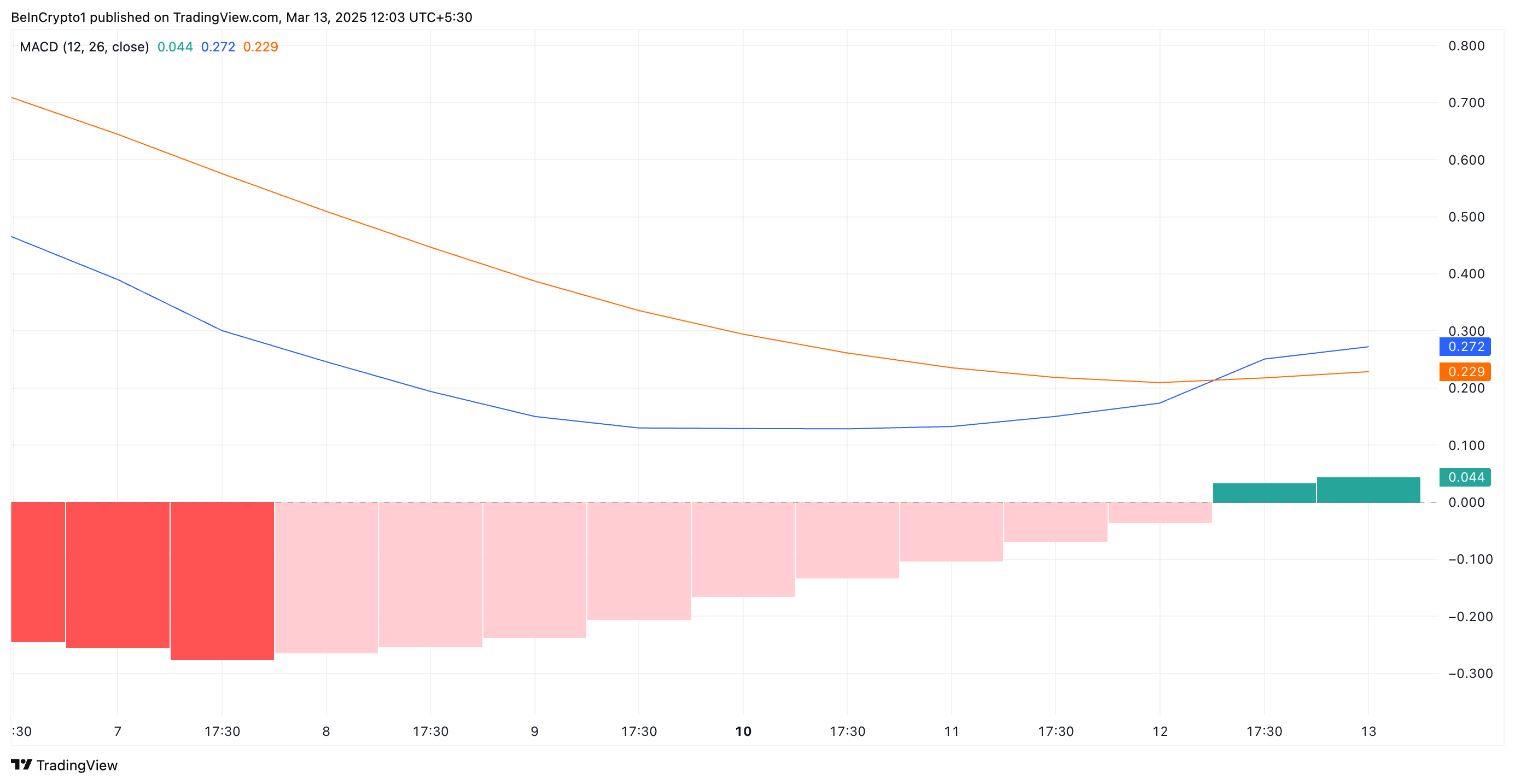
График MACD для IP. Источник: TradingView

Кроме того, линия Aroon Up IP, которая отслеживает силу тренда, на момент публикации находится на отметке 92,86%.

Близкие к 100% значения сигнализируют о сильном восходящем тренде. Это совпадает с движением токена Story, который регулярно обновляет исторические максимумы (ATH).

График Aroon Up для IP. Источник: TradingView

Прогноз IP: возможен ли возврат к ATH

На момент написания этого анализа IP торгуется по $5,85. За последние 24 часа он снизился на 1,8%.

Альткоин по-прежнему держится значительно выше поддержки на уровне $5,54. Если бычий настрой на рынке сохранится, IP может продолжить рост и попытаться достичь своего рекордного максимума $7,95.

Анализ цены IP. Источник: TradingView

Однако слишком активная фиксация прибыли грозит отменить оптимистичный прогноз. В таком случае монета может растерять недавние достижения и просесть ниже поддержки $5,54 — вероятно, до $4,05.

Lecturas Relacionadas

Just now, DeepSeek V4 updates with DSpark, improving inference speed by 80%

DeepSeek has updated its DeepSeek V4 model with the DSpark speculative decoding framework, achieving a significant 60-85% speedup in generation for Flash models and 57-78% for Pro models while maintaining the same overall throughput. This engineering-focused update, rather than a core architectural change, introduces DSpark to address latency and throughput bottlenecks in high-concurrency production environments. DSpark combines high-throughput parallel generation with adaptive load-aware verification. Its key innovations include a semi-autoregressive generation architecture to model dependencies within token blocks and a hardware-aware confidence-scheduled verification system. This system uses a confidence head to predict token acceptance probabilities, allowing it to dynamically optimize verification length per request and allocate compute only to tokens with the highest expected payoff. The asynchronous scheduler is designed for real-world deployment, ensuring zero-overhead scheduling and continuous CUDA graph replay while preserving the target model's output distribution. In tests across mathematical reasoning, code generation, and daily dialogue, DSpark outperformed state-of-the-art models like Eagle3 and DFlash, increasing average acceptance length by 26.7%-30.9% and 16.3%-18.4% respectively on Qwen3 target models. DeepSeek also open-sourced DeepSpec, a full-stack codebase for training and evaluating speculative decoding draft models, providing a standardized toolkit that includes data preparation tools, model implementations, training code, and evaluation scripts.

marsbitHace 5 hora(s)

Just now, DeepSeek V4 updates with DSpark, improving inference speed by 80%

marsbitHace 5 hora(s)

BIT Research: The 2028 Halving Is Not the End, the Real Shake-Up of the Bitcoin Mining Industry Is Just Beginning

The Bitcoin mining industry is undergoing its most complex structural adjustment since inception. Despite Bitcoin's price holding near $61,000 and the network hash rate approaching a record 1 ZH/s, miner profitability is deteriorating. The industry is operating close to its breakeven point, with the 2028 halving expected to accelerate consolidation. The challenges extend beyond the halving's subsidy reduction; the industry's revenue model has yet to successfully transition towards a fee-driven structure. Increasingly, mining companies are evolving from simple Bitcoin producers into infrastructure and energy operators, including providers of AI/HPC computing power. Competition is shifting from pure hash rate expansion to business model upgrades. Economic pressure is evident. The theoretical daily mining revenue at current prices is around $78 million, yet the actual figure is only about $33 million—a 136% gap. Transaction fees remain low at roughly $220k daily, far below historical implied levels. With a current estimated industry-wide breakeven price near $65,000, mining alone is struggling to generate ideal profits. The 2028 halving is projected to push the fundamental production cost floor to approximately $93,289. This will likely accelerate a shift towards consolidation among larger, well-capitalized miners with diversified revenue streams. Competitive advantage will belong to institutionalized players with access to low-cost energy, AI/HPC hosting operations, and stronger balance sheets. In essence, Bitcoin mining is transitioning from a "mining business" to an "infrastructure business." Future profitability and resilience will depend less on block rewards and more on diversified income sources like energy management and computational infrastructure services. For investors, the key question is not the halving itself, but which miners can successfully navigate this business model transformation.

marsbitHace 6 hora(s)

BIT Research: The 2028 Halving Is Not the End, the Real Shake-Up of the Bitcoin Mining Industry Is Just Beginning

marsbitHace 6 hora(s)

Trading

Spot
活动图片