Прогноз цены XRP: предположения аналитиков о потенциальном крахе $1 уже 1 марта

cryptonews.ruPublicado a 2024-09-28Actualizado a 2025-02-28

  • XRP упал более чем на 8% за последние 24 часа, поскольку цифровой актив ненадолго упал ниже 2 долларов.
  • Egrag Crypto считает, что к концу 2026 года XRP может вырасти до $320.
  • CryptoBull заявил, что дно XRP достигнуто, и установил следующую цель в 4 доллара.

XRP упал, занимая сейчас четвертое место по рыночной капитализации, и потерял 8,4% в цене за последние 24 часа, торгуясь сейчас на уровне 1,99 доллара.

Только за прошедшую неделю альткоин упал на 23,6%, что заставило инвесторов задаться вопросом: потенциальный обвал на 1 доллар уже к 1 марта?

Но, несмотря на спад, известный аналитик Egrag Crypto сохраняет оптимистичный настрой, предполагая, что XRP все еще может достичь 320 долларов к 2026 году.

В сообщении на X (ранее Twitter) аналитик поделился графиком, показывающим, что в случае экстремального бычьего сценария цена может даже вырасти до 800 долларов. Egrag Crypto заверил инвесторов, что любая цена ниже этих уровней станет прекрасной возможностью для покупки.

#XRP — Do you Comprehend?

If you do not know what you are hodling, SELL NOW and get some Rest.

In the next couple of months and years it won't make a difference at what price you bought #XRP, the only thing you will say I wish I bought more.#XRPFamily Together We Rise. pic.twitter.com/tzpOnzg4vv

— EGRAG CRYPTO (@egragcrypto) February 27, 2025

Аналитический оптимизм и технические закономерности

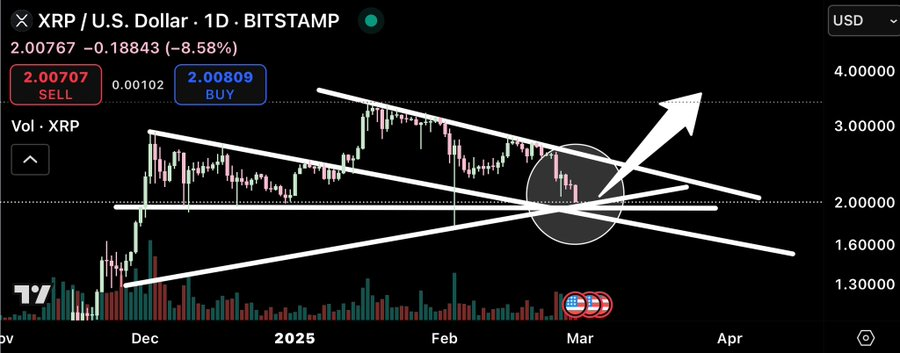
Точно так же другой аналитик, CryptoBull, вторит этому оптимизму, утверждая, что «XRP достигает здесь дна, а затем поднимается выше 4 долларов!». Это утверждение согласуется с приведенным ниже графиком, на котором изображена модель нисходящего клина, техническая установка, которая исторически предшествует сильным прорывам.
Итоги заседания SEC от 27 февраля еще не известны

Комиссия США по ценным бумагам и биржам (SEC) провела закрытое заседание 27 февраля, вызвав спекуляции по поводу своей позиции по иску Ripple против SEC. Согласно повестке дня заседания Sunshine Act, SEC обсудила правоприменительные меры, административные процедуры и урегулирование судебных споров.

Связанный: XRP: медвежьи обвинения против бычьих технических показателей и всплеска принятия в Японии

Поскольку регулятор прекращает дела против Coinbase, Uniswap, OpenSea и последнее против Consensys, участники рынка считают, что SEC также откажется от иска против Ripple, что потенциально приведет к росту XRP.

Анализ цен XRP

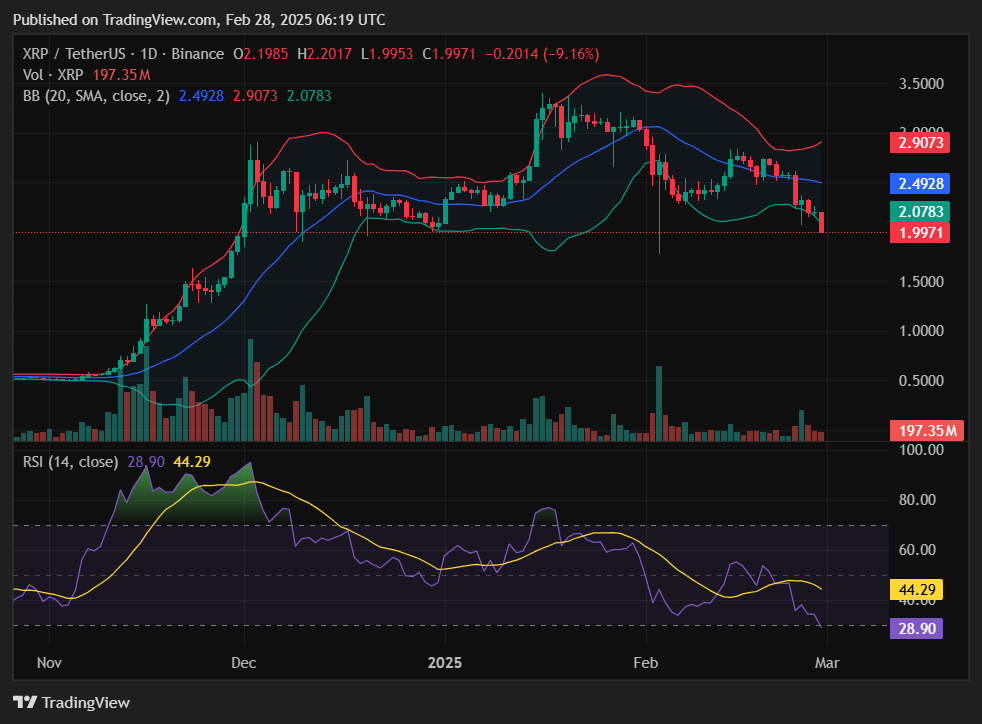
Дневной график, предоставленный TradingView ниже, показывает, что индекс относительной силы (RSI) показывает значение 28,90 для токена XRP, что означает, что цифровой актив перепродан. Наклон линии предполагает дальнейшее снижение токена, но это может представлять собой благоприятную точку входа для покупателей.
Связанный: Условное депонирование XRP под огнем критики: адвокат развенчивает теорию «ценового дампа»

Кроме того, цена XRP потеряла нижнюю полосу Боллинджера на уровне 2,07 доллара, поскольку поддержка XRP прорвалась ниже ценника в 2 доллара. Если быки получат контроль, вероятно повторное тестирование уровня 2,49 доллара, но если продавцы сохранят доминирующее положение, уже к 1 марта для XRP может оказаться в игре 1 доллар.


Criptos en tendencia

Lecturas Relacionadas

Will the Ethereum Foundation Evolve into a 'Mascot'? Diversified Organizations Are Fragmenting Its Functions

The Ethereum Foundation (EF) is undergoing significant internal turmoil and functional erosion. Following its largest-ever layoff of 54 staff (20% of its workforce) and a major organizational restructuring announced in June, its Protocol Support Team has been officially dissolved. This comes alongside the high-profile resignation of key figures like co-executive director Xiaowei Wang, bringing senior departures this year to at least eight. Criticism of EF's rigid structure, opaque decision-making, and perceived lack of a clear value narrative for ETH has intensified within the community. The layoffs have catalyzed the emergence of independent, non-profit organizations like Ethlabs and Ethereum Institutional, founded by former EF researchers and members. These entities are now taking on core functions such as protocol research/development and institutional adoption, effectively fragmenting the EF's traditional leadership role. Concurrently, EF's security team is adapting to technological change, deploying specialized AI agents to audit Ethereum's codebase, which successfully discovered a critical vulnerability (CVE-2026-34219). While EF states AI complements rather than replaces researchers, it signals a potential future shift in its operational model. Faced with these challenges—internal restructuring, talent drain, the rise of competing organizations, and AI integration—the Ethereum Foundation appears to be stepping back from a central commanding role. Analysts and community observers speculate it may increasingly transition towards a symbolic "ecosystem mascot" function, while decentralized initiatives drive Ethereum's future growth and institutional adoption.

marsbitHace 10 min(s)

Will the Ethereum Foundation Evolve into a 'Mascot'? Diversified Organizations Are Fragmenting Its Functions

marsbitHace 10 min(s)

Nearly a Hundred Players Rush into Embodied Data: With 4.47 Billion Yuan in Financing in One Year, Who Can Really Make Money by 'Selling Data'?

The domestic embodied AI data industry has attracted nearly 100 players, with 70 focused on data collection and 27 on data infrastructure. In the past year, 15 independent embodied data service providers raised approximately 4.47 billion yuan. Despite this growth, the sector remains early-stage, fragmented, and faces significant challenges. Data collection methods are diverse, categorized into four main routes: teleoperation of real robots, human demonstration without a robot (using motion capture, exoskeletons, etc.), simulation synthesis, and distillation from internet videos. Most companies (43%) adopt hybrid approaches, combining multiple routes, as no single method can meet all training needs. Teleoperation alone is pursued by 31% of players, often by state-owned platforms and robot companies, while newer firms favor asset-light, no-hardware human demonstration. Independent data service providers now form the largest player group (40%), indicating the emergence of a distinct industry segment rather than just a subsidiary function for robot makers. Two-thirds of all players are "embodied-native" startups, while one-third are companies that pivoted from fields like AI data annotation, which are more prevalent in the data infrastructure layer. Current annual industry capacity is estimated at 1.6-1.8 million hours plus 70-80 million data points, with a short-term goal to increase this 15-20 fold within 1-3 years. Data collection factories are spread across 20 provinces in China, concentrated in the Yangtze River Delta, Beijing-Tianjin-Hebei, and Pearl River Delta regions. Financially, the 4.47 billion yuan raised in the past year pales compared to the 43.8 billion yuan raised by the broader embodied intelligence sector in just the first half of 2026, highlighting that data remains a less "sexy" bet for investors. The 15 funded independent providers show clear stratification: a top tier led by a unicorn (Lightwheel Intelligence, 3.1 billion yuan), a middle tier of 11 firms raising tens to hundreds of millions, and an early-stage tier of 3 companies. Sixty-nine investment institutions have participated, but none have made concentrated bets, reflecting uncertainty about viable business models. Over half of these funded companies are less than a year old, most are at pre-A or A rounds, and profitability remains largely unproven. In summary, the embodied data industry has become an independent track creating jobs and local economic activity. However, it is still nascent, with unformed consensus, unsolved problems, and unproven business models. The coming 1-2 years will be a critical validation window to see if companies can build sustainable, profitable businesses purely by "selling data."

marsbitHace 3 hora(s)

Nearly a Hundred Players Rush into Embodied Data: With 4.47 Billion Yuan in Financing in One Year, Who Can Really Make Money by 'Selling Data'?

marsbitHace 3 hora(s)

Dialogue with Multicoin Partner: The Crypto Market Has Bottomed Out, Favoring Three Cryptocurrencies in This Cycle

In a recent interview, Multicoin Capital managing partner Tushar Jain shared his views on the crypto market. He believes the market has bottomed and is at an inflection point, citing that negative news no longer causes significant price declines and application adoption continues to grow. Jain remains highly bullish on Solana, viewing it as the correct architectural choice for internet capital markets, particularly for spot and tokenized security trading. He is also positive on Hyperliquid, noting its leadership in decentralized derivatives trading. His investment approach focuses on concentrating capital in top convictions rather than equal allocation. A distinct opportunity he highlights is Zcash (ZEC), which he sees as a return to the industry's cypherpunk ethos and a potential top-five asset by market cap. For assets like Zcash without cash flows, his valuation framework is based on relative market cap ranking. Regarding investment strategy, Jain employs a "three-part" entry method to avoid timing pitfalls and emphasizes long-term "active management" over "active trading." He outlines four sources of investment edge: informational, analytical, behavioral/psychological, and structural. On portfolio management, the fund uses Bitcoin as its "cash," selling assets into Bitcoin during market euphoria to reduce beta risk and using Bitcoin to buy dips. Sales occur only if a better opportunity arises, the investment thesis breaks, or valuations become excessively overheated. While respectful of Ethereum's resilience, he questions its unclear scaling roadmap. Finally, Jain reaffirms his commitment to the thesis that blockchains will form the foundational architecture for future capital markets.

marsbitHace 3 hora(s)

Dialogue with Multicoin Partner: The Crypto Market Has Bottomed Out, Favoring Three Cryptocurrencies in This Cycle

marsbitHace 3 hora(s)

Trading

Spot

Artículos destacados

Qué es XRP 2.0

XRP 2.0: Una Nueva Frontera en el Panorama de las Criptomonedas Introducción a XRP 2.0 En el siempre cambiante ámbito de las criptomonedas, nuevos proyectos surgen continuamente, compitiendo por atención y adopción. Una de estas iniciativas prometedoras es XRP 2.0, un nuevo proyecto de criptomoneda diseñado para aprovechar la tecnología blockchain avanzada y metodologías de encriptación robustas. Aunque el nombre establece paralelismos con el XRP de Ripple, es crucial señalar que XRP 2.0 opera de manera independiente, enfocándose en mejorar la seguridad de las transacciones, la privacidad y la escalabilidad. A medida que el panorama financiero digital abraza cada vez más soluciones descentralizadas, XRP 2.0 busca contribuir de manera significativa a web3 y a la expansión general de los proyectos de criptomonedas. ¿Qué es XRP 2.0? En esencia, XRP 2.0 es un proyecto de criptomoneda que busca crear un ecosistema de moneda digital seguro y descentralizado. Su tecnología fundamental integra principios avanzados de blockchain con técnicas de encriptación de vanguardia. El objetivo principal de XRP 2.0 es establecerse como una plataforma confiable y eficiente que permita la ejecución rápida de transacciones mientras prioriza la protección de la privacidad de sus usuarios. El proyecto se promociona como una solución a muchas limitaciones enfrentadas por las criptomonedas existentes, proponiendo un sistema que puede manejar un mayor volumen de transacciones con mejor velocidad y privacidad. Esta versatilidad posiciona a XRP 2.0 como un competidor significativo en un mercado plagado de diversas monedas digitales. ¿Quién es el Creador de XRP 2.0? La identidad del creador detrás de XRP 2.0 ha sido señalada como 'Wilbur.' Sin embargo, los detalles completos sobre Wilbur o su entidad asociada siguen siendo elusivos. La anonimidad de muchos creadores de criptomonedas no es un fenómeno poco común en la industria, a menudo diseñado para mantener un grado de privacidad y seguridad. ¿Quiénes son los Inversores de XRP 2.0? Hasta ahora, la información específica relacionada con las fundaciones o organizaciones de inversión que apoyan a XRP 2.0 no está disponible públicamente. En el sector de las criptomonedas, el respaldo de inversores respetables puede influir significativamente en la credibilidad y el éxito de un proyecto, sin embargo, la transparencia sobre los patrocinadores financieros de XRP 2.0 no se ha establecido. ¿Cómo Funciona XRP 2.0? XRP 2.0 se destaca al emplear una combinación de tecnología blockchain y algoritmos de encriptación avanzados que aseguran transacciones seguras y descentralizadas. Su estructura innovadora incluye características únicas diseñadas para fomentar el compromiso del usuario y ampliar las funcionalidades más allá de las transacciones convencionales de criptomonedas. Entre estas características, XRP 2.0 incorpora capacidades impulsadas por IA, como funcionalidades de texto a imagen y de texto a voz. Estas adiciones están diseñadas para mejorar la experiencia interactiva de los usuarios, promoviendo una mayor aplicabilidad en diversos sectores. Al unir avances tecnológicos con un diseño centrado en el usuario, XRP 2.0 busca captar la atención de una amplia gama de individuos y empresas que buscan integrar soluciones de criptomonedas en sus marcos operativos. Cronología de XRP 2.0 Entender XRP 2.0 requiere examinar los hitos que han definido su viaje hasta ahora: 23 de julio de 2023: Se presenta XRP 2.0 como un nuevo proyecto de criptomonedas, con el objetivo de revolucionar las capacidades de transacciones seguras y descentralizadas en el ámbito de blockchain. 8 de septiembre de 2023: Se lanza otro proyecto, XRP20, marcando la aparición de un token ERC-20 en la blockchain de Ethereum que no guarda relación con XRP 2.0. 13 de noviembre de 2023: El Libro Mayor de XRP experimenta una actualización significativa con el lanzamiento de la versión 2.0.0 del software del servidor rippled. Es esencial señalar que este desarrollo está desconectado del proyecto de criptomonedas XRP 2.0. Puntos Clave sobre XRP 2.0 Para destilar la esencia de XRP 2.0, surgen varios factores críticos: Características Únicas: La inclusión de características como texto a imagen y texto a voz impulsadas por IA diversifica aún más las aplicaciones potenciales de XRP 2.0. Tecnología Blockchain: El marco utiliza mecanismos avanzados de blockchain y protocolos de encriptación, asegurando un entorno seguro y descentralizado para las transacciones. Escalabilidad y Privacidad: XRP 2.0 prioriza la protección mejorada de la privacidad en los procesos de transacción y la escalabilidad necesaria para acomodar una base de usuarios creciente. No Afiliación con Ripple: Es importante destacar que, a pesar de su nombre, XRP 2.0 no tiene ninguna lealtad ni colaboración con el XRP de Ripple, diferenciando su marco operativo y objetivos dentro del ecosistema de criptomonedas. Conclusión XRP 2.0 representa una ambiciosa aventura en la esfera de las criptomonedas, buscando ofrecer una combinación de seguridad, privacidad y eficiencia en las transacciones digitales. Al integrar tecnologías sofisticadas y características amigables para el usuario, el proyecto se propone ampliar los horizontes de lo que la criptomoneda puede lograr en la economía digital de hoy. Si bien la anonimidad de su creador y la falta de inversores revelados pueden generar cuestionamientos para algunos, el enfoque de XRP 2.0 en funcionalidades avanzadas y descentralización realza su atractivo en un mercado de criptomonedas cada vez más abarrotado. A medida que el paisaje de las criptomonedas sigue evolucionando, XRP 2.0 podría emerger como un jugador crucial en la expansión de soluciones blockchain seguras y escalables.

211 Vistas totalesPublicado en 2024.04.05Actualizado en 2024.12.03

Qué es XRP 2.0

Cómo comprar XRP

¡Bienvenido a HTX.com! Hemos hecho que comprar XRP (XRP) sea simple y conveniente. Sigue nuestra guía paso a paso para iniciar tu viaje de criptos.Paso 1: crea tu cuenta HTXUtiliza tu correo electrónico o número de teléfono para registrarte y obtener una cuenta gratuita en HTX. Experimenta un proceso de registro sin complicaciones y desbloquea todas las funciones.Obtener mi cuentaPaso 2: ve a Comprar cripto y elige tu método de pagoTarjeta de crédito/débito: usa tu Visa o Mastercard para comprar XRP (XRP) al instante.Saldo: utiliza fondos del saldo de tu cuenta HTX para tradear sin problemas.Terceros: hemos agregado métodos de pago populares como Google Pay y Apple Pay para mejorar la comodidad.P2P: tradear directamente con otros usuarios en HTX.Over-the-Counter (OTC): ofrecemos servicios personalizados y tipos de cambio competitivos para los traders.Paso 3: guarda tu XRP (XRP)Después de comprar tu XRP (XRP), guárdalo en tu cuenta HTX. Alternativamente, puedes enviarlo a otro lugar mediante transferencia blockchain o utilizarlo para tradear otras criptomonedas.Paso 4: tradear XRP (XRP)Tradear fácilmente con XRP (XRP) en HTX's mercado spot. Simplemente accede a tu cuenta, selecciona tu par de trading, ejecuta tus trades y monitorea en tiempo real. Ofrecemos una experiencia fácil de usar tanto para principiantes como para traders experimentados.

1.5k Vistas totalesPublicado en 2024.12.10Actualizado en 2026.06.02

Cómo comprar XRP

Discusiones

Bienvenido a la comunidad de HTX. Aquí puedes mantenerte informado sobre los últimos desarrollos de la plataforma y acceder a análisis profesionales del mercado. A continuación se presentan las opiniones de los usuarios sobre el precio de XRP (XRP).

活动图片