Tron Falls Sharply As Sun Scrambles To Save Stablecoin

newsbtcPublicado a 2022-06-16Actualizado a 2022-06-16

Resumen

Tron price momentum faded over the weekend, and the price has dropped by more than 40% since then. The cryptocurrency is presently having difficulty gaining traction. Tron Falls AS USDD ...

Tron price momentum faded over the weekend, and the price has dropped by more than 40% since then. The cryptocurrency is presently having difficulty gaining traction.
Tron Falls AS USDD  Depegs
TRX has dropped 19% and is now trading at $0.05, its lowest level in 15 months. In the last 24 hours, the token has also been the worst performer among the top 50 cryptocurrencies.
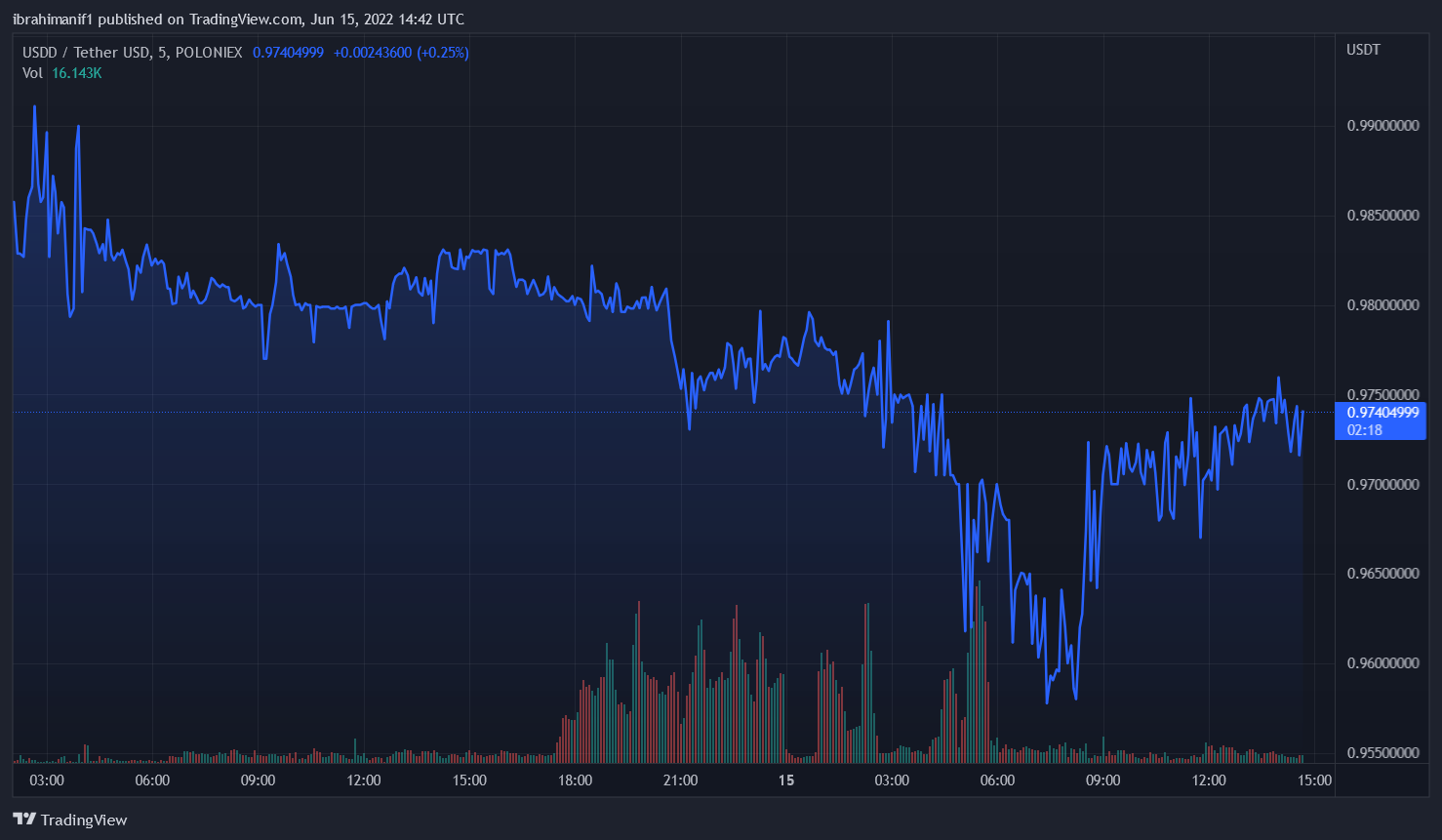
The token’s weakness follows the loss of the USDD algorithmic stablecoin’s dollar peg, despite founder Justin Sun’s repeated efforts to keep the peg.
In the last 24 hours, the token’s entire market valuation has dropped by nearly 1% to $701.4 million. The token has garnered comparisons to Terra’s UST stablecoin, which vanished in May due to its algorithmic nature.
tron

USDD/USDT breaks dollar peg. Source: TradingView
Fear began as soon as the USDD’s 1:1 peg to the dollar was lost. TRX hasn’t been able to reverse the downward trend since then, plummeting by more than 40% in less than a week. TRX may face tremendous sell pressure to close the gap as long as USDD is below one dollar.
TRX has found support at the $0.05 level, from which it has bounced higher. TRX’s resistance is at $0.057, and given the current fundamentals, it doesn’t appear likely that the trend will shift.
Justin Sun Scrambles To Save USDD
However, Tron, like Terra, is putting billions of dollars behind the coin. Because USDD is not as large as UST, which was worth roughly $20 billion at its peak, crypto specialists think that it will not suffer the same fate.
USDD had recently been changed by Tron’s Sun to strengthen collateralization and make it less vulnerable to a crash like Terra.
This week, Tron spent over $700 million on the open market to sustain the USDD peg. Justin Sun also stated that a $2.5 billion fund would be set up to help TRX.
Tron has purchased TRX on multiple occasions to support the token, most notably withdrawing $948 million ($47 million) from Binance. The Tron DAO has made a number of withdrawals from Binance and has also used its USDC assets to purchase more tokens.
Tron has also announced a mining pool with Curve Finance and Convex Finance, which is intended to attract yield-hungry traders with an estimated APR of 96.25%.
Despite Justin Suns’ assertions that the USDD is unduly collateralized, the market does not appear to agree. The trend for TRX is likely to be negative as long as this continues, and the next significant support is identified at $0.040.


Lecturas Relacionadas

$9.4 Billion: The Largest Robotics Funding This Year Has Emerged

Munich-based humanoid robotics company Neura has completed a $1.4 billion (approximately RMB 94.9 billion) Series C funding round, valuing the company at around $7 billion and positioning it among the global leaders in the sector. The investment round is notable not just for its size—reportedly the largest in robotics this year—but also for its strategic backers, which include tech giants like NVIDIA and Amazon, alongside established industrial players such as German engineering firms Bosch and Schaeffler. This mix of investors signals a significant shift in the industry's focus from technological demonstrations and general-purpose narratives toward practical, industrial deployment and commercialization. Neura's approach centers on developing humanoid robots for defined, high-value industrial tasks rather than pursuing a general-purpose model. Its early validation comes from a partnership with BMW, where its robots are being tested on actual production lines. The involvement of Bosch and Schaeffler, companies deeply embedded in global manufacturing, underscores a growing belief that humanoid robots are transitioning from labs to viable factory-floor solutions. The article highlights two converging trends driving investment: advancements in AI and large language models, which enhance robots' perception and decision-making in unstructured environments, and mounting pressure from labor shortages and rising costs in major manufacturing regions. The funding landscape is now bifurcating between companies like Figure AI, focusing on versatile general-purpose robots, and firms like Neura, targeting specific vertical industrial applications with clearer, shorter paths to ROI. While technical hurdles remain, the core challenges for widespread adoption are increasingly seen as engineering and commercial in nature: managing the high integration and customization costs for different factory environments and establishing robust, localized maintenance and service networks. The record investment in Neura, particularly from industrial capital, indicates the industry's growing confidence in moving from proving feasibility to solving the practical problems of scalability, reliability, and building sustainable business models around humanoid robots in real-world settings like automotive manufacturing and hazardous labor environments.

marsbitHace 10 hora(s)

$9.4 Billion: The Largest Robotics Funding This Year Has Emerged

marsbitHace 10 hora(s)

Trading

Spot
Futuros
活动图片