What Altcoins to Watch in February as Polkadot ETF Gains Momentum?

bitcoinistPublicado a 2025-02-02Actualizado a 2025-02-02

Resumen

The ETF season is in full swing, and the latest to join the race? Polkadot.  21Shares has officially filed for...

The ETF season is in full swing, and the latest to join the race? Polkadot. 

21Shares has officially filed for a Polkadot ETF with the SEC, aiming to launch it on the Cboe BZX Exchange—the same exchange that introduced the first Polkadot exchange-traded product (ETP) back in 2021. 

Polkadot is a blockchain network designed to connect different blockchains, making them work together more efficiently. If approved, this ETF could make investing in Polkadot easier for mainstream investors, potentially boosting adoption and demand. 

With institutional interest in crypto rising, this could be a massive moment for Polkadot and the altcoin market as a whole. 

If ETFs keep rolling out like this, we might soon see every major altcoin get its own. With that in mind, here are five altcoins to watch (and buy) in February: 

1. $WEPE – The Top Presale to Watch

Only 14 days remain in $WEPE’s presale, and investors are rushing in. 

The token is priced at $0.0003665, with over $66M raised so far. If this momentum keeps up, $WEPE could even surpass Pepe Unchained’s massive $70M presale milestone—possibly making it the biggest meme coin presale ever. 
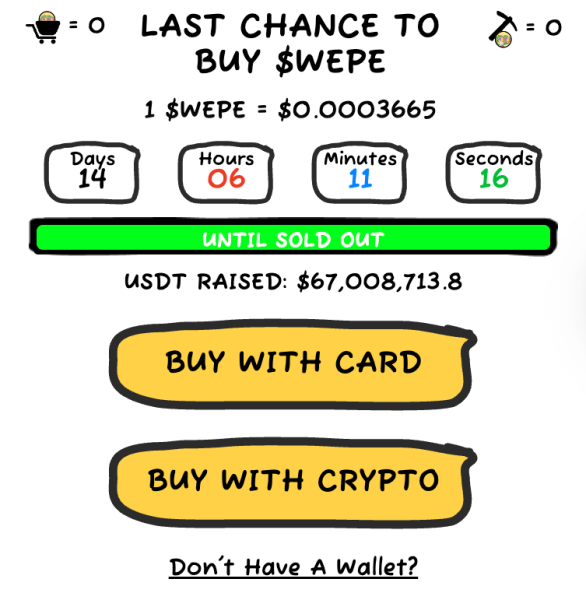
Last chance to buy $WEPE

What makes $WEPE special?
Its strong community-driven approach and well-structured tokenomics.

Unlike typical meme coins that rely solely on hype, $WEPE introduces real-time trading tools, staking rewards, and an exclusive members-only insights group for traders. These features make it more than just a speculative asset.

The team is already teasing major exchange listings, which could send the price soaring post-launch. The buzz is growing, and early investors are seeing serious potential here. 

With only days left before the presale closes, now might be the last chance to get in before $WEPE goes mainstream. 

2. $SOLX – A Staking-Powered Giant

$SOLX has smashed through a $16M presale milestone, proving its strong demand. 

Currently priced at $0.001622, this token offers more than just meme coin hype—it integrates staking rewards and DeFi elements to give holders passive income opportunities. 

Unlike traditional meme coins that depend on short-term speculation, $SOLX introduces yield-bearing staking, which allows holders to earn passive income by locking their tokens.

The project’s smart contracts automatically distribute staking rewards based on the amount held, creating an incentive to accumulate and hold for the long term.

This staking mechanism is powered by a decentralized protocol that ensures security and fair reward distribution.

As it approaches its exchange debut, traders are speculating on big price moves ahead, especially if staking adoption increases within the ecosystem.

3. $MIND – AI Meets Crypto

AI is taking over everything—from chatbots to crypto. 

$MIND, priced at $0.0032402, is riding this trend hard. The project has already pulled in millions in its presale, proving that investors are eager to bet on AI-powered blockchain projects.

What makes $MIND interesting is its mix of meme coin culture and artificial intelligence. $MIND leverages AI to enhance trading efficiency, market analytics, and predictive modeling.

This project integrates AI-driven trading algorithms that claim to provide insights into market trends. The system scans on-chain and off-chain data, offering real-time suggestions on potential trade opportunities.

Additionally, $MIND is developing a machine learning-powered portfolio optimization tool, which helps investors manage risk exposure within their crypto holdings.

The fusion of AI technology with meme coin culture gives $MIND a unique edge. If AI continues its dominance in 2025, this token could be a big winner.

4. $PEPU – The Meme Coin Comeback Story

$PEPU just pulled off an impressive rally, surging 37% in just 24 hours to hit $0.02041. 

After a rough post-exchange debut, it’s now up 161% in the last 10 days. 
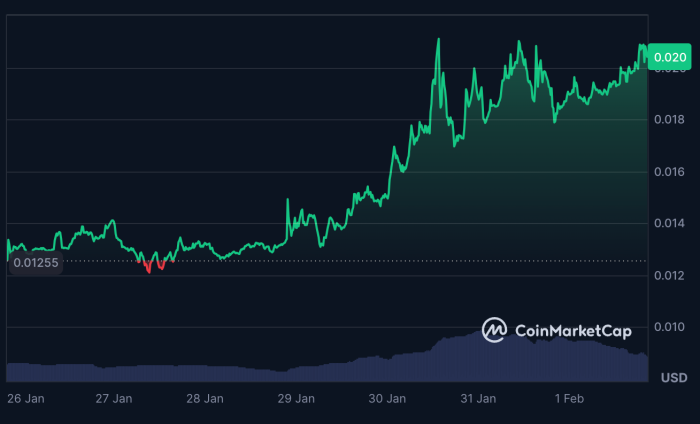
$PEPU price rising on CoinMarketCap.
Source: CoinMarketCap.

The catalyst? Its meme coin launchpad, “Pepe’s Pump Pad,” is generating major buzz. This feature allows users to discover, vote on, and invest in new meme coins before they hit major exchanges.

Essentially, it acts as an incubator for emerging meme coin projects, giving early supporters an advantage. 

The ability to participate in early-stage investments gives $PEPU holders a unique value proposition beyond just price speculation. As new tokens launch on Pepe’s Pump Pad, demand for $PEPU is expected to increase, further driving liquidity into the ecosystem.

Investors had initially written off $PEPU, but the recent price action is making them reconsider. With new developments fueling excitement, $PEPU could be positioning itself for a bigger breakout. 

Whether it maintains this momentum remains to be seen, but for now, the bulls are back in charge. 

5. $PEPE – A Big Win in Japan

$PEPE just secured a listing on a major Japanese exchange—bitFlyer— giving it a fresh boost in credibility and market exposure. 

BitFlyer post on X - $PEPE Listing.

While the price reaction has been mixed, this move strengthens $PEPE’s presence in Asia—a region with a growing appetite for meme coins. 

Being listed on a regulated Japanese exchange is no small feat. Japan has some of the strictest crypto regulations in the world, meaning that any token approved for listing has met high compliance standards.

This reinforces $PEPE’s legitimacy as a meme coin with institutional-grade credibility.

This listing also opens the doors for Japanese retail and institutional investors who were previously unable to access $PEPE through regulated platforms. It could set a precedent for more meme coins entering the Japanese market.

If institutional adoption continues, $PEPE could become one of the more stable meme coin investments, rather than just another short-lived trend.

The Polkadot ETF Effect

With the Polkadot ETF in the works and institutional interest in crypto surging, February is shaping up to be a pivotal month. 

These five altcoins have the hype, utility, and momentum to make big moves. 

As always, do your research before investing—and don’t get too caught up in the meme coin madness. 

Lecturas Relacionadas

The Veil of Mythos Becomes Anthropic's Lever to Move Trillions

The article discusses Anthropic's reported upcoming $30 billion funding round, which would value the company at over $900 billion. It analyzes how the company has leveraged strategic narratives around its unreleased "Mythos" model, rather than just its publicly available products, to drive this massive valuation. Key points include Google's surprising $40 billion investment in a competitor, suggesting it is buying strategic positioning. Anthropic's "Glasswing" cybersecurity project and the unreleased Mythos model are portrayed not through direct proof, but through carefully crafted narratives of being "too powerful for public release," creating an aura of exclusive, high-level capability. This is bolstered by reports of the White House and NSA seeking access to Claude/Mythos despite previous security concerns, implying indispensable technology. Furthermore, Anthropic's reported rapid revenue growth—from a $1 billion annual run-rate in late 2024 to over $30 billion by April 2026, largely driven by enterprise API and Claude Code—provides a financial story for investors. The article concludes that Anthropic's core business model is effectively converting unverifiable technical potential, government interest, and future revenue projections into a compelling narrative that secures immense capital, using the actions of wealthy investors and powerful institutions as the ultimate validation of its worth.

marsbitHace 33 min(s)

The Veil of Mythos Becomes Anthropic's Lever to Move Trillions

marsbitHace 33 min(s)

Google CEO Admits Lagging Behind in Coding

Google CEO Sundar Pichai acknowledged in a recent interview that Google's Gemini AI models are currently "lagging behind" in coding capabilities, particularly for complex, long-horizon tasks requiring advanced developer expertise. He noted the field is advancing at an "unprecedented" pace, where 30-60 days now brings changes equivalent to five years in the past. Pichai expressed that achieving Artificial General Intelligence (AGI) now seems closer than previously imagined due to rapid progress. While highlighting strengths in text, multimodal, and reasoning tasks, Pichai admitted competitors like Anthropic and OpenAI have focused more intently on coding. He emphasized Google's commitment to catching up, citing internal tools like Antigravity 2.0 and the newly released Gemini 3.5 Flash, which aims to address previous shortcomings. Regarding Google Search's AI-driven overhaul, Pichai stated changes will be gradual to align with user needs, not disrupt the core search experience or its advertising model. He addressed public AI anxiety as understandable, given the technology's potential to reshape jobs and society, but remained optimistic about AI augmenting human capabilities and creating new opportunities. Pichai stressed the need for broad societal dialogue and responsible development as AI approaches more advanced, potentially recursive self-improvement stages. He affirmed Google's long-term commitment to leading in AI while navigating its profound implications responsibly.

marsbitHace 2 hora(s)

Google CEO Admits Lagging Behind in Coding

marsbitHace 2 hora(s)

The Paradox of Automation: The Stronger the AI, the Busier Humans Become

The Paradox of Automation: The more powerful AI becomes, the more work humans have to do. This article, based on observations from AI-heavy company Every, argues that while AI agents automate tasks like coding, writing, and customer service, they don't eliminate human jobs. Instead, they transform work and create *more* demand for human expertise. AI commoditizes "yesterday's human capabilities" by cheaply generating code, text, and images from past data. This leads to an abundance of similar, generic outputs. Consequently, what becomes scarce and valuable is human judgment in the present moment: knowing *what* is worth doing, *why*, and *how* to do it well. The article identifies two collaboration models: "Agent employees" for delegated tasks and "human-AI collaboration" within tools like Claude Code for complex work. In both cases, humans are essential to set direction, judge quality, and maintain systems. As AI makes execution cheap, human roles shift from executors to designers, reviewers, and meaning-makers. The author addresses "benchmark anxiety" by explaining that AI excels within specific, human-defined problem "frames." As AI masters one frame (e.g., code rewriting), new, more complex frames emerge (e.g., deciding *when* to rewrite). This creates an ongoing cycle where AI chases the frames, but humans remain the "framers." Even with advanced AGI, this dynamic may persist as long as AI lacks true human-like agency and self-directed purpose. The core paradox holds: automation amplifies the need for the very human judgment it seems to replace.

marsbitHace 3 hora(s)

The Paradox of Automation: The Stronger the AI, the Busier Humans Become

marsbitHace 3 hora(s)

a16z: 7 Charts to Understand How Tokenization is Changing the Nature of Assets

"a16z: 7 Charts on How Tokenization is Changing the Nature of Assets" Tokenized Assets (or Real-World Assets - RWA) are transforming asset forms, liquidity, and financial system construction. The market recently surpassed $30 billion, stabilizing around $34 billion (excluding stablecoins), representing a tenfold increase in less than two years, driven by clearer regulations, mature institutional infrastructure, and increased financial institution adoption. The primary driver of recent growth is tokenized U.S. Treasury bonds. These offer investors efficient, flexible digital access to yield-bearing assets and improve institutional operations like settlement and collateral management. Other asset classes show varied growth: asset-backed credit leads, followed by niche financial assets (e.g., reinsurance, mining notes), while venture capital took longer to scale. Market segmentation shows high concentration. In commodities, tokenized gold dominates (~$5 billion), as its standardized, storable nature fits tokenization well. Bonds are the largest category ($15.2B), but only ~5% are used in DeFi protocols. Conversely, smaller niches like reinsurance tokens see high (~84%) on-chain utilization, highlighting a core industry divide: most current tokenized assets are merely digitized records for easier holding/transfer, lacking the "composability" (free combination/interaction) that is key to blockchain-native finance. The ecosystem is distributed across multiple blockchains, with Ethereum hosting over half the value ($15.7B), followed by BNB Chain, Solana, and others. Future market size predictions vary widely (e.g., $2-$30 trillion by 2030+), but all indicate massive potential from the current small base. Tokenized assets currently represent minuscule fractions of their global counterparts (e.g., 0.01% of global bonds). The current phase focuses on digitizing straightforward assets. The next challenge is to bring more complex financial components on-chain and deeply integrate tokenized assets into composable, internet-native financial infrastructure.

链捕手Hace 4 hora(s)

a16z: 7 Charts to Understand How Tokenization is Changing the Nature of Assets

链捕手Hace 4 hora(s)

Trading

Spot
Futuros

Artículos destacados

Cómo comprar DOT

¡Bienvenido a HTX.com! Hemos hecho que comprar Polkadot (DOT) sea simple y conveniente. Sigue nuestra guía paso a paso para iniciar tu viaje de criptos.Paso 1: crea tu cuenta HTXUtiliza tu correo electrónico o número de teléfono para registrarte y obtener una cuenta gratuita en HTX. Experimenta un proceso de registro sin complicaciones y desbloquea todas las funciones.Obtener mi cuentaPaso 2: ve a Comprar cripto y elige tu método de pagoTarjeta de crédito/débito: usa tu Visa o Mastercard para comprar Polkadot (DOT) al instante.Saldo: utiliza fondos del saldo de tu cuenta HTX para tradear sin problemas.Terceros: hemos agregado métodos de pago populares como Google Pay y Apple Pay para mejorar la comodidad.P2P: tradear directamente con otros usuarios en HTX.Over-the-Counter (OTC): ofrecemos servicios personalizados y tipos de cambio competitivos para los traders.Paso 3: guarda tu Polkadot (DOT)Después de comprar tu Polkadot (DOT), guárdalo en tu cuenta HTX. Alternativamente, puedes enviarlo a otro lugar mediante transferencia blockchain o utilizarlo para tradear otras criptomonedas.Paso 4: tradear Polkadot (DOT)Tradear fácilmente con Polkadot (DOT) en HTX's mercado spot. Simplemente accede a tu cuenta, selecciona tu par de trading, ejecuta tus trades y monitorea en tiempo real. Ofrecemos una experiencia fácil de usar tanto para principiantes como para traders experimentados.

527 Vistas totalesPublicado en 2024.12.12Actualizado en 2025.03.21

Cómo comprar DOT

Discusiones

Bienvenido a la comunidad de HTX. Aquí puedes mantenerte informado sobre los últimos desarrollos de la plataforma y acceder a análisis profesionales del mercado. A continuación se presentan las opiniones de los usuarios sobre el precio de DOT (DOT).

活动图片