Can Dogecoin Price Hit $20? Here’s What Will Happen If DOGE Repeats Previous Cycles

bitcoinistPublicado a 2025-01-26Actualizado a 2025-01-26

Resumen

Crypto analyst Trader Tardigrade has raised the possibility of the Dogecoin price rallying to as high as $20 in this...

Crypto analyst Trader Tardigrade has raised the possibility of the Dogecoin price rallying to as high as $20 in this bull run. The $20 price prediction came into the picture as the crypto analyst revealed what would happen if DOGE repeated previous cycles. 

Dogecoin To Rally To $20 If This Happens

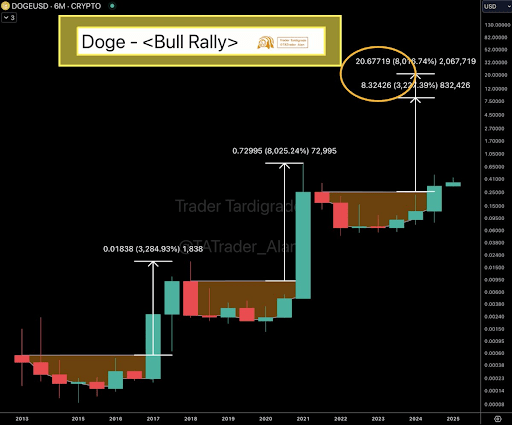
In an X post, Trader Tardigrade predicted that the Dogecoin price could rise to as high as $20 if it replicates its historical performance. He noted that Dogecoin experienced bull rallies after surpassing the previous candle body high in 20217 and 2021, with gains of 3,000% and 8,000%, respectively. 

In line with this, he predicted that the Dogeocoin price could rally to as high as $20.68 if DOGE follows a similar pattern. Interestingly, Trader Tardigrade previously predicted that DOGE could rally to as high as $8 if it mirrors the 2017 bull run and rally to as high as $30 if it mirrors the 2021 bull run. 
Dogecoin
Aligning price trend points to $20 for DOGE | Source: Trader Tardigrade on X

Meanwhile, the crypto analyst also suggested that the foremost meme coin could soon begin the next leg of its bull run. In another X post, he stated that the Dogecoin price has broken out a converging triangle and the moving average convergence divergence (MACD) shows a bullish crossover. He added that DOGE may start a bull rally from here. 

Crypto analyst Ali Martinez also hinted a bullish reversal for the Dogecoin price. In an X post, he stated that the TD Sequential has presented a buy signal on DOGE’s hourly chart. This indicates that the foremost meme coin could be well primed to record another move to the upside. 

DOGE’s Outlook Is Far From Bearish

In an X post, crypto analyst Kevin Capital made a case for why the Dogecoin price is far from being bearish. He stated that DOGE is still seeing fast expansion on the 50 and 200 moving averages after its weekly golden cross occurred. He added that the meme coin is above the macro golden pocket at $0.26 and is battling the macro .786.  

In line with this, he suggested that there was no reason for market participants to be bearish on the Dogecoin price. However, in the meantime, he mentioned that he wasn’t focus very much on DOGE or other altcoins because the Bitcoin price will determine the next move in the market. The crypto analyst reassured that nothing has changed regarding DOGE’s bull run, stating that cycle tops don’t occur when everyone is bearish. 

Crypto analyst Javon Marks also recently made a bullish case for the Dogecoin price, predicting that it could witness at least a 5x increase from its current level. 

​​At the time of writing, the Dogecoin price is trading at around $0.35, down over 3% in the last 24 hours, according to data from CoinMarketCap.

Dogecoin
DOGE trading at $0.34 on the 1D chart | Source: DOGEUSDT on Tradingview.com
Featured image from Unsplash, chart from Tradingview.com
Scott Matherson

Scott Matherson

Scott Matherson is a leading crypto writer at Bitcoinist, who possesses a sharp analytical mind and a deep understanding of the digital currency landscape. Scott has earned a reputation for delivering thought-provoking and well-researched articles that resonate with both newcomers and seasoned crypto enthusiasts. Outside of his writing, Scott is passionate about promoting crypto literacy and often works to educate the public on the potential of blockchain.

Lecturas Relacionadas

The Revived Codex, Carrying OpenAI's Hopes for IPO

This article analyzes the intense recent development of OpenAI's Codex, positioning it as a crucial component for OpenAI's impending IPO. Over the past two months, Codex has seen a rapid series of major updates focused on integrating into real enterprise workflows. Key new features include enhanced context capture (Appshots, file previews, built-in browser), long-running task execution ("Goal Mode"), remote operation (phone control, lock-screen access), and enterprise management tools (plugin sharing, access tokens, automated risk review). These updates aim to make Codex a comprehensive AI workbench that can "see the scene, push tasks, and manage risks." The author argues that while ChatGPT proves OpenAI's massive user base and API provides foundational revenue, Codex represents OpenAI's clearest path to demonstrating tangible, high-value commercial viability. It targets developers and engineering teams—a segment already accustomed to paying for efficiency gains in costly software development cycles. This is critical because, despite higher overall revenue, OpenAI's adjusted operating margins remain deeply negative, highlighting the challenge of outrunning immense compute costs. The pressure is amplified by competitor Anthropic's success with Claude Code, which has shown that a focused approach on high-value enterprise and developer workflows can lead to a path toward profitability. Codex's aggressive evolution is thus seen as OpenAI's strategic move to capture a similar enterprise-ready, revenue-generating narrative essential for its market debut. In essence, "ChatGPT proved OpenAI has users. Codex needs to prove OpenAI is a business that can make money."

marsbitHace 21 min(s)

The Revived Codex, Carrying OpenAI's Hopes for IPO

marsbitHace 21 min(s)

a16z: 7 Charts to Understand How Tokenization Is Changing the Nature of Assets

a16z: 7 Charts on How Tokenization is Transforming the Nature of Assets Tokenized Assets, often referred to as "real-world assets" (RWA), are altering the form, flow, and structure of the financial system. The market recently surpassed $30 billion (excluding stablecoins), driven largely by tokenized U.S. Treasuries. These offer investors digital, yield-bearing assets with efficient settlement. Growth varies significantly by asset class. Asset-backed credit leads in speed, followed by niche financial assets, while venture capital and active strategies took longer to scale. U.S. Treasuries and commodities dominate, holding about two-thirds of the current market share. Within commodities, gold tokenization dominates entirely due to its standardization and historical appeal in crypto. The ecosystem is spread across multiple blockchains. Ethereum holds over half the market, with others like BNB Chain, Solana, and Stellar holding significant shares. However, a key insight is that most tokenized assets currently lack "composability." While the total market is large, only a small fraction (e.g., 5% of tokenized bonds) is used within DeFi protocols. Many tokens are simply digital records of off-chain assets, not natively programmable financial building blocks. In contrast, smaller categories like reinsurance tokens see very high on-chain usage. Looking ahead, forecasts for the tokenized asset market by 2030 range from $2 trillion to over $30 trillion, representing immense potential growth from today's ~$340 billion base. Yet, relative to global markets (e.g., $140T+ in bonds), tokenization's penetration remains minuscule (<0.02%). The current phase focuses on digitizing straightforward assets for efficiency. The next major challenge is bringing more complex financial instruments on-chain and integrating tokenized assets into truly composable, internet-native financial infrastructure.

marsbitHace 51 min(s)

a16z: 7 Charts to Understand How Tokenization Is Changing the Nature of Assets

marsbitHace 51 min(s)

Data Theft at Will! Major Vulnerability Exposed in This Popular AI Programming Tool

A critical vulnerability in Anthropic's Claude Code AI programming tool allowed attackers to bypass its network sandbox for over five months, enabling potential data exfiltration. Independent researcher Aonan Guan discovered a second complete bypass exploiting a null-byte injection in the SOCKS5 proxy. This flaw, present since the sandbox's launch in October 2025, let processes inside the sandbox access any host, contrary to user-configured domain whitelists. The attack chain involved manipulating hostnames (e.g., `attacker.com\x00.google.com`). JavaScript's `endsWith()` check would pass `.google.com`, while the underlying C `getaddrinfo()` function would only parse `attacker.com` due to the null byte, creating a parser discrepancy. Combined with a previously disclosed prompt injection method, this could leak API keys, credentials, and internal data. Anthropic silently fixed the issue in April 2026 without a security advisory, CVE, or user notification. The researcher noted that Claude Code itself confirmed the vulnerability's severity when tested. This incident highlights broader industry issues, as similar vulnerabilities found in Google's Gemini CLI and GitHub's Copilot Agent also lacked public disclosures. The report criticizes the false sense of security created by a broken sandbox and emphasizes the need for defense-in-depth and transparency in AI tool security.

marsbitHace 4 hora(s)

Data Theft at Will! Major Vulnerability Exposed in This Popular AI Programming Tool

marsbitHace 4 hora(s)

Trading

Spot
Futuros
活动图片