Ross Ulbricht Is A Millionaire Straight Out Of Prison? On-Chain Sleuths Find $44 Million In Bitcoin Wallets Linked To Him

bitcoinistPublicado a 2025-01-23Actualizado a 2025-01-24

Resumen

The recently pardoned Ross Ulbricht, the founder of the dark web marketplace Silk Road, looks to still hold millions of...

The recently pardoned Ross Ulbricht, the founder of the dark web marketplace Silk Road, looks to still hold millions of dollars in Bitcoin. This comes following the revelation of wallets linked to the Silk Road founder, containing coins that remained untouched while he was in prison. 

Ross Ulbricht Reportedly Still Holds $44 Million In Bitcoin

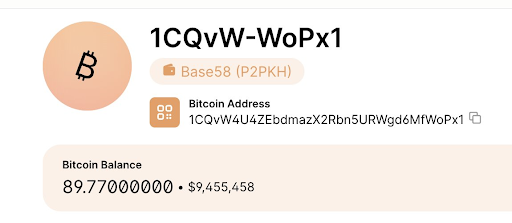
In an X post, On-chain sleuth Conor Grogan revealed that the Silk Road founder Ross Ulbricht still holds $44 million in Bitcoin. Grogan stated that he found 430 BTC across dozens of wallets associated with Ulbricht that were not confiscated by the US government and have been untouched for over 13 years, the period in which Ulbricht was in jail.

Grogan remarked that these wallets were probably dust wallets back then, which could explain why the US government paid little attention to them and failed to trace them. However, these wallets are now collectively worth over $44 million. This sum could undoubtedly help Ulbricht, who was recently pardoned by US President Donald Trump, get back on track after spending around 13 years in prison for cybercrimes involving the Silk Road marketplace. 
Bitcoin
Ulbricht Bitcoin wallet in millions | Source: Grogan on X

However, while these bitcoins may indeed belong to Ross Ulbricht, there is a probability that the Silk Road may no longer have access to them. Grogan noted that it is unlikely that he has the keys stored down anywhere, meaning that Ulbricht may be unable to access these funds or even move them to sell. 

Meanwhile, it is worth mentioning that Ross Ulbricht contributed to most of the bitcoins that the US government currently holds. The government has seized 144,000 BTC from the Silk Road founder following his arrest back in 2013. The government also seized several bitcoins from other suspects who were arrested in connection to the Silk Road marketplace. Arkham Intelligence data shows that the government currently holds 198,109 BTC ($20 billion).

One Crypto-Related Campaign Promise Fulfilled 

By pardoning Ross Ulbricht, US President Donald Trump has fulfilled one of the crypto-related campaign promises that he made prior to his election victory in November last year. This move by the pro-crypto president has sparked optimism that he will also fulfill other promises made to the crypto community.

Among these crypto-related promises, which the crypto community is highly anticipating, is the creation of a Strategic Bitocin Reserve. Alongside pardoning Ross Ulbricht on day one in office, Trump has promised to create a US BTC reserve, in which the government will hold its seized Bitcoin instead of auctioning them. 

Although Trump did not mention anything about this BTC reserve or crypto in general in his inaugural speech, Ross Ulbricht’s pardon provides optimism that the US president will fulfill this crypto campaign promise and implement several other crypto-friendly policies.

Bitcoin
BTC trading at $102,056 on the 1D chart | Source: BTCUSDT on Tradingview.com
Featured image from Unsplash, chart from Tradingview.com
Scott Matherson

Scott Matherson

Scott Matherson is a leading crypto writer at Bitcoinist, who possesses a sharp analytical mind and a deep understanding of the digital currency landscape. Scott has earned a reputation for delivering thought-provoking and well-researched articles that resonate with both newcomers and seasoned crypto enthusiasts. Outside of his writing, Scott is passionate about promoting crypto literacy and often works to educate the public on the potential of blockchain.

Lecturas Relacionadas

a16z: 7 Charts to Understand How Tokenization Is Changing the Nature of Assets

a16z: 7 Charts on How Tokenization is Transforming the Nature of Assets Tokenized Assets, often referred to as "real-world assets" (RWA), are altering the form, flow, and structure of the financial system. The market recently surpassed $30 billion (excluding stablecoins), driven largely by tokenized U.S. Treasuries. These offer investors digital, yield-bearing assets with efficient settlement. Growth varies significantly by asset class. Asset-backed credit leads in speed, followed by niche financial assets, while venture capital and active strategies took longer to scale. U.S. Treasuries and commodities dominate, holding about two-thirds of the current market share. Within commodities, gold tokenization dominates entirely due to its standardization and historical appeal in crypto. The ecosystem is spread across multiple blockchains. Ethereum holds over half the market, with others like BNB Chain, Solana, and Stellar holding significant shares. However, a key insight is that most tokenized assets currently lack "composability." While the total market is large, only a small fraction (e.g., 5% of tokenized bonds) is used within DeFi protocols. Many tokens are simply digital records of off-chain assets, not natively programmable financial building blocks. In contrast, smaller categories like reinsurance tokens see very high on-chain usage. Looking ahead, forecasts for the tokenized asset market by 2030 range from $2 trillion to over $30 trillion, representing immense potential growth from today's ~$340 billion base. Yet, relative to global markets (e.g., $140T+ in bonds), tokenization's penetration remains minuscule (<0.02%). The current phase focuses on digitizing straightforward assets for efficiency. The next major challenge is bringing more complex financial instruments on-chain and integrating tokenized assets into truly composable, internet-native financial infrastructure.

marsbitHace 8 min(s)

a16z: 7 Charts to Understand How Tokenization Is Changing the Nature of Assets

marsbitHace 8 min(s)

Data Theft at Will! Major Vulnerability Exposed in This Popular AI Programming Tool

A critical vulnerability in Anthropic's Claude Code AI programming tool allowed attackers to bypass its network sandbox for over five months, enabling potential data exfiltration. Independent researcher Aonan Guan discovered a second complete bypass exploiting a null-byte injection in the SOCKS5 proxy. This flaw, present since the sandbox's launch in October 2025, let processes inside the sandbox access any host, contrary to user-configured domain whitelists. The attack chain involved manipulating hostnames (e.g., `attacker.com\x00.google.com`). JavaScript's `endsWith()` check would pass `.google.com`, while the underlying C `getaddrinfo()` function would only parse `attacker.com` due to the null byte, creating a parser discrepancy. Combined with a previously disclosed prompt injection method, this could leak API keys, credentials, and internal data. Anthropic silently fixed the issue in April 2026 without a security advisory, CVE, or user notification. The researcher noted that Claude Code itself confirmed the vulnerability's severity when tested. This incident highlights broader industry issues, as similar vulnerabilities found in Google's Gemini CLI and GitHub's Copilot Agent also lacked public disclosures. The report criticizes the false sense of security created by a broken sandbox and emphasizes the need for defense-in-depth and transparency in AI tool security.

marsbitHace 3 hora(s)

Data Theft at Will! Major Vulnerability Exposed in This Popular AI Programming Tool

marsbitHace 3 hora(s)

Under the squeeze between giants Tether and Circle, how can foreign exchange stablecoins break through?

In the face of dominance by Tether (USDT) and Circle (USDC), new entrants in the stablecoin space face significant challenges competing directly, especially in the foreign exchange (FX) market. A more viable and efficient path forward is the adoption of synthetic foreign exchange (Forex) built atop existing USD stablecoin rails. The rise of stablecoin neo-banks represents the next major growth area for mass crypto adoption, with FX becoming a core component. However, replicating the vast liquidity, distribution channels, and network effects of USDT/USDC is extremely difficult for new FX stablecoin issuers. The total market cap of all FX stablecoins is a fraction (roughly 1/700th) of USD stablecoins, leading to issues like poor liquidity, peg instability, limited acceptance, and complex compliance hurdles. Instead of issuing spot FX stablecoins, the article advocates for a model inspired by traditional finance's non-deliverable forwards (NDFs). Users would continue to hold underlying USDT/USDC, while their account balances are displayed and economically settled in their preferred local currency through MtM (Mark-to-Market) NDF structures. This approach leverages the deep liquidity and infrastructure of USD stablecoins while providing synthetic forex exposure. Key advantages include strong peg stability via oracles, retained access to USD stablecoin yields and liquidity, high capital efficiency, and easy scalability to new currencies. Primary use cases for this on-chain NDF forex include: 1. Neo-banks, custodians, and wallets offering multi-currency accounts to attract international users and increase deposits. 2. Forex carry trade strategies, potentially offering more stable and scalable yields compared to crypto-native products like Ethena. 3. Global corporate payments, allowing businesses to receive payments in local currencies while hedging forex risk on-chain, similar to services offered by Stripe in traditional finance. This synthetic forex model presents a pragmatic solution to overcome the network effects of incumbents and unlock the next wave of stablecoin utility for global consumers and businesses.

marsbitHace 4 hora(s)

Under the squeeze between giants Tether and Circle, how can foreign exchange stablecoins break through?

marsbitHace 4 hora(s)

Trading

Spot
Futuros
活动图片