市场一夜入冬? APT 生死时刻来袭 ! Memecoin 狂热就此终结?

金色财经Publicado a 2024-12-23Actualizado a 2026-07-10

APT 面临更大的下行压力,因为它正在测试可能决定其下一步重大举措的关键支撑位。

v2-58073aa0fee993ff1e33c9bbba3f43e0_720w.webp?source=d16d100b

在过去 24 小时内,Aptos [APT]大幅下跌5.5%,成为当日跌幅最大的货币之一。此次下跌延续了 APT 的看跌趋势,APT 持续遭遇抛售,过去一周下跌了 10.92%。

在这个关键时刻,APT 要么从近期的损失中恢复过来,要么延续其下跌趋势。那么APT 能守住关键支撑位并反弹吗?

APT 的支撑位能守住吗?

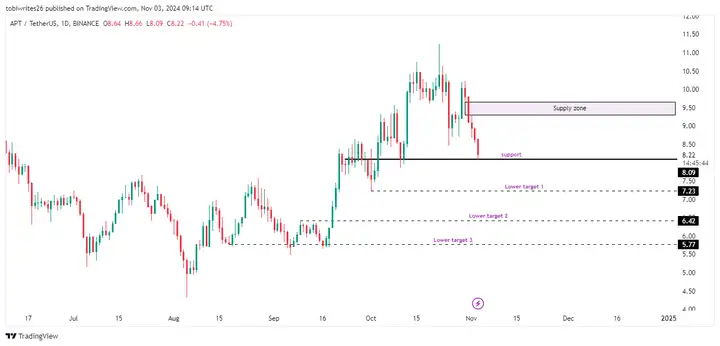
APT 已达到图表上的关键点,这可能决定其是反弹还是进一步下跌。这一关键支撑位位于 8.09 美元。

通常情况下,支撑位应能吸引足够的购买压力,从而引发价格反弹,尽管这并不总是能保证的。从此处反弹可能会在价格降温之前将价格推回附近的供应区。

如果 APT 未能守住这一水平,下一个下行目标将是 7.23 美元。市场兴趣持续下降可能会导致其再次跌至 6.42 美元甚至更低至 6.04 美元。
v2-eaff5b7acaa82cddd3ac92af0732bf1e_720w.webp?source=d16d100b

随着看跌压力加剧,APT 处于边缘

Coinglass的链上数据显示,由于抛售活动加剧导致 APT 价格下跌,APT 可能即将陷入大幅下滑。

清算数据(通过分析多头和空头头寸的损失来判断市场方向)表明普遍存在看跌情绪。

v2-f321c9d3ea395dd0285d19804a0cd0d1_720w.webp?source=d16d100b

在过去的 24 小时内,市场已出现 165 万美元的清算,其中多头仓位清算金额高达 145 万美元,这表明预期价格上涨的交易者措手不及。

与此同时,空头清算金额仅为 202,370 美元,表明看跌压力占主导地位

未平仓合约的下降也预示着 APT 可能下跌。在 10 月 14 日达到 2.5904 亿美元的峰值后,未平仓合约已降至 1.6896 亿美元,反映出购买兴趣的减弱。

未平仓量衡量市场上活跃、未结算衍生品合约的数量。大幅下跌通常意味着空头头寸增加,因为交易员越来越预期 APT 会进一步下跌。

11月最大代币解锁

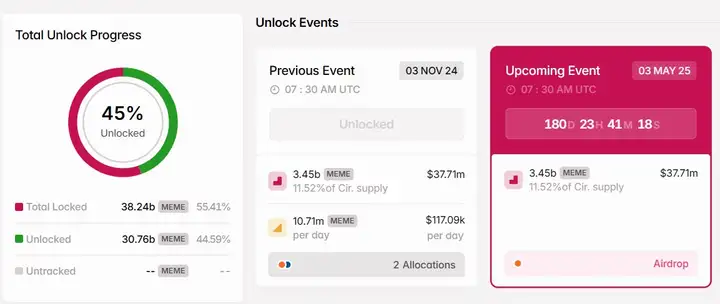
Meme 项目 Memecoin 计划通过空投解锁34.5 亿枚代币,价值约 3780 万美元。除了悬崖解锁外,它还将为其贡献者执行线性代币解锁。每天将有超过 1000 万枚 MEME 代币,价值约 117,000 美元。MEME 代币的价格目前徘徊在 0.010 美元,比 2024 年的最高价 0.053 美元低 81%。
v2-b661510bab8c4b72acf6f62509648374_720w.webp?source=d16d100b

其中第 1 层区块链 Aptos 将解锁另外 1131 万个代币,价值 9300 万美元。其中约 3200 万美元将分配给项目的核心贡献者,2600 万美元分配给社区,1100 万美元分配给基金会,2300 万美元分配给投资者。APT 代币目前的交易价格约为 8.18 美元,比 2024 年 18.14 美元的高点低 54%,预计这也将会使价格产生波动。

随着交易所净流量增加,对 APT 的需求下降

在撰写本文时,APT 的交易所净流量在过去 12 小时内有所增加,表明市场信心正在减弱,并导致该资产当前价格下跌。

交易所净流量衡量加密货币从交易所的流入和流出。净流量为正表明流入量增加,通常预示着随着更多代币可供出售,价格可能下跌。

相反,净流量为负表示资金流出,这通常是看涨信号,因为交易所的供应量减少了。由于 APT 的净流量为正,因此可能进一步下跌。

简而言之,APT 正处于关键节点,这一支撑位很可能决定资产是呈上升趋势还是继续下跌,当前链上指标显示市场参与者大幅抛售,而更广泛的指标则表明交易员持续承受抛售压力。预计短期内价格将会窄幅震荡上涨潜力有限,但随着大盘企稳市场开始复苏预计价格将触发反弹。


Criptos en tendencia

Lecturas Relacionadas

After Aave's Exit and TVL's Sharp Fluctuation, Where Does MegaETH's Valuation Anchor Lie?

Following the withdrawal of Aave and a sharp drop in its Total Value Locked (TVL), the valuation of the high-performance DeFi blockchain MegaETH faces scrutiny. Once a highly anticipated project with a fully diluted valuation (FDV) reaching around $2 billion, MegaETH saw its TVL plummet from a May peak of $245 million to just over $30 million in July, a roughly 70% decline. Its native token, MEGA, currently trades around $0.048 with a market cap of approximately $54 million and an FDV of about $480 million. The report identifies a core vulnerability: MegaETH's TVL was heavily dependent on a single protocol, Aave V3, which at its peak contributed around 90% of the chain's TVL. A significant portion of this capital is attributed to leveraged yield-farming strategies involving stablecoins like USDe. When the profitability of these strategies diminished, capital rapidly exited, exposing the lack of diversified, sustainable activity. Three key mismatches between MegaETH's valuation and its fundamentals are highlighted: 1. **Valuation vs. Real Usage:** With an FDV of ~$4.8B but only ~$1M in annualized protocol revenue and ~2,600 daily active addresses, the valuation appears disconnected from current economic activity. 2. **Token Narrative vs. Ecosystem Reality:** Despite its DeFi narrative, nearly 80% of the chain's recent protocol revenue comes from a trading card game, Monster, not from core DeFi applications like Aave. The chain's native stablecoin, USDM, also shows low trading volume and a declining market cap. 3. **Short-Term Hype vs. Long-Term Delivery:** Initial hype from token generation, blue-chip integrations, and influencer support has faded. Major protocols like Uniswap now hold minimal TVL on the chain, indicating that early capital was largely transient and driven by incentives rather than organic demand. The situation reflects a broader market trend where investors are becoming less tolerant of valuations based on inflated TVL and narrative, demanding clearer evidence of sustainable transactions, revenue, and ecosystem development. While MEGA's price may experience short-term rebounds from market sentiment, a fundamental re-rating likely depends on the team's ability to convert its remaining resources into tangible, user-retaining applications and genuine ecosystem growth.

链捕手Hace 4 hora(s)

After Aave's Exit and TVL's Sharp Fluctuation, Where Does MegaETH's Valuation Anchor Lie?

链捕手Hace 4 hora(s)

Goldman Sachs In-Depth Report: Who Will Be the Long-Term Winners in China's AI Large Model Industry?

Goldman Sachs Report: China's AI Models at an Inflection Point China's open-source/open-weight large language models (LLMs) have reached performance parity with top global proprietary models, according to a Goldman Sachs report. This is driven by architectural innovations and higher parameter efficiency, allowing Chinese models to achieve comparable capabilities at 2%-10% the parameter size and significantly lower cost. The market is evolving into a two-tiered structure: a high-end segment (e.g., GLM5.2, Qwen3.7 Max) with premium pricing and a low-end, price-sensitive segment for global SMEs and individual users. Key points: * **Cost & Performance:** Innovations like Mixture of Experts (MoE) enable high performance with smaller models. Projects like Meituan's LongCat 2.0, trained on domestic hardware, highlight progress in tech self-sufficiency. * **Open-Source Strategy:** Most Chinese players use open-source/open-weight models for flexibility and ecosystem growth. However, Goldman notes this may underreport actual deployment and revenue. A shift toward "open-weight + community license" models with revenue sharing (e.g., MiniMax) could improve monetization. * **Market Shift & Global Expansion:** Enterprise AI adoption is shifting from "token maximization" to "ROI-first." International expansion, especially in non-US markets, is a major growth driver. Chinese models are increasingly available on global platforms like AWS Bedrock and Microsoft Copilot. * **Competitive Landscape:** Using a framework based on pricing power, cost advantage, and financial strength, Goldman identifies **Zhipu AI and DeepSeek** as the strongest in foundational text models, and **ByteDance** as the leader in multimodal/video generation. The report maintains Buy ratings on MiniMax and Kuaishou. * **Market Growth:** China's AI model API and subscription revenue is projected to grow from an estimated ¥35 billion in 2026 to ¥879 billion by 2030.

marsbitHace 4 hora(s)

Goldman Sachs In-Depth Report: Who Will Be the Long-Term Winners in China's AI Large Model Industry?

marsbitHace 4 hora(s)

Goldman Sachs Deep Dive Report: Who Will Become the Long-Term Winners in China's AI Large Model Industry?

Goldman Sachs Report: Who Will Be the Long-Term Winners in China's AI Large Model Industry? China's AI large model sector is at a historic inflection point. Goldman Sachs argues that the intelligence of Chinese open-source/open-weight models is approaching top global proprietary models. Rapid adoption by domestic enterprises and global SMEs is creating a data flywheel effect that will further drive model iteration. The evolution is summarized as moving from "DeepSeek's cost-efficiency moment last year to GLM's model-intelligence moment this year." Chinese models achieve near-state-of-the-art performance at significantly lower cost, primarily due to architectural innovations like Mixture of Experts (MoE) and higher parameter efficiency. Models like DeepSeek V4 Pro (1.6T params), GLM5.2 (0.7T), and MiniMax M3 (0.4T) are much smaller than global leaders. Recent advancements in coding capability are attributed to better data curation and RLHF. Landmarks like Meituan's LongCat 2.0, trained fully on domestic AI chips, demonstrate progress in hardware stack independence. The market is forming a "two-tiered structure." The high-end tier (e.g., GLM5.2, Alibaba's Qwen3.7 Max) prices around $1 per million tokens, about 10-25% of US top models, with estimated inference gross margins of 10-20%. The low-end tier (priced as low as $0.06-$0.2 per million tokens) targets price-sensitive global SMEs and individuals. MiniMax derives 60-70% of revenue overseas. Goldman forecasts China's AI model API/subscription revenue to grow from an estimated RMB 35bn in 2026 to RMB 879bn by 2030. Most Chinese players adopt open-source/open-weight strategies for deployment flexibility and community feedback, though this limits monetization as deployments on third-party platforms (e.g., Alibaba Cloud) may not generate direct revenue. A shift towards "open-weight + community license" models with revenue-sharing agreements (like MiniMax's approach) could improve unit economics. International expansion, particularly in non-US markets, is the key growth driver. The global enterprise AI paradigm is shifting from "token maximization" to "ROI prioritization." Chinese models are already hosted on major global platforms like AWS Bedrock and are under consideration for integration into Microsoft Copilot. Using a competitive framework based on pricing power, cost advantage, and financial strength, Goldman identifies the strongest players: In foundational text models, Zhipu AI (initiated coverage) and DeepSeek lead. In multimodal/video generation, ByteDance's Seed is the frontrunner, with Kuaishou's Kling and MiniMax's Hailuo also well-positioned. Goldman maintains a Buy rating on MiniMax, citing its attractive valuation.

链捕手Hace 4 hora(s)

Goldman Sachs Deep Dive Report: Who Will Become the Long-Term Winners in China's AI Large Model Industry?

链捕手Hace 4 hora(s)

Trading

Spot

Artículos destacados

Cómo comprar APT

¡Bienvenido a HTX.com! Hemos hecho que comprar Aptos (APT) sea simple y conveniente. Sigue nuestra guía paso a paso para iniciar tu viaje de criptos.Paso 1: crea tu cuenta HTXUtiliza tu correo electrónico o número de teléfono para registrarte y obtener una cuenta gratuita en HTX. Experimenta un proceso de registro sin complicaciones y desbloquea todas las funciones.Obtener mi cuentaPaso 2: ve a Comprar cripto y elige tu método de pagoTarjeta de crédito/débito: usa tu Visa o Mastercard para comprar Aptos (APT) al instante.Saldo: utiliza fondos del saldo de tu cuenta HTX para tradear sin problemas.Terceros: hemos agregado métodos de pago populares como Google Pay y Apple Pay para mejorar la comodidad.P2P: tradear directamente con otros usuarios en HTX.Over-the-Counter (OTC): ofrecemos servicios personalizados y tipos de cambio competitivos para los traders.Paso 3: guarda tu Aptos (APT)Después de comprar tu Aptos (APT), guárdalo en tu cuenta HTX. Alternativamente, puedes enviarlo a otro lugar mediante transferencia blockchain o utilizarlo para tradear otras criptomonedas.Paso 4: tradear Aptos (APT)Tradear fácilmente con Aptos (APT) en HTX's mercado spot. Simplemente accede a tu cuenta, selecciona tu par de trading, ejecuta tus trades y monitorea en tiempo real. Ofrecemos una experiencia fácil de usar tanto para principiantes como para traders experimentados.

174 Vistas totalesPublicado en 2024.12.11Actualizado en 2026.06.02

Cómo comprar APT

Discusiones

Bienvenido a la comunidad de HTX. Aquí puedes mantenerte informado sobre los últimos desarrollos de la plataforma y acceder a análisis profesionales del mercado. A continuación se presentan las opiniones de los usuarios sobre el precio de APT (APT).

活动图片